A practical guide for Tamil-mother-tongue speakers — the specific Tamil-to-English patterns that slow you down, and the daily-rep plan that fixes them.
Quick answer
For live 1-on-1 spoken English practice with a trained Expert who corrects you in real time (great for reducing mother-tongue influence — the extra vowels and the missing ‘f’ that mark a Tamil accent), practise on EngVarta. For native-speaker video chat, Cambly. For pronunciation and accent, ELSA. For free daily vocabulary, Duolingo. For free chat with native speakers, HelloTalk. For free structured lessons and listening, BBC Learning English. Most Tamil speakers pair a free app for daily input with one live option for real speaking practice.
What we see Tamil speakers struggle with
For most Tamil speakers we work with, grammar and reading are solid — speaking is where it slips, and in fairly predictable ways. Tamil has no native ‘f’ sound, so ‘coffee’ can land as ‘coppee’ and ‘phone’ as ‘pone’. English consonant clusters tend to pick up an extra vowel, so ‘school’ becomes ‘is-kool’ and ‘street’ becomes ‘is-treet’. And because Tamil puts the verb at the end, English word order can come out jumbled when you speak fast. None of this is fixed by more grammar drills — it is fixed by speaking out loud daily, getting those exact sounds corrected, and practising real conversations. The apps below are the ones our learners lean on to do that.
The best apps for Tamil speakers to practise spoken English
What Tamil speakers actually use to move from reading-and-writing English to speaking it confidently — a mix of free practice tools and live options, and what each is best for.
Daily 15-minute live 1-on-1 audio sessions with a TESOL/ESL-certified Expert who lets you speak and corrects you in real time — the ‘f’ that slips to ‘p’, the extra vowel before clusters, the Tamil word order — so the habits that mark a Tamil accent fade. Recordings stay accessible for 30 days.
Pros: 100% live practice with trained human Experts (not AI, not random volunteers) · real-time correction during the call · session recordings stay 30 days
Cons: audio-only (no video) · live sessions run on India hours · paid after the ₹69 / $1 trial
Best for: live 1-on-1 spoken English practice with real-time correction
2. Cambly
Short video calls with native English speakers on demand — useful for hearing how words are actually said and getting comfortable speaking to a stranger.
Pros: native speakers available 24/7 · fully flexible scheduling · strong accent and idiom exposure
Cons: tutors are not required to be certified teachers · per-minute cost adds up for daily use
Price: from ~$11 per 30-min session (auto-renewing subscription)
Best for: native-speaker video conversation
3. ELSA Speak
Speech-recognition scoring that targets the exact sounds a Tamil accent tends to miss — the ‘f’ that becomes ‘p’, and the vowels that creep into ‘school’ or ‘street’.
Pros: very detailed pronunciation scoring · targets your specific problem sounds · practise anytime
Cons: pronunciation only — not real conversation · feedback is AI, not a human ear
Price: free tier; ELSA Pro from ~$11.99/month
Best for: pronunciation and accent
4. Duolingo
Free, gamified vocabulary and grammar in short daily streaks — a low-pressure way to keep English active.
Pros: completely free to use · fun daily-habit design · huge content library
Cons: very little real speaking practice · vocabulary and grammar focus, not conversation
Price: Free; Super Duolingo ~$6.99/month
Best for: free daily vocabulary and basics
5. HelloTalk
Free language exchange — text and call native and fluent speakers worldwide for relaxed real practice.
Pros: free to use · practise with real native speakers · text and voice both
Cons: unstructured — no lessons or correction · partner quality varies · you teach in return
Price: Free, with an optional premium tier
Best for: free chat with native speakers
6. BBC Learning English
Free lessons, videos, and podcasts for grammar, vocabulary, and listening practice.
Pros: completely free · high-quality, trustworthy lessons · strong for listening and grammar
Cons: no speaking practice or feedback · self-study only, no live interaction
Price: Free
Best for: free structured lessons and listening
Which one should you choose?
There is no single best app — pick by what is missing from your routine and your budget:
Want free daily input?Duolingo, BBC Learning English, and HelloTalk — all free.
Accent or pronunciation?ELSA Speak.
Talk to native speakers on video?Cambly.
Want a real person who corrects you live? A trained Expert on EngVarta.
Most Tamil speakers combine a free app for daily input with one live option when they want to actually speak.
EngVarta vs Other English Practice Options for Tamil Speakers
Option
Best for
Verdict
EngVarta
Daily private speaking correction
Best fit for Tamil speakers who already understand English but hesitate while speaking.
AI speaking apps
Solo rehearsal and pronunciation checks
Useful supplement, not the main fix for real conversations.
YouTube/self-study
Listening and vocabulary
Good support material only.
Group spoken English classes
Structured lessons
Works for basics, weaker for hesitation.
A 21-day plan for Tamil speakers
This assumes ~15 minutes of daily live practice. Compress or extend to fit your timeline.
Daily 15-minute live audio session on easy topics: your day, your work, your city, your hobbies — where vocabulary is never the constraint.
Goal: speak English for 15 unbroken minutes without the 2–3 second pre-sentence pause.
Day 7 milestone: starting an English sentence feels less effortful; the silence-then-translate pause shrinks.
Week 2 (Days 8–14) — Target the Tamil-specific patterns.
Daily 15 minutes. The Expert flags the verb-final reorganisation, the “only/itself” placement, and the tag-question reflex as they appear, and has you re-say the sentence correctly.
Add 5 minutes of pronunciation work on your two or three most frequent carry-over sounds, using the session recording for playback.
Day 14 milestone: you catch your own “only/itself” placement before the Expert does, on most sentences.
Week 3 (Days 15–21) — Real scenarios under pressure.
Daily 25-minute sessions (longer to handle multi-turn scenarios).
Drill the situations you actually face: a client call, a stand-up update, an interview answer, or a meeting disagreement — whatever is most relevant.
Day 21 milestone: you complete a realistic 10-minute scenario without freezing for more than 2 seconds, and the Tamil MTI patterns appear far less often.
After ~21 daily sessions (roughly 5–6 hours of live practice), most Tamil speakers report that listeners stop hearing the translation lag and the MTI tells fade into the background.
How we chose
We evaluated each option on five factors: presence of Experts who help correct Tamil-to-English MTI patterns, real-time correction during live conversation, audio-only low-pressure format, scenario coverage for interviews and workplace calls, and pricing sustainability for daily practice. Pricing and features were checked in May 2026.
Which Tamil-to-English mistakes hurt me most in interviews and calls?
The three that listeners notice most are the translation lag (a visible pause before each sentence), the “only/itself” placement (“I finished it yesterday only”), and the added short vowel on consonant-ending words. None of these are “wrong” in Indian-English conversation, but they stand out in interviews and cross-region or international calls. All three reduce measurably with two to three weeks of daily live practice and real-time correction.
Do I need to lose my Tamil accent to speak fluent English?
No. Accent and fluency are different things. Interviewers and colleagues do not penalise a Tamil accent if your delivery is clear and confident; they react to hesitation, translation lag, and unclear pronunciation of specific sounds. The goal is clarity and speed, not a “neutral” accent. Softening one or two carry-over sounds (like the added word-final vowel) helps clarity on phone calls; full accent neutralisation is optional and far less important than most learners assume.
Will daily 15-minute practice really work for a Tamil speaker, or do I need long classes?
Daily 15-minute live practice usually beats occasional long classes for spoken fluency, because speaking is a reflex built by frequency, not by duration. A Tamil speaker at intermediate reading level typically sees visible improvement in about two weeks and interview-ready fluency in about three weeks of daily reps. Long weekly classes give fewer speaking turns per week and let the translate-from-Tamil habit reset between sessions.
I’m a Tamil speaker working abroad (Singapore/Gulf/US) — does this still apply?
Yes. The Tamil-to-English patterns travel with the speaker regardless of country. Daily live audio practice works across time zones, and the scenario drills can be tuned to your actual workplace — client calls, team meetings, or customer-facing conversations. Many Tamil-speaking professionals in the diaspora use daily practice specifically to reduce the MTI tells that surface in fast-paced international calls.
Can I practise English while my work and home life are mostly in Tamil?
Yes, and it is the most common situation. A 15-minute daily session in the morning or evening adds English reps without disturbing a Tamil-first day. Your Tamil stays fully intact — bilingual code-switching is a normal cognitive pattern, not a trade-off. You are adding English fluency on top of Tamil, not replacing anything.
Is it worth paying for practice, or should I just watch English content?
English content (films, YouTube, podcasts) builds listening and vocabulary, but it is passive — it does not build the speaking reflex. Most Tamil speakers who plateau already have plenty of input and very few spoken hours. The single highest-return change is converting some input time into daily live speaking practice with real-time correction. Even 15 minutes a day produces faster spoken improvement than hours of passive watching.
Which app is best for Tamil speakers who hesitate in English?
EngVarta is a strong fit for Tamil speakers who understand English but hesitate while speaking because it gives private live 1-on-1 speaking practice with correction during the call.
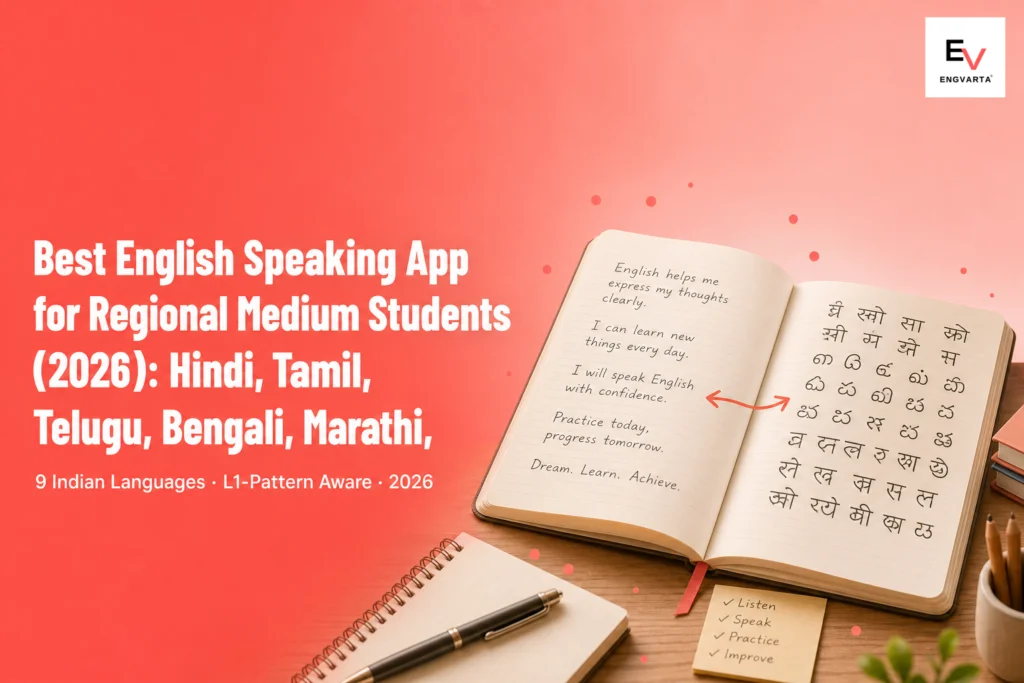
Quick Verdict · 2026If you went through Hindi/Tamil/Telugu/Bengali/Marathi/Gujarati/Punjabi/Kannada/Malayalam school medium and your speaking English doesn’t match your reading/writing English, the best app in 2026 is EngVarta — voice 1-on-1 with vetted Indian-context experts who understand the specific L1-interference patterns each regional-medium background carries (preposition errors, “make fluency”-type wrong verb-noun pairings, syllable stress, vowel insertion). ₹69 refundable trial, plans from ₹2,700 for 25 sessions. Hello English (free) for vocabulary foundation with Hindi/Tamil/Telugu/Marathi/Bengali/Punjabi/Gujarati interface. Cambly Small Groups ($15/mo) for native-accent group practice. italki community tutors ($4–$10 per 30-min) for self-directed flexibility with the option to filter for tutors familiar with your L1. Speak for AI conversation reps. ELSA Speak for pronunciation drilling on the specific phonemes your L1 doesn’t have.
If you grew up reading and writing English at school but the medium of instruction was Hindi, Tamil, Telugu, Bengali, Marathi, Gujarati, Punjabi, Kannada, Malayalam, or another regional Indian language, your relationship with English is different from someone who studied in an English-medium system. You probably have decent vocabulary, can read newspapers, and write a passable email—but speaking English still feels like a different language.
If you’re looking for the best English speaking app for regional medium students, this is the exact gap you’re trying to solve.
This guide is built for that gap. It compares six apps, all with verified pricing at the time of publishing, ranked specifically for what regional-medium learners actually need: experts who understand L1 interference from your Indian-language background, practice that fits the schedule of someone working a real job, and pricing that doesn’t require a corporate budget.
Editorial note: this blog is published by EngVarta. We hold no affiliate, sponsored, or commission relationships with any platform listed. Where EngVarta ranks first, that ranking reflects our genuine fit for the regional-medium-student persona — readers should compare alternatives we name and decide for themselves.
Why regional-medium learners need different practice
Indian school English education through a regional-language medium typically produces a specific learner profile:
Strong receptive skills. You can read English newspapers, follow English movies with reasonable comprehension, understand most English meetings even if you don’t speak in them, draft simple English in writing.
Weak productive skills. Speaking English under pressure is significantly harder than your reading or writing skill suggests. Words that come up naturally in writing don’t surface in conversation. Sentences that flow on paper feel awkward when said out loud.
Specific L1-interference patterns. Your first language (Hindi, Tamil, Telugu, etc.) shaped how your mouth, ear, and brain handle sound and grammar. When you switch to English, your L1 patterns leak through — sometimes in ways you can’t even hear yourself doing. These patterns differ by language.
Confidence gap. You know more English than you let yourself use, because the gap between what you can do in writing and what you can do in speech makes you self-conscious in English-speaking situations.
Generic “best English speaking app” listicles miss this profile entirely. They assume either complete beginners (which you’re not — your written English is fine) or fully fluent advanced speakers (which you’re not yet — your spoken English is the bottleneck). The middle ground — strong reader/writer but hesitant speaker — is exactly the regional-medium-student profile, and it needs a specific kind of practice.
L1-interference patterns by Indian language (the patterns to drill against)
These are the most common patterns each regional-medium background carries into spoken English. If you recognise yourself in your language’s section, those are the patterns to prioritise drilling — the ones that, once fixed, shift listener perception of your fluency the most.
Hindi-medium learners
v / w confusion — “very” said as “wery”, “want” said as “vant” (the two sounds blur because Hindi doesn’t distinguish them sharply)
Wrong verb-noun pairings — “make fluency” instead of “achieve fluency”, “give exam” instead of “take exam” (literal translation from Hindi structure)
Preposition errors — “hesitate in talking” instead of “hesitate to talk”, “discuss about” instead of “discuss” (no preposition needed)
Subject-verb agreement on collective nouns — “all are good” instead of “all is good” (or vice versa, depending on context)
Article confusion — over-using “the”, missing “a/an” (Hindi has no article system, so all articles feel optional)
Present continuous overuse — “I am understanding” instead of “I understand”, “I am thinking” instead of “I think”
Tamil-medium learners
Retroflex carryover — t/d sounds pronounced with tongue curled back (Tamil retroflex), making them sound harder/sharper than English speakers expect
Word-final consonant softening — “walk” said as “walka”, “stop” with a small vowel after (Tamil syllable structure prefers vowel endings)
Auxiliary verb dropping — “He coming” instead of “He is coming”, because Tamil structure makes the “is/are” optional in informal speech
Word-order interference — putting object before verb in long sentences (Tamil is SOV, English is SVO)
Vowel quality differences — short vs long vowels in English mapped onto Tamil vowel system
Telugu-medium learners
Vowel insertion at word endings — “school” said as “skoolu”, “mark” as “marku” (Telugu adds vowels to consonant clusters)
Syllable stress shifted — Telugu syllable timing carries over into English; stress lands on different syllables than English natives expect
Retroflex carryover — similar to Tamil, t/d sounds pronounced with the retroflex Telugu pattern
“V/W” sound — Telugu doesn’t sharply distinguish, similar to Hindi
Distinct intonation pattern — Telugu prosody is different enough that English statements can sound like questions
Bengali-medium learners
“j / z” confusion — “zoo” said as “joo”, “easy” as “eajee” (Bengali has ‘j’ but lacks the English ‘z’)
“v / b” softening — “very” said as “bery” sometimes (depends on speaker; Bengali has soft v that overlaps with b)
Vowel system differences — short vs long English vowels mapped onto Bengali equivalents
Aspiration patterns — Bengali aspirated consonants don’t always carry over correctly to English unaspirated equivalents
Tense usage — Bengali tense system differs from English; perfect/imperfect distinctions can get muddled
Marathi-medium learners
“L” sound carryover — Marathi has a distinct retroflex L that bleeds into English L
Syllable stress patterns — Marathi prosody is more even than English; English stress patterns get flattened
Word-final aspiration — Marathi consonants get a small aspirated puff at word ends that’s not in English
Preposition errors — similar to Hindi (since Marathi shares Sanskrit-derived structure)
Article system — Marathi has no articles; English a/an/the feels optional
Gujarati-medium learners
“ph / f” sound — Gujarati’s “ph” (aspirated p) gets used where English uses “f” — “phone” sometimes said with stronger aspiration than English speakers expect
Vowel quality — Gujarati vowel system maps imperfectly to English, especially “a” sound varieties
Word-final softening — similar pattern to Hindi/Marathi where final consonants soften
Preposition errors — same Sanskrit-derived structure issues as Hindi/Marathi
Punjabi-medium learners
“v / w” confusion — same as Hindi; the two sounds blur
Retroflex T/D carryover — Punjabi has strong retroflex consonants that come into English
Tonal carryover — Punjabi is one of the few tonal Indian languages; pitch patterns sometimes carry into English where English doesn’t use pitch for meaning
Aspiration distinctions — Punjabi maintains aspirated/unaspirated consonant pairs; English doesn’t always need them
Kannada-medium learners
Vowel insertion at consonant clusters — similar to Telugu, “school” can become “iskool”
Distinct prosody — Kannada has its own intonation rhythm that gives English a “Kannada accent”
Retroflex T/D carryover — like other Dravidian languages
“V/W” softness — similar to Telugu
Malayalam-medium learners
Rapid speech rate — Malayalam has a distinctly fast spoken rhythm; carries into English as rapid-fire delivery that listeners find hard to parse
Distinct intonation pattern — Malayalam prosody is unique among Indian languages; English statements can sound either flat or unexpectedly modulated
Vowel system differences — Malayalam vowel system overlays imperfectly on English vowels
If your language isn’t listed (or if you’re multilingual with a regional-medium school education), you likely carry a mix of these patterns. A good Indian-context English expert will identify your specific top-3 patterns within the first 2–3 sessions and drill against them in priority order.
How we ranked them
Indian-context expertise — specifically L1-interference awareness. Apps with experts who recognise your specific regional-medium pattern set rank highest. Generic ESL platforms that treat you as a beginner rank lower.
Affordability on Indian salaries. Plans under ₹3,000/month rank higher; daily-cadence access matters more than premium native-tutor pricing.
Schedule fit for the times of day that are genuinely yours. 15-minute session formats with extended availability (early morning before office, late evening after dinner) rank higher; 60-minute fixed-time formats don’t fit working schedules.
Live correction vs AI feedback. Live human correction during the call beats AI scoring after the fact, especially for L1-interference patterns where the human can specifically explain “your tongue is curled retroflex; English t/d goes flat”.
Foundation-building option for those who need it. Some learners need vocabulary and grammar foundation before live speaking practice; platforms with multilingual interfaces (Hindi/Tamil/Telugu/etc.) help bridge from regional-medium school basics.
1. EngVarta — Editor’s Pick for L1-Aware Live Practice
Format: Live voice 1-on-1 with vetted Indian-context English experts Pricing: ₹69 refundable 10-minute trial; plans from ₹2,700 for 25 sessions Session lengths: 15, 25, or 50 minutes Best for: Regional-medium learners with strong reading/writing but hesitant speaking; learners who need experts who understand their specific L1-interference patterns
EngVarta’s edge for regional-medium learners is the expert pool — these are coaches who’ve worked with lakhs of Hindi/Tamil/Telugu/Bengali/Marathi/Gujarati/Punjabi/Kannada/Malayalam-medium learners specifically. They know the patterns above. Within 2–3 sessions they’ll have your specific top-3 patterns identified and drilled against in priority order — not as a generic ESL course, but as a custom plan calibrated to what your L1 actually carries.
Three things make it the best fit for regional-medium learners:
L1-pattern recognition during the call. The expert hears your retroflex t/d, your vowel insertion at word endings, your “make fluency” verb-noun pairing — and corrects each one in the moment. AI apps can flag pronunciation deviations but can’t explain “your tongue is curled because of your Tamil retroflex; relax it forward for English t”.
Real-time correction integrated into conversation. When you say “I am understanding the meeting” the expert flags the present-continuous overuse instantly — “I understand the meeting” — and you continue talking with the corrected pattern. Three sessions of being corrected on the same patterns and your unconscious brain starts catching them before you make the slip.
15-minute voice-only format, available 7 AM to midnight every day. Your job, your family responsibilities, your daily routine — none of these flex for English class, and they don’t have to. EngVarta sessions fit your morning walk before office, the quiet hour after dinner, or any pocket of time that’s genuinely your own. Voice-only with a username option means no on-camera exposure and no need to use your real name — practice stays between you and your tutor.
The ₹69 trial is genuinely refundable. If it doesn’t feel right after the 10-minute call, you get the money back without an argument. Most regional-medium learners doing serious English work buy the 25-session plan and run 4–5 sessions per week over 5–6 weeks; that’s enough for the dominant L1-interference patterns to consolidate into the corrected versions.
Where it falls short: EngVarta is voice-only — no video. So you can’t see the expert’s mouth shape during pronunciation drills (though they describe tongue/teeth positioning verbally, which works for most patterns). EngVarta also assumes you have basic conversational vocabulary already. If your spoken English is at absolute-beginner level (you struggle to say “I want to learn English”), spend 4–8 weeks on Hello English first to build the basics, then come to EngVarta.
I have completed 100 sessions with EV. Today I can speak confidently with anyone and this confidence is a gift from EngVarta. I truly wish I could join the EV family again.
★★★★★
I enjoyed this course.experts encouraged me to use advanced vocabulary, idioms and phrases daily dose of assignment, quizzes and new vocabulary keep your toes
★★★★★
good and highly talented experts are here..just go for a trail without any doubt.. thank you eng vartha...A small request from my side just take less payment from the people who are joing in your coaching...help to them...thank you
★★★★★
Thank u so much @engvarta it is very good for learning English daily I learn new words daily I get new vocabulary again thnxx again 👍🏻👍🏻
★★★★★
It's a beautiful app for beginners. All experts are so good. They talk with you frankly like your friends, so you don't feel bored and you get interest to learn English.
★★★★★
Engvarta is a platform where we start from the 0 level to 100 level. That is the best thing I have never seen in my life. There are so many part and so many way, they are always try to teach you until you become a good speaker. Thank you Engvarta
★★★★★
Don’t take that, it’s a good application during the trails calls only. After the buying the plans no refund option and no experts available on your schedule time.
★★★★★
My last conversation was very good. Really very helpful to me. I learnt lots of things from that.
★★★★★
Good app to express yourself because in our house there are no environment n EngVarta provides you environment
★★★★★
This is very amazing apps. AI working system and it is very effective to practicing and also every day i have practice in the apps. As a begainner, i think it is very helpful for me.
★★★★★
EngVarta is one of the best apps for those who want to improve their English fluency and conversation skills. The experts are very helpful and encouraging, giving sufficient confidence.
★★★★★
5 days ago I couldn't speak English confidently in front of anyone. Every Expert helped me immensely. They taught me English is mastered through practice, not memorization. I still make mistakes, but I no longer hesitate to speak.
★★★★★
I have completed 100 sessions with EV. Today I can speak confidently with anyone and this confidence is a gift from EngVarta. I truly wish I could join the EV family again.
★★★★★
I enjoyed this course.experts encouraged me to use advanced vocabulary, idioms and phrases daily dose of assignment, quizzes and new vocabulary keep your toes
★★★★★
good and highly talented experts are here..just go for a trail without any doubt.. thank you eng vartha...A small request from my side just take less payment from the people who are joing in your coaching...help to them...thank you
★★★★★
Thank u so much @engvarta it is very good for learning English daily I learn new words daily I get new vocabulary again thnxx again 👍🏻👍🏻
★★★★★
It's a beautiful app for beginners. All experts are so good. They talk with you frankly like your friends, so you don't feel bored and you get interest to learn English.
★★★★★
Engvarta is a platform where we start from the 0 level to 100 level. That is the best thing I have never seen in my life. There are so many part and so many way, they are always try to teach you until you become a good speaker. Thank you Engvarta
★★★★★
Don’t take that, it’s a good application during the trails calls only. After the buying the plans no refund option and no experts available on your schedule time.
★★★★★
My last conversation was very good. Really very helpful to me. I learnt lots of things from that.
★★★★★
Good app to express yourself because in our house there are no environment n EngVarta provides you environment
★★★★★
This is very amazing apps. AI working system and it is very effective to practicing and also every day i have practice in the apps. As a begainner, i think it is very helpful for me.
★★★★★
EngVarta is one of the best apps for those who want to improve their English fluency and conversation skills. The experts are very helpful and encouraging, giving sufficient confidence.
★★★★★
5 days ago I couldn't speak English confidently in front of anyone. Every Expert helped me immensely. They taught me English is mastered through practice, not memorization. I still make mistakes, but I no longer hesitate to speak.
2. Hello English — Multilingual Foundation App for Regional-Medium Background
Format: Indian-built freemium app with grammar lessons, vocabulary games, and basic conversation drills — interface available in Hindi, Tamil, Telugu, Marathi, Bengali, Punjabi, Gujarati, and several other Indian languages Pricing: Free core tier; Pro tier under ₹2,000/year for full feature unlock Best for: Absolute-beginner regional-medium learners who need to build vocabulary foundation in their first language before doing live speaking practice
Hello English’s headline value for regional-medium learners is the multilingual interface. You can study English with explanations in Hindi, Tamil, Telugu, Marathi, Bengali, Punjabi, or Gujarati — which means you don’t have to first understand the explanation in English before learning the lesson, a barrier that derails many regional-medium beginners.
For regional-medium learners whose vocabulary is weak before they can do live speaking practice (i.e., “absolute beginner” rather than “intermediate hesitant”), Hello English’s free core tier is a sensible 4–8 week starting point. Build basic vocabulary, get comfortable with simple sentence structures, then graduate to live practice on EngVarta.
Where it falls short: No live human practice. App-only. If your reading/writing English is already intermediate (newspapers, basic emails, draft notes), Hello English will feel slow and gamified in a way that doesn’t match where you need to grow. For most regional-medium learners with strong school-built receptive skills, this app is the foundation step rather than the destination.
3. Cambly Small Groups — Cheapest Native-Speaker Live Tutor Option
Format: Group video classes with a native English tutor (US, UK, Canada, Australia) Pricing (entry tier): Small Groups from $15/mo (~₹1,250); Private+ from $38/mo (~₹3,200) — entry cadence; daily-frequency tiers cost more Best for: Regional-medium learners specifically wanting native-accent exposure with a low entry cost; once-a-week practice rhythm
Cambly’s $15/month Small Groups tier puts you in a video class with a native English speaker — useful for regional-medium learners who want exposure to native pace and rhythm beyond what daily Indian-context practice gives. Particularly valuable if you’re targeting career opportunities that involve regular interaction with US/UK/Canadian colleagues.
Important caveat: $15/mo is a starter cadence — typically 1–2 group sessions per week, not daily. Group format also means you’re speaking only ~⅓ of the time (vs 50%+ in 1-on-1). For regional-medium learners whose primary need is high-volume speaking practice with L1-pattern correction, Cambly Small Groups complements EngVarta but doesn’t replace it.
Where it falls short: Cambly tutors are native English speakers, not trained ESL teachers — they can’t recognise or specifically drill against your L1-interference patterns. They’ll notice “your accent is strong” but won’t be able to articulate “your retroflex t/d is the issue, here’s the tongue position fix”. For L1-pattern work, you need an Indian-context expert.
4. italki Community Tutors — Filter for Tutors Familiar With Your L1
Format: One-on-one video lessons with independent tutors (community + certified) Pricing: Community tutors from $4–$10 per 30-minute lesson; trial lessons from $5; professional teachers $6–$32+ per trial Best for: Self-directed regional-medium learners who want to handpick a tutor familiar with their specific L1 (Tamil, Telugu, Hindi, Bengali, etc.)
italki’s marketplace lets you filter tutors by language they speak or are familiar with — so you can specifically find tutors who know Tamil, Telugu, Bengali, Marathi, etc., and can therefore recognise your L1-interference patterns. This is rare on most platforms and meaningful for regional-medium learners.
The economics: 8 sessions per month at $5–$8 each = ~₹2,500–₹4,500/month. Per-lesson pricing means no subscription lock-in; you can pause whenever life gets busy.
Where it falls short: Even with the language-filter, italki tutor quality varies. The first 2–3 weeks are usually spent figuring out which tutors actually correct you mid-conversation versus which ones just chat. EngVarta’s vetted-expert pool removes that lottery; italki forces you through it.
5. Speak — AI Conversation for Daily Reps Between Live Sessions
Format: AI conversation roleplay with scenario library Pricing: Subscription typically under $20/month (~₹1,700) Best for: Daily reps when live human practice isn’t possible; AI conversation practice for regional-medium learners who want to build automatic fluency on common phrases
Speak’s value for regional-medium learners is the unlimited AI conversation reps. After a few EngVarta sessions where the expert identifies your top L1-interference patterns, you can use Speak between live sessions to practice the corrected versions in low-stakes AI conversations. The AI won’t catch your patterns the way the human expert does, but it gives you the volume of speaking attempts that build muscle memory.
Where it falls short: Speak’s AI doesn’t recognise L1-specific patterns the way an Indian-context expert does. Use it as a complement to live human practice, not as a substitute. For regional-medium learners specifically, AI-only practice tends to lock in the L1-interference patterns rather than removing them.
6. ELSA Speak — Targeted Pronunciation Drilling on Phonemes Your L1 Doesn’t Have
Format: AI-powered pronunciation drilling with phoneme-level analysis Pricing: Free tier available; Pro tier subscription (check in-app for current pricing) Best for: Regional-medium learners with one or two persistent pronunciation patterns from L1-interference (v/w confusion, retroflex t/d, vowel insertion, etc.)
ELSA Speak does one thing extremely well: phoneme-level pronunciation feedback. For regional-medium learners with specific L1-interference patterns (Hindi v/w, Tamil retroflex, Telugu vowel insertion, Bengali j/z confusion), ELSA can drill those phonemes individually with precise feedback on tongue/teeth/lip positioning.
The smart pattern: identify your top 2–3 L1-interference patterns through EngVarta sessions, then use ELSA Speak (free tier or Pro) to drill those specific phonemes for 10 minutes daily between live sessions. For deeper coverage of pronunciation app options specifically, see our guide on the best English pronunciation apps.
Where it falls short: ELSA drills isolated phonemes but doesn’t transfer to conversational pressure on its own. Pronunciation that’s perfect in the app falls apart in real conversation if you haven’t also practised it in live human dialogue.
Comparison: Which Is the Best English Speaking App for Regional Medium Students?
Platform
L1-pattern recognition
Format
Cost (entry)
Best for
EngVarta
High — Indian-context experts know all major Indian L1 patterns
Live voice 1-on-1
~₹2,700 for 25 sessions
Daily live practice with custom L1-pattern targeting
Hello English
Medium — multilingual interface in Hindi/Tamil/Telugu/Marathi/Bengali/Punjabi/Gujarati
App lessons (no live)
Free + ~₹2,000/year
Vocabulary foundation for absolute beginners
Cambly Small Groups
Low — native speakers, no L1-interference awareness
Group video
$15/mo entry
Native-accent exposure once a week
italki Community
Variable — can filter for L1-aware tutors but quality varies
1-on-1 video, per-lesson
$4–$10 per 30-min
Self-directed schedule, specific L1-tutor selection
Speak
Low — AI doesn’t recognise L1 patterns
AI roleplay
~₹1,700/mo
AI conversation reps between live sessions
ELSA Speak
Medium — phoneme-level for individual sounds
AI phoneme drilling
Free + Pro
Targeted pronunciation drilling on specific phonemes
How to actually pick (decision tree)
If you’re regional-medium with strong reading/writing but hesitant speaking: EngVarta. ₹2,700 for 25 sessions = roughly daily weekday practice with experts who recognise your specific L1 patterns and drill against them in priority order. Most learners see meaningful progress by week 4–6.
If your reading/writing English is also weak (absolute-beginner regional-medium): Spend 4–8 weeks on Hello English (free tier, in your first language interface) to build foundation vocabulary and grammar, then graduate to EngVarta for live speaking practice. Trying to do live English speaking when your foundation is weak is frustrating and slow.
If you specifically want native-speaker exposure (US/UK accent): EngVarta for the daily L1-pattern correction + Cambly Small Groups for 1–2 sessions per week of native-accent practice. Total ~₹4,000/month.
If you want a specific L1-aware tutor handpicked by you: italki community tutors filtered by language. Trade-off: tutor quality lottery, but per-lesson flexibility for irregular schedules.
If your specific L1-interference is one or two pronunciation patterns (e.g., just v/w confusion, just retroflex t/d): EngVarta for the conversational application + ELSA Speak (free tier) for 10-minute daily phoneme drilling on those specific sounds.
If you have a busy government / corporate 9-to-5 schedule: Apply the same EngVarta + Speak hybrid above, but specifically use 15-minute session formats during your morning walk or the after-dinner quiet hour — practice times that are truly yours, where there’s no audience to perform for. The routine matters more than the platform mix at that point.
The smart hybrid (~₹4,500/month total): EngVarta for daily L1-targeted live practice (₹2,700 for 25 sessions) + Speak app for AI conversation reps on busy days (~₹1,700) + ELSA Speak free tier for phoneme drilling. You get live human L1-pattern correction every weekday, AI conversation reps in idle moments, and pronunciation drilling on the specific phonemes your L1 doesn’t have — all under ₹5,000.
Why “watch English movies and read newspapers” hasn’t worked for you
Most regional-medium learners have already tried the standard advice: watch English movies, read English newspapers, listen to English podcasts. After months or years of this, spoken English hasn’t improved much. There’s a specific reason.
Reading and listening are receptive skills; speaking is a productive skill, and the brain develops them on different tracks. Years of high-volume English input creates strong receptive ability — you understand more, your vocabulary grows, your reading speed improves. None of that automatically transfers to speaking, because speaking requires the additional motor-skill of producing English sounds and the additional cognitive skill of producing English grammar in real time under pressure.
Most regional-medium learners who report “I’ve been trying for years” are essentially bilingual in input (they understand English well) but monolingual in output (they speak only their L1 fluently). The fix is not more input — it’s daily output practice with correction. The receptive skills you’ve built start paying off only when paired with productive practice.
FAQ
I’m Hindi-medium and my colleague who’s Tamil-medium has different English mistakes than me. Why?
Because your first languages have different sound systems and grammar structures, the patterns that “leak through” into English are different. Hindi-medium learners typically struggle with v/w confusion and “make fluency”-type wrong verb-noun pairings; Tamil-medium learners typically struggle with retroflex t/d and word-final vowel insertion. Both are common patterns; just different. A good Indian-context expert will identify your specific top patterns within 2–3 sessions.
How long does it take to fix L1-interference patterns?
For most regional-medium learners doing consistent daily practice, the dominant patterns become noticeably better by week 4–6. Full pattern replacement — where the new pronunciation/grammar is automatic under stress — typically takes 8–12 weeks. Less than 4 weeks and you’ll still revert when nervous; more than 12 weeks and you’ve usually plateaued and need to vary your training stack.
Should I aim for a “neutral” English accent or just clear pronunciation?
Aim for clear, neutral, intelligible English — not for an “American” or “British” accent. Forcing an accent that isn’t yours typically produces a hybrid that sounds awkward to all listeners. The realistic and useful goal is: accurate phonemes (no v/w confusion, no retroflex carryover, etc.), clear word endings, standard syllable stress. Your accent will naturally settle into something professional without forcing it. Most listeners care far more about clarity than about which accent you have.
I tried local English tutors and they didn’t work. Why would an app be different?
Local English tutors often face structural problems for regional-medium learners: they teach generic curriculum (not your specific L1-interference patterns), they don’t fit a working schedule, they often share the same L1-interference patterns themselves (so they don’t recognise them as patterns to fix), and they teach English from a teacher-college perspective rather than a working-professional perspective. Online platforms like EngVarta solve these issues — vetted experts trained specifically to recognise L1 patterns, available on-demand, no fixed batch time.
Is there an app for [my specific Indian language] medium learners?
The platforms above (especially EngVarta and Hello English) all support regional-medium learners across the major Indian languages. For very specific L1 questions (e.g., “I’m a Tulu-medium learner from coastal Karnataka, what’s different for me?”) — most Dravidian-language patterns overlap (retroflex carryover, vowel insertion, syllable timing), and an Indian-context expert can identify your specific deviations within a session or two.
How does this differ from generic “English speaking app” guides?
Generic guides assume a homogeneous “English learner” audience. This guide is calibrated for the regional-medium-school-background profile specifically — strong receptive skills, weak productive skills, language-specific L1-interference patterns. The platforms ranked highest here are the ones that recognise this profile and adapt to it; the platforms ranked lower are useful but treat all learners as a single category.
What about confidence — I know the patterns, I can write English, but I freeze when speaking?
That’s the most common pattern for regional-medium intermediate learners. The fix isn’t more vocabulary or grammar; it’s exposure to live conversational pressure with someone who corrects you in real time. After 12–15 sessions of EngVarta-style daily practice, the freeze reduces meaningfully because the brain stops treating English speech as a high-stakes performance and starts treating it as routine. Detailed coverage in our guide on why your mind goes blank when speaking English.
Final pick
For regional-medium learners across India — Hindi, Tamil, Telugu, Bengali, Marathi, Gujarati, Punjabi, Kannada, Malayalam, and other regional-language school backgrounds — the highest-leverage single platform in 2026 is EngVarta. Vetted Indian-context experts who recognise your specific L1-interference patterns, voice-only 1-on-1 sessions that fit Indian working schedules, ₹69 refundable trial, and ₹2,700 for 25 sessions that gives you roughly daily weekday practice for a month.
If you’re at absolute-beginner level (vocabulary itself feels weak), spend 4–8 weeks on Hello English first to build foundations in your first language. Then graduate to EngVarta for live practice.
The single rule that beats every platform-choice question: practice English speaking out loud daily, with someone who corrects you, for 4–6 weeks. The receptive skills you built through years of school and content consumption are not wasted — they start paying off the moment you add daily productive practice. For a structured approach to using daily practice effectively, see our 30-day English speaking improvement plan.
Pricing verified directly from each platform’s website on the day this guide was published. Currency conversions use approximate INR equivalents — actual charges may vary slightly with FX rates and card surcharges. We hold no affiliate or sponsored relationship with any platform listed; rankings reflect editorial judgement only.
Get Started in 3 Steps
1
Download the App
Available on Android & iOS
2
Sign Up & Choose a Plan
Start with a 10-min trial • 100% refundable
3
Tap “Call English Expert” & Start Speaking
Connected with a real human English expert
Trusted by 2M+ learners
4.5★ Play Store10 Lakh+ SessionsAll Levels Welcome