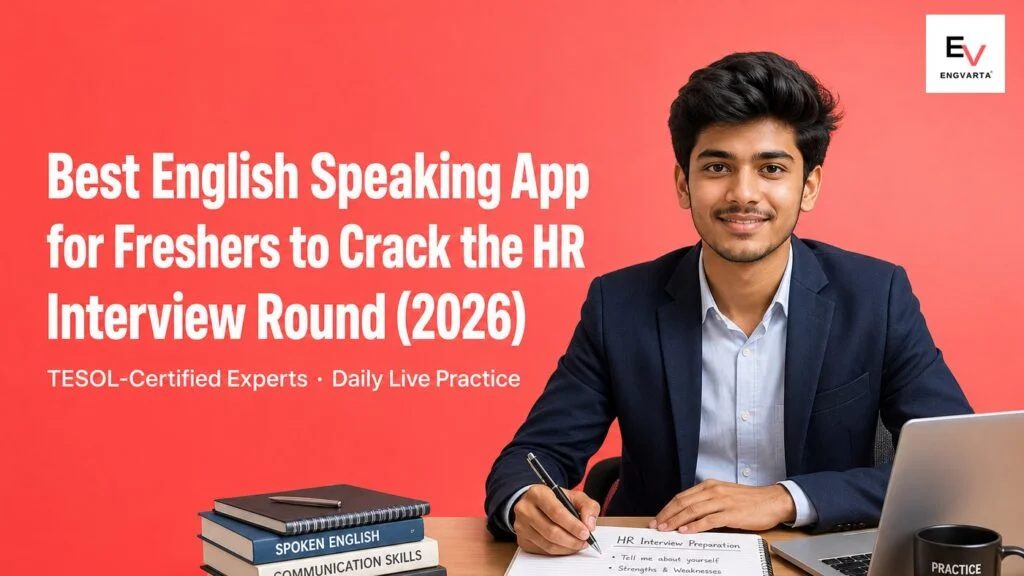
English Speaking App For Interview Preparation |

Tag

english speaking app for interview preparation

Best English Speaking Apps for HR Interview Practice (2026) — Tested for Freshers

June 1, 2026 • 12 min read • By Rishish Pandey

Indian fresher practising spoken English for an HR interview round — best English speaking app for freshers HR interview round 2026
Quick answer For live HR mock rounds with real-time correction, practise with a trained Expert on EngVarta. for free mock interviewer, ChatGPT Voice Mode; for AI app for answer rehearsal, Speak; for clearer delivery of key lines, ELSA Speak; for native-speaker mock practice, Cambly; for hand-picking an interview-coach tutor, italki / Preply. Most people pair one free option for volume with one structured option for feedback.

For the HR round — self-introduction, common questions, strengths and weaknesses, salary and notice-period answers, and confident spoken delivery, with a daily live-practice plan.

How we picked

We ranked each option on what the HR round actually tests: live mock-interview practice, real-time correction of spoken answers, a private low-pressure format, fit for the HR round specifically — self-introduction, strengths and weaknesses, salary and notice-period talk — and pricing a fresher can sustain for daily pre-interview reps. We also cross-checked our shortlist against what freshers are commonly recommended for this exact goal. Pricing and features were verified in June 2026, and competitor names are mentioned for context only.

Why freshers freeze in the HR round even when their English is okay

Most freshers have studied English for years and read it comfortably. The gap shows up only when they have to speak under pressure, in front of a real interviewer, for the first time. The problem is rarely vocabulary or grammar — it is assembly speed and nerves. The brain forms the answer in the mother tongue first, then converts it to English, which adds a visible pause and burns the mental energy that should go into the actual answer.

Three patterns are common: the memorised-answer freeze, where a learnt self-introduction collapses the moment the interviewer asks a small follow-up; the translate-then-speak lag that makes answers slow and hesitant; and over-formal textbook phrasing that sounds rehearsed. Reading more sample answers cures none of them. They close only with spoken reps under live correction — which is why the right tool for the HR round is one that makes you speak, not one that makes you read.

The best apps for HR interview English practice

1. EngVarta

EngVarta gives you a daily 15-minute live 1-on-1 audio session with a TESOL/ESL-certified English Expert who runs the exact parts of the HR round that trip freshers up.

  • Price: ₹69 / $1 refundable trial; ₹2,700 / $45 for 25 sessions (~₹108 / $1.80 each)
  • Best for: live HR mock rounds

2. ChatGPT Voice Mode

Prompt it to act as an HR interviewer, deliver your self-introduction, and have it ask the common questions plus a few follow-ups — a genuinely useful, always-available way to rehearse before the real thing.

  • Price: Free (with usage limits); ChatGPT Plus $20/month
  • Best for: free mock interviewer

3. Speak

An AI app with spoken drills and roleplay that gets your answers out of your mouth quickly, good for warming up the self-introduction before a live session.

  • Price: from $17.99/month (Premium), ~₹1,700/month
  • Best for: AI app for answer rehearsal

4. ELSA Speak

An AI app that scores pronunciation and word stress, useful for cleaning up your opening line, your company name, and the terms you must get right when nerves make speech rush.

  • Price: free tier; ELSA Pro from ~$11.99/month (~₹1,150)
  • Best for: clearer delivery of key lines

5. Cambly

On-demand video chat with native tutors who can run a casual mock interview, useful if you want native-accent exposure before a global-company round.

  • Price: from ~$11 per 30-min session (auto-renewing subscription)
  • Best for: native-speaker mock practice

6. italki / Preply

Marketplaces where you can book a tutor and brief them to drill the HR round — helpful if you want one person who knows interview coaching.

  • Price: italki community tutors ~$4–20/lesson; Preply from ~$15/hour
  • Best for: hand-picking an interview-coach tutor

AI answer practice vs live mock rounds: when to use each

AI tools like ChatGPT Voice and Speak are genuinely useful for one job: getting your answers out of your mouth so the words stop being a blank page. Use them to warm up — it is one of the cheapest, most available things a fresher can do. But an app can’t fully give you a real interviewer. It never makes you nervous, never reacts impatiently, and accepts a translated, hesitant answer as readily as a confident one, so it does not train the composure half of the HR round.

That half is built with a live person. A real Expert makes you hold eye-contact-equivalent focus, adds a follow-up you did not expect, and corrects your phrasing the instant it slips — under the kind of pressure a panel creates. For an Indian fresher, an Expert who knows exactly where HR-round nerves show up, at a price a student can sustain, turns rehearsal into real readiness. Use AI to warm up; use live mock rounds to walk in ready.

Comparison at a glance

App Live human Real-time correction HR-round mock practice Fresher / India context
EngVarta Yes (1-on-1 Expert) Yes, during the call Yes (self-intro, follow-ups, salary talk) Yes
ChatGPT Voice No (AI) Generic feedback Q&A only, no real interviewer Partial
Speak No (AI) Limited Answer rehearsal only Partial
ELSA Speak No (AI) Pronunciation only No Partial
Cambly Yes (native tutor) Varies by tutor Casual mock possible Limited
italki / Preply Yes (tutor) Varies by tutor If you brief the tutor Limited

This ranking is based on fit for the HR interview round specifically — live mock practice, answer correction, beating the freeze — not general English-learning popularity.

Best option for freshers by need

Your situationBest optionWhy
Understand English but freeze in interviewsEngVartaLive mock rounds build a response reflex faster than reading answers.
Want free, solo rehearsal the night beforeChatGPT Voice / SpeakAlways-on AI rehearsal of your self-introduction and common answers.
Clients/panel often ask you to repeat yourselfELSA SpeakPronunciation and stress drills make key lines clearer.
Want native-accent mock before a global-company roundCamblyNative tutors on demand for casual mock practice.
Need basic grammar before live answer practiceSelf-study / grammar courseBuild sentence basics first, then move to live reps.

HR-round questions freshers should practise out loud

HR questionWhat to practise
Tell me about yourselfA 60-second structured introduction: background, key skills, and what you bring.
Why should we hire you?Match two or three strengths to the role in clear, confident sentences.
What are your strengths and weaknesses?Honest strengths with one example; a weakness you are actively improving.
Where do you see yourself in five years?A realistic, growth-focused answer tied to the role.
Salary expectation and notice period?Calm, polite handling without under-asking or over-asking.

A 2-week HR-round practice plan for freshers

Week 1 — break the freeze. Daily 15-minute live audio sessions on easy topics and your self-introduction, so speaking English for 15 unbroken minutes feels normal. The Expert flags where you translate before speaking and pushes you to answer directly, while AI rehearsal on ChatGPT Voice or Speak fills any day too chaotic for a live call.

Week 2 — drill the HR round. Move to mock rounds: the Expert plays the interviewer, asks the common questions and follow-ups, and corrects answer framing in real time, with consolidated feedback at the end of each call. By the end of the week you complete a full mock HR round without freezing for more than a couple of seconds. Recordings stay accessible for 30 days, so you can replay a tricky exchange and shadow the Expert’s phrasing.

Frequently Asked Questions

Q1. Which app is best for freshers to prepare for the HR round?

Ans: EngVarta is a strong fit for freshers because they can practise the HR round live with an English Expert who role-plays the interviewer, corrects the self-introduction and common answers during the call, and builds response confidence before the real interview. AI apps like ChatGPT Voice and Speak are useful warm-ups, but they cannot reproduce real-panel pressure.

Q2. How can a fresher improve English quickly before an HR interview?

Ans: Daily 15-minute live speaking practice for two to three weeks usually produces visible improvement. Freshers rehearse the self-introduction and common HR answers out loud with an Expert, fix phrasing in real time, and build the response speed that reading sample answers alone does not give.

Q3. What does the HR round actually test for freshers?

Ans: The HR round tests communication, clarity, attitude, and self-awareness — not technical depth. Freshers are judged on how confidently they introduce themselves, explain strengths and goals, and handle salary or notice-period questions in clear spoken English.

Q4. Can AI apps replace a live mock interview?

Ans: Not fully. AI apps like ChatGPT Voice and Speak are excellent for solo rehearsal and for generating practice questions, but they do not apply real interviewer pressure or surprise follow-ups, and their feedback is generic. The most effective approach pairs AI rehearsal with live mock rounds that correct your delivery under pressure.

Q5. How many days of practice do freshers need before the HR round?

Ans: For a fresher at intermediate English level, daily 15-minute live practice over two to three weeks is usually enough to walk into the HR round without freezing. Start earlier if your interview is further away so you can also drill follow-up questions and a full mock round.

Q6. Can freshers practise HR answers privately without being judged?

Ans: Yes. Private 1-on-1 practice lets freshers rehearse the self-introduction, the weaknesses question, and salary talk with an Expert before facing a real panel — no classroom, no peers, and no embarrassment while making and fixing mistakes.

Reviewed by the EngVarta content team. Pricing and features verified June 2026; competitor details are summarised from public sources and mentioned for context only.

Best Apps to Prepare English for an HR Interview Round (2026)

May 28, 2026 • 17 min read • By Rishish Pandey

How to Prepare English Speaking for HR Interview Round with mock interview practice

A daily-rep practice protocol for Indian working professionals — what HR actually screens for, the 10 most common questions, and a 7/14/30-day prep plan.

Quick answer
For live mock-interview practice with real-time correction, practise with an Expert on EngVarta. For native-speaker video and mock interviews, Cambly. For pronunciation and clarity, ELSA. For free vocabulary and basics, Duolingo. For free structured lessons, BBC Learning English. Most candidates pair a free app for daily reps with one live option for real mock-interview practice.

Where candidates freeze in HR rounds

Most candidates know the answers — they freeze because they are translating in their head, worrying about grammar, and speaking under nerves all at once. The common stumbles are the open-ended ones: ‘tell me about yourself’, strengths and weaknesses, and ‘why this company’. What helps is rehearsing those answers out loud until they come automatically. The apps below are the ones our learners lean on to practise that.

The best apps to prepare English for an HR interview

Apps to rehearse answers out loud so common HR questions feel automatic on the day.

App Best for Price
EngVarta live mock-interview practice ₹69 / $1 trial; ~₹108 a session
Cambly native-speaker video & mock interviews from ~$11 / 30-min
ELSA Speak pronunciation & clarity free tier; Pro ~$11.99/mo
Duolingo free vocabulary & basics Free; Super ~$6.99/mo
BBC Learning English free structured lessons Free

1. EngVarta

EngVarta gives you daily 15-minute live 1-on-1 audio sessions where a trained Expert plays the interviewer — ‘tell me about yourself’, your strengths, the tricky follow-ups — and corrects your phrasing in real time, so your answers come out calm and structured on the day rather than rehearsed-sounding.

  • Pros: 100% live practice with trained human Experts (not AI, not random volunteers) · real-time correction during the call · session recordings stay 30 days
  • Cons: audio-only (no video) · live sessions run on India hours · paid after the ₹69 / $1 trial
  • Price: ₹69 / $1 refundable trial; ₹2,700 / $45 for 25 sessions (~₹108 / $1.80 each)
  • Best for: live mock-interview practice with real-time correction

2. Cambly

Cambly puts you on video with native English speakers on demand. You can ask a tutor to run a mock interview and get used to answering a real person under light pressure, with exposure to natural phrasing.

  • Pros: native speakers available 24/7 · fully flexible scheduling · strong accent and idiom exposure
  • Cons: tutors are not required to be certified teachers · per-minute cost adds up for daily use
  • Price: from ~$11 per 30-min session (auto-renewing subscription)
  • Best for: native-speaker video and mock interviews

3. ELSA Speak

ELSA scores your pronunciation sound by sound and drills the words that blur under nerves, so you are clearly understood when an interviewer is listening closely — useful if accent or clarity is what trips you up.

  • Pros: very detailed pronunciation scoring · targets your specific problem sounds · practise anytime
  • Cons: pronunciation only — not real conversation · feedback is AI, not a human ear
  • Price: free tier; ELSA Pro from ~$11.99/month
  • Best for: pronunciation and clarity

4. Duolingo

Duolingo is the free, gamified app for keeping vocabulary and grammar warm before an interview. Short daily lessons build the words and structures you will lean on, though it will not rehearse answers for you.

  • Pros: completely free to use · fun daily-habit design · huge content library
  • Cons: very little real speaking practice · vocabulary and grammar focus, not conversation
  • Price: Free; Super Duolingo ~$6.99/month
  • Best for: free daily vocabulary and basics

5. BBC Learning English

BBC Learning English offers free lessons, videos, and podcasts, including interview and workplace English — strong for building listening comprehension and picking up professional phrasing from a trusted source.

  • Pros: completely free · high-quality, trustworthy lessons · strong for listening and grammar
  • Cons: no speaking practice or feedback · self-study only, no live interaction
  • Price: Free
  • Best for: free structured lessons and listening

Which one should you choose?

There is no single best app — pick by what is missing from your routine and your budget:

  • Want free daily prep? Duolingo and BBC Learning English.
  • Worried about pronunciation under pressure? ELSA Speak.
  • Want native-speaker conversation? Cambly.
  • Want a real mock interview with live correction? A trained Expert on EngVarta.

Most candidates combine a free app for daily reps with one live mock-interview session before the real thing.

What HR interviewers actually test (and what they do not)

Many candidates assume HR rounds test English vocabulary or grammar. That assumption is wrong, and it costs offers.

What HR rounds actually screen for, in order of weight:

1. Communication clarity under mild pressure. Can you structure a coherent two-minute answer to an open question without losing the thread? This is the single largest signal. The HR manager is checking whether you can communicate with a client, a senior, or a team member when the conversation is not pre-planned.

2. Story structure (the STAR pattern). Situation, Task, Action, Result. HR managers are trained to listen for this pattern in answers to “Tell me about a time you…” questions. Candidates who tell rambling stories without resolution score lower regardless of vocabulary.

3. Cultural fit and motivation. “Why this company?”, “Why are you leaving your current job?”, and “Where do you see yourself in five years?” are not personality tests. They are checking whether your reasons for the move match the role and whether your trajectory aligns with how the company grows people internally.

4. Conflict-handling and self-awareness. “Tell me about a conflict with a teammate”, “What is your biggest weakness”, and “Describe a failure” measure how you talk about hard things. Candidates who deflect (“I have no weakness”, “It was the other person’s fault”) fail this screen even when their answers sound polished.

5. Listening and follow-up handling. Can you answer the question that was actually asked, not the one you prepared for? HR managers often ask a planned question and then a sharp follow-up that reveals whether you were narrating from memory or genuinely engaging.

What HR rounds do not test: your accent, your grammar perfection, your vocabulary range. A clear, confident Indian-English speaker who structures answers well outscores a candidate with a polished American accent and weak structure. This is consistent with patterns we observe across EngVarta Expert sessions with Indian working professionals.

The 10 most common HR questions and the structural answer pattern for each

Below is the question, what HR is actually screening for, and the one-line structural pattern of a strong answer. The pattern is not a script — it is a skeleton you fill with your own examples.

1. Tell me about yourself. Screens for: communication clarity, ability to prioritise relevant information. Pattern: Current role and headline metric (one sentence) → Career arc and what you optimised for (two sentences) → Why you are talking to them today (one sentence). Two minutes total. Stop talking.

2. Why are you looking to leave your current company? Screens for: maturity, no-bridges-burned signal. Pattern: One forward-looking reason (what you want to do next) — never a backward-looking complaint about your current employer.

3. Walk me through your resume. Screens for: ability to extract narrative from listed facts. Pattern: Chronological with one transition reason between each role (“I moved from X to Y because I wanted to learn Z”). The transitions matter more than the role descriptions.

4. What is your biggest weakness? Screens for: self-awareness, no-deflection signal. Pattern: A real weakness that does not torpedo the role → what you have already done to address it → current state. Do not pick a fake weakness like “I work too hard.”

5. Describe a conflict with a teammate and how you handled it. Screens for: emotional regulation, willingness to own your part. Pattern: STAR — Situation (one sentence on the conflict, neutral language) → Task (what needed to happen) → Action (what specifically you did, including the part you initially got wrong) → Result (resolution + what you would do differently next time).

6. Where do you see yourself in five years? Screens for: alignment between your goals and how the company grows people. Pattern: One direction you want to grow in (technical / managerial / breadth) → one specific role-relevant capability you want to deepen → openness about exact title.

7. Why this company? Screens for: research signal, genuine interest. Pattern: One specific thing about the company (a product, a recent launch, the team culture as you have heard it described) → why that connects to what you want next → why your skills fit. Never a generic “great company” answer.

8. Tell me about a time you failed. Screens for: ability to talk honestly about hard things. Pattern: Real failure with stakes (do not pick something trivial) → what you misjudged → what you changed in your approach afterwards → evidence the change held.

9. What is your salary expectation? Screens for: market awareness, negotiation maturity. Pattern: A researched range (not a single number) → context on what bucket of compensation you are factoring in (base, variable, ESOPs) → openness to discussion based on the full package.

10. Do you have any questions for us? Screens for: curiosity, preparation. Pattern: Two questions minimum. One about the role or team. One about how the company makes decisions or grows people. Never “no questions.”

Beyond these ten, expect 3–5 follow-ups that test depth: “Can you give me another example?”, “What did the other person say?”, “What would you do differently now?”. Unprepared candidates fall apart during the follow-ups. Practising follow-ups with a live interviewer is non-negotiable.

The day-by-day practice protocol (7 / 14 / 30 days)

The right prep window depends on how many days you have until the interview and what your current English speaking baseline is. The structure below works for any window because it is built around daily 15-minute reps, not a one-time crash session.

If you have 7 days (high urgency — interview is next week):

  • Days 1–2 : One 15-minute live mock with an English Expert. Focus only on Question 1 (Tell me about yourself). Record. Re-listen the same evening.
  • Days 3–4 : Two 15-minute mocks. Cover Q2, Q3, Q4 in Day 3; Q5, Q6, Q7 in Day 4. Each session ends with the Expert flagging two specific patterns to fix.
  • Day 5 : One 25-minute full mock. The Expert runs Q1–Q10 with follow-ups. No script — just answer.
  • Day 6 : One 15-minute targeted rep on whichever questions you stumbled on in Day 5.
  • Day 7 : One 25-minute final dress-rehearsal mock. Stop preparing after this. Sleep early.

If you have 14 days (moderate window):

  • Days 1–3 : Three 15-minute mocks. Q1–Q3 with deep follow-up practice.
  • Days 4–6 : Three 15-minute mocks. Q4–Q7.
  • Days 7–8 : Two 15-minute mocks. Q8–Q10.
  • Day 9 : First full 25-minute mock interview.
  • Days 10–12 : Three 15-minute targeted reps based on what broke in Day 9.
  • Day 13 : Second full 25-minute mock. Compare to Day 9 recording — measure the delta.
  • Day 14 : One 15-minute light rep. Rest.

If you have 30 days (strong window):

  • Week 1 : Daily 15-minute mocks. Cover all 10 questions twice.
  • Week 2 : Daily 15-minute mocks. Focus on follow-up handling and pivoting mid-answer.
  • Week 3 : Three 25-minute full mocks + four 15-minute targeted reps.
  • Week 4 : Two 25-minute full mocks + three 15-minute final-polish reps. Final dress rehearsal two days before the interview.

What every protocol shares: daily reps in the actual format you will face (live spoken English, with a real listener asking unpredictable follow-ups), recordings you replay, and a trained instructor flagging two specific patterns per session — not twenty.

How this guide was compiled (methodology)

This guide aggregates patterns from three sources:

  1. Patterns observed across EngVarta Expert sessions with Indian working professionals running mock HR interviews — what breaks candidates in HR rounds (mind-blank, mother-tongue translation lag, run-on sentences, filler-word density).
  2. Publicly visible company-careers pages and reported HR-round structures (Amazon Leadership Principles, Google’s hiring process documentation, Microsoft’s growth-mindset framework). No private or confidential information from any company is used.

Ready to Practice with Real Experts?

Try EngVarta today — ₹69 trial (India) / $1 trial (International) · 100% refundable

FAQs

Q1. How long does an HR interview round typically last in India?

Ans : Most HR rounds run 20–45 minutes. Entry-level rounds at IT services companies skew to 20–30 minutes. Mid-senior MNC and consulting rounds skew to 30–45 minutes. SaaS startup rounds are shorter and more conversational, often 20–30 minutes including time for your own questions at the end.

Q2. Is it acceptable to ask for a question to be repeated?

Ans : Yes. Asking “Could you please repeat that?” or “Can you give me a moment to think?” is professional, not weak. It is better than rushing into a half-formed answer. HR managers note the candidates who buy time gracefully versus the ones who fill silence with filler words.

Q3. Should I memorise HR interview answers or speak naturally?

Ans : Memorised answers collapse the moment the interviewer asks an unscripted follow-up — and follow-ups are where most HR rounds are won or lost. The right preparation is to memorise the structure of each answer (the 10 patterns above) and improvise the content using your own examples. Live mock interviews are the format that builds genuine improvisation reflex, because they include unpredictable follow-ups self-practice cannot.

Q4. Can I switch from English to Hindi or another language mid-answer if I lose words?

Ans : Avoid it unless the interviewer has already established that the conversation can switch. In most Indian MNC HR rounds the interview is conducted in English to screen for English communication ability. Switching languages signals to the interviewer that you cannot complete a thought in English under pressure. Better: pause, use a filler-replacement phrase (“Let me think about that for a second”), then continue in English.

Q5. What is the difference between an HR round and a behavioural round?

Ans : The HR round at most Indian companies covers a mix of fit-screening, behavioural questions, and salary or logistics discussion. A “behavioural round” specifically (more common at US-headquartered companies like Amazon, Google, Meta) focuses heavily on STAR-pattern questions tied to leadership principles or company values, with little fit-screening. The questions overlap but the weighting differs.

Q6. How many practice interviews should I do before the real thing?

Ans : At minimum, three live full-length mocks plus daily 15-minute targeted reps. Three full mocks lets you measure the delta between your first attempt and your final dress rehearsal — that delta is the truest signal of readiness. Candidates who do only one mock interview tend to plateau because they have not yet seen their own failure modes under pressure.

Q7. Will an AI interview practice app prepare me for the actual HR round?

Ans : Partially. AI is useful for the rehearsal-of-a-planned-answer phase and for vocabulary warmups. AI does not replicate the unpredictable follow-up, the silence-after-your-weak-answer, or the reading-your-body-language layer of a real HR interaction. For HR-round prep specifically, AI complements live human mocks; it does not replace them.

Q8. Which app is best for practising HR interview answers in English?

Ans : EngVarta is the closest fit for HR-round preparation specifically. Sessions are live 1-on-1 audio with TESOL/ESL-certified Experts who run behavioural questions, ask follow-ups, and correct phrasing in real time. Cambly and italki are broader speaking practice without HR-specific drills; AI apps (ChatGPT Voice, Speak) help with planned-answer warmups but cannot simulate unpredictable HR follow-ups.

Q9. Is EngVarta useful if my interview is in the next 7 days?

Ans : Yes. The 7-day plan is the most-asked window: daily 15-minute mock rounds with an Expert across the seven mornings before the interview produce a measurable improvement in response time, filler-word density, and STAR-structure delivery. Most learners book three full-length mocks plus daily targeted reps inside this window.

Q10. How is a live mock HR interview different from practising answers with ChatGPT?

Ans : ChatGPT will accept your answer and continue. A live Expert will interrupt mid-sentence, ask the unpredictable follow-up an HR manager would actually ask, and flag the phrase that sounded rehearsed. The skill HR rounds test — improvising a structured answer under pressure — only forms when the listener pushes back. ChatGPT is excellent for rehearsing a planned answer; it does not fully recreate the pressure of being asked something you did not prepare for.

What Our Learners Say

Rated 4.5★ from 9,100+ reviews on Google Play

★★★★★
I am happy while speaking with experts and getting feedback on my speaking skills.
★★★★★
The supporting people along with the experts are very supportive. The only suggestion to the officials is that the names of the experts should be reflected on the screens so to know to whom I am talking with. Thank you Engvarta, continue supporting people like me. Thank You.
★★★★★
I am living in Italy for 20 years. I never got the chance to speak English but now I want to speak again to help my children. It was a very good experience. I want to congrats your team for making such an excellent app.
★★★★★
Nice platform to practice English speaking. Teachers are awesome. Thanks
★★★★★
I am really enjoying my journey with EngVarta where the learning is not limited to communication skills but also enrichment of ideas and thoughts.
★★★★★
It is a very nice app. The expert whom I talked to is very amiable and very knowledgeable.
★★★★★
Experts are friendly and supportive. Great platform to improve your communication skills.
★★★★★
Great app for learning English speaking. All the experts are supportive and non-judgemental. After every session, constructive feedback is provided to enhance yoilur skills. Also it has AI enabled feature for assignment practice. Overall a great platform to practise English speaking with experts.
★★★★★
i completed my trial session, expert was good. I installed this app because chatgpt recommended it and I find it quite good speaking practice. experts are professional and friendly. plans are also economical compared to other english courses i took in the past.
★★★★★
I am really enjoying this app and it is very useful for my IELTS preparation. It is a great application that I have never seen.
★★★★★
I have been practising English on EngVarta for the past 30 days and results are significant. I’m happy to be here.
★★★★★
It's a incredible app... It builds my confidence to speak English fluently, gives you practice to start your conversation without any hesitation, provides daily free vocabulary and quizes also...Expensive but amazing & worth it...

Related guides on EngVarta

Pricing and feature details about practice platforms are checked as of May 2026 against each platform’s public page.