English Fluency For Study Abroad Students |

Tag

english fluency for study abroad students

English Speaking Practice for Engineering Students in India (2026): Daily Live 1-on-1 Guide for Placements & MS Abroad

May 18, 2026 • 13 min read • By Rishish Pandey

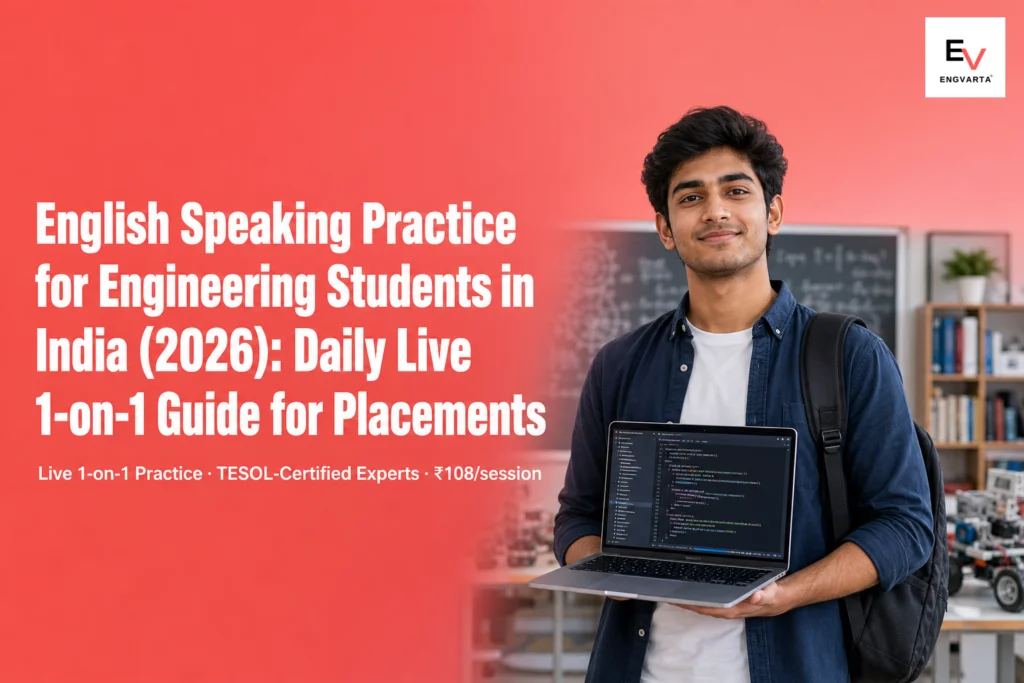
Confident Indian engineering student holding laptop with code in college campus — English speaking practice for engineering students 2026
Quick VerdictEnglish speaking practice for engineering students in India is not about vocabulary or grammar — most engineering students already read and write English well. The gap is conversational fluency under stress: campus placement interviews, MNC HR rounds, group discussions, MS-abroad video interviews, and the first 90 days of a new job where you have to actually talk to clients. The fastest fix is daily 15-minute 1-on-1 live English speaking practice with a TESOL/ESL-certified Expert — 25 sessions over a semester usually closes the gap. EngVarta starts at a ₹69 refundable trial, with the full 25-session pack at ₹2,700 (~₹108 per session) — designed for student budgets.

Every Indian engineering student we have spoken with — IIT, NIT, BITS, state university, private autonomous — describes the same problem in different words: “I can read technical papers easily but I freeze the moment an interviewer asks me to explain my project.” The CGPA is high. The resume is strong. The English in the resume is grammatically clean. But the placement interview is a spoken exam, and spoken English is a different muscle.

This guide is for engineering students in India — across all tiers, all branches, all years — who know their English speaking is the bottleneck between them and the placement, the internship, or the MS admission they actually want. We compare the apps and platforms that work for engineering-student schedules and budgets, with honest notes on where each one fits and where it does not.

Why Engineering Students Specifically Struggle with Spoken English

The pattern repeats every placement season in every Indian engineering campus:

1. Reading-and-writing fluency outruns speaking fluency. Engineering syllabi are English-medium, technical content is consumed in English (textbooks, Stack Overflow, GitHub, papers), and assignments are submitted in English. But the actual speaking reps — explaining a concept aloud, defending a design decision, narrating what your project does to a non-technical listener — never happen in classrooms or labs. Four years of strong written English, almost no oral practice.

2. Hostel-life conversations are in the regional language. Most students chat with friends, eat in the mess, watch movies, and play games in Hindi, Tamil, Telugu, Bengali, Malayalam, Marathi or their mother tongue. The brain spends 95% of its conversational hours not in English. When the placement-cell interview switches to English mode, the muscle is rusty.

3. The translation lag is brutal in interviews. You think the answer in your mother tongue, translate to English in real time, and the 2-second pause makes the interviewer think you do not know the answer. Native-fluency speakers think directly in English. Bridging that lag takes 50–100 hours of focused speaking reps.

4. Group discussions punish hesitation. Campus GDs reward the candidate who speaks first and speaks confidently — not necessarily the one with the best technical knowledge. Engineering students with weaker spoken fluency get filtered out at the GD stage and never reach the HR round where their technical strength would matter.

5. MNC HR rounds are designed to test spoken English deliberately. “Tell me about yourself” is not a vague opening question — it is a calibrated test of how fluently you can speak about your own life for 60–90 seconds without scripted preparation. Companies like Accenture, Infosys, TCS, Wipro, Capgemini, Cognizant, and global MNCs (Google, Amazon, Microsoft, Goldman Sachs) all use spoken-English checkpoints as a filter early in their funnel.

The fix for all five is the same: live, 1-on-1, voice-based English speaking practice with a trained Expert who can simulate the placement-interview format, give real-time corrections during the call, and push you with spontaneous follow-ups the way a real interviewer will.

1. EngVarta — Best for Daily English Speaking Practice on a Student Budget

EngVarta is built for exactly this use case. You connect with a TESOL/ESL-certified English Expert in minutes, on demand, for 15-, 25- or 50-minute sessions. For engineering students preparing for placements or MS interviews, the 15-minute slot is the right cadence for daily practice — short enough to fit between classes or after lab hours, long enough to build conversational stamina session-over-session.

What makes EngVarta a fit for engineering students specifically:

  • Voice-only sessions. No video pressure. You focus entirely on what you are saying — no need to worry about your hostel-room background or whether your hair is combed.
  • Real-time corrections during the call. The Expert flags hesitation, weak verbs, “ums” and unclear pronunciation in the moment — not in a written PDF you would never open later.
  • Consolidated feedback towards the end covering pace, filler-word frequency, and grammar patterns you repeat (most engineering students have 2–3 signature patterns — “actually” overuse, mixing past and present tense in narration, dropping articles before nouns).
  • Recording accessible 30 days post-session so you can listen back the next morning at 1.5× speed and hear every stumble exactly as your future interviewer will hear it.
  • Refundable trial at ₹69 — roughly the cost of a samosa-and-chai in the mess. Validate the format before committing.
  • ₹2,700 for a 25-session pack at ~₹108 per session. Daily 15-minute sessions for a full month, or alternate-day for two months. Fits a student-budget calendar.
  • Suitable for kids 7+ with parent guidance — useful if you are mentoring a younger sibling on the side.

For students preparing specifically for MS abroad video interviews — Carnegie Mellon, Georgia Tech, UT Austin, ETH Zurich, Imperial — the ₹5,130 plan (25 sessions of 25 minutes, ~₹205 per session) gives you longer mock-interview slots that better simulate the actual admissions video call.

Ready to Practice with Real Experts?

Try EngVarta today — ₹69 trial (India) / $1 trial (International) · 100% refundable

2. Speak — AI-Only Conversation, Good for Daily Reps at Low Cost

Speak is one of the most-funded AI-only English-speaking apps. You talk to an AI tutor that responds in voice, drills your pronunciation, and gives you unlimited reps for roughly $20/month. For pure repetition volume — getting 30+ hours of speaking time per month at a flat rate — it is unbeatable.

Where Speak fits in a student’s stack: as a 10-minute daily warm-up before bigger live sessions. For a deeper take on live human vs AI practice, see our real-people vs AI breakdown. Where it falls short for placement prep specifically: the AI cannot push back on hesitation in the way a human Expert can. It logs your “ums” as data but rarely interrupts your flow to correct them in the moment, and in-the-moment correction is what builds the under-pressure muscle. Speak also runs in USD pricing and the monthly subscription cost compounds across a multi-month preparation arc.

3. ELSA Speak — Pronunciation Drilling for Specific Sounds

The greatest tool we are aware of for specific pronunciation issues, such as “v” vs. “w,” “th” sounds, schwa neutralisation, or the long “ee” in terms like “sheet,” is ELSA Speak. It scores each phoneme you produce and gives visual feedback. For engineering students from regional-medium school backgrounds whose pronunciation drift is hurting their interview clarity, 10 minutes of ELSA daily for 4–6 weeks before placement season produces measurable improvement.

What ELSA does not do: build conversational fluency. It is a pronunciation gym, not a conversation simulator. Use it alongside live human practice, not instead of it.

4. Cambly — Native-Speaker Video Conversation, Premium Pricing

Cambly uses video to link you with native English speakers from the US, UK, Canada, and Australia. For engineering students aiming at MS programs in the US specifically, exposure to American native speakers can help you tune your ear to the cadence of US admissions interviewers.

Trade-offs to be honest about: Cambly is a video-first product, which adds camera-pressure on top of speaking-pressure (a known problem for engineering students who already feel self-conscious in interviews). Pricing is in USD and works out roughly 4–6× the per-session cost of EngVarta. The tutors are conversation partners, not interview coaches by default — you have to brief each tutor on the placement-interview format every time. For an honest side-by-side, see our EngVarta vs Cambly comparison.

5. Preply — Marketplace with Variable Quality

Preply is a marketplace: you browse tutor profiles, read reviews, book sessions à la carte. Pricing varies wildly ($5–$40 per hour depending on tutor). Quality is inconsistent — some tutors are excellent, some are conversation partners with little structured teaching experience.

Where Preply works for engineering students: if you want a long-term coach (one tutor across 30+ sessions over a semester) and you are willing to invest the first 3–4 sessions in finding the right person. Where it does not: if you need on-demand, predictable practice cadence — booking the same tutor 5 days a week is harder than it sounds because most tutors are part-time.

6. Free Practice — YouTube + Self-Recording + Toastmasters Campus Chapter

The zero-cost stack worth using:

  • YouTube for watching campus-placement mock interviews and HR round examples (search “Infosys HR round” or “Accenture interview experience”). Watch 5–10 of these to understand the format. This builds awareness, not speaking skill.
  • Self-recording on your phone’s voice memo app. Pick a question — “Tell me about your final-year project” — and answer it cold. Listen back the next day. Write down every “umm” and pause.
  • Toastmasters — many engineering campuses have a chapter. ₹1,000–₹2,000 annual membership, weekly meetings, structured speaking practice in front of an audience. Excellent for developing stage presence; less useful for fluency in one-on-one interviews where quick Q&A responses are required.

These work as supplements. They do not work as a substitute for live human practice with someone who interrupts you and pushes back — because you cannot correct what you do not yet hear as a problem.

How Much English Speaking Practice for Engineering Students Is Enough for Placement Season?

Realistic minimums based on hundreds of EngVarta-learner placement outcomes:

  • 1 semester before placements (6+ months out) : 3 sessions per week of 15 minutes. Build conversational stamina at a relaxed pace.
  • 3 months before placements : 4–5 sessions per week of 15 minutes. Add one 25-minute mock-interview session per week.
  • 1 month before placements:  Daily 15-minute sessions, plus two full 25-minute mocks per week. Your day-to-day conversations will feel easy by comparison.
  • Final 2 weeks : Daily 25-minute mock-interview sessions. Brief your Expert on the specific companies you have shortlists from — Infosys vs Goldman Sachs vs Google have different interview formats, and your Expert can simulate each.

What If You Are From a Tier 2 or Tier 3 College?

The English-speaking gap is the single most addressable factor that prevents Tier 2/3 engineering students from clearing MNC interviews despite strong technical skills. Most of the technical filtering happens online before the interview — your CodeChef rank, your project portfolio, your Hackerrank scores get you into the interview pool. After that, the interview is largely a spoken-English test.

If you are 2 years out from placements, start now with 3 sessions per week. By the time placement season hits, you will have 200+ hours of conversational reps under your belt, and the spoken-English gap that filters out most of your peers will no longer apply to you. The total cost over 2 years: ~₹10,000–₹12,000, which is roughly the cost of 2 textbooks.

What If You Are Targeting MS Abroad — US, Canada, Germany, UK?

The MS application process tests spoken English at multiple checkpoints:

  • TOEFL/IELTS speaking section. 20-second prep + 60-second monologue under timer pressure. Daily practice with an Expert who simulates the format for 6 weeks before the test is the single biggest score-mover.
  • Video application interviews. Carnegie Mellon MSCS, MIT Sloan, ETH Zurich — many top programs include a 20–30 minute video interview as part of admissions. Spoken fluency under camera is the assessment.
  • Visa interview (F1 for US). See our dedicated guide on F1 visa interview English speaking practice for the full prep arc.
  • First 90 days on campus. US/UK/Canadian campus life — TA work, group projects, lab meetings — happens entirely in English. Students who arrive with weak spoken fluency lose the first semester to social isolation and acclimatisation; students who arrive fluent jump straight into research and networking.

Start 6 months before your application deadline. Daily 15-minute sessions, with one 25-minute mock per week. Cost: ~₹5,000–₹6,000 total. Cheaper than a single GRE coaching module.

What Our Learners Say

Rated 4.5★ from 9,100+ reviews on Google Play

★★★★★
Great app to overcome inferiority of speaking English.
★★★★★
engverta is good for those who is struggling to speak English...I m new commer but I feel good experience with engverta experts they listen our broken English, they rectify mistakes ,they talk withvery humbly..
★★★★★
Engvarta is a platform where we start from the 0 level to 100 level. That is the best thing I have never seen in my life. There are so many part and so many way, they are always try to teach you until you become a good speaker. Thank you Engvarta
★★★★★
Really we can see the positive results from the app. Well done!
★★★★★
It was a great experience. I felt so much better. This is a very positive experience for me.
★★★★★
My last conversation was very good. Really very helpful to me. I learnt lots of things from that.
★★★★★
Experts are friendly and supportive. Great platform to improve your communication skills.
★★★★★
I have been using EngVarta for the past three months and from the period I am using I feel a considerable amount of difference in how I was speaking earlier and now how I am speaking and I think the EngVarta team has done a commendable job in improving my English fluency skill.
★★★★★
I find the app very helpful and user friendly. The UI design is very soothing for eye. Students can get good benefit out of it if they regularly use it to practise their spoken English. Good luck to the app team for building a professional app for the greater good.
★★★★★
good and highly talented experts are here..just go for a trail without any doubt.. thank you eng vartha...A small request from my side just take less payment from the people who are joing in your coaching...help to them...thank you
★★★★★
My last 12 sessions experience is really great. It's a great app to improve English fluency and communication skills. All experts are quite friendly and highly skilled.
★★★★★
excellent app for learning fluency and If you genuinely correct your mistakes then you should opt for this

Conclusion :

For engineering students in India, the single biggest leverage point between a strong technical background and the placement, MS admission, or first MNC job you actually want is daily live English speaking practice with a trained Expert. Not vocabulary apps. Not grammar books. Not group classes where you speak 2 minutes out of 60. Daily 15-minute 1-on-1 reps with a TESOL/ESL-certified Expert who interrupts you when you hesitate, corrects you in real time, and pushes you with spontaneous follow-ups the way a real interviewer will.

Start with the ₹69 refundable trial. If it works for your routine, commit to the ₹2,700 25-session pack and run it through one full month of placement-season prep. Most engineering students who do this consistently say the same thing: “I wish I had started this in second year.”

FAQs

Q1. Which app is best for English speaking practice for engineering students in India?

Ans : For daily live practice on a student budget, EngVarta offers TESOL/ESL-certified Experts at ₹108 per 15-minute session (₹2,700 for 25 sessions). For AI-only daily reps, Speak is the cheapest at flat-rate monthly pricing. For native-speaker exposure (mostly useful for MS abroad), Cambly works but costs 4–6× more per session.

Q2. How long does it take an engineering student to become fluent in English speaking?

Ans : For an intermediate-level engineering student, 50–100 hours of focused 1-on-1 practice usually closes the placement-interview gap. At 15 minutes per day, that is 4–8 months of consistent daily practice. The students who succeed are the ones who treat it like gym — daily reps, no skipped days, same time slot every day.

Q3. Can I prepare for campus placements in 1 month?

Ans : If your spoken English is already moderate, yes — daily 25-minute mock-interview sessions for 4 weeks will measurably improve your fluency and confidence under interview pressure. If your spoken English is weak (you freeze in front of strangers in English), one month is not enough — start 3–6 months out.

Q4. Is YouTube enough for placement interview English practice?

Ans : No. YouTube teaches you what questions to expect; it does not build the muscle to answer them fluently under pressure. Use YouTube for format awareness, but pair it with daily live human practice for the actual reps.

Q5. Should I learn an American accent for MS interviews abroad?

Ans : No. Admissions interviewers are trained to understand all global English accents. A clear, well-paced Indian English is far better than a fake American accent that adds another layer of unnatural-sounding stress to your speech.

Q6. Do I need to be fluent before I start MS abroad, or will I pick it up on campus?

Ans : You need to be reasonably fluent before you arrive. Students who land in the US with weak spoken English lose the first semester to acclimatisation, miss out on TA opportunities, and feel socially isolated. Fluent students jump straight into research within the first 2 weeks. 6 months of daily 15-minute practice before departure is the right investment.

Q7. Is EngVarta good for engineering students from regional-medium school backgrounds?

Ans : Yes — many EngVarta learners are first-generation English-medium engineering students whose schooling was in Hindi, Tamil, Telugu, Bengali, Marathi or other regional languages. TESOL/ESL-certified Experts specifically understand the transition path and adapt sessions to your starting point without judgement.

Q8. What is the cheapest way to practise English speaking as an engineering student?

Ans : Free: self-recording on your phone + watching YouTube placement-interview videos. Low-cost: EngVarta’s ₹69 refundable trial + ₹2,700 25-session pack. Mid-cost: monthly AI app subscriptions ($10–$20/month for Speak or ELSA). Premium: native-speaker video apps (Cambly, $40–$60/month equivalent).

Editorial note: This guide is researched and written by the EngVarta team. We compare our own platform alongside other tools that Indian engineering students commonly use, and we are honest about where each tool fits — including where it does not.

Best English Speaking Practice for F1 Student Visa Interview USA (2026) : Confidence Builder Guide

May 16, 2026 • 10 min read • By Rishish Pandey

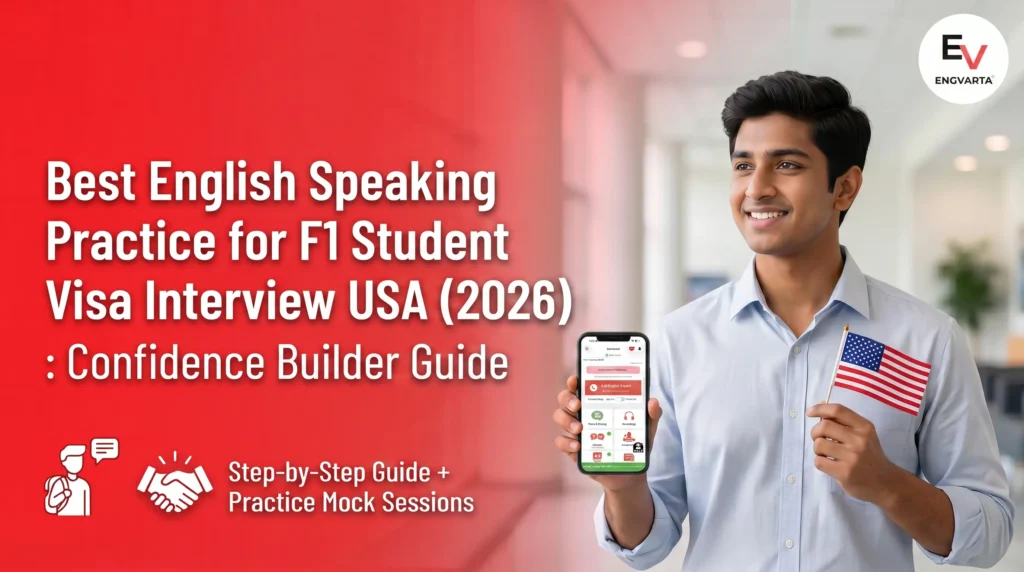
F1 visa interview English speaking practice for Indian students
Quick VerdictThe F1 visa interview is short — usually under three minutes — and visa officers decide on the spot. The single biggest predictor of approval is your ability to speak English clearly and confidently while answering targeted questions about your program, funding, and intent to return. The fastest way to be ready is daily 1-on-1 mock-interview practice with a real human Expert who can correct hesitation, vague answers, and pronunciation in real time. EngVarta gives you that on a refundable trial — start the day you pay your SEVIS fee and you will arrive at the consulate with at least 25 mock sessions behind you.

Every year, lakhs of Indian students apply for F1 visas to study in the United States. The acceptance letter from a US university is the easy part. The visa officer’s three-minute interview at the US Consulate in Mumbai, Delhi, Chennai, Hyderabad or Kolkata is what stands between you and your flight to JFK or SFO.

That is why many students now focus seriously on F1 Visa Interview English Speaking Practice before their interview date. The F1 visa interview is unlike any conversation you have had before. The visa officer is trained to look for hesitation, inconsistency, and fluency under stress. A perfectly worded answer that you stumble over is worse than a simple, fluent one. Your spoken English is being graded — silently — alongside your funding documents and your I-20.

This guide explains exactly what English skills the F1 interview tests, what kind of practice actually works (and what wastes time), and the apps and platforms Indian students rely on to get interview-ready in 30 to 60 days.

What the F1 Visa Interview Actually Tests

Most students prepare answers to common questions like “Why this university?” and “How will you fund your education?” That is necessary, but not sufficient. The visa officer is also evaluating four spoken-English skills:

1. Fluency under stress. Long pauses, “umm”, and “actually” repeated four times in one sentence signal nervousness. Visa officers see thousands of interviews and read hesitation as a possible sign of a memorised script.

2. Pronunciation clarity. You do not need an American accent. You do need to be understood the first time. Indian English with crisp consonants and clear vowel sounds is fine. Mumbled, rapid-fire English is not.

3. Spontaneous follow-ups. The officer rarely asks questions in the order you rehearsed. A question like “Why did you choose Purdue over Texas A&M?” requires you to compare two universities on the spot, in plain English, in under 20 seconds.

4. Confidence in your own story. Your reasons for studying abroad must sound lived-in, not memorised. The officer can tell when an answer is your own.

This is the gap that English-speaking apps with pre-recorded lessons or AI-only conversation cannot bridge. You need a real human who interrupts you, asks awkward follow-ups, and tells you which words you slurred — every single day for 30 days before your interview.

Why Most F1 Aspirants Get Their English Practice Wrong

Three patterns we see again and again on calls with EngVarta learners preparing for F1:

Pattern 1 — Over-rehearsed scripted answers. Students memorise answers to 20 commonly asked questions, deliver them word-perfect at home, and freeze when the officer asks the 21st question. Memorisation is not fluency.

Pattern 2 — Practising only with friends or family. Friends do not interrupt. They do not push back. They do not say “I did not understand that, please repeat.” A real interviewer does all three.

Pattern 3 — Reading mock-interview questions on YouTube. Watching videos teaches you what questions to expect. It does not teach your mouth to form fluent answers under pressure.

The fix for all three is the same: live, 1-on-1, voice-only English practice with a trained Expert who simulates the interview format, gives real-time corrections during the call, and shares consolidated feedback towards the end.

1. EngVarta — Live 1-on-1 F1 Interview Mock Practice

EngVarta is built for exactly this use case. You connect with a TESOL/ESL-certified English Expert in minutes, on demand, for 15-, 25- or 50-minute sessions. For F1 prep, the 25-minute slot works well — it mirrors a longer-than-usual visa interview and gives the Expert time to ask 6–8 spontaneous follow-ups.

What makes EngVarta different from group classes or AI apps:

  • Voice-only sessions. No video pressure. You focus entirely on speaking.
  • Real-time corrections during the call. The Expert flags hesitation, weak verbs, and unclear pronunciation in the moment — not in a written PDF you ignore later.
  • Consolidated feedback towards the end covering pace, filler words, and grammar patterns you repeat.
  • Recording accessible 30 days post-session so you can re-listen to your own answers and hear what the visa officer will hear.
  • Refundable trial at ₹69 so you can validate the format before committing to a 25-session pack.

For F1 prep, we recommend the ₹2,700 plan (25 sessions of 15 minutes, ~₹108 per session) if your interview is 6–8 weeks away — that is one session every other day. If you have less than 4 weeks, the ₹5,130 plan (25 sessions of 25 minutes, ~₹205 per session) gives you longer mock-interview slots that better simulate the consulate experience.

Ready to Practice with Real Experts?

Try EngVarta today — ₹69 trial (India) / $1 trial (International) · 100% refundable

2. Cambly — Native-speaker Conversation, Higher Cost

Cambly connects you with native English speakers (US, UK, Canadian, Australian) over video. For F1 specifically, talking to American native speakers can help you get used to the cadence of an American consular officer.

Trade-offs: Cambly is a video-first product, which can add camera-pressure on top of speaking-pressure. Pricing is in USD and works out roughly 4–6× the per-minute cost of EngVarta for Indian students. Tutors are conversational partners, not interview coaches by default — you have to brief each tutor on the F1 format yourself.

For an honest side-by-side, see our EngVarta vs Cambly comparison.

3. Yes Mam Education / IDP / Other Counsellor-Run Mock Sessions

Many education consultants offer F1 mock-interview sessions as part of their visa-prep package. These are usually 1–3 sessions in total, conducted in batches with 5–10 students at a time, and cost anywhere from ₹3,000 to ₹15,000 as an add-on.

They work as a final-week sanity check — the consultant has seen the latest officer questions and can flag inconsistencies in your story. They do not work as English-fluency builders. One mock session two days before the interview cannot fix six months of weak speaking practice.

Use these alongside daily EngVarta sessions, not instead of them.

4. ELSA Speak — Pronunciation Drilling for Specific Sounds

If your problem is specific sounds — “v” vs “w”, “th” sounds, the schwa — ELSA Speak is a targeted AI tool that gives you visual feedback on individual phonemes. It is not a conversation app and will not help you build fluent answers, but as a 10-minute-a-day pronunciation supplement it can be useful in the final 4 weeks before the interview.

Most F1 candidates do not need this. Indian English pronunciation is already understandable to American officers. Skip ELSA unless a TESOL Expert specifically tells you certain sounds are unclear.

5. Free Practice — YouTube Mock Interviews + Self-Recording

The free-tier stack: watch 5–10 F1 mock-interview videos on YouTube (search “F1 visa interview Mumbai 2025” and “F1 visa interview rejected reasons”). Then record yourself answering the same questions on your phone’s voice memo app. Listen back the next day and write down every “umm” and pause.

This works to build self-awareness. It does not work as a substitute for live human practice, because you cannot correct what you do not yet hear as a problem.

F1 Interview Day Checklist — Speaking Prep

  • Have your full story memorised as themes, not as scripted sentences.
  • Be able to explain your program, your university choice, and your post-degree plan in three sentences each.
  • Practise the “I plan to return to India because…” answer with at least 5 different concrete reasons (job market, family business, specific industry growth, parents’ health, etc.).
  • Do at least one mock interview within 24 hours of your slot.
  • Sleep. A tired brain produces longer pauses.

How Much English Practice Is Enough?

If your TOEFL or IELTS score is already at the band your university required, your written English is fine. The visa interview tests spoken English under stress, which is a different muscle.

Our recommendation, based on calls with hundreds of Indian F1 candidates over the years:

  • 8+ weeks before interview: 3 sessions per week of 15 minutes each. Build conversational stamina.
  • 4–8 weeks before: 4 sessions per week, with at least one full mock-interview slot of 25 minutes.
  • Final 2 weeks: Daily sessions. Mix 15-minute fluency drills with 25-minute full mocks.
  • Final 48 hours: Two 25-minute mock interviews. Then sleep. Do not over-practise on interview day itself.

What If My English Is Already Strong?

If you score 110+ on TOEFL iBT or 7.5+ on IELTS, your concern is not vocabulary or grammar — it is the gap between writing English well and speaking it under interview-room pressure. You still need mock-interview reps. Two sessions per week for 6 weeks is usually enough.

What If My English Is Weak?

If you scored just at the cutoff (TOEFL 80 or IELTS 6.5) and you know your spoken English is your weakest skill, give yourself longer. Start 90 days before your interview. Do daily 15-minute sessions for the first 60 days to build basic conversational fluency, then switch to 25-minute mock-interview slots for the final 30 days.

Indian students who try to compress this into 2 weeks of cramming are the ones who freeze in the interview window.

Bottom Line

The F1 visa interview is a spoken-English exam disguised as a document check. Officers decide on the basis of clarity, fluency, and confidence in your own story — not on the basis of how perfectly you have memorised an answer.

The single change that moves the needle most is daily 1-on-1 voice-only practice with a trained human Expert, starting at least 30 days before your slot. EngVarta is the most cost-efficient way to build that muscle for Indian students. Connect in minutes, refundable trial at ₹69, real-time corrections during the call.

Editorial note: This guide is researched and written by the EngVarta team. We compare our own platform alongside other tools that Indian F1 candidates commonly use, and we are honest about where each tool fits — including where it does not.
What Our Learners Say

Rated 4.5★ from 9,100+ reviews on Google Play

★★★★★
This app is amazing! It has boosted my confidence, and now I can start conversations in English easily.
★★★★★
hii i have taken your 69 rs plan for expert calling but no response from your side you gove the number i am trying to call on that number but no response r u making me fool? or what?
★★★★★
Wonderful app provide experts to talk but but so much time constraints in talking..
★★★★★
Nice platform to practice English speaking. Teachers are awesome. Thanks
★★★★★
This app is too much helpful for me. I can surely say that every student must follow this app for their English speaking.
★★★★★
Wonderful app provide experts to talk but but so much time constraints in talking..
★★★★★
It's always a pleasure talking to you. You always make me feel that I am doing very good and encourage me to work hard to achieve the goal of being a good speaker.
★★★★★
Excellent platform for people who don’t find any people to speak in English. Live experts help to build confidence while speaking and guiding to improve your communication!
★★★★★
Engvarta is the best app for the people who are really serious in their learning English.
★★★★★
Great !!! Enjoying it 👍experts reAlly help you to see your mistakes and correct them in the mean time.
★★★★★
Great !!! Enjoying it 👍experts reAlly help you to see your mistakes and correct them in the mean time.
★★★★★
Really helpful to me. Many people want to talk but can't because of people who just laugh at their efforts. This app really helps. I love this initiative.

FAQs ( F1 visa interview English speaking practice )

How long is the F1 visa interview?
Usually 2–4 minutes of actual conversation, after document verification. The officer asks 4–8 questions, decides quickly, and either stamps your passport or hands you a 221(g) refusal slip on the spot.

What English level do I need for the F1 interview?
You need to be able to answer spontaneous questions in clear, confident English without long pauses. There is no formal English-test requirement at the interview itself, but you must already meet your university’s TOEFL/IELTS minimum.

Can I prepare for the F1 interview in 1 week?
If your spoken English is already fluent, yes — focus the week on memorising your story and doing 4–5 mock interviews. If your spoken English is weak, one week is not enough; postpone your slot if possible and prepare for 4–6 weeks instead.

Is EngVarta good for F1 interview prep?
Yes. The 1-on-1 voice-only format with TESOL/ESL-certified Experts mirrors the consulate interview better than group classes or AI apps. Real-time corrections during the call build the muscle for fluent under-pressure speaking. The refundable trial at ₹69 lets you test the format before committing.

What is the most common reason F1 visas are rejected?
Three reasons dominate: (1) inability to clearly explain why this specific university and program, (2) weak ties to India that make the officer doubt return intent, and (3) inconsistencies between what you say and what your documents show. All three are made worse by hesitant English.

Should I practise an American accent before my F1 interview?
No. Visa officers are trained to understand all global English accents. A clear, well-paced Indian English is far better than a fake American accent that adds another layer of unnatural-sounding stress.

Can I retake the F1 interview if I get rejected?
Yes — you can reapply and pay the fee again. Most students who get a 221(g) administrative refusal can address the gap and reschedule. A clear 214(b) refusal (officer believes you will not return to India) is harder to overcome and usually requires significant change in your circumstances.