Learn 10 Tips to Become Fluent in English in 2026

10 Tips to Become Fluent in English

To become fluent in English in 2026, you don’t need perfect grammar or advanced vocabulary.
You need confidence, consistency, and real speaking practice.

Most English learners already understand the language.
They can read emails, watch videos, and follow conversations.
Yet when it’s time to speak, they hesitate.

That hesitation is not because of lack of knowledge.
It’s because fluency is built through daily use, not study alone.

In this blog, you’ll learn 10 tips to become fluent in English in 2026, even if you feel stuck today.

Why Many Learners Struggle to Become Fluent in English

Before fixing the problem, it’s important to understand it.

Most learners struggle because:

  • They translate sentences in their head

  • They fear making mistakes

  • They don’t speak English regularly

  • They rarely get feedback on their speaking

Fluency improves only when English becomes a daily habit, not an occasional activity.

👉 You may also find this helpful:
Speak English Confidently With These 3 Simple Tips
This blog explains why confidence breaks down and how consistent practice helps rebuild it.

1. Stop Waiting for Perfect English

People who become fluent in English are not perfect speakers.

They pause.
They correct themselves.
They keep speaking.

Waiting for perfect sentences increases hesitation.
Speaking imperfectly builds fluency.

2. Think in Ideas, Not Sentences

Instead of thinking:
“How do I say this in English?”

Think:
“What is the idea I want to express?”

This shift helps you respond faster and speak more naturally.

3. Speak Every Day—Even for 10 Minutes

To become fluent in English, consistency matters more than long study hours.

Speaking English for 10–15 minutes daily trains your brain to:

  • Reduce hesitation

  • Respond faster

  • Feel comfortable expressing thoughts

Daily speaking builds confidence gradually.

4. Practice with Feedback

Speaking alone helps, but speaking with feedback helps faster.

Feedback shows you:

  • What sounds unnatural

  • Where you hesitate

  • How to improve sentence flow

Without feedback, the same mistakes repeat.

5. Learn Vocabulary Through Real Situations

Memorising word lists does not help you become fluent in English.

Words become useful when:

  • You learn them in real situations

  • You use them in conversations

  • You hear corrections immediately

Context makes vocabulary stick.

6. Focus on Clarity, Not Accent

You don’t need a foreign accent to become fluent in English.

Clear pronunciation and natural pace matter more than accent.

If people understand you easily, your English is effective.

7. Replace Passive Learning with Active Speaking

Watching English videos feels productive, but fluency needs action.

Try:

  • Answering questions aloud

  • Explaining opinions

  • Reacting in real time

Speaking activates learning far more than watching.

8. Practice Real Conversations

Scripted dialogues don’t prepare you for real life.

Real conversations include:

  • Unexpected questions

  • Interruptions

  • Natural pauses

Handling these situations builds real fluency.

9. Measure Progress by Comfort, Not Grammar

Instead of asking:
“Is my grammar perfect?”

Ask:

  • Do I hesitate less?

  • Do I express ideas faster?

  • Do I recover quickly after mistakes?

These are signs that you are becoming fluent in English.

10. Build a Speaking System, Not Motivation

Motivation fades.
Systems stay.

To become fluent in English, you need:

  • Fixed daily speaking time

  • Real conversation partners

  • Regular feedback

When speaking becomes routine, confidence follows naturally.

How EngVarta Helps You Become Fluent in English

EngVarta is built around how people actually become fluent in English.

With the EngVarta app, learners get:

  • 1-on-1 live English conversations with trained experts

  • Daily speaking practice in real-life situations

  • Personalised feedback after every session

  • A safe space to make mistakes and improve

Instead of memorising rules, learners use English every day — which builds fluency and confidence together.

Start Your English Speaking Practice Today

Fluency doesn’t arrive suddenly in 2026.
It is built one conversation at a time.

👉 Download the EngVarta App
Download for Android | Download for iOS

Follow EngVarta for Daily English Practice Tips

Final Thought

By the end of 2026, you’ll either say:
“I wish I had started speaking earlier.”

Or:
“I’m glad I practiced even when it felt uncomfortable.”

To become fluent in English, action matters more than intention.

Frequently Asked Questions (FAQs)

Why Your English Didn’t Improve in 2025 (Even Though You Tried)

Speak English

(A moment of honest reflection)

You didn’t ignore English in 2025.
You didn’t “not care.”

You tried.

You watched videos on pronunciation.
You bookmarked reels on vocabulary.
You told yourself, “This year, I’ll finally improve.”

And yet, as the year quietly came to an end, you found yourself in the same place — still thinking too much before speaking, still hesitating in conversations, still doubting your words.

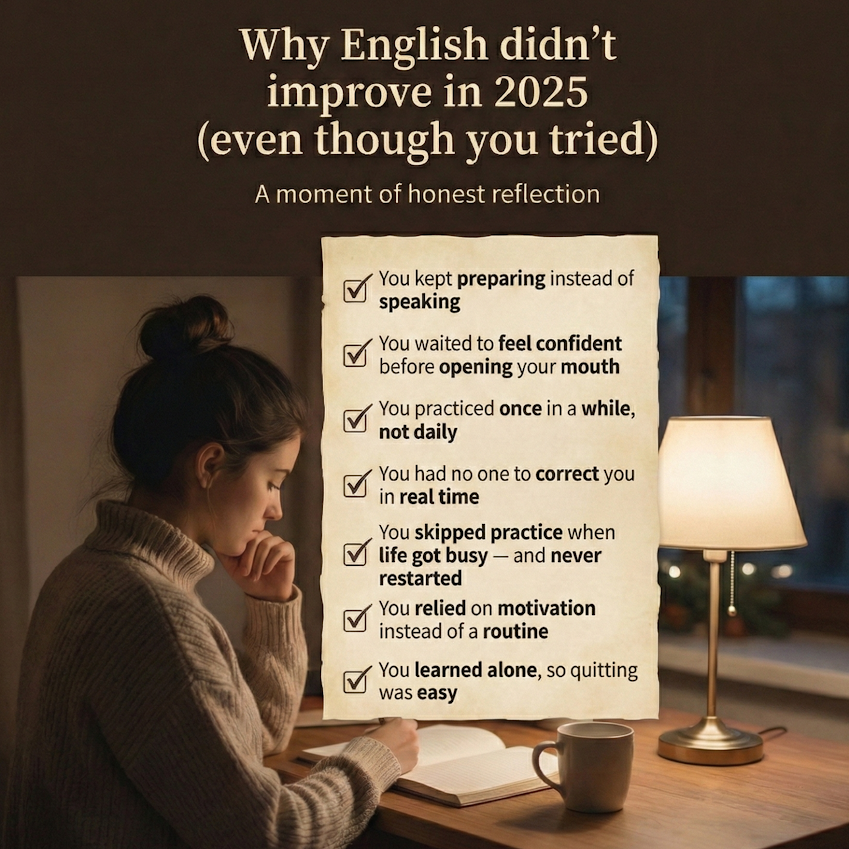
The image above captures that exact moment.
A quiet evening. A notebook open. A mind full of effort — and frustration.

This blog is not about blaming you.
It’s about understanding why effort didn’t convert into confidence.

Many learners want to speak English confidently, but end up stuck in the same cycle year after year. They understand English, can read it well, and even write decently — yet speaking still feels difficult. This gap between knowing English and speaking it confidently is what frustrates most learners.

The Truth Most Learners Don’t Hear

To speak English confidently, you don’t need more rules or more content. You need repeated exposure to real conversations where you can speak freely, make mistakes, and continue without fear.

Most learners struggle not because they lack intelligence, but because they never get enough chances to actually use English in real life.

English doesn’t improve just because you want it to.
It improves when the right habits replace the wrong ones.

Most learners repeat the same patterns year after year — not because they are lazy, but because no one shows them a better system.

Let’s walk through those patterns honestly.

You Kept Preparing Instead of Speaking

Preparation feels safe.

You can learn silently.
You can pause, rewind, and retry.
No one hears your mistakes.

So you kept preparing.

But here’s the uncomfortable truth:

Preparation without speaking is procrastination in disguise.

English is not absorbed like information.
It’s built like a muscle.

Until your mouth starts moving, improvement stays theoretical.

You Waited to Feel Confident Before Opening Your Mouth

Many learners believe confidence is a prerequisite.

“I’ll speak when I’m confident.”
“I just need a little more clarity.”
“I’m not ready yet.”

But confidence is not a starting point.
It’s a side effect.

Confidence comes after:

  • Saying things wrong

  • Getting corrected

  • Surviving awkward pauses

  • Realising nothing bad happened

Every confident English speaker you admire once spoke badly — repeatedly.

You Practiced Occasionally, Not Consistently

Some weeks you practiced seriously.
Other weeks disappeared into work, family, stress, or exams.

And then English quietly slipped down your priority list.

The problem isn’t missing a day.
The problem is not returning.

English rewards consistency, not intensity.

Ten minutes every day beats two hours once a week — every single time.

You Had No One to Correct You in Real Time

Learning alone creates blind spots.

You may:

  • Repeat the same mistake for months

  • Think your sentence is correct when it isn’t

  • Lose confidence because you’re unsure

Without real-time correction, your brain doesn’t know what to fix.

This is why many learners feel stuck despite “studying” for years.

You Skipped Practice When Life Got Busy — and Never Restarted

Life doesn’t pause for learning.

Deadlines come.
Health issues arise.
Responsibilities pile up.

So practice stops — temporarily.

But without a system, temporary breaks turn into permanent gaps.

English doesn’t disappear — but confidence does.

You Relied on Motivation Instead of a Routine

Motivation is emotional.
Routines are structural.

Motivation says, “I feel like practicing today.”
Routines say, “This is what I do daily.”

English improves when practice becomes as normal as brushing your teeth — not when you’re “in the mood.”

You Learned Alone — So Quitting Was Easy

When no one expects you, stopping feels harmless.

No accountability.
No reminder.
No sense of progress being watched.

Learning alone makes quitting invisible — until months later, when regret shows up.

This Is Not a Failure. It’s a Pattern.

And patterns can be changed.

Learners who finally speak English confidently don’t suddenly become smarter.
They simply change how they practice.

They speak first.
They practice daily.
They get corrected kindly.
They don’t do it alone.

How the EngVarta App Helps You Break This Pattern

EngVarta is designed for learners who want to speak English confidently in real-life situations — interviews, meetings, phone calls, and daily conversations.

EngVarta was created specifically for learners stuck in this exact loop.

Not beginners who don’t know English —
but learners who know English yet struggle to speak confidently.

Here’s how EngVarta directly solves the problems mentioned above:

1. It Forces You to Speak, Not Prepare

EngVarta connects you with real English experts for one-on-one live conversations.
You speak from day one — no waiting, no overthinking.

2. Confidence Comes Through Action

You don’t wait to “feel confident.”
Confidence builds naturally as you speak daily in a safe, supportive environment.

3. Daily Practice Becomes a Habit

Sessions are short and practical, designed for busy lives.
This removes the excuse of “no time” and builds consistency.

4. Real-Time, Friendly Corrections

Experts correct you gently while you speak — helping you improve without embarrassment or interruption.

5. You’re No Longer Learning Alone

Someone listens to you.
Responds to you.
Guides you.

That simple human connection changes everything.

If 2025 Felt Like a Loop, 2026 Can Be a Turning Point

English didn’t fail you.
Your effort didn’t go waste.

It just needed a better system.

One that replaces:

  • Preparation with practice

  • Motivation with routine

  • Isolation with guidance

Start Speaking — Not Someday, Today

👉 Download the EngVarta App:
Download for Android | Download for iOS

Speak daily.
Get corrected.
Build confidence through real conversations.

Stay Connected With EngVarta

Final Thought

Learning English is not the goal.
Being able to speak English confidently — without fear, hesitation, or overthinking — is.

And that confidence is built one real conversation at a time.

Frequently Asked Questions (FAQs)

🎇 Exciting EngVarta Diwali Festive Sale is Live! 🎆

Exciting EngVarta Diwali Festive Sale is Live!

Diwali — the festival of lights, positivity, and new beginnings — is here!
And so is your chance to brighten up your English-speaking journey with EngVarta’s Diwali Festive Sale, now live on the app! ✨

This Diwali, let your confidence sparkle as much as the diyas around you. Whether you dream of speaking fluently at work, during interviews, or in everyday conversations — EngVarta is here to make that dream come true.

 🌟 What is EngVarta?

EngVarta is a live English-speaking practice app that helps you improve your fluency by connecting you with English experts over one-on-one calls.
It’s not just an app — it’s your daily English-speaking partner.

Here’s what makes EngVarta truly special:

  • 💬 Practice Real Conversations: Speak with experts who guide you just like friends — no judgment, only support.

  • 🧠 Personalized Feedback: Get tips on pronunciation, grammar, and natural expression.

  • 🎯 Goal-Based Learning: Choose your path — job interviews, confidence building, or daily conversation.

  • 🏆 Fun New Features: Enjoy daily quizzes, vocabulary lessons, and earn exciting rewards as you practice.

💥 What’s in the Diwali Festive Sale?

This festive season, EngVarta brings a special surprise for all learners!
You’ll find exclusive festive offers inside the app that make it easier than ever to begin your English fluency journey.

It’s the perfect time to gift yourself something meaningful — the confidence to speak English naturally and fearlessly.

But hurry — these festive offers are available for a limited time only!

📲 How to Get the Offer

  1. Download the EngVarta app from the links below.

  2. Sign up or log in to your account.

  3. Explore EngVarta plans that fit your practice goals — and this Diwali, give yourself the gift of confidence by choosing the plan that helps you speak more and shine brighter every day.

  4. Start your English-speaking journey with expert guidance today!

👉 Download EngVarta on the Play Store
👉 Download EngVarta on the App Store

🌠 Final Thoughts

Diwali is a reminder that even the smallest spark can light up the darkest room — and sometimes, all you need is a little push to start something amazing.

Let this Diwali be that start. Speak up, practice daily, and watch your English — and confidence — glow brighter than ever.

Light up your journey with EngVarta.

How to Improve Your English Communication Skills?

How to Improve Your English Communication Skills?

English has become the language of opportunity. From job interviews and presentations to travelling abroad or simply making friends, strong English communication skills can shape your future in ways you can’t imagine.

But here’s the secret: becoming fluent in English isn’t about memorising grammar rules or learning hundreds of words at once. It’s about practicing consistently, building confidence, and learning how to express yourself naturally.

In this blog, we’ll explore practical steps to improve your English communication skills, and also see how the EngVarta App can be your partner in this journey.

1. Practice Every Day, Even if It’s Just 10 Minutes

Consistency matters more than intensity. Instead of waiting for the “right time,” start small. Talk about your day in English, describe what you see around you, or practice speaking in front of a mirror for 10 minutes daily.

2. Listen More Than You Speak

Fluent speakers are also good listeners. Watch English movies, listen to podcasts, or follow TED Talks. This helps you absorb correct pronunciation, sentence patterns, and natural expressions.

3. Think in English Instead of Translating

One of the biggest obstacles learners face is thinking in their native language and then translating into English. This slows you down and makes you nervous. Train your mind to think directly in English.

👉 You can read this blog on How to Stop Translating in Your Head While Speaking English

This article will guide you with techniques to break free from the translation trap.

4. Expand Your Vocabulary in Context

Instead of cramming 20 new words daily, focus on learning 2–3 words and using them in sentences. For example, if you learn the word “versatile,” try saying: “This jacket is versatile; I can wear it to work or on a trip.” Using words in real life makes them stick.

5. Practice With Real People

Reading and listening are great, but speaking with real people is the ultimate game-changer. You need feedback, correction, and the confidence that comes from real conversations.

How the EngVarta App Can Help You

This is where EngVarta comes in. It’s not just another English learning app—it’s a practice platform where you connect with live English experts over phone calls.

Here’s how EngVarta helps you improve faster:

  • 🗣 Daily conversation practice with experts, just like talking to a friend.

  • Personalized feedback on grammar, pronunciation, and fluency.

  • 💡 Practical topics like interviews, meetings, and presentations.

  • 📈 Progress tracking to see how far you’ve come.

If you want to transform your English from hesitant to confident, EngVarta provides the safe, judgment-free space you need.

👉 Download the EngVarta App now:

Final Thoughts

Improving your English communication skills is a journey, not a race. With daily practice, mindful listening, and the right guidance, you can achieve fluency and confidence.

Remember: you don’t have to be perfect to start speaking—you have to start speaking to become perfect.

So why wait? Take your first step today with EngVarta, and let every conversation bring you closer to the confident speaker you want to be.

Connect With EngVarta

Stay updated and keep learning with us:


Frequently Asked Questions (FAQs)

The 5 Best English-Speaking Practice Apps for 2025

The 5 Best English-Speaking Practice Apps for 2025

Speaking English fluently is no longer a luxury. In today’s world, it’s a necessity for growth, confidence, and connection. Whether you want to communicate effectively at work, crack the IELTS exam, travel confidently, or simply hold conversations without hesitation, these Best English-Speaking Practice Apps in 2025 will help you achieve your goals.

In the past, learning English meant joining a coaching centre or memorising grammar rules. But the world has changed. Now, with your phone in hand, you can practise anytime, anywhere. You can speak with experts, receive instant AI feedback, and build confidence gradually. The beauty of these apps is that they make practice accessible and non-judgmental, which is exactly what every learner needs.

Speak English Confidently with the Right App

Choose from these Best English-Speaking Practice Apps that align with your fluency goals and start your journey today.

Why choose an English-Speaking Practice App?

Because spoken English is not learnt by reading alone. It is mastered by speaking, listening, making mistakes, and correcting them in real time. These apps recreate real-life situations, remove your fear of judgment, and give you structured practice to build fluency naturally.

1. EngVarta

If you often feel hesitant while speaking English despite knowing vocabulary and grammar, EngVarta can be your game changer. This app connects you with live English experts anytime between morning and midnight, allowing you to practise real conversations daily. Each call is like speaking with a supportive mentor who corrects your mistakes gently and guides you towards improvement.

Unlike typical English learning apps that focus on theory, EngVarta immerses you in spoken English practice so you start thinking in English without translating from your native language. Over time, your fear of making mistakes fades because you realise English is not about perfection – it’s about expressing yourself confidently.

Why we recommend it:
EngVarta ranks among the Best English-Speaking Practice Apps in India because it focuses on real-life spoken English, building your confidence to speak naturally at work, interviews, or social situations without feeling nervous.

🔗 Download EngVarta:
Download for Android | Download for iOS

EngVarta

2. FixoLang

Preparing for IELTS speaking is stressful for most learners, but FixoLang makes it structured and goal-oriented. It simulates the actual IELTS speaking test environment by giving you cue card topics, preparation time, and recording your answers under realistic time limits.

The AI then evaluates your responses instantly across fluency, coherence, vocabulary, and pronunciation, providing you with a predicted band score. This detailed feedback pinpoints your weaknesses and helps you improve systematically before your actual test day.

Why we recommend it:
FixoLang stands out as one of the Best English-Speaking Practice Apps for IELTS aspirants who want realistic practice, targeted feedback, and confidence to perform well on exam day.

🔗 Download FixoLang:
Download for Android | Download for iOS

3. BoldVoice

Pronunciation is often overlooked, yet it plays a critical role in being understood clearly. BoldVoice addresses this by offering pronunciation and accent training with Hollywood accent coaches. The lessons cover not only sounds but also stress patterns and intonation, making your English sound natural and confident.

You can record your speech and receive AI-powered feedback instantly, correcting errors before they become habits. The app uses IPA transcriptions and mouth diagrams to guide you precisely, which is incredibly helpful for tricky sounds.

4. HelloTalk

Learning English is also about understanding cultural contexts, idioms, and everyday slang. HelloTalk brings this experience alive by connecting you with native speakers worldwide. You can chat, send voice notes, or make video calls, teaching them your language while they teach you English.

While the app doesn’t provide structured lessons like others, it offers authentic, real-life conversations that enrich your spoken English and cultural understanding. You learn how English is actually spoken in daily life, not just how it’s written in textbooks.

5. Promova

If you’re a beginner looking to build confidence gradually or someone wanting quick daily lessons to keep English fresh, Promova is a practical choice. It offers bite-sized lessons covering daily conversation topics like travel, shopping, introductions, and small talk.

Its user-friendly design, realistic dialogues, and contextual vocabulary make learning engaging rather than overwhelming. For working professionals or students with tight schedules, Promova ensures you stay consistent with short, actionable lessons daily.

Speak English Confidently with the Right App

Fluency is not built overnight. It is built with consistent practice, exposure to real conversations, instant feedback, and gradual confidence. These Best English-Speaking Practice Apps for 2025 give you exactly that – a safe, structured, and effective path to become a fluent English speaker.

Whether your goal is to ace IELTS, speak confidently in meetings, build an international accent, or hold casual conversations fluently, these apps make it achievable. Among them, EngVarta and FixoLang stand out for building practical fluency and targeted IELTS speaking skills, while BoldVoice, HelloTalk, and Promova complement your journey with pronunciation mastery, cultural immersion, and vocabulary building.

Ready to start your journey?

Practice today with these Best English-Speaking Practice Apps and transform your hesitation into fluent, confident expression in every sphere of life.

Frequently Asked Questions

How To Talk With A Fellow Teacher On Your First Day Of School?

How To Talk With A Fellow Teacher On Your First Day Of School?
  • Teachers are an integral part of our life, at various stages of one’s life the role of a teacher or a mentor is unquestionable. Taking the responsibility of a teacher is not a child’s play, the future of many lives is in your hands.
  • Therefore, we salute all teachers and send across warm wishes and hugs along with congratulations to all the young teachers out there, who are stepping in the world of education providers.
  • We understand your nervousness for your first day as a teacher and you need to make a good impression not just for students, but also for your fellow teachers thus we offer our services to make this day as memorable as possible.

During your teaching career, you will get an opportunity to meet many teachers who will teach you something new and sometimes you’ll teach them. And its foundation will begin right from your first day when you will meet your fellow teachers and talk to them.
Don’t spoil this opportunity of making an impression just because you are nervous or aren’t confident.

Let us all take you through some basic communication tips for your first day at school.

1. Greet everyone well

Well, this is “the basic etiquette” to follow each day, every day with everyone. When you go to the Staff room or you are introduced to fellow teachers, then you should say Good Morning or hello with a smile.

Making a firm handshake is often taken as a sign of confidence. So, when you are meeting someone individually, then tell your name while shaking hands with them. Please note that if someone has already introduced you, do not repeat your name, just say hello and ask how you are?

Most importantly, always keep a smile on your face and make an eye contact while greeting them. Making an eye contact while conversation demonstrates your confidence and builds a little trust level.

2. Conversation starters

Mostly, the other teacher will start the conversation first out of curiosity. They will be interested in knowing about your college, your education, how are you feeling, how did you find the school, etc. Pre-prepare the answer to such questions beforehand so that you can answer them confidently.
Keep your answers brief, not too small and not too long either.

Let’s just say they do not start the conversation first and it comes up to you, pre – prepare what you can ask as well to avoid awkward silences. Your questions can start from how they are doing? As you haven’t already asked that.

Next, ask them about the class, subject they teach, how long they have been teaching and all. Make sure to include some questions related to attendance sheet, coursework, school rules, etc. while you are at it, as this will reflect your sincerity towards your job.

Now take care of two things here –

Firstly, do not ask any personal questions like their marital status or kids etc.. Or school related questions like how’s the school or does the salary come on time or not, as these questions might make the other person uncomfortable.
Secondly, do listen carefully when someone is answering your questions. For one, you will get new questions to ask. For example, if they say that they have studied in Punjab, you can always quote the obvious question about the food of Punjab.

On the other hand, you can easily predict whether the person in front of you have any interest in talking to you or not. If he doesn’t respond properly or not interrogating you for anything, then you should be silent.

3. Show your nervousness

Not just this helps making you a better impression, but arriving early allows you to reign in your anxiety and prepare yourself for the interview. No one wants to see a sweaty person walking in and apologizing for the delay.
Arriving on time also reflects upon your commitment for the job. Please note before time means 15 – 20 minutes before the scheduled time. No one would appreciate you for sitting on the office stairs waiting for them while the office is still getting cleaned.

For Regular English Practice with Expert: Download EngVarta Mobile App

playstoreitune


Top 5 Best English Speaking Courses in India (2025 Edition)

Top 5 Best English Speaking Courses in India (2025 Edition)

If you’re reading this, chances are you’re serious about improving your English speaking skills in 2025. Maybe you’re preparing for a job interview, aiming to study abroad, or simply tired of losing confidence in conversations. Whatever your reason, you’re not alone.

English remains the language of opportunity in India — from career growth to cracking competitive exams, from global travel to day-to-day confidence. In fact, according to recent surveys, over 85% of Indian professionals believe English fluency is directly linked to better career growth.

But here’s the challenge: with so many apps, institutes, and courses out there, which one actually works?

This guide covers the Top 5 Best English Speaking Courses in India (2025 Edition), with a close look at their pros, cons, pricing, and most importantly — who each course is best suited for.

Quick Comparison Table: Best English Speaking Courses in India (2025)

Platform Best For Mode Pricing Key Features
EngVarta Daily 1-on-1 speaking practice Mobile App Affordable, monthly plans Live calls with Indian experts, real-time correction
SpeakIn Corporate communication skills Website + App Premium, corporate plans Industry professionals, soft skills training
Cambly Speaking with native tutors Website + App Higher-end Native speakers, IELTS prep, flexible timings
British Council Structured courses + certification Online + Centres Moderate to high Grammar, business English, certifications
Duolingo Fun, gamified learning for beginners App + Website Free (paid upgrade) Gamified lessons, vocabulary building

1. EngVarta – Best for One-on-One Speaking Practice with Experts

If you want to speak English fluently, you need to practice it, not just study grammar books. That’s where EngVarta shines.

EngVarta connects you with live English experts over phone calls. No video, no judgment — just natural conversations designed for Indian learners. The goal is not memorization, but building fluency and confidence through consistent speaking practice.

Why EngVarta stands out:

  • Personalized 1-on-1 live sessions — no group classes

  • Speak anytime, anywhere — no scheduling hassles

  • Designed especially for Indian learners by Indian experts

  • Real-time corrections + instant feedback

  • Builds fluency as a daily speaking habit

Who it’s for: Students, working professionals, homemakers, or anyone who wants daily spoken English practice.

👉 Download EngVarta App on Google Play | Download on iOS

2. SpeakIn – Best for Learning from Industry Professionals

SpeakIn helps learners strengthen corporate communication skills by connecting them with industry professionals.

Why it stands out:

  • Focus on workplace communication and presentations

  • Real trainers from top industries

  • Adds soft skills + English improvement together

Who it’s for: Working professionals, team leads, and job seekers preparing for interviews or leadership roles.

3. Cambly – Best for Native Speaker Practice

Cambly allows learners to interact with native English tutors worldwide. It’s especially useful for those preparing for IELTS Speaking or planning to move abroad.

Why it stands out:

  • Native tutors with global accents

  • Great for IELTS prep and fluency

  • Flexible schedules

Who it’s for: Intermediate to advanced learners who want international exposure.

4. British Council – Best for Structured Courses & Certification

A globally trusted name, the British Council is ideal for learners who prefer a structured curriculum.

Why it stands out:

  • Reputed institution with credibility

  • Covers grammar, writing, business communication

  • Offers certifications recognized worldwide

Who it’s for: Students and professionals who want structured, academic-style learning with recognized certificates.

5. Duolingo – Best for Beginners Who Like Fun Learning

Duolingo is perfect for absolute beginners who want to make English practice a daily habit through gamified lessons.

Why it stands out:

  • Fun and engaging gamification

  • Daily streaks and rewards for consistency

  • Free with paid upgrade option

Who it’s for: School students, hobby learners, or beginners.

What About Location-Based Learning?

If you’re in Delhi, Mumbai, or Bangalore, you’ll find many local coaching institutes. However, most city-based spoken English classes still focus heavily on theory. Apps like EngVarta or Cambly are better if you want practice without commuting, while British Council has physical centres in major metros for those who prefer classroom learning.

Final Thoughts

There’s no one-size-fits-all when it comes to English-speaking courses in India. Some learners prefer structured programs with certifications, while others want flexibility and daily speaking practice.

If your goal is to speak English fluently and confidently in real life, ⭐ EngVarta is the standout option in 2025. Unlike rigid courses or gamified apps, it offers consistent speaking practice with real experts, anytime, anywhere.

Your fluency journey doesn’t need to wait.
👉 Start practicing with EngVarta today

Frequently Asked Questions (FAQ’s)

How to Overcome Fear of Speaking English and Sound Natural

How to Overcome Fear of Speaking English and Sound Natural

“I just forget everything I want to say…”
“What if they judge my English?”
“My hands start shaking the moment I open my mouth.”

If you’ve ever felt this way before a conversation — whether it’s a job interview, a team meeting, or even just introducing yourself in English — you’re not alone.

Most of us were taught how to read and write English in school. But no one really showed us how to overcome fear of speaking or how to own our voice in a room full of people. No one taught us how to feel comfortable in our skin while speaking.

So let’s change that.

This blog isn’t about grammar rules or perfect pronunciation. It’s about what you can do — practically, mentally, emotionally — to overcome fear of speaking and go from feeling nervous to sounding natural in any conversation.

1. Flip the Fear: “They’re Not Better Than Me”

Let’s start with a mindset shift.

Most nervousness comes from one thought:

“They speak better than me. What if I mess up?”

But here’s the truth: People aren’t focused on your mistakes. They’re focused on themselves.
They’re thinking about what to say next, how they sound, or how they look.

So instead of thinking “I hope I don’t mess up,” tell yourself:

“I’m here to connect, not to impress.”

You’re not on stage. You’re in a conversation. That shift alone takes off so much pressure and helps you slowly overcome fear of speaking by focusing on connection instead of performance.

2. Learn the Power of Pauses

You don’t have to speak fast to sound fluent.

When you’re nervous, you tend to rush. Words tumble out, you lose your train of thought, and then… panic.

Here’s what confident speakers do differently:

  • They pause.

  • They breathe.

  • They give their brain a second to catch up.

Try this:
Before you respond to someone, take a 1-second pause.
It feels long in your head. But to others? It looks confident and thoughtful.

This simple trick gives your brain space and trains you to stay calm — a powerful way to overcome fear of speaking in the moment.

3. Practice with Real People, Not Just Books

You don’t learn to swim by reading about it.
You get in the water.

Speaking English is the same. You’ll never feel “ready enough” by just watching videos or reading blogs (even this one!).

The real breakthrough comes when you:

  • Speak out loud every day — even to yourself.

  • Talk to someone who listens, corrects you, and supports you.

  • Repeat real conversations until your mouth stops feeling stiff.

That’s exactly why thousands of learners use EngVarta — where you can speak to English experts on phone calls every day. No pressure, no awkward silences. Just real improvement.

It’s not about perfect grammar — it’s about practicing consistently until you overcome the fear of speaking and replace it with real confidence.

4. Use the Mirror Trick

One of the fastest ways to feel natural in conversations?

Talk to your mirror every morning.
Yes, seriously.

Look yourself in the eye and speak for 2 minutes on any topic — your day, your goals, or even what you ate for breakfast.

Why it works:

  • It desensitizes you to the fear of speaking.

  • You become more aware of your tone and expressions.

  • You stop sounding robotic and start sounding real.

Do this daily, and you’ll notice your brain doesn’t freeze up in conversations anymore.

And if public speaking makes your hands sweat and your voice tremble, you’re not alone. The fear is real — but it can be overcome.

To go deeper into how to overcome fear of speaking in front of an audience and build lasting confidence, check out this detailed guide:
👉 Public Speaking: Overcoming Fear and Building Confidence

Combine those strategies with daily mirror practice, and you’ll start noticing how natural you begin to sound — not just in front of the mirror, but in real conversations too.

5. Prepare Phrases, Not Paragraphs

Most people try to memorize long responses for situations, but real conversations are never that predictable.

Instead, prepare flexible, everyday phrases that you can use in different contexts. Like:

  • “That’s a great question. Let me think…”

  • “I’ve never tried that before, but it sounds interesting.”

  • “Can you repeat that a little slower, please?”

These phrases become your safety net — they buy you time and make you sound fluent, even when you’re thinking. And with time, you’ll naturally overcome fear of speaking by being better prepared for real-world situations.

Final Thoughts: Confidence Comes From Reps, Not Perfection

There’s no shortcut.
The only way to stop feeling nervous is to walk through it, one sentence at a time.

But the more you speak, the less scared you feel. The more you show up — even imperfectly — the more natural it becomes.

Start small. Start today.

Because every confident English speaker you admire?
They were once nervous too.

🚀 Want to Practice Speaking Daily with English Experts?

If you’re serious about transforming your spoken English, try EngVarta — the app where you can talk to live English experts on calls, practice real conversations, and build confidence from day one.

📱 Follow us on Instagram: https://www.instagram.com/engvarta.app
👍 Like our Facebook page: https://www.facebook.com/EngVarta
📺 Watch helpful videos on YouTube: https://www.youtube.com/@EngVarta

Best Fluent English Practice App to Boost Your Speaking Skills

Best Fluent English Practice App to Boost Your Speaking Skills

You’ve studied grammar.
Watched English movies.
Even tried repeating dialogues from a web series.

But when it’s time to speak?
You pause. You doubt. You stay quiet.

The missing link?
Not more studying — but real, consistent speaking practice.

That’s where a Fluent English Practice App can be a game-changer.
It gives you the space to speak, make mistakes, and improve — all from your phone.

Let’s look at the top apps that are helping learners become fluent, confident speakers.

1. EngVarta – Top Pick for Indian Learners

EngVarta gives you the most natural way to improve spoken English — by actually speaking with live experts over phone calls. It’s not a course or a class — it’s real-time conversation, correction, and confidence-building.

No rigid lessons. No fear of judgement. Just meaningful practice that helps you grow every day.

Why EngVarta is the Most Practical Fluent English Practice App:
Real Conversations: Talk about your day, work, or interviews — and get guided corrections.
Anytime Practice: Morning, evening, or during a tea break — speak when it suits you.
Supportive Experts: Learn in a no-pressure space where mistakes are part of growth.
Made for Indian Learners: Designed with your challenges and goals in mind.

Pros:

  • Trained English experts

  • Focused on real fluency, not just theory

  • 100% refundable trial available

Cons:

  • Not free (but offers great value for the price)

🌟 EngVarta is the Fluent English Practice App that turns shy learners into confident speakers — one call at a time.

📲 Start Your Practice Now:

🔗 Stay Connected with EngVarta:

📸 Instagramhttps://www.instagram.com/engvarta.app
📘 Facebookhttps://www.facebook.com/engvarta
▶️ YouTubehttps://www.youtube.com/@EngVarta

2. ElsA Speak

Best for: Pronunciation and fluency using AI

ElsA Speak is an AI-powered Fluent English Practice App that gives instant feedback on your pronunciation and speaking pace. If you want to sound clear and confident, this app is a good start.

Pros:

  • Smart AI corrections

  • Intonation training

  • Voice scoring system

Cons:

  • No live interaction

  • Lacks real conversation practice

3. Cambly

Best for: Practicing with native English tutors

Cambly connects you with native English speakers through live video calls. It’s ideal if you want to improve your accent, prepare for IELTS, or have professional conversations with people from around the world.

Pros:

  • Native tutors from US/UK

  • Flexible timings

  • Customized sessions for job interviews, travel, and business English

Cons:

  • Premium pricing

  • Not ideal for total beginners

4. HelloTalk

Best for: Casual language exchange with people worldwide

This app is more like a social platform for language learners. You connect with real users who want to learn your language, while they help you with English.

Pros:

  • Free and community-driven

  • Speak with users across the globe

  • Multiple chat options (text, voice, call)

Cons:

  • No structured lessons

  • May lack focus on speaking fluency

5. Duolingo (Speaking Mode)

Best for: Beginners starting with speaking practice

Duolingo now includes speaking tasks in its gamified learning journey. While it’s not a complete Fluent English Practice App, it’s great for developing the habit of speaking daily.

Pros:

  • Fun and addictive

  • Encourages consistency

  • Covers the basics of speaking

Cons:

  • Limited depth

  • No expert feedback

🧭Final Recommendation: Which App Should You Pick?

Here’s a quick summary based on your fluency goal:

Goal Recommended App
Talk to natives Cambly
Fix your pronunciation ElsA Speak
Practice fluency in real time EngVarta
Social language exchange HelloTalk
Beginner speaking habit Duolingo

But if you want a Fluent English Practice App that gives you:

✅ Real conversations
✅ Supportive experts
✅ Progress you can feel

👉 Then EngVarta is your go-to app.

🚀 Ready to Start Speaking Fluently?

📲 Download EngVarta today
💬 Speak to a live English expert
🎯 Practice daily. Grow naturally.

Because fluency isn’t taught — it’s practiced.

And the right Fluent English Practice App can take you from knowing English… to living it.

Use EngVarta & Learn How to Use Would, Could, and Should in English

Use EngVarta & Learn How to Use Would, Could, and Should in English

Ever feel confused about when to use would, could, and should in English? You’re not alone! These little words can be tricky, but once you understand how they work, you’ll sound more fluent and confident. Let’s break them down together with simple rules and everyday examples.

What Are Modal Verbs?

Modal verbs are special helper verbs that add meaning to the main verb. They show things like possibility, ability, or advice. The stars of today’s lesson—would, could, and should—are three of the most popular ones!

When to Use Would

Use would to talk about:

  • Polite requests: Would you help me, please?
  • Imaginary or unreal situations: I would go to Paris if I had the money.
  • Future in the past: He said he would call me.
  • Wishes and desires: I would love a slice of cake.

👉 Quick Tip: Think of would as a softer, more polite version of will.

When to Use Could

Use could for:

  • Past ability: She could read when she was three!
  • Polite requests: Could you please pass the salt?
  • Possibility: It could snow tomorrow.
  • Suggestions: You could try restarting your phone.

👉 Quick Tip: Could is like a more polite or uncertain form of can.

When to Use Should

Use should when giving advice, opinions, or talking about what’s right:

  • Advice: You should drink more water.
  • Expectation: She should be here by now.
  • Moral obligation: People should be kind.
  • Suggestions: Should we go out for lunch?

👉 Quick Tip: Should is a gentle way of saying something is the right thing to do.

Final Thoughts

Learning how to use would, could, and should doesn’t have to be hard. Keep practicing with real sentences, and you’ll start using them naturally. They may be small words, but they make a big difference in your English!

Learn and Practice More with EngVarta

Want to improve your spoken English with live practice? Try the EngVarta, where you can talk to live English experts any time!

👉EngVarta YouTube Channel: https://www.youtube.com/@EngVarta

👉 Follow EngVarta on Instagram: https://www.instagram.com/engvarta