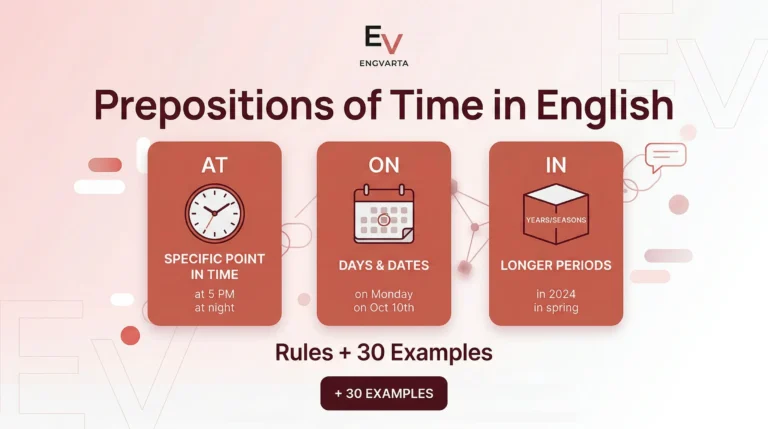
Prepositions of time in English — at, on, and in — follow clear rules once you know the pattern. Use AT for specific times (at 5 PM, at noon). Use ON for specific days and dates (on Monday, on March 15). Use IN for longer periods—months, years, seasons, and parts of the day (in July, in 2026, in the morning). If you’ve ever paused mid-sentence wondering whether to say “at night” or “in night,” this guide will fix that forever.
This guide on prepositions of time in English includes three simple rules, 30+ real-life examples, and common mistakes Indian speakers make (with corrections).
For deeper grammar practice, you may also like our guide on A, An, The — English articles rules and Will, Shall, and Going To for future tense.
Table of Contents [show]
The 3 Rules Simplified: AT, ON, IN for Time
Think of the three prepositions as a zoom lens. AT is the most zoomed in — a precise point in time. ON zooms out slightly to a whole day or date. IN is the widest view — months, years, seasons, and parts of the day.
Use AT for:
- Specific clock times — at 5 PM, at 8:15
- Specific moments of the day — at noon, at midnight, at sunrise, at sunset, at dawn, at dusk, at night
- Festivals and holidays — at Diwali, at Christmas, at Eid, at Easter
- Mealtimes — at lunchtime, at breakfast, at dinner
- The weekend (British English) — at the weekend
- Specific points — at the beginning, at the end, at the moment
Use ON for:
- Days of the week — on Monday, on Friday
- Specific dates — on March 15, on June 10, on the 5th of May
- Specific days with adjectives — on a rainy day, on a cold morning
- Named days — on my birthday, on New Year’s Day, on Independence Day
- Weekends (American English) — on the weekend
Use IN for:
- Months — in July, in December
- Years — in 2026, in 1995
- Decades and centuries — in the 1990s, in the 21st century
- Seasons — in summer, in winter, in monsoon
- Parts of the day — in the morning, in the afternoon, in the evening (but NOT “in the night” — use at night)
- Future time periods — in an hour, in two weeks, in ten years
Prepositions of Time in English: Quick Comparison (At vs On vs In)
| Preposition | Used For | Example |
|---|---|---|
| AT | Clock times, precise moments, festivals, mealtimes | at 7 PM, at noon, at Diwali |
| ON | Days, dates, named days | on Monday, on March 15, on my birthday |
| IN | Months, years, seasons, parts of day | in July, in 2026, in the morning |
30+ Example Sentences: AT, ON, IN in Real Conversations
Here are 30+ example sentences organized by preposition. Read each one out loud to train your ear for the natural pattern.
10 Examples with AT (specific times and moments)
- Let’s meet at 7 PM outside the café.
- The meeting starts at noon sharp.
- I wake up at dawn for my morning walk.
- We exchange gifts at Christmas every year.
- The Mumbai express arrives at 8:15.
- Call me at midnight — I’ll be awake.
- At the moment, I’m busy preparing for an exam.
- I’ll see you at lunchtime.
- The show starts at 9 o’clock.
- At the beginning of the class, we review last week’s lesson.
10 Examples with ON (days and dates)
- The meeting is on Monday at 11 AM.
- She was born on March 15, 1990.
- I usually relax on weekends.
- We met on a rainy day in June.
- On my birthday, we went to a nice restaurant.
- On New Year’s Eve, we celebrate with family.
- I don’t work on Sundays.
- On that day, everything changed for our team.
- The flight to London is on June 10.
- On weekdays, I wake up early to hit the gym.
10 Examples with IN (months, years, seasons, parts of day)
- I was born in 1995.
- School starts in September after the summer break.
- In summer, we go to the hills to escape the heat.
- In the morning, I drink coffee before checking emails.
- In the 21st century, technology rules our lives.
- In India, festivals are a big part of daily life.
- Will you finish the report in an hour?
- In the future, AI will change how we learn English.
- She got married in 2020 during the lockdown.
- In winter, the days are shorter and colder.
Common Mistakes Indian Speakers Make (with Corrections)
Here are the most frequent mistakes Indian English speakers make with time prepositions — and how to fix them instantly.
- Wrong: I sleep in the night. Right: I sleep at night. (Always “at night” — never “in the night.”)
- Wrong: I’ll see you in Monday. Right: I’ll see you on Monday. (Days always take “on.”)
- Wrong: She was born on July. Right: She was born in July. (Months always take “in.”)
- Wrong: We met at 15th March. Right: We met on 15th March. (Dates take “on.”)
- Wrong: I’ll call you in 5 PM. Right: I’ll call you at 5 PM. (Clock times take “at.”)
- Wrong: In Diwali, we light lamps. Right: At Diwali, we light lamps. (Festivals take “at.”)
- Wrong: I was born on 1995. Right: I was born in 1995. (Years take “in.”)
Quick Cheat Sheet
- AT → clock times, precise moments, festivals, night, mealtimes
- ON → days of the week, dates, named days (birthday, anniversary)
- IN → months, years, seasons, centuries, parts of the day (morning/afternoon/evening)
- Remember the exception: at night, NOT “in the night”
- Remember: at the weekend (UK) vs on the weekend (US) — both correct
Practice Makes Perfect: Speak It Out Loud
Reading rules is one thing. Actually using at, on, and in confidently in a live conversation is another. The fastest way to lock these patterns into your speech is to practise with a real person who corrects you the moment you slip up.
On EngVarta, you can speak 1-on-1 with live English experts who fix your grammar mistakes gently and help you build fluency — session by session. Plans start from ₹2,700 for 25 sessions (India) or from $45 for 25 sessions (International). See all plans and pricing here.
You’ve read the comparison. You know the numbers. The only thing left is to actually start.
Frequently Asked Questions
When do I use “at,” “on,” “in” for time?
Use at for specific clock times and precise moments (at 5 PM, at noon, at Diwali). Use on for days of the week and specific dates (on Monday, on March 15). Use in for longer periods like months, years, seasons, and parts of the day (in July, in 2026, in the morning).
Is it “in the night” or “at night”?
The correct form is at night. Although we say “in the morning,” “in the afternoon,” and “in the evening,” night is the exception and always takes “at.” Example: “I read books at night before sleeping.”
Do I use “on” or “in” for dates?
Always use on for specific dates. For example: “I was born on 15th March” or “The meeting is on June 10.” Use in only for the month or year alone — “I was born in March” or “in 1995.”
What’s the difference between “at the weekend” and “on the weekend”?
Both are correct — it’s a regional preference. British English uses at the weekend (e.g., “I relax at the weekend”), while American English uses on the weekend (e.g., “I relax on the weekend”). Indian English tends to follow the British pattern, so “at the weekend” is perfectly natural in India.
Can I use “at” for festivals like Diwali and Holi?
Yes — festivals always take at. Examples: “We burst crackers at Diwali,” “At Holi, we play with colours,” “At Christmas, we decorate the tree.” Avoid saying “on Diwali” or “in Diwali” — both are incorrect.
Found this useful? Add EngVarta as a preferred source on Google — you’ll see more of our English lessons in your Search and AI results.