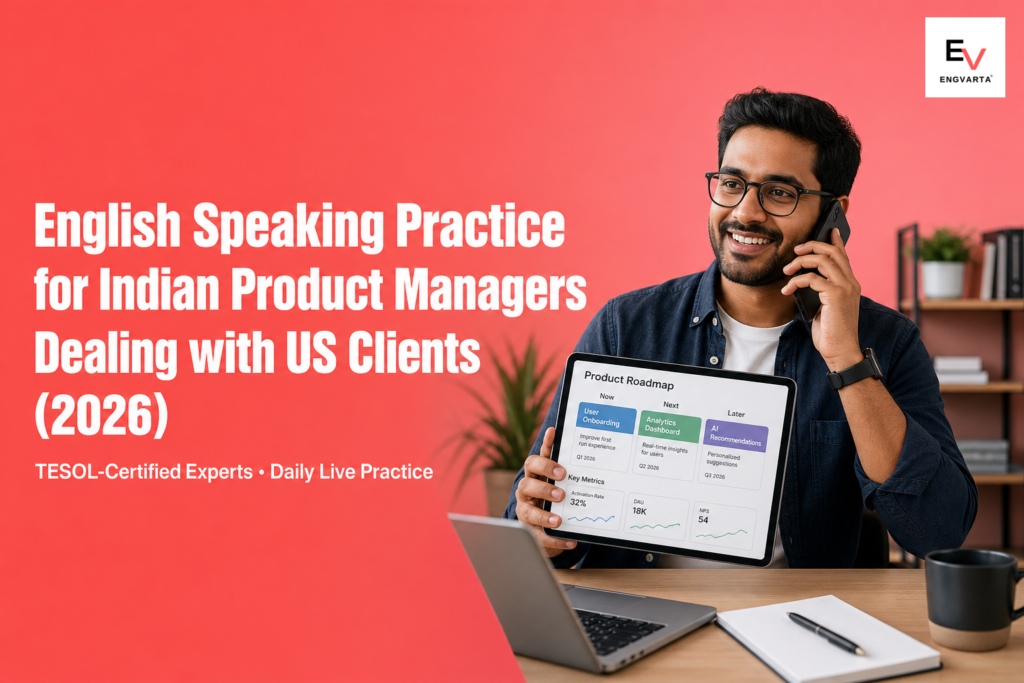
You wrote the PRD in two hours. The customer review call took two weeks to recover from. The product is sound, the research is solid, the spec is airtight — and yet, twelve minutes into a discovery call with a US-based VP of Engineering, you heard yourself say “yeah, so, basically, we are thinking” three times in a row and watched the customer’s attention drift to their second monitor.
If you are an Indian product manager at a SaaS startup, a global capability center, or an MNC product team serving US customers, this gap shows up everywhere. Your written PRDs read fluently. Your Slack messages are crisp. Your investor-deck slides are clean. But the moment the work moves from text to live conversation — a 30-minute discovery call, a 10-minute exec readout, a sprint review with a US-based engineering lead asking “”Why are we doing this instead of X?” – the polish drops.
This guide is for mid-level and senior PMs who already have the product playbook but need English speaking practice for product managers that mirrors the actual scenarios on a PM’s calendar. Not grammar drills. Not Toastmasters speeches. Customer interviews. Exec readouts. Sprint reviews. Roadmap defense. The kind of structured coaching from a certified Expert that turns the freeze into a habit of fluent, confident replies in front of a US audience.
Why spoken English for product managers is a different skill from “general English fluency”
General English fluency is about getting your message across — ordering food, making small talk, narrating your weekend. The bar is being understood. There is no clock running and no professional cost to a clumsy phrase.
Product management English has a completely different bar. Discovery interviews are 30 minutes, exec readouts are often 10, and your stakeholders are listening for signal in every sentence. A pause to find a word costs you the perception of strategic thinking. Two filler words in a single answer (“basically”, “actually”) repeated through a roadmap meeting can quietly cap your next promotion. A reactive, defensive tone when a CTO challenges your prioritization signals that the decision was not yours to begin with.
The skill stack for PM English is specific: framing open-ended discovery questions in real time, narrating a product decision under cross-functional scrutiny, defending a roadmap “no” with authority, switching register between engineer and executive audiences inside the same meeting, and holding a steady voice when a senior US-based stakeholder pushes back hard on a slide you rehearsed for a week. None of these are vocabulary problems.
6 specific English-speaking scenarios every Indian PM at a US-customer company faces
Before we get into how to practise, please identify the specific circumstances in which your English is the bottleneck. Most PMs cannot articulate this — they say “I want to improve my English for work” when what they actually mean is “I lose authority in front of US executives because my replies sound rehearsed instead of decisive.”
1. Customer interviews and discovery calls
The hardest English on a PM’s calendar is the second half of a customer discovery call, when the script runs out and you have to follow the user where their pain leads. A US customer says “we tried to solve this with a spreadsheet” and you have ten seconds to decide whether the right follow-up is “walk me through what broke first”, “how often does that come up”, or “what would have to be true for that spreadsheet to keep working.”
The fluent move is open-ended and probing. The default move under English pressure is closed-ended — “did the spreadsheet have problems?” — which gets you a yes and a dead branch. Live practice with an Expert who plays the user, gives a vague answer on purpose, and forces you to probe again is the only way to build that muscle.
2. Executive readouts — the 10-minute exec register
An exec readout is the most compressed English on the PM’s calendar. You have ten minutes — sometimes five — to summarize a quarter of work, defend a prioritization decision, surface a risk, and ask for a specific commitment. Senior US executives expect bottom-line-first English: the conclusion in the first sentence, the evidence in the second, the ask in the third, the rationale only if they pull on it.
Most Indian PMs default to the opposite pattern — context first, then the build-up, then finally the recommendation in minute eight. Culturally this reads as thorough back home and as buried-the-lede in a US exec meeting. The exec register has to be practiced live, with someone playing the time-poor sponsor, before it lands in the actual meeting.
3. Sprint reviews and demo-day storytelling
Narrating a product decision in front of engineers, designers, sales, and customer success is a separate English skill from anything else in product. You are not selling, not teaching, not pitching. You are explaining “here is what we shipped, here is why we made the trade-offs, here is what we learned” in a way that holds attention across four professional vocabularies.
Most PMs reach for hedged language under cross-functional scrutiny — “we kind of decided”, “we sort of saw”, “we thought maybe” — which signals to the engineering lead that the decision is open for relitigation. The fix is rehearsed live narration, with an Expert pushing back the way an engineer would, until the hedge disappears.
4. Cross-functional alignment meetings
Engineering, design, sales, and customer success each have their own professional vocabulary in English. An engineering lead wants constraints, dependencies, edge cases. A design lead wants user goals and validation evidence. A sales lead wants deal impact and competitor framing. A CS lead wants adoption risk and support load.
Most Indian PMs explain everything to everyone the same way — usually the engineering way — and watch the design lead disengage, the sales lead get frustrated, and the CS lead miss the support-load implication entirely. A live Expert can simulate each audience in a separate session, so by the real alignment meeting you have already practiced the four versions.
5. Roadmap defense — saying no with grace, in English, to a CTO or VP
Saying no to a senior stakeholder is the most politically charged English a PM speaks. The wrong phrasing — “we cannot do that”, “that is not on the roadmap”, “the team is too busy” — reads as a wall. The right phrasing — “the cost of that work this quarter is X, the trade-off would be Y, here is what I would deprioritize to make room” — reads as a partnership.
Most PMs do not learn this English from a textbook because it does not exist in textbooks. It exists in the rooms where senior PMs have already taken the hit and developed a playbook. The closest substitute is rehearsing the no-with-grace conversation live, with an Expert playing the CTO who is not happy with the answer.
6. 1:1s with US-based directs or skip-level managers
The most underrated English on the PM’s calendar is the casual 1:1 with a US-based director or skip-level manager. American conversational register is informal but signal-dense — “how is your week going” is a check on bandwidth and stress. “What is keeping you up at night” is a request for the top risk on your plate. Indian deference patterns — “everything is fine, sir, no issues” — are read as “this PM is not tracking anything serious” and quietly cap how much new scope you get trusted with. The fix is practicing the American 1:1 register specifically — surfacing one real risk per check-in, asking for one specific thing, being warm without being formal.
Why generic English apps fail product managers
No PM-context scenarios. Most apps drill grammar, vocabulary, and pronunciation in isolation. None of them put you in a discovery call where the customer goes silent, or in an exec readout where the sponsor cuts you off at minute two. Without the scenario, the practice is content without context.
AI drills cannot push back like a real stakeholder. The hardest English moment in a PM’s week is when a real human disagrees with you in real time. An AI role-play partner cannot reproduce the sharpness of a CTO saying “I do not buy that data” or a customer saying “we do not actually need that feature.” The pressure is what makes the practice productive.
No feedback on register-switching. Apps optimize for one English voice. PMs need three — exec, engineer, customer — sometimes inside the same hour. A live Expert can switch register on demand and call out when your switch missed.
Reading-heavy apps do not build live-speaking pressure tolerance. The bottleneck is not knowing English. It is producing English under time pressure in front of an audience. That tolerance only builds from reps in live conversations. This is the gap that online English coaching with a real human Expert is built to close.
3 specific role-plays a product manager can practice with EngVarta
One of the underused features of EngVarta sessions is that you can tell the Expert exactly what to role-play before the call starts. Below are three role-plays that map directly to the highest-stakes English moments in a PM’s week.
Role-play 1: “Walk me through the customer-research summary” — the unrehearsed exec readout
Tell the Expert: “I will spend two minutes summarizing the key findings from a recent customer-research project. Cut me off at minute two and ask one tough follow-up — either about sample size, about how I am sure the pain is real, or about what we should do next.” Then begin.
The point of this role-play is not the content. It is the cadence under interruption. By the third or fourth rep you will start opening with the conclusion, not the methodology — which is the exact muscle you need in front of a real US executive.
Role-play 2: “Why are we building X over Y?” — defending a prioritization decision
Tell the Expert: “Pretend you are a senior engineering lead in the US who thinks we should be building Y instead of X. Push back on my reasoning. Do not let me off the hook with vague answers.” Then defend a real prioritization decision from your last quarter.
The English skill this builds is the ability to hold a position under live pressure without sliding into defensive or apologetic language. The first three runs will be uncomfortable. By run five you will hear your own voice settle into a steadier register.
Role-play 3: “What is the customer pain we are solving?” — the PM elevator pitch under cross-functional questioning
Tell the Expert: “I have 60 seconds to explain the customer pain we are solving and why now. After my 60 seconds, ask me three questions — one from an engineer’s perspective, one from a designer’s perspective, one from a sales lead’s perspective.” Then begin.
This role-play builds the register-switching muscle in a single session. You hear how your same answer lands differently for three audiences, and the Expert can flag in real time which version was sharpest.
How EngVarta’s coaching format fits a PM’s calendar
EngVarta is built around live 1-on-1 audio sessions with TESOL or ESL-certified English Experts. The session length is learner-selected — 15, 25, or 50 minutes — which maps cleanly onto the PM workday.
15-minute sessions = sprint-review pre-rehearsal. Use these the morning before a sprint review or demo day. Narrate the decision or the demo flow once, get real-time corrections, run it again. Two reps in 15 minutes is enough to settle the cadence.
25-minute sessions = full mock customer-interview practice. A 25-minute session gives you enough room to run a complete discovery script with the Expert playing the customer, then debrief at the end. This is the sweet spot for PMs preparing for a high-stakes user interview or a design-partner conversation.
50-minute sessions = full executive readout plus Q&A simulation. A 50-minute session is long enough to run a complete readout, take live pushback, recover, and then debrief on register, pacing, and which answers landed. This is the format to use the week before a board readout, a customer advisory board, or a leadership offsite.
Across all three formats, the mechanics are the same. Connect in minutes with the next available Expert. Audio-only, so you focus on voice, pacing, and word choice rather than how you look on camera. Real-time corrections during the call, and consolidated feedback towards the end of the session pulling together the patterns the Expert noticed. The session recording is accessible for 30 days so you can review your own framing — useful for PMs who want to study how their answer to a roadmap-defense question evolved from rep one to rep five.
Pricing is set up for daily practice rather than one-off sessions. India: ₹2,700 for a 25-session plan of 15-minute sessions (about ₹108 per session), or ₹5,130 for a 25-session plan of 25-minute sessions (about ₹205 per session). USD markets: $45 for 25 sessions of 15-minutes (about $1.80 per session) or $85 for 25 sessions of 25-minutes (about $3.40 per session). The trial is ₹69 in India or $1 internationally — 100% refundable.
Ready to Practice with Real Experts?
Try EngVarta today — ₹69 trial (India) / $1 trial (International) · 100% refundable


A 6-week practice plan for a PM preparing for an exec-level English moment
If you have a specific upcoming moment — a new role, a board readout, a major customer pitch, a leadership offsite, a skip-level interview — six weeks is enough runway to move your spoken English from “competent on paper” to “confident on the call.”
Week 1 — Diagnostic and baseline
Two 25-minute sessions. In the first, talk for ten minutes about a product you shipped recently, then get a consolidated read on pacing, filler words, and register. In the second, run a customer-interview role-play. You are baselining where you are. Record the patterns the Expert flags — these become the targets for the next four weeks.
Week 2 — Discovery and customer-interview reps
Three 25-minute customer-interview role-plays. Different scenarios each time — a happy customer, a frustrated customer, a customer who is not sure they have the problem you think they have. The goal is to make open-ended probing questions automatic.
Week 3 — Exec readout and bottom-line-first English
Two 50-minute sessions. Each one is a full mock readout — you prepare a real readout from your calendar, deliver it in the first 15 minutes, the Expert pushes back hard for the next 20, you recover and debrief for the last 15. The skill you are building is leading with the conclusion.
Week 4 — Roadmap defense and the no-with-grace
Three 25-minute roadmap-defense role-plays. The Expert plays a different senior stakeholder each session — a CTO who wants speed, a VP of Sales who wants a competitive feature, a CS leader who wants migration tooling. You defend the current roadmap without sliding into defensive or apologetic phrasing.
Week 5 — Register-switching and cross-functional alignment
Three 25-minute sessions. The Expert switches audience inside each session — engineer, designer, sales lead. You narrate the same product decision in different registers across the week. The skill is register flexibility.
Week 6 — Full dress rehearsal and consolidation
Two 50-minute sessions. The first is a full dress rehearsal of the upcoming moment — board readout, customer pitch, whatever it is. The second is a recovery session two days before the real meeting, where you run the toughest parts again and lock in the cadence. By the time the real meeting starts, you will have rehearsed the same English in different formats roughly 15 times. That is what confidence on the call actually is.
Why live human coaching beats apps alone for PMs
Most English-learning categories now have a credible AI-only option. PMs are an exception. The English moments PMs care about are the ones where value is generated by friction with a real human stakeholder. An AI cannot replicate the sharpness of a real CTO’s pushback, the silence of a real customer unsure how to answer your question, or the warmth of an American 1:1 that catches you off-guard.
What live online English coaching gives a PM that an app cannot: a partner who can read your hedge, call it out in the moment, ask you to re-run the answer, and explain the pattern at the end. That feedback loop — real-time corrections during the call plus consolidated feedback towards the end of the session — is the single highest-leverage practice format for the kind of English a senior PM uses on a US-customer call.
Frequently Asked Questions : ( English speaking practice for product managers)
Q1. Why do Indian product managers struggle with spoken English when they write well?
Ans : Written English has no clock. You can edit, restart, and reread before sending. Spoken English in a PM meeting is real-time, audience-aware, and unforgiving. The gap is not vocabulary — it is producing the right register and cadence under live pressure with a US stakeholder. That gap only closes with live speaking reps.
Q2. Can EngVarta cover PM-specific scenarios in coaching sessions?
Ans :Yes. Tell the Expert before the session what scenario you want to role-play — customer discovery, exec readout, roadmap defense, cross-functional alignment, or a tough 1:1. Experts are trained to switch register, play different stakeholders, and push back the way a real audience would. Each session can simulate a different PM scenario.
Q3. How is English coaching for PMs different from general English coaching?
Ans : General coaching builds everyday fluency. PM-focused coaching builds register-switching, bottom-line-first phrasing for exec readouts, open-ended discovery question framing, and roadmap-defense language. The vocabulary overlap is large but the practice format and feedback focus are entirely different. EngVarta Experts can adjust their session toward PM scenarios on request.
Q4. Will this help me with customer interviews and discovery calls?
Ans : Yes — customer interview practice is one of the highest-value role-plays a PM can request. The Expert plays the customer, gives intentionally vague answers, and forces you to probe with open-ended follow-ups. By rep five your discovery questions will flow without textbook construction, and you will lose fewer interviews to dead-end yes-or-no branches.
Q5. How much time per day should a PM spend on English speaking practice?
15 to 25 minutes of focused live practice per day is enough for most working PMs. The bottleneck is not hours — it is reps under live pressure. A 15-minute session before a sprint review, or a 25-minute session three times a week for general practice, compounds faster than an hour of self-paced app drills.
Q6. Is EngVarta an online English coaching app for product managers?
Ans : EngVarta is a live 1-on-1 online English coaching app where every session is an audio call with a TESOL or ESL-certified English Expert. It is not PM-only — but PM scenarios like customer discovery, exec readout, and roadmap defense are exactly the kind of role-plays Experts are trained to run, which makes it a strong fit for working product managers.
What Our Learners Say
Rated 4.5★ from 9,100+ reviews on Google Play
Reviewed by Rishish Pandey, Co-founder & CTO, EngVarta. Last updated 2026-05-14.
Pricing accurate as of 2026-05-14; verify current rates on the EngVarta app.
Related reading on engvarta.com: the engineering-PM English handoff guide for software engineers in India, the PM-to-sales handoff English for B2B SaaS sellers, a guide on meeting confidence with senior stakeholders, our take on accent and clarity for the American workplace, the full live English coaching overview, and the roundup of the best English speaking apps in the US for diaspora professionals.