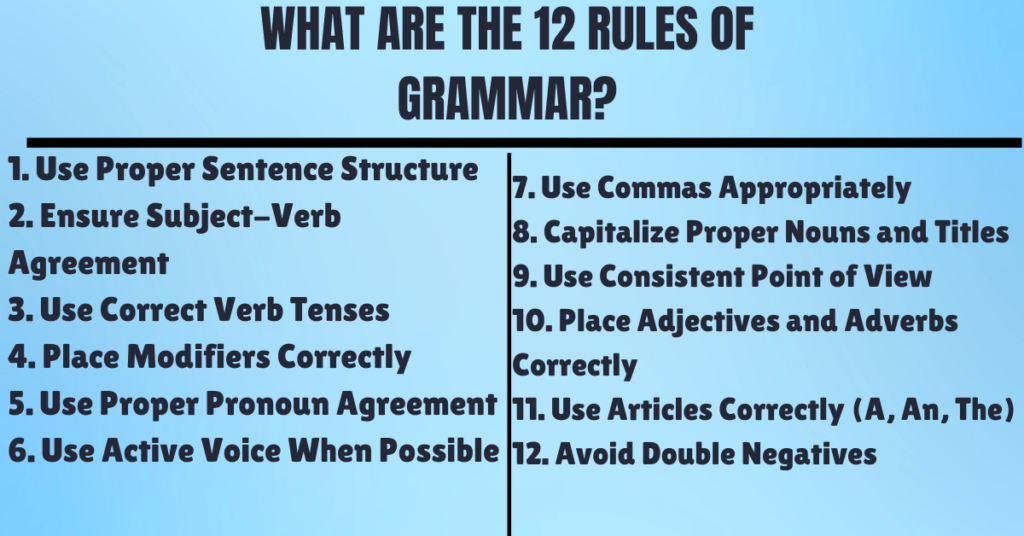
Good grammar is essential for making sure our sentences are clear, precise, and understood as we intend. Knowing a few fundamental grammar rules can help anyone, from beginners to advanced learners, improve their writing and speaking skills. Here are the 12 essential grammar rules that everyone should know.
1. Use Proper Sentence Structure
Every sentence should have at least one subject (who or what the sentence is about) and one predicate (what the subject is doing). Together, these form a complete thought. This grammar rule ensures your sentences are clear and convey a complete idea.
Example: The dog barked loudly.
Here, “The dog” is the subject, and “barked loudly” is the predicate.
2. Ensure Subject-Verb Agreement
In a sentence, the subject and verb must agree in number. This means a singular subject takes a singular verb, and a plural subject takes a plural verb. This grammar rule is key to maintaining clarity in your sentences.
Example: She walks to school. (Singular subject and verb)
Example: They walk to school. (Plural subject and verb)
3. Use Correct Verb Tenses
Verb tenses indicate when an action occurs (past, present, or future). It’s essential to use the correct tense and be consistent throughout your sentence or paragraph. This grammar rule ensures your reader or listener knows when the action is happening.
Example: He studied yesterday. (Past tense)
Example: She studies every day. (Present tense)
4. Place Modifiers Correctly
Modifiers add detail to a sentence, but they should be placed close to the word they’re modifying to avoid confusion. Misplaced modifiers can change the meaning of a sentence, so following this grammar rule is essential for accuracy.
Correct: The boy with a red hat is my friend.
Incorrect: The boy is my friend with a red hat.
5. Use Proper Pronoun Agreement
Pronouns must agree with the nouns they replace in both number (singular/plural) and gender. Following this grammar rule helps keep sentences clear and understandable.
Example: Sarah lost her book. (“Her” refers to Sarah)
Example: The students raised their hands. (“Their” refers to students)
6. Use Active Voice When Possible
In the active voice, the subject performs the action, making sentences clearer and more direct. This grammar rule can make your writing and speaking more engaging.
Active Voice: The chef prepared the meal.
Passive Voice: The meal was prepared by the chef.
7. Use Commas Appropriately
Commas help clarify meaning by separating different elements in a sentence. Use them to separate items in a list, introductory phrases, and clauses. This grammar rule is crucial for proper punctuation.
Example: After dinner, we went for a walk.
Example: She bought apples, oranges, and bananas.
8. Capitalize Proper Nouns and Titles
Always capitalize proper nouns (specific names of people, places, and things) and titles when they’re used as part of someone’s name. This grammar rule ensures correct formatting in formal writing.
Example: I visited New York City.
Example: Doctor Smith is here.
9. Use Consistent Point of View
Maintain a consistent point of view throughout a sentence or paragraph. Shifting from “I” to “you” or “he/she” within a sentence can be confusing. This grammar rule keeps the sentence focused.
Correct: I went to the market and bought some vegetables.
Incorrect: I went to the market, and you bought some vegetables.
10. Place Adjectives and Adverbs Correctly
Adjectives describe nouns, while adverbs modify verbs, adjectives, or other adverbs. Make sure they’re placed correctly to clarify what they’re modifying. This grammar rule enhances clarity.
Example: She quickly finished her homework. (Quickly modifies the verb finished)
Example: The blue car is mine. (Blue describes the car)
11. Use Articles Correctly (A, An, The)
“A” and “an” are indefinite articles and are used with non-specific nouns, while “the” is a definite article used for specific nouns. Following this grammar rule helps clarify which nouns are general and which are specific.
Example: I saw a cat. (Any cat)
Example: I saw the cat that lives in our neighborhood. (A specific cat)
12. Avoid Double Negatives
Double negatives can make sentences confusing. In English, using two negatives in the same sentence cancels each other out, making the sentence positive. This grammar rule is essential for clarity.
Incorrect: I don’t have no money.
Correct: I don’t have any money.
In Summary
These 12 grammar rules provide a strong foundation for clear, effective communication in English. Mastering them can make a significant difference in how well you express yourself, whether you’re speaking or writing. But remember, grammar alone isn’t enough. To truly build fluency, you need consistent, real-world practice. That’s where the EngVarta app comes in. It connects you with live English experts over phone calls, giving you a safe space to apply these rules in actual conversations, get instant corrections, and boost your confidence. Download the EngVarta app today and turn grammar knowledge into real communication skills. Happy learning!
Frequently Asked Questions about English Grammar Rules
What is grammar in English?
Grammar is the set of rules that governs how words combine to form sentences in a language. English grammar covers parts of speech (nouns, verbs, adjectives, etc.), tenses, sentence structure, punctuation, and word agreement. Knowing grammar helps you communicate clearly and be understood — it’s the structure underneath every sentence you speak or write.
What are the 12 basic rules of English grammar?
The 12 essential grammar rules every English learner should know:
- Subject-verb agreement — singular subjects take singular verbs, plural subjects take plural verbs.
- Use the correct tense — past, present, or future, consistently within a sentence or paragraph.
- Articles (a, an, the) — use them correctly with nouns to specify identity.
- Active vs passive voice — prefer active in most cases for clarity.
- Pronouns must agree with their antecedents — match number and gender.
- Modifiers are placed correctly — keep adjectives and adverbs near what they describe.
- Use prepositions correctly — different prepositions change meaning (“in” the room vs “on” the room).
- Capitalization rules — proper nouns, sentence starts, “I” pronoun.
- Punctuation — periods, commas, semi-colons, question marks each have specific uses.
- Conditional sentences — if/then patterns follow specific tense rules.
- Reported speech — direct speech to indirect speech requires tense backshift.
- Avoid double negatives — “I don’t know nothing” is incorrect; use “I don’t know anything.”
Why is grammar important in English?
Grammar matters because it creates clarity. Bad grammar in spoken English can change the meaning of what you’re trying to say or make you harder to understand. In professional contexts (interviews, emails, presentations), grammar errors signal lack of attention to detail. In everyday conversation, basic grammar accuracy helps native and fluent speakers process what you say without effort.
How many grammar rules are there in English?
There’s no single agreed-upon number. Comprehensive grammar reference books cover 100+ rules. For practical fluency, mastering the 12 core rules above plus 20-30 commonly-used patterns (tenses, prepositions, conditionals) is enough for most learners. Native speakers don’t consciously remember rules — they internalize patterns through exposure and use.
What are the most common grammar mistakes Indian English speakers make?
Frequent grammar errors include:
- Using “the” with general statements (“I love the music” instead of “I love music”)
- Confusing “since” and “for” with time expressions (“I am here since two days” — should be “for two days”)
- Using continuous tense for stative verbs (“I am understanding” — should be “I understand”)
- Subject-verb agreement with collective nouns
- Mixing up “less” and “fewer” (use “less” for uncountable, “fewer” for countable)
- Using “only” or “also” in the wrong sentence position
How can I improve my English grammar quickly?
To improve grammar in 4-8 weeks:
- Pick ONE grammar rule per week and use it deliberately in conversation and writing
- Read sector-relevant English content daily (news, blogs in your industry) — exposure cements patterns
- Get feedback from a teacher or expert who can flag specific mistakes you make
- Practice grammar in spoken contexts, not just written drills
- Track your most common errors in a notebook and review weekly
Grammar improves fastest when used in real conversation with someone who corrects you. Daily live practice with a TESOL/ESL-certified Expert (like through EngVarta’s $1 refundable trial) catches errors as you make them, which is more effective than self-study alone.
What is the difference between grammar and syntax?
Grammar is the broader set of rules covering all aspects of language structure (parts of speech, tense, agreement, articles, etc.). Syntax is specifically about how words are arranged in a sentence — the word order. Grammar includes syntax. For example, “The cat sat on the mat” follows English syntax (Subject-Verb-Object). Saying “Sat the cat on mat the” violates syntax even though all words are correct.
How long does it take to master English grammar?
Reaching solid functional grammar — where most of your spoken and written English is accurate — typically takes 6-12 months of consistent practice for intermediate learners. Mastering nuance (when to break grammar rules for style, regional variations, formal vs casual register) takes 2-4 years of immersion or deliberate practice. The 12 core rules above can be learned in 2-4 weeks; internalizing them takes longer.
What is the best way to practice English grammar?
The most effective grammar practice combines:
- Live conversation with someone who corrects you in real time (1-on-1 with an expert is ideal)
- Reading 30 minutes a day in English at your level
- Listening to native English content (podcasts, shows) for natural rhythm
- Writing short pieces and getting feedback
- Targeted drills on your weakest areas (don’t just practice what you’re already good at)
Are grammar rules different in spoken English vs written English?
Yes — spoken English is more flexible. Native speakers regularly use sentence fragments, contractions (“gonna,” “wanna”), informal sentence endings, and start sentences with “And” or “But.” These would be flagged as errors in formal writing but are perfectly natural in conversation. Knowing both registers — formal grammar for writing and presentations, conversational grammar for everyday speech — is what fluent speakers do.