
Improve English Fluency |

Tag

Improve English fluency

How to Stop Translating from Your Native Language While Speaking English

November 29, 2024 • 4 min read • By Swati Raj

How to Stop Translating from Your Native Language While Speaking English

Mastering English fluency can feel like scaling a mountain, especially when you find yourself mentally translating sentences from your native language. This habit can slow down your responses, reduce confidence, and make conversations awkward. But here’s the good news—breaking free from this cycle is entirely achievable! In this blog, we’ll explore why this happens and provide actionable tips to think and speak directly in English. We’ll also dive into how the EngVarta, one of the best English learning apps, can be your game-changing tool in this journey.

Why Do You Translate While Speaking English?

  1. Dependency on Familiar Patterns
    Your brain prefers your native language because it’s familiar and comfortable. Translating gives you a sense of security.
  2. Lack of Vocabulary
    Without a strong English vocabulary, you search for equivalents in your native language, creating a habit of translation.
  3. Fear of Making Mistakes
    Translating can feel like a safety net to ensure correctness, even though it slows your fluency.

Effects of Translating on Your English Fluency

  • Slow Response Time
    Mental translation delays your replies, making conversations feel stilted.
  • Grammatical Errors
    Different languages have unique structures, and literal translations often result in incorrect grammar.
  • Reduced Confidence
    You may feel hesitant and self-conscious, hindering your ability to express yourself freely.

7 Practical Tips to Stop Translating in Your Head

1. Immerse Yourself in English

Surround yourself with English content—books, movies, and podcasts. Immersion helps your brain adapt to thinking directly in English.

2. Practice Speaking Daily

Regular practice builds muscle memory for English phrases and expressions. Using apps like EngVarta, widely regarded as the best English practice app, offers real-life speaking opportunities to enhance your fluency.

3. Learn Vocabulary in Context

Instead of memorising word lists, learn words through sentences or situations. This helps you recall them naturally during conversations.

4. Think in English

Start narrating your day, thoughts, or plans in English in your mind. It’s a small step toward forming an English-speaking habit.

5. Use Visual Learning

Connect words directly to images or experiences instead of your native language. For instance, associate “apple” with the fruit, not the translation.

6. Be Okay with Mistakes

Fluency comes with practice, and mistakes are part of the process. Focus on expressing yourself rather than perfection.

7. Engage with Native or Fluent Speakers

Speaking with fluent English speakers forces you to think on your feet and respond quickly without translating.

How EngVarta Can Help You Stop Translating

EngVarta is a practical solution for anyone struggling with fluency issues and translation habits. It’s not just another app; it’s one of the best English speaking apps for immersive learning. Here’s how:

1. Real-Time English Conversations

The app connects you with live English experts, allowing you to practice speaking in real-life scenarios without judgment.

2. Personalized Learning

Experts provide corrections and suggestions tailored to your needs, helping you refine your English without relying on translations.

3. Convenience and Flexibility

Practice anytime, anywhere. The app’s flexibility ensures you never miss a session, keeping your progress consistent.

4. Confidence Building

With daily practice and supportive feedback, you’ll gradually gain the confidence to think and speak directly in English.

When it comes to the best spoken English apps, EngVarta shines with its ability to mimic real-world conversations and give learners the environment they need to succeed.

Success Stories: How Users Overcame Translation Habits with EngVarta

Many EngVarta users have shared inspiring journeys of breaking free from translation dependency. For instance:

    • Ravi, a working professional, mentioned how daily conversations on EngVarta helped him respond confidently during client meetings.
    • Anita, a homemaker, shared that thinking in English became natural after practicing small talk with EngVarta experts every evening.

Their success underscores why EngVarta is considered one of the best English learning apps for building fluency.

Conclusion

Stopping the habit of translating while speaking English isn’t an overnight process—it’s a gradual transformation. By immersing yourself in the language, practicing consistently, and using tools like the EngVarta app, you can train your brain to think and communicate directly in English. Whether you’re preparing for interviews, academic goals, or daily conversations, EngVarta stands out as the best English practice app to help you master fluency.

Ready to level up your English? Download EngVarta, one of the best spoken English apps, today and start your journey to confident, translation-free English conversations!

10 Common Mistakes to Avoid When Using Prepositions in Spoken English

September 11, 2024 • 9 min read • By Swati Raj

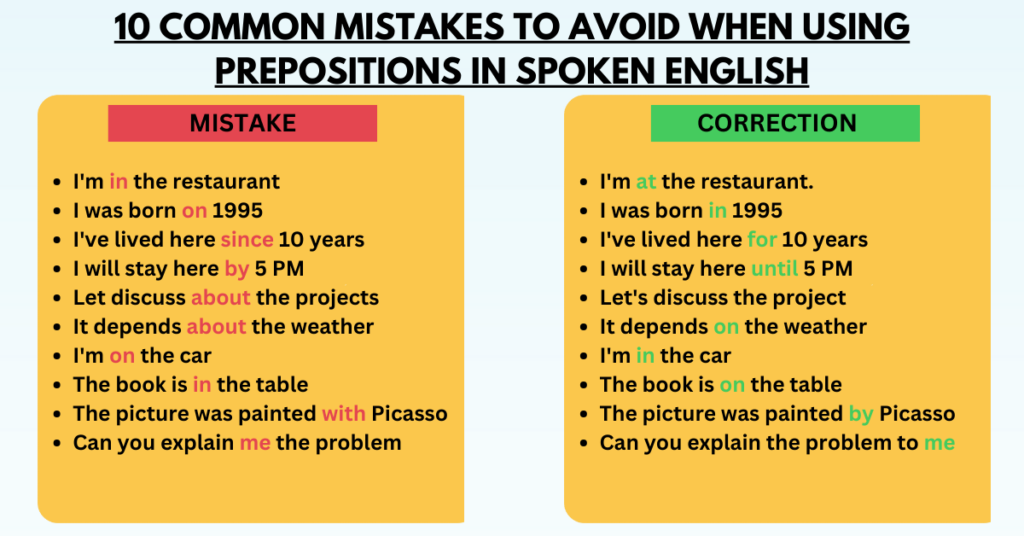
10 Common Mistakes to Avoid When Using Prepositions in Spoken English

Prepositions are those small but mighty words that link nouns, pronouns, or phrases to other words within a sentence. They’re everywhere in spoken English, but mastering their use can be tricky, especially for non-native speakers. Today, we’ll go over 10 common mistakes people make with prepositions and how to avoid them.

1. Confusing ‘In’ and ‘At’ for Locations

  • Mistake: Saying, “I’m in the restaurant” when you mean, “I’m at the restaurant.”
  • Correction: Use ‘at’ when you’re talking about specific locations, like “at the office” or “at the park.” Use ‘in’ when you’re referring to something more general or enclosed, like “in the city” or “in the car.”

2. Using ‘On’ Instead of ‘In’ for Months and Years

  • Mistake: Saying, “I was born on 1995″ instead of “I was born in 1995.”
  • Correction: Use ‘in’ for months, years, centuries, and long periods of time, like “in March” or “in 2025.” Use ‘on’ for specific days or dates, like “on Tuesday” or “on December 12th.”

3. Mixing Up ‘For’ and ‘Since’ with Time Expressions

  • Mistake: Saying, “I’ve lived here since 10 years” instead of “I’ve lived here for 10 years.”
  • Correction: Use ‘for’ when talking about the length of time (a duration), like “for 10 years.” Use ‘since’ when you’re referring to the starting point in time, like “since 2010.”

4. Incorrect Use of ‘By’ and ‘Until’

  • Mistake: Saying, “I will stay here by 5 PM” instead of “I will stay here until 5 PM.”
  • Correction: ‘Until’ is used to indicate the time something will continue to happen, like “until 5 PM.” ‘By’ is used to show the deadline or when something must be completed, like “Please finish this by Friday.”

5. Incorrect Use of ‘To’ After ‘Discuss’

  • Mistake: Saying, “Let’s discuss about the project” instead of “Let’s discuss the project.”
  • Correction: The verb ‘discuss’ doesn’t require a preposition. You should say, “Let’s discuss the project,” without ‘about.’

6. Confusing ‘On’ and ‘About’ After ‘Depend’

  • Mistake: Saying, “It depends about the weather” instead of “It depends on the weather.”
  • Correction: Always use ‘on’ after the verb ‘depend,’ as in “It depends on the weather,” or “It depends on you.”

7. Mixing Up ‘In’ and ‘On’ with Transportation

  • Mistake: Saying, “I’m on the car” instead of “I’m in the car.”
  • Correction: Use ‘in’ for smaller vehicles like cars or taxis (“in the car”) and ‘on’ for larger modes of transportation like buses, trains, and planes (“on the bus”).

8. Using ‘In’ Instead of ‘On’ for Surfaces

  • Mistake: Saying, “The book is in the table” instead of “The book is on the table.”
  • Correction: Use ‘on’ when referring to something that’s on a surface, like “on the table,” “on the floor,” or “on the shelf.”

9. Confusing ‘With’ and ‘By’

  • Mistake: Saying, “The picture was painted with Picasso” instead of “The picture was painted by Picasso.”
  • Correction: Use ‘by’ when you’re talking about the agent or doer of an action (“painted by Picasso”), and ‘with’ when you’re referring to the tool or instrument used (“painted with a brush”).

10. Incorrect Use of ‘To’ After ‘Explain’

  • Mistake: Saying, “Can you explain me the problem?” instead of “Can you explain the problem to me?”
  • Correction: The verb ‘explain’ needs to be followed by the object first and then the person it’s explained to: “Explain the problem to me.”

For more information, you can check this blog Prepositions of Time in English – At, On, In

How to Avoid These Mistakes?

  1. Practice Listening and Reading: Exposure to correct usage through podcasts, TV shows, and books will help you naturally pick up the right prepositions.
  2. Use an English Learning App: Apps like EngVarta provide real-time conversations with English experts, helping you identify and correct preposition mistakes in real time.
  3. Create Flashcards: Make a list of common preposition phrases and review them daily.
  4. Speak Regularly: The more you practice speaking English, the more natural it is to use prepositions.

Mastering prepositions may seem challenging, but with practice, you’ll find yourself making fewer and fewer mistakes. Prepositions can often change the entire meaning of a sentence, so using them correctly is key to fluency.

By avoiding these 10 common mistakes, you’ll see a noticeable improvement in your spoken English!

Ready to master prepositions and speak English confidently? Download EngVarta today and start practicing with live experts!

Frequently Asked Questions about English Prepositions

What are English prepositions and why are they tricky?

Prepositions are short words (in, on, at, by, for, of, to, with, from, about) that connect nouns, pronouns, or phrases to other words in a sentence. They’re tricky because they don’t translate directly between languages — Hindi, Tamil, Bengali, and other Indian languages handle position/direction/time differently than English. Learners often calque from their native language, leading to errors like “I’m interested in to learn” (should be “interested in learning”) or “good in maths” (should be “good at maths”).

What are the most common English preposition mistakes?

Frequent errors Indian English speakers make: (1) “Good IN English” → “good AT English”. (2) “Discussing ABOUT this” → “discussing this” (no preposition needed). (3) “Married WITH her” → “married TO her”. (4) “Different THAN” → “different FROM”. (5) “On Monday morning” → “on Monday morning” (correct) but “in the morning” (correct), “at night” (correct). Time prepositions: AT exact times, ON days, IN months/seasons/years. Place prepositions: AT specific locations, ON surfaces, IN enclosed spaces.

What’s the difference between in, on, and at?

For TIME: AT for exact times (at 5pm, at noon), ON for specific days (on Monday, on Christmas), IN for longer periods (in May, in 2026, in winter). For PLACE: AT for specific points (at the bus stop, at the door), ON for surfaces (on the table, on the wall), IN for enclosed spaces (in the room, in the car, in India). When in doubt, think of the preposition as zooming in: IN is broadest (a country), ON is narrower (a street), AT is specific (a corner).

How can I avoid preposition mistakes in spoken English?

Effective strategies: (1) Memorise high-frequency verb-preposition combinations as PHRASES (depend on, listen to, agree with, look forward to, instead of memorising “depend” and “on” separately). (2) Read English daily and note every preposition usage that surprises you. (3) Get feedback from a TESOL/ESL-certified Expert who flags preposition errors as they happen — these errors are often invisible to learners. EngVarta‘s daily 1-on-1 sessions catch preposition mistakes in real conversation, with corrections in the moment.

What are essential English prepositions to know?

Top 20 high-frequency prepositions: in, on, at, by, for, of, to, with, from, about, after, before, between, during, into, through, without, against, among, beyond. Mastering these covers ~95% of everyday English usage. Memorise common phrases that use them (“by the way”, “for instance”, “in fact”, “of course”) rather than learning prepositions in isolation.

How long does it take to master English prepositions?

Most learners reach 80% accuracy on common prepositions in 6-12 months of daily practice with feedback. Reaching 95%+ accuracy takes 1-2 years because some preposition uses are highly idiomatic (e.g., “interested IN” vs “fond OF” — no logical reason for the difference). Acceptance helps: native speakers often disagree on “correct” preposition use too. Focus on the patterns that matter for clarity.

Should I memorise preposition rules or learn them in context?

Both, but lean toward CONTEXT. Rules give you a starting framework (time prepositions: at/on/in pattern). Context (real sentences, conversations, written examples) is what locks usage into memory. Reading English daily and noting prepositions in their natural context is more effective than memorising rule lists. Active production (speaking, writing) with corrections is the fastest path to accuracy.