Improve English Fluency |

Tag

Improve English fluency

Which Apps I Have to Use to Build My Confidence in English? (2026 Expert Guide)

March 7, 2026 • 10 min read • By Mahesh .

apps to build English confidence

In our experience helping thousands of working professionals, we’ve found that the biggest barrier to career growth isn’t a lack of vocabulary—it’s the “hesitation gap.” You might know the grammar, but when the Zoom camera turns on, your confidence vanishes. In 2026, the market is flooded with AI bots, but the most effective apps to build English confidence are those that bridge the gap between “knowing” and “doing.”

What are the best apps to build English confidence?

The best apps to build English confidence in 2026 are EngVarta (for 1-on-1 human mentorship), ELSA Speak (for AI-driven pronunciation), and Cambly (for native immersion). For job seekers, EngVarta is the gold standard because it provides anonymous, judgment-free practice with real experts, which is essential for overcoming social anxiety in professional settings.

When searching for apps to build English confidence, most learners make the mistake of choosing “game-like” tools. While these are fun, they rarely help you survive a high-stakes board meeting. To truly improve English speaking, you need a platform that simulates real-world pressure while providing a safety net. This is why a dedicated app to build confidence in English is no longer a luxury—it’s a career necessity.

Why Most English Learning Apps Fail but EngVarta App is Best

In our years of analyzing educational technology, we’ve noticed that most apps to improve English speaking fail because they are “passive.” You click buttons, match words, and listen to pre-recorded audio. But the brain only builds confidence when it is forced to produce speech in real-time. This is why we categorize the EngVarta app differently; it’s an active training ground.

Apps to build English confidence often fail because:

  1. AI Lacks Empathy : A bot can correct your grammar, but it can’t sense when you’re nervous.
  2. No Cultural Nuance : Only a human-centric English conversation practice app can teach you how to sound persuasive, not just “correct.”
  3. The Gamification Trap : You don’t need a “streak” to get a promotion; you need to speak clearly under pressure.

By choosing the best app to learn English speaking, you are investing in your “vocal identity.” The EngVarta app excels here because it focuses on the psychology of speaking, making it the superior choice among apps to build English confidence.

EngVarta: The Premium “Human-First” Choice for Professionals

When we look for the best app to learn English speaking, we prioritize results over flashy interfaces. EngVarta has revolutionized the market by offering something AI cannot: The Human Mirror. For anyone serious about a learn English speaking at home app, EngVarta is the only platform that treats you like an executive, not a student.

Key Features of EngVarta :

  • 1-on-1 Live Calls : No group classes where you can hide behind others. Just you and a mentor using the English speaking practice app for 15 minutes of focused output.
  • Confidentiality & Security : This is the “crucial element” of the application to build trust in English. You don’t have to turn on your camera. You can make mistakes without feeling “watched.”
  • On-Demand Access : As the best app to learn English speaking, EngVarta doesn’t force you to schedule weeks in advance. Tap to talk whenever you have 15 minutes.
  • Call Recordings : Every session on this English conversation practice app is recorded so you can listen back and spot your own hesitation patterns.

Comparison Table: Top Apps to Build English Confidence in 2026

App Name Primary Focus Human or AI? Best For Confidence Level
EngVarta Real-world Fluency 100% Human Job Interviews & Meetings Highest
ELSA Speak Pronunciation AI MTI Reduction Medium
Cambly Native Exposure Human Casual Networking High
Duolingo Max Basics/Vocabulary AI Absolute Beginners Low
HelloTalk Exchange Peer-to-Peer Casual Chatting Medium

This table shows why apps to build English confidence are not created equal. If your goal is professional success, you need the human-led expertise of an English speaking practice app like EngVarta.

Who Should Use EngVarta?

In our professional opinion, not every free English speaking app is suitable for a career transition. If you are a working professional, the EngVarta app is specifically designed for your “high-pressure” lifestyle.

  1. The “Silent” Manager : You have 10 years of experience but stay quiet in meetings. You need apps to build English confidence that force you to lead the conversation.
  2. The Ambitious Job Seeker : You need an English conversation practice app to simulate mock interviews.
  3. The Global Traveler : You need to improve English speaking to interact with international clients.
  4. The Shy Learner : You need a learn English speaking at home app that offers total anonymity to remove the fear of judgment.

What are the common mistakes while learning English speaking?

The most common mistakes include over-prioritizing grammar rules over conversation, practicing in “low-stakes” environments (like talking to yourself), and avoiding feedback. To build confidence, you must shift from passive listening to active output using an English conversation practice app that provides real-time human correction.

⚠️ Common Mistakes to Avoid in 2026

Before you choose a learn English speaking at home app, stop these three self-sabotaging habits:

  • The Perfectionism Paradox : Waiting until your grammar is “perfect” before you start speaking is like waiting to get fit before you join a gym. You get fit at the gym. This is why you need apps to build English confidence that encourage messy, real-world mistakes.
  • Passive Consumption : Watching “English with [Influencer]” videos for 4 hours a day is entertainment, not practice. To build confidence, you need “Active Output” via an English speaking practice app.
  • The “Solo-Practice” Ceiling : Talking to yourself in the mirror is great for beginners, but it doesn’t prepare you for the unpredictability of a real conversation. You need apps to build English confidence that introduce a second, unpredictable person into the mix.

Before vs. After Using EngVarta: The Transformation

Aspect Before EngVarta After 30 Days of EngVarta
Mental Translation Constant pausing to translate thoughts. Thinks directly in English.
Meeting Presence Mic remains on mute; camera off. Actively contributes; leads Q&A.
Interview Performance Answers are short and robotic. Persuasive, story-driven communication.
Vocabulary Usage Uses simple “safe” words only. Uses high-level professional idioms.

This transformation is why we recommend EngVarta over any other app to build confidence in English. It changes your “Speaking Identity.”

How EngVarta Helps You Succeed (The Review)

Our detailed review of the EngVarta app reveals that its success lies in “Desensitization.” By speaking to a stranger daily on an English conversation practice app, your brain stops viewing English as a “threat.”

As you improve English speaking through 1-on-1 sessions, the experts provide contextual feedback that AI simply cannot. They help you with your “Tone” and “Executive Presence,” making this the best app to learn English speaking for 2026. If you want to learn English speaking at home app style, this is the most efficient path to fluency.

Real Experiences, Real Success EngVarta Review
See how learners from different backgrounds improved their English confidence through daily conversations and real practice with EngVarta experts.

Ready to Speak English Confidently?

Stop just learning English—start speaking it.
Practice real conversations with expert mentors and build your confidence faster.

Download EngVarta today and start your first live English speaking session.

👉  Android And IOS App 

Conclusion :

In 2026, your ability to communicate is your greatest asset. While there are thousands of apps to build English confidence, don’t settle for a game when you need a growth engine. The EngVarta app is the only best app to learn English speaking that prioritizes your career outcomes over “points” and “badges.”

Join our Community for Daily Tips :

Frequently Asked Questions ( FAQs )

Frequently Asked Questions about Apps for English Speaking Confidence

Which app is best for building English speaking confidence?

For Indian and South Asian learners, EngVarta is the most-used app for building speaking confidence — daily 1-on-1 audio sessions with TESOL/ESL-certified Experts who scaffold conversations gently and provide encouragement alongside corrections. ₹69 refundable trial. The audio-only format reduces on-camera anxiety, making it ideal for learners who feel shy. For supplementary AI-driven low-pressure practice: Speak app for casual conversation reps, ELSA Speak for pronunciation building.

Why do I feel nervous speaking English?

Common reasons for English speaking anxiety: (1) Fear of making mistakes in front of others. (2) Worry about being judged for accent or fluency. (3) Cognitive load of managing grammar, vocabulary, and pronunciation simultaneously. (4) Lack of practice — anxiety reduces with exposure. (5) Cultural pressure (in India, English fluency carries social status). The fix: low-stakes daily practice. Apps that pair you with patient, supportive tutors (like EngVarta) reduce anxiety much faster than thrown-into-deep-end approaches.

How can I overcome fear of speaking English?

Effective anxiety-reduction strategies: (1) Start with audio-only sessions (no video pressure). (2) Practice with the same Expert for 10-15 sessions to build comfort. (3) Speak in front of a mirror solo to build muscle memory. (4) Join low-pressure conversation groups online. (5) Acknowledge mistakes are inevitable — fluent speakers also make errors. (6) Reframe practice: each error is data, not failure. Most learners notice meaningful confidence improvement within 4-6 weeks of daily practice.

How long does it take to feel confident speaking English?

Realistic timeline: 4-6 weeks of daily practice to feel comfortable in low-stakes conversations (with friends, in apps). 3-6 months to feel confident in semi-formal contexts (work meetings with colleagues). 12-18 months to feel confident in high-stakes contexts (job interviews, presentations, client meetings). The variable that determines speed: hours of LIVE practice with supportive feedback per week.

Should I use AI apps or live tutor apps for confidence?

Both have roles. AI apps (Speak, Talkpal, Praktika): excellent for practising without social pressure. Use them when you’re highly anxious — AI doesn’t judge, doesn’t have facial expressions to interpret. Live tutor apps (EngVarta, Cambly, italki): better for breakthrough confidence — facing a real human and surviving builds confidence faster than perfect AI conversations. Most learners benefit from BOTH: AI apps for daily reps + live tutor apps for confidence-building.

How can I sound more confident in English?

Confidence in spoken English signals: (1) Speak slightly louder than your normal volume. (2) Pace your speech — slower indicates control. (3) Make eye contact (in video) or pause for emphasis. (4) Avoid filler words (“um”, “like”, “you know”) — even native speakers reduce these for credibility. (5) End sentences with conviction, not rising pitch (which sounds questioning). (6) Practice power-poses before high-stakes calls. (7) Daily live practice cements confidence as habit.

What Our Learners Say

Rated 4.5★ from 9,100+ reviews on Google Play

★★★★★
Wonderful! They provide you a best platform to talk. A very unique idea I think. English is learned more by speaking than by being taught. So this is the best platform I think. And also you get a chance to interact with intellectual experts so that you can explore yourself.
★★★★
A very good app its just as good as shown in the advertisement,but I wish it would have been a bit cheaper,
★★★★★
Wonderful application for English learners and good for speaking with trainers .All trainers are well experienced and help us within the time period,Thanks
★★★★★
Wonderful! They provide you a best platform to talk. A very unique idea I think. English is learned more by speaking than by being taught. So this is the best platform I think. And also you get a chance to interact with intellectual experts so that you can explore yourself.
★★★★★
My last 12 sessions experience is really great. It's a great app to improve English fluency and communication skills. All experts are quite friendly and highly skilled.
★★★★★
It was a great experience. I felt so much better. This is a very positive experience for me.
★★★★★
I have been using EngVarta for the past three months and from the period I am using I feel a considerable amount of difference in how I was speaking earlier and now how I am speaking and I think the EngVarta team has done a commendable job in improving my English fluency skill.
★★★★★
i completed my trial session, expert was good. I installed this app because chatgpt recommended it and I find it quite good speaking practice. experts are professional and friendly. plans are also economical compared to other english courses i took in the past.
★★★★★
good and highly talented experts are here..just go for a trail without any doubt.. thank you eng vartha...A small request from my side just take less payment from the people who are joing in your coaching...help to them...thank you
★★★★★
My journey at EngVarta was really awesome. It is a very good platform to learn communication skills. I will definitely recommend all my friends to join EngVarta.
★★★★★
Its just great, I mean in terms of environment that it gives you is just awesome. Thnx again for boosting my confidence.
★★★★★
EngVarta helps me a lot to become more fluent in speaking English. We can practice without any fear of making mistakes. I would recommend all the people who are hungry to learn English.

Ready to Practice with Real Experts?

Try EngVarta today — ₹69 trial (India) / $1 trial (International) · 100% refundable

What is the Best Way to Practice English Talking for Job Interviews and Business Meetings?

February 6, 2026 • 10 min read • By Mahesh .

Practice English Talking

In our experience, the biggest hurdle for Indian professionals isn’t a lack of vocabulary; it’s the “fluency gap.” We’ve seen brilliant engineers, data scientists, and senior managers struggle because they spend too much cognitive energy translating thoughts from Hindi, Tamil, or Bengali to English mid-sentence. In 2026, the corporate world moves at the speed of thought. High-stakes environments—whether it’s a “Series B” pitch or a critical stakeholder meeting—don’t allow time for mental translation. Many professionals find that consistent practice English talking sessions, whether with apps, language partners, or one-on-one coaching, help close this fluency gap and build confidence for real-world communication.

Whether you are aiming for a dream role at a global tech giant or leading a cross-border project, the way you practice defines how you perform. To bridge the gap, you need a strategy that moves beyond textbooks and into the realm of neurological conditioning. Apps like EngVarta provide live, one-on-one spoken English practice with real expert coaches, helping professionals build the fluency and confidence required to perform seamlessly in real-world corporate conversations.

What is the fastest way to practice English talking for interviews?

The fastest way to practice English talking for interviews is through “Live Immersion” and “Scenario-Based Simulations.” Instead of memorizing answers to common questions, engage in 1-on-1 conversations with experts. Using apps like EngVarta allows you to simulate real-world interview pressure, receive instant feedback on your vocal variety and sentence structure, and effectively kill the habit of mental translation.

Why EngVarta is the Gold Standard for Indian Job Seekers

In the 2026 job market, recruiters have shifted away from testing technical knowledge (which is now often pre-vetted by AI) toward evaluating “Culture Fit” and “Executive Presence.” Traditional coaching centers often fail because they treat English as a subject to be studied rather than a skill to be performed.

EngVarta changes the game by connecting you with live English experts anonymously. This anonymity is crucial; it removes the “fear of judgment”—the single biggest psychological barrier for Indian professionals. When you practice English talking for job interviews on the app, you are essentially “training your brain” for high-pressure scenarios.

Real-time Corrections: 

Unlike a classroom, where feedback is delayed, here you are corrected as you speak. This creates a neural loop that prevents mistakes from becoming “fossilized.”

Interview Simulations: 

You can request experts to grill you on specific behavioral questions like “Describe a time you failed” or “How do you handle conflict in a remote team?”

The “On-Demand” Advantage: 

Practice during your commute or 15 minutes before your actual interview to “warm up” your vocal cords and shift your brain into English mode.

👉 Get Started on EngVarta:

 📱 Download for Android | 🍎 Download for iOS

How can I improve my English speaking for professional meetings?

To improve English speaking for professional meetings, focus on “Active Rehearsal” and “Collaborative Fluency.” Use the “Shadowing Technique” by mimicking industry leaders on podcasts and participate in live 1-on-1 business English conversation practice. Master transition phrases and “diplomatic language” to sound more authoritative and polished during high-stakes negotiations, while regularly engaging in practice English talking to strengthen real-world fluency.

The Dynamics of 2026 Virtual and Hybrid Meetings

The shift to permanent hybrid work has changed the rules of engagement. You no longer just need to speak; you need to command a “digital presence.” This means your articulation must be crisp, and your ability to summarize complex points must be immediate.

Comparison: Practice Methods for Workplace Communication

Method Best For Time Required Effectiveness Scalability
EngVarta App Real-time confidence, flow & nuance 15 mins/day High Excellent
AI Tutors/Chatbots Basic grammar & simple syntax 30 mins/day Medium Good
YouTube Shadowing Pronunciation & intonation 20 mins/day Medium Limited
Traditional Classes Theoretical grammar & group talk 1 hour/day Low Poor
Reading Books Vocabulary expansion (Passive) 45 mins/day Low Very Poor

For business English conversation practice, we recommend a “Practice-First” approach. In professional meetings, the most respected voice isn’t always the loudest; it’s the one that can handle interruptions with grace and clarify technical points on the fly. This is where practice English for workplace communication through live experts beats passive consumption every time.

Why is “active listening” crucial for business English conversation practice?

Active listening is the secret weapon for professional fluency. It allows you to decode industry-specific jargon, understand the “tonality” of global leadership, and mirror the communication style of your stakeholders. By listening to experts during your improve English speaking for professional meetings sessions, you learn to respond contextually rather than delivering robotic, pre-recorded responses.

The Psychology of “Mirroring” in Business

In global business, rapport is built through mirroring. If your stakeholder uses specific idioms or a certain pace of speech, being able to match that (without losing your identity) creates instant trust. Through active listening practice, you move from “hearing words” to “interpreting intent.”

When you use EngVarta, the expert acts as a mirror. They reflect your communication style back to you, highlighting where you are clear and where you are losing the audience. This feedback loop is essential for practice English talking for job interviews and large-scale presentations.

Contemporary interviews focus less on “What is your job?” and more on “How do you approach problems?” Here’s how to apply spoken English tips for interviews to address the three key aspects of 2026 hiring:

1. The Behavioral Pillar

Questions like “Tell me about a time you managed a cross-functional team” require a narrative arc. Practice the STAR (Situation, Task, Action, Result) method in your practice sessions.

  • Common Pitfall: Using “We” too much.
  • The Fix: Use “I” to highlight your specific contribution, even in a team setting.

2. The Cultural Pillar

Recruiters want to know if you can communicate with teams in London, San Francisco, or Tokyo. This requires “Neutral English”—English that is free of heavy regional slang and is paced for global understanding.

  • Practice Tip: Ask your EngVarta expert to evaluate your “Clarity Index.” Are you speaking too fast? Are your consonants clear?

3. The Crisis Pillar

“What actions would you take if our primary server failed while the CEO was on a call?” These questions test your ability to maintain composure. If you stumble over your English here, it signals a lack of confidence, not just a lack of language.

  • Practice Tip: Practice “Thinking Out Loud.” Narrate your thought process as you solve a problem.

Expert Strategies to Improve English Speaking for Professional Meetings

Beyond the basics, senior professionals need to master “Diplomatic Language.” This involves using softeners to disagree without being disagreeable.

  1. Use Softeners: Instead of saying “You are wrong,” try “I see your point, however, have we considered the impact on X?”
  2. Master Transition Phrases: * To add a point: “Building on what Sarah mentioned…”
    • To shift topics: “If we could pivot for a moment to the budget…”
    • In conclusion: “To bring our conversation to a close on this…”
  3. The “Record and Replay” Protocol: Use the recording feature in EngVarta to listen back to your sessions. You will be surprised at the small fillers (like “um,” “uh,” and “like”) you can easily eliminate once you become aware of them.
  4. Think in English: This is the most cited advice for a reason. Start by narrating your daily tasks in your head. Instead of thinking “Aaj meeting ke liye late ho jayenge,” think “I might be running late for the meeting.”
  5. The 1% Rule: Don’t try to learn 100 new words today. Aim to master one phrasal verb (like bring up, call off, or get across) and use it three times in your next session.

The Long-Term ROI of English Fluency for Indian Professionals

We often view English as a “requirement,” but in 2026, it is a “multiplier.” A professional with high-level communication skills can command a 30% to 50% higher salary than a peer with identical technical skills but lower fluency.

Why? Because leadership is communication. You cannot inspire a team, negotiate a contract, or represent a brand on a global stage if you are struggling with your sentences. Investing in practice English talking for workplace communication is not just a personal hobby; it is a strategic career move.

Final Thoughts

The road to becoming a confident communicator isn’t paved with grammar books or passive YouTube watching; it’s paved with real, uncomfortable, and exhilarating conversations. If you are serious about your career growth in the 2026 economy, you need a daily workout for your speech, such as dedicated practice English talking sessions to build fluency and confidence.

The “fluency gap” is only as wide as your hesitation. Whether you’re looking for spoken English tips for interviews to land your next role or you want to dominate your next board-level Zoom call, the EngVarta app provides the most practical, judgment-free environment to evolve.

Frequently Asked Questions ( FAQs)

Frequently Asked Questions

What type of English speaking practice is best for leadership roles and presentations?

Leadership roles require structured, confident, and impactful communication. Practicing English talking through live roleplays, presentation simulations, and expert feedback is most effective. EngVarta helps professionals rehearse these high-stakes scenarios with real-time guidance.

How can working professionals practice English talking without fear of mistakes?

Working professionals can practice English talking effectively by using platforms that offer anonymous, one-on-one speaking sessions. EngVarta provides a judgment-free environment where professionals can speak freely, make mistakes, and improve fluency without hesitation.

How often should I practice English talking to see results?

For visible improvement, it’s recommended to practice English talking at least 20–30 minutes daily. Regular sessions on EngVarta help you think in English, reduce mental translation, and develop natural fluency needed for professional conversations.

How can I improve my English speaking for business meetings quickly?

To improve English speaking for business meetings quickly, you need daily speaking practice focused on professional scenarios like presentations, negotiations, and updates. EngVarta offers one-on-one spoken English sessions where you practice real business conversations and receive instant feedback to sound more professional and fluent.

What is the best way to practice English talking for job interviews?

The best way to practice English talking for job interviews is through live, real-time conversation practice that simulates actual interview pressure. EngVarta connects you with live English experts who help you practice common interview questions, improve clarity, and build confidence without the fear of judgment.

The Game Changing Trick to Score a 7+ Band Score in IELTS Speaking – Proven Tips & Sample Answers

October 13, 2025 • 9 min read • By Swati Raj

The Game Changing Trick to Score a 7+ Band Score in IELTS Speaking

Most learners chase “fancy words.” Band-7 candidates do something simpler and smarter: they tell tiny, clear stories. In IELTS Speaking, small stories unlock all four scoring areas at once—fluency & coherence, vocabulary, grammar, and pronunciation. When your answer has a beginning, middle, and end, you naturally speak longer, connect ideas, choose better words, vary structures, and keep a calm rhythm.

The S.P.E.A.K. Loop (your 60-second story)

One loop you can use in Part 1, Part 2, and Part 3:

Set the context → Point (your answer) → Evidence (tiny story) → Add nuance (“it depends…”) → Key takeaway (land cleanly)

Three sizes

  • Nano (10–12s): S → P → K (fast follow-ups in Part 1)

  • Standard (20–30s): S → P → E → K (great for Part 1)

  • Long turn (90–120s): S → P → E → A → K (the Part-2 sweet spot)

Why S.P.E.A.K. lifts your score

  • Fluency & Coherence: You stop listing and start connecting.

  • Lexical Resource: The story forces natural paraphrase and topic words.

  • Grammar Range & Accuracy: Stories invite mixed tenses and clause types.

  • Pronunciation: Clear steps = natural pauses, stress, and intonation.

Signposts to keep handy:
“To give you a quick picture… / The short answer is… / For instance… / That said… / So overall…”

Sample Answers (that actually sound human)

Part 1

Q: Do you enjoy cooking?
To give you a quick picture, I cook a few times a week. The short answer is yes—mostly simple meals. For instance, during lockdown I learned one-pot pasta to save time. That said, on busy days I just order in. So overall, I enjoy cooking, but convenience sometimes wins.

Why it works: Natural paraphrase (“simple meals,” “order in”), mixed tenses, clean close.

Q: Do you prefer e-books or paper books?
In brief, I lean toward e-books. For example, I highlight and search instantly, which saves time. That said, on weekends I still enjoy paper—especially non-fiction with visuals. So overall, e-books for weekdays, paper for slow Sundays.

Part 2 (Cue Card)

Cue: Describe a time you solved a problem.
To set the scene, last semester our slides crashed 10 minutes before a presentation. The short answer is we recovered by switching to a plain, text-only deck and doubling down on the story. For example, I suggested we outline three beats—challenge, approach, result—and speak without visuals. That said, we spoke a bit fast at first. In the end, the professor praised our clarity. Looking back, when your story is solid, slides are optional.

Timing map for Part 2:

  • 0:00–0:20 → S + P

  • 0:20–1:20 → E (2–3 vivid beats)

  • 1:20–2:00 → A + K (what changed / what you learned)

Part 3 (Discussion)

Q: Should schools focus more on creativity than exams?
In brief, I’d tilt slightly toward creativity. For instance, projects push students to apply ideas and speak more, which deepens learning. That said, exams still provide standards and accountability. So overall, a hybrid—creative projects backed by fair assessments—makes the most sense.

Q: How will technology change education in the next decade?
To set the context, tech will make learning more personalized. For example, adaptive platforms already adjust difficulty in real time. That said, access and digital well-being are real concerns. So overall, tech can widen opportunity—if we pair it with teacher training and sensible screen-time norms.

Band 5 vs Band 7 (hear the difference)

Question: What do you do in your free time?

  • Band-5 feel: “I watch movies. I like music. Sometimes I go out.”
    Issues: list-like, no development, flat delivery.

  • Band-7 feel:
    To give you a quick picture, I unwind with films or a short run. For instance, weeknights are comedies; Sundays are documentaries. That said, if friends are free, I’d rather meet them outdoors. So overall, I balance quiet time with social plans.”

What changed: a story spine, contrast, paraphrases, tidy close—and you sound real, not rehearsed.

Vocabulary Upgrades (without sounding fake)

  • “I like” → “I gravitate toward / I tend to prefer

  • “very important” → “pivotal / essential

  • “problem” → “hiccup / setback” (pick what fits)

  • “a lot” → “a great deal / considerably

  • “because” → “since / as / given that

Rule: Upgrade one word per sentence—never all of them.

Grammar & Delivery: High-Yield Moves

Grammar to sprinkle in:

  • Past + Present Perfect: “I learned the habit and I’ve kept it since.”

  • If-clauses: “If time is tight, I skip details.” / “If I had more time, I would add a contrast.”

  • Relative clause: “A routine that helps me is shadowing.”

  • Cleft for emphasis:What changed my score was structuring answers.”

Pronunciation habits:

  • Speak in thought groups (5–9 words).

  • Stress meaning words: “KEY takeaway,” “REAL issue.”

  • Use a 1-beat pause instead of fillers (um/like).

  • A light smile relaxes the jaw and clarifies sounds.

“Calm → clear” in 60 seconds (pre-answer reset)

  1. Box breath (4-4-4-4) twice.

  2. Jaw drop silently (“ah”) to relax.

  3. Whisper your anchor: “To give you a quick picture…

  4. One idea per sentence—short beats > long monologues.

Diagnostic Checklist (after any practice)

  • Did I Set context in one clean line?

  • Did I state a clear Point early?

  • Did I add Evidence (a micro-story)?

  • Did I Add nuance (“That said… / On the other hand…”) once?

  • Did I Close cleanly (“So overall…”)?

Score yourself 0–2 on: Fluency, Coherence, Vocabulary, Grammar, Pronunciation. Aim for 8/10+ consistently.

A 7-Day Plan (15 minutes a day)

Day 1 — Loop Drills
5 Part-1 questions → S.P.E.A.K. in ~20s each. Record once. Cut lists, add one tiny example.

Day 2 — PPF for Part 2
One cue card → Past → Present → Future (90–120s). Add a reflection line.

Day 3 — Contrast Muscle
Every answer includes “That said…” + one precise limit. Listen for more natural tone.

Day 4 — Paraphrase Bank
Pick 10 topics (food, travel, work…). Write 3 synonyms each. Speak 60s per topic. You can check out this blog for more common topics for the IELTS Speaking Test.

Day 5 — Grammar Mix
One complex sentence per answer (relative clause / if-clause / cleft). Accuracy > complexity.

Day 6 — Pronunciation
Mark pauses and meaning words; re-record. Aim for steady pace, not speed.

Day 7 — Full Mock (11–14 min)
Do a complete test. Use the checklist. Target 8+/10 on your rubric. Save best attempt; revisit in 72 hours to hear progress.

Common Traps (that keep you at Band 6)

  1. Memorized scripts that don’t answer the question.

  2. Vocabulary stuffing that sacrifices clarity.

  3. One-line answers with no development.

  4. Flat delivery—no signposts, no contrast, no close.

Fix: Use S.P.E.A.K., give one micro-example, add one contrast, and land the takeaway.

How FixoLang Helps You Master IELTS Speaking

If structure is the engine, feedback is the fuel. FixoLang turns your practice into a tight feedback loop so you improve where it counts.

AI Speaking Partner

  • Realistic prompts for Parts 1–3 (with natural follow-ups), so you practice exactly what appears in the real test.

  • Instant notes on fluency, coherence, vocabulary, grammar, pronunciation—aligned to IELTS descriptors—so you know why a response works (or doesn’t).

Band-Style Scoring & Trends

  • Criterion-wise breakdown shows your strongest and weakest areas, so you fix the right thing next.

  • A score history and progress graph keep motivation high.

Cue-Card Long Turn (Part-2)

  • Built-in 1-minute prep + 2-minute timer mirrors test pressure.

  • Bullet-note capture nudges you to plan with PPF/STAR inside your S.P.E.A.K. loop (structure over memorization).

Stress & Pace Feedback

  • Visualize your pauses, speed, and stressed words to clean up delivery and reduce fillers.

  • One-tap re-record makes it easy to focus on a single improvement each attempt.

Topic Bank & Smart Review

  • Fresh cue cards and realistic follow-ups across common themes (work/study, travel, health, tech, environment).

  • Smart Review surfaces your weakest answers first, so every practice minute is targeted.

Quick start (3 steps):

  1. Open FixoLang → IELTS Speaking → Full Mock

  2. Record Part 1 → Part 2 → Part 3

  3. Read criterion notes, fix one thing, and re-record just that part. Repeat tomorrow.

Download FixoLang App now:

Learn with FixoLang (social):

Final Thought

In IELTS Speaking, coherence is kindness—to the examiner and to yourself. Build tiny stories with S.P.E.A.K., practice for 15 minutes a day, and let structure carry your vocabulary, grammar, and pronunciation to Band 7+. Pair that structure with FixoLang’s instant, criterion-wise feedback and you won’t just practice more—you’ll improve faster where it matters most.

Frequently Asked Questions (FAQ’s)

Frequently Asked Questions

How do I improve coherence quickly?

Front-load context (“To give you a quick picture…”), state a clear point, add one-line evidence, and finish with “So overall…”. That spine alone lifts IELTS Speaking coherence.

How long should I speak in Part 2?

Aim close to 2 minutes. Budget time: ~20s for context + point, ~60s for a mini-story with 2–3 beats, ~30s for nuance and a final takeaway.

Is it okay to memorize answers?

Memorize structures and signposts, not full scripts. Off-topic memorized replies sound unnatural and can lower your score.

Are short answers bad?

Short and empty—yes. Short but developed—no. Use S.P.E.A.K. to add one line of context and one tiny example; then close cleanly.

Do I need a “native” accent to score 7+?

No. Any accent is fine if you’re clear and consistent. Focus on intelligibility, clean stress, and steady pace. Examiners score clarity, not accent type.

Still Thinking in Hindi Before You Speak English? Here’s How to Stop

June 27, 2025 • 8 min read • By Swati Raj

Still Thinking in Hindi Before You Speak English? Here’s How to Stop

Do you ever catch yourself translating from Hindi to English in your head before you speak?

You’re not alone.

Many English learners — especially in India — go through this exact struggle. You know the words, you understand the grammar, but when it’s time to speak… you pause. You think in Hindi first. Then slowly, you try to turn it into English.

This habit is one of the biggest reasons behind hesitation and slow speech.

In this blog, let’s dive into why you’re still thinking in Hindi — and more importantly, how to train your brain to think directly in English.

Why You’re Still Thinking in Hindi

Here are a few common reasons why this habit develops:

1. Hindi is your default setting

It’s the language you use for emotions, daily life, thoughts — everything. Your brain is hardwired to think in it.

2. English was taught as a subject, not as a skill

You’ve studied English grammar and vocabulary, but you weren’t encouraged to use it in real conversations.

3. Fear of making mistakes

We often think in Hindi because we feel more confident forming a thought in our mother tongue first, and then translating. That translation step is what causes hesitation.

But here’s the thing — you can change this.

You can reprogram your thinking pattern, and it doesn’t take a language degree — it just takes consistency and the right exercises.

How to Stop Thinking in Hindi While Speaking English

Let’s break it down into daily, practical habits.

1. Train Your Eyes and Mind

Wherever you are, look around and name things in English.

“Fan. Table. Plant. Phone. Water bottle.”

Then move to small phrases:

“The fan is running.”
“The bottle is empty.”

This builds an English vocabulary for your everyday surroundings — without depending on Hindi.

If you feel your vocabulary is limited, start expanding it with simple yet powerful words. You can check out this list of 50 simple English words to boost your vocabulary and begin adding them to your daily thoughts.

2. Narrate Your Routine

Talk to yourself in English as you go through your day.

  • “I’m brushing my teeth.”

  • “Let me check my phone.”

  • “Time to cook dinner.”

This constant narration helps you think directly in English without translating in your head.

3. Express Emotions in English

Instead of saying “Mujhe gussa aa raha hai” in your head, say:

“I’m feeling angry.”
“I’m annoyed right now.”
“I’m super excited about this!”

Practicing emotional vocabulary is a powerful way to switch your internal language from Hindi to English.

4. Use the “Slow & Speak” Technique

When someone asks you something in English, don’t panic.
Don’t rush to translate.

Just pause for 5 seconds, think slowly in English, and then respond.

Speed doesn’t equal fluency — clarity of thought does.

5. Don’t Aim for Perfection

Trying to speak perfect English will keep you stuck in the translation loop.

Instead:

  • Speak simply.

  • Use short sentences.

  • Make mistakes — it’s how fluency is built.

Nobody learned English by only thinking about grammar. People learn it by using it daily.

The 7-Day Challenge to Break the Habit

Try this challenge for the next 7 days:

🗓️ Choose one activity each day (walking, cooking, scrolling Instagram)
🗣️ Narrate your thoughts in English only
⏱️ Don’t allow yourself to think in Hindi during that activity

You’ll be amazed at how quickly your brain adjusts.

Your Thoughts Shape Your Fluency

Fluency isn’t just about speaking.

It’s about how you think.

When you’re still thinking in Hindi, English will always feel like a second language. But once your thoughts start flowing in English — even broken English — that’s when real fluency begins.

And the truth is: you already know enough English to begin this journey.

All you need now is practice and a little courage to speak, even if it’s not perfect.

Want to Practice English Without Feeling Judged?

If you’re ready to stop thinking in Hindi and finally start thinking in English, try the EngVarta App.

EngVarta helps you practice live English conversations with experts — so you can stop overthinking and start speaking fluently and naturally.

No books. No boring grammar drills. Just real talk.

Frequently Asked Questions about Thinking in English (Not Hindi)

Why do I think in Hindi when speaking English?

Thinking in Hindi (or any native language) while speaking English is a stage every non-native learner passes through. Reasons: (1) Your brain processes meaning in your native language first, then translates. (2) Your active English vocabulary isn’t broad enough to cover your thoughts directly. (3) Lack of practice in spoken English contexts. (4) Anxiety about errors makes you safer-route through Hindi. The fix: deliberate practice that forces direct English thinking — 25-30 min/day for 4-6 weeks usually starts the shift.

How do I stop translating from Hindi to English in my head?

Effective techniques: (1) Force yourself to think in English during low-stakes solo activities (commentary on cooking, walking, getting ready). (2) Practice English-only conversations daily — when you can’t translate fast enough, the brain adapts to direct English thinking. (3) Build a vocabulary of “English-first” topics (your work, hobbies, interests) where you’ve never used Hindi. (4) Daily live practice with a TESOL/ESL-certified Expert who notices when you’re translating and pushes you to think directly. EngVarta‘s daily 25-min sessions help build this exact skill — Experts can detect translation pauses and prompt direct English thinking.

How long does it take to think in English instead of Hindi?

Realistic timeline: 4-6 weeks of daily practice to start thinking in English for familiar topics; 6-12 months to think in English consistently across most contexts; 2+ years to think in English even in emotional or unexpected situations. Most adult learners always have some Hindi-thinking residue, especially under stress. That’s normal — even fluent multilingual people sometimes “feel” things in their first language while expressing them in English.

Why do I pause when speaking English?

Common reasons for pauses: (1) Translating from Hindi mid-sentence. (2) Searching for vocabulary. (3) Constructing grammar in your head. (4) Anxiety about making errors. (5) Genuine thinking time about content. Some pauses are natural — fluent native speakers pause too. The problem is when pauses are AT EVERY SENTENCE rather than for emphasis or thinking time. Fix: practice speaking out loud daily until your tongue catches up with your thoughts.

How can I speak English without thinking in Hindi?

Practical 4-week plan: Week 1: Choose 3 topics (your job, hobby, daily routine) — practice 5 min/day in English-only mode. Week 2: Expand to 5 topics, 10 min/day each in solo monologue. Week 3: Add 25-min daily live practice with a TESOL/ESL-certified Expert — explicitly request “no translation” feedback. Week 4: Speak English in low-stakes social interactions (ordering food, casual conversation) without preparing translations. Most learners notice substantial reduction in translation by week 4.

Is thinking in Hindi while speaking English a sign of weak fluency?

Yes — but it’s normal at intermediate level. Translating mid-sentence is the #1 indicator of intermediate-vs-advanced fluency. Advanced speakers don’t translate; they think in English directly. The good news: this is one of the most fixable fluency markers. 4-6 weeks of dedicated practice usually produces noticeable shift. Don’t accept “I always think in Hindi” as permanent — it’s a stage, not a destination.

Ready to Practice with Real Experts?

Try EngVarta today — ₹69 trial (India) / $1 trial (International) · 100% refundable

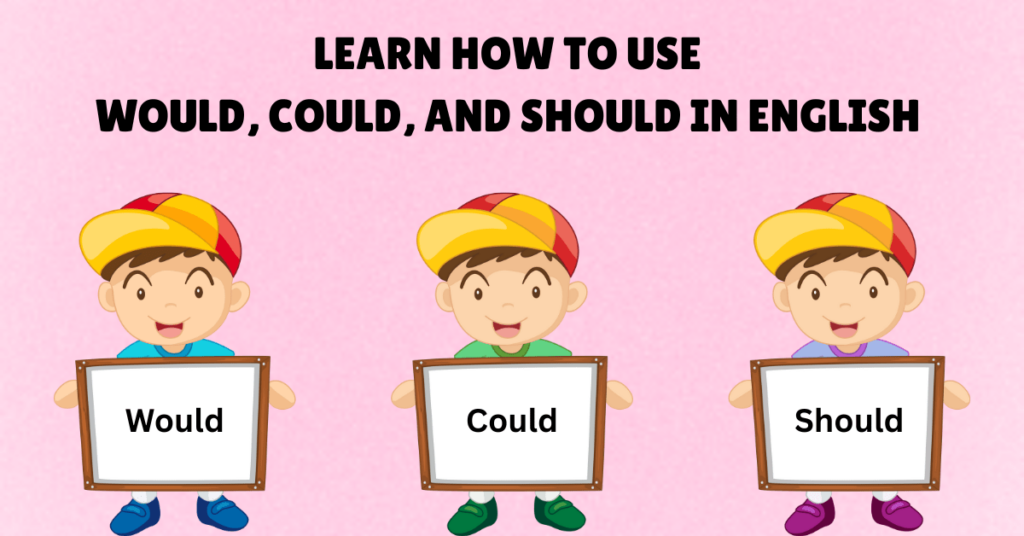
Use EngVarta & Learn How to Use Would, Could, and Should in English

April 1, 2025 • 7 min read • By Swati Raj

Use EngVarta & Learn How to Use Would, Could, and Should in English

Ever feel confused about when to use would, could, and should in English? You’re not alone! These little words can be tricky, but once you understand how they work, you’ll sound more fluent and confident. Let’s break them down together with simple rules and everyday examples.

What Are Modal Verbs?

Modal verbs are special helper verbs that add meaning to the main verb. They show things like possibility, ability, or advice. The stars of today’s lesson—would, could, and should—are three of the most popular ones!

When to Use Would

Use would to talk about:

  • Polite requests: Would you help me, please?
  • Imaginary or unreal situations: I would go to Paris if I had the money.
  • Future in the past: He said he would call me.
  • Wishes and desires: I would love a slice of cake.

👉 Quick Tip: Think of would as a softer, more polite version of will.

When to Use Could

Use could for:

  • Past ability: She could read when she was three!
  • Polite requests: Could you please pass the salt?
  • Possibility: It could snow tomorrow.
  • Suggestions: You could try restarting your phone.

👉 Quick Tip: Could is like a more polite or uncertain form of can.

When to Use Should

Use should when giving advice, opinions, or talking about what’s right:

  • Advice: You should drink more water.
  • Expectation: She should be here by now.
  • Moral obligation: People should be kind.
  • Suggestions: Should we go out for lunch?

👉 Quick Tip: Should is a gentle way of saying something is the right thing to do.

Final Thoughts

Learning how to use would, could, and should doesn’t have to be hard. Keep practicing with real sentences, and you’ll start using them naturally. They may be small words, but they make a big difference in your English!

Learn and Practice More with EngVarta

Want to improve your spoken English with live practice? Try the EngVarta, where you can talk to live English experts any time!

Modals also pair with the passive voice—this could be done, the report should be reviewed, that would be appreciated—if you want the full pattern, read our guide on active and passive voice in English grammar.

👉EngVarta YouTube Channel: https://www.youtube.com/@EngVarta

👉 Follow EngVarta on Instagram: https://www.instagram.com/engvarta

Frequently Asked Questions about Would, Could, and Should

What is the difference between would, could, and should?
“Would” expresses hypothetical situations, polite requests, or past habits. “Could” expresses past ability or polite possibility. “Should” expresses advice, obligation, or expectation. Quick test: WOULD = imagined/conditional (“I would help if I could”). COULD = ability/possibility (“She could speak three languages”). SHOULD = recommendation (“You should rest”). Each carries a different shade of meaning that English learners often mix up.
When should I use ‘would’?
Use “would” for: (1) Hypothetical/conditional situations: “I would travel more if I had time.” (2) Polite requests: “Would you pass the salt?” (3) Past habits: “When I was young, I would walk to school every day.” (4) Reported speech of “will”: “She said she would call.” (5) Wishes: “I wish I would win the lottery.” Common Indian English error: using “would” for present-tense politeness when “could” or “can” would be more accurate.
When should I use ‘could’?
Use “could” for: (1) Past ability: “I could swim when I was 5.” (2) Polite requests: “Could you help me?” (3) Possibility (less certain than “may”): “It could rain later.” (4) Suggestions: “We could try a different approach.” (5) Past possibility: “He could have been there.” “Could” is generally less formal than “would” for politeness — “Could you” feels softer than “Would you.”
When should I use ‘should’?
Use “should” for: (1) Advice/recommendation: “You should see a doctor.” (2) Expectation: “The package should arrive tomorrow.” (3) Obligation (mild): “We should respect the rules.” (4) Past regret: “I should have studied harder.” (5) Probability: “She should be home by now.” “Should” is the most directive of the three — it implies a recommended course of action, not just a possibility.
What are some examples of would vs could vs should?
Same situation, three meanings: “I WOULD call her if I had her number” (conditional — depends on having her number). “I COULD call her if you want me to” (ability/willingness — I have the option). “I SHOULD call her — it’s been a week” (advice/obligation — I ought to). Or: “WOULD you like coffee?” (polite offer). “COULD I have coffee?” (polite request). “SHOULD I have coffee?” (asking for advice).
What’s the difference between ‘would’ and ‘will’?
“Will” expresses certainty about the future (“I will call you tomorrow”). “Would” expresses hypothetical or conditional (“I would call you if I had time”). Will = definitely. Would = if certain conditions are met. Common error: using “will” when “would” is correct in conditionals — “If I had money, I will buy a house” should be “If I had money, I would buy a house.”
What’s the difference between ‘could’ and ‘can’?
“Can” expresses present ability or permission (“I can speak English”). “Could” expresses past ability OR polite present (“I could speak English at age 8” / “Could I speak English with you for practice?”). When asking for permission politely, “could” is softer than “can” — “Could I leave early today?” sounds more polite than “Can I leave early today?” though both are correct.
How can I practice would, could, and should correctly?
Effective practice: (1) Use each modal verb in 3 sentences daily — one for each purpose (conditional, ability/permission, advice). (2) Listen to English shows and note when speakers use which modal. (3) Practice in real conversation where someone can flag misuse. (4) Read English news articles and circle every “would/could/should” — note why each was chosen. EngVarta‘s TESOL/ESL-certified Experts can prompt you to use specific modals in conversation and explain why one fits better than another. The $1 refundable trial lets you try this on a topic where you typically struggle.

How to Stop Translating from Your Native Language While Speaking English

November 29, 2024 • 4 min read • By Swati Raj

How to Stop Translating from Your Native Language While Speaking English

Mastering English fluency can feel like scaling a mountain, especially when you find yourself mentally translating sentences from your native language. This habit can slow down your responses, reduce confidence, and make conversations awkward. But here’s the good news—breaking free from this cycle is entirely achievable! In this blog, we’ll explore why this happens and provide actionable tips to think and speak directly in English. We’ll also dive into how the EngVarta, one of the best English learning apps, can be your game-changing tool in this journey.

Why Do You Translate While Speaking English?

  1. Dependency on Familiar Patterns
    Your brain prefers your native language because it’s familiar and comfortable. Translating gives you a sense of security.
  2. Lack of Vocabulary
    Without a strong English vocabulary, you search for equivalents in your native language, creating a habit of translation.
  3. Fear of Making Mistakes
    Translating can feel like a safety net to ensure correctness, even though it slows your fluency.

Effects of Translating on Your English Fluency

  • Slow Response Time
    Mental translation delays your replies, making conversations feel stilted.
  • Grammatical Errors
    Different languages have unique structures, and literal translations often result in incorrect grammar.
  • Reduced Confidence
    You may feel hesitant and self-conscious, hindering your ability to express yourself freely.

7 Practical Tips to Stop Translating in Your Head

1. Immerse Yourself in English

Surround yourself with English content—books, movies, and podcasts. Immersion helps your brain adapt to thinking directly in English.

2. Practice Speaking Daily

Regular practice builds muscle memory for English phrases and expressions. Using apps like EngVarta, widely regarded as the best English practice app, offers real-life speaking opportunities to enhance your fluency.

3. Learn Vocabulary in Context

Instead of memorising word lists, learn words through sentences or situations. This helps you recall them naturally during conversations.

4. Think in English

Start narrating your day, thoughts, or plans in English in your mind. It’s a small step toward forming an English-speaking habit.

5. Use Visual Learning

Connect words directly to images or experiences instead of your native language. For instance, associate “apple” with the fruit, not the translation.

6. Be Okay with Mistakes

Fluency comes with practice, and mistakes are part of the process. Focus on expressing yourself rather than perfection.

7. Engage with Native or Fluent Speakers

Speaking with fluent English speakers forces you to think on your feet and respond quickly without translating.

How EngVarta Can Help You Stop Translating

EngVarta is a practical solution for anyone struggling with fluency issues and translation habits. It’s not just another app; it’s one of the best English speaking apps for immersive learning. Here’s how:

1. Real-Time English Conversations

The app connects you with live English experts, allowing you to practice speaking in real-life scenarios without judgment.

2. Personalized Learning

Experts provide corrections and suggestions tailored to your needs, helping you refine your English without relying on translations.

3. Convenience and Flexibility

Practice anytime, anywhere. The app’s flexibility ensures you never miss a session, keeping your progress consistent.

4. Confidence Building

With daily practice and supportive feedback, you’ll gradually gain the confidence to think and speak directly in English.

When it comes to the best spoken English apps, EngVarta shines with its ability to mimic real-world conversations and give learners the environment they need to succeed.

Success Stories: How Users Overcame Translation Habits with EngVarta

Many EngVarta users have shared inspiring journeys of breaking free from translation dependency. For instance:

    • Ravi, a working professional, mentioned how daily conversations on EngVarta helped him respond confidently during client meetings.
    • Anita, a homemaker, shared that thinking in English became natural after practicing small talk with EngVarta experts every evening.

Their success underscores why EngVarta is considered one of the best English learning apps for building fluency.

Conclusion

Stopping the habit of translating while speaking English isn’t an overnight process—it’s a gradual transformation. By immersing yourself in the language, practicing consistently, and using tools like the EngVarta app, you can train your brain to think and communicate directly in English. Whether you’re preparing for interviews, academic goals, or daily conversations, EngVarta stands out as the best English practice app to help you master fluency.

Ready to level up your English? Download EngVarta, one of the best spoken English apps, today and start your journey to confident, translation-free English conversations!

Is EngVarta Free? Free vs Paid Ways to Learn English (2026)

October 3, 2024 • 13 min read • By Swati Raj

Learn English with EngVarta – Both Free and Paid Ways to Become Fluent
Quick Verdict (2026)Yes, EngVarta has a free way and a paid way to learn English. What’s 100% free: the EngVarta vocabulary series, quizzes, and video lessons — all available both on the EngVarta YouTube channel and inside the EngVarta app. What’s paid: live 1-on-1 audio practice sessions with TESOL/ESL-certified Experts, starting at ~₹108 per session (₹2,700 for 25 sessions). The trial is ₹69 and 100% refundable. Most learners use both: free vocabulary + quizzes to learn the rules, paid live sessions to practise speaking out loud with real-time correction.

Updated for 2026. Everyone has a different way of learning English. Some want full immersion with a live expert correcting them in real time. Others prefer to pick up tips and lessons at their own pace, on their own schedule, without spending money. EngVarta gives you both options — a completely free YouTube channel and a paid live-practice app — so you can pick whichever fits your budget, time, and goal.

This guide breaks down exactly what’s free, what’s paid, what each path is best for, and how to combine the two for the fastest fluency results.

The Free Way to Learn English — Vocabulary Series, Quizzes & Video Lessons

If you want to learn English without spending anything, EngVarta’s entire self-learning library is 100% free. The vocabulary series, daily quizzes, and video lessons are all available at no cost — you can access them on the EngVarta YouTube channel or directly inside the EngVarta app. Completely free. No signup wall. No trial period that converts to paid. No ads to dismiss. Open the app or YouTube and start learning.

The videos are designed for learners at every level — beginners building their first vocabulary, intermediate learners ironing out grammar gaps, and advanced speakers polishing pronunciation and accent. You can watch on your phone or laptop, on the bus, during a tea break, or before bed. Your pace, your schedule, your choice.

What’s included free (on YouTube and inside the app):

  1. EngVarta vocabulary series — everyday words for beginners through to advanced and academic vocabulary, with examples and pronunciation guidance
  2. Daily quizzes — vocabulary, grammar, and comprehension quizzes to test what you’ve learned and reinforce retention
  3. Video lessons — grammar rules, sentence structures, and practical speaking tips that apply to real-world conversations
  4. Speaking tips and conversation patterns — how to start conversations, common phrases, and natural-sounding response patterns
  5. Pronunciation drilling — sounds Indian learners commonly struggle with, mother-tongue-influence (MTI) fixes, and accent-neutralisation tips
  6. Motivational content — learner stories, study habit tips, and ideas to keep you consistent past the first 30 days

👉 Visit the EngVarta YouTube channel and subscribe for free English lessons 👈

One subscribe = instant access to everything. New videos are added regularly, so subscribing means you’ll see the latest lessons in your YouTube feed without searching for them. It’s the easiest, lowest-friction way to start your English learning journey without spending a rupee.

The Paid Way — The EngVarta App for Live 1-on-1 Practice

The YouTube channel teaches you English. The EngVarta app helps you actually speak it. That’s the difference: watching videos builds knowledge, but only live practice with someone correcting you builds fluency.

The EngVarta app connects you to a TESOL or ESL-certified English Expert over a live audio call. You pick the session length you want (15, 25, or 50 minutes), book a slot any time between 7 AM and midnight, and you’re connected to an Expert in minutes. The Expert listens to you speak, corrects your pronunciation, grammar, and word choice in real time during the call, and shares consolidated feedback towards the end of the session highlighting your top improvement areas.

Sessions are recorded and accessible for 30 days, so you can replay your weak spots and track your progress over time. Between sessions, the app gives you personalised practice tasks and a vocabulary builder to keep momentum going.

What the paid app gives you:

  1. Live 1-on-1 audio practice with TESOL/ESL-certified Experts — real conversations, not scripted lessons or AI bots
  2. Real-time correction during the call on pronunciation, grammar, and fluency — not after-the-fact written reports
  3. Consolidated feedback towards the end of every session, summarising what you covered and what to work on next
  4. Session recording for 30 days so you can review and self-correct between practice sessions
  5. Flexible scheduling from 7 AM to midnight, daily — works around morning routines, after-work hours, or late-night study sessions
  6. Personalised practice tasks + a vocabulary builder between sessions to keep daily progress going
  7. Audio-only design — works on slow mobile data and removes the camera-pressure that holds back self-conscious learners
  8. Milestone certificates as you complete practice-hour thresholds and reach speaking-progress milestones — useful for HR records, departmental training files, and upskilling submissions

What does the EngVarta app cost in 2026?

  • Trial: ₹69 for a 10-minute session, 100% refundable if you don’t want to continue
  • Starter plan: ₹2,700 for 25 sessions (~₹108 per session)
  • Larger plans: 50, 100, 150, and 300 sessions available with proportional discounting
  • Pause feature: built-in for travel, work crunches, or breaks — your sessions don’t expire
  • USD markets: roughly $1.80 per session for learners outside India (US, UAE, Canada, Singapore)

EngVarta is trusted by lakhs of learners who’ve used the app for daily speaking practice since 2017 — over 10 lakh sessions completed across India and expanding markets.

Ready to Practice with Real Experts?

Try EngVarta today — ₹69 trial (India) / $1 trial (International) · 100% refundable
Why Start with EngVarta’s Free Self-Learning Library?

  1. Quality lessons, anytime, anywhere — quick, informative videos you can watch on your phone or laptop, on your own schedule
  2. Comprehensive coverage — grammar, vocabulary, speaking patterns, pronunciation, and accent guidance, all in one place
  3. Self-paced learning, no pressure — watch a video once, twice, ten times until it clicks; no instructor waiting on you
  4. Completely free, no subscription needed — the vocabulary series, quizzes, and video lessons are 100% free on both YouTube and inside the app. No hidden upgrades, no “free trial that auto-renews” trap

How to Combine the Free and Paid Paths for Faster Fluency

The fastest fluency gains come from combining both paths. Here’s the proven pattern most successful EngVarta learners follow:

  1. Start with the free self-learning library — spend 15 minutes a day on the vocabulary series, daily quizzes, and video lessons (use either the EngVarta YouTube channel or the app, whichever you prefer). Build the foundation, learn the rules, expand your vocabulary, no cost.
  2. Add the ₹69 refundable trial after a week or two of YouTube — book a 10-minute live session to feel the difference between watching and actually speaking with feedback.
  3. If the trial works, move to the 25-session starter plan — do one 25-minute session every weekday morning (or after dinner). At ~₹108 per session, the daily cost of fluency practice is less than a cup of coffee.
  4. Keep watching YouTube alongside — the videos reinforce what your Expert corrected during practice. Lesson on one platform, application on the other.

👉 Subscribe to the EngVarta YouTube channel 👈 to start the free path today.

Ready to add live practice? Download the EngVarta app on Android, find it on the iOS App Store, or use the web version at engvarta.com.

Frequently Asked Questions

Is EngVarta free?

EngVarta has both free and paid features. Free: the EngVarta vocabulary series, daily quizzes, and video lessons — all available on the EngVarta YouTube channel and inside the EngVarta app, with no signup wall and no subscription. Paid: live 1-on-1 audio practice sessions with TESOL/ESL-certified English Experts, starting at ~₹108 per session. There’s a ₹69 trial that’s 100% refundable if you decide not to continue.

Is the EngVarta app free or paid?

The EngVarta app has both free and paid parts. Free inside the app: vocabulary series, daily quizzes, and video lessons — the same self-learning content available on the YouTube channel, just packaged inside the app. Paid inside the app: the live 1-on-1 audio practice sessions with English Experts, starting at ₹2,700 for 25 sessions (~₹108 per session), with a ₹69 refundable trial. The live practice is paid because each session involves a real certified English Expert giving you 1-on-1 correction in real time — that’s the value the cost covers.

How much does EngVarta cost in 2026?

The starter plan is ₹2,700 for 25 sessions (~₹108 per session). Larger plans (50, 100, 150, and 300 sessions) are available with proportional discounting. The trial is ₹69 for a 10-minute session and 100% refundable. In USD markets (US, UAE, Canada, Singapore), pricing works out to roughly $1.80 per session.

Does EngVarta have a free trial?

EngVarta has a refundable trial, not a free trial. The trial costs ₹69 for a 10-minute live session and is 100% refundable if you decide not to continue. The reason it isn’t free is that the trial connects you to a real, certified English Expert who spends 10 minutes 1-on-1 with you — the ₹69 covers their time. The refund means you take zero financial risk.

What’s the difference between EngVarta YouTube and the EngVarta app?

The free self-learning content (vocabulary series, quizzes, video lessons) is the same on both — you can access it via the YouTube channel or inside the EngVarta app, whichever fits your habit. The only thing the app adds on top of YouTube is the paid feature: live 1-on-1 audio practice sessions with a real, certified English Expert who corrects you in real time and shares consolidated feedback at the end of each call. Self-learning content builds knowledge; live practice builds fluency. Most learners use both.

Where can I download the EngVarta app?

The EngVarta app is available on the Google Play Store for Android, on the Apple App Store for iOS, and on the web at engvarta.com. The same account works across all three platforms.

Does EngVarta give certificates?

Yes — EngVarta issues milestone certificates as learners complete practice-hour thresholds and reach speaking-progress milestones. These are useful for HR records, departmental training files, and upskilling submissions. They’re earned through actual practice (not seat-time in a curriculum or exam-based), so the certificate reflects real spoken-English progress.

Can absolute beginners use EngVarta?

Yes. The YouTube channel covers content for absolute beginners through to advanced learners. For the paid app, beginners can book sessions with Experts who specialise in early-stage learners — the Expert will pace the conversation, use simpler vocabulary, and gradually increase complexity as your confidence grows.

What ages and audiences does EngVarta serve?

EngVarta serves working professionals, college students preparing for placements and interviews, government employees needing English for postings, homemakers rebuilding fluency on their own schedule, and learners preparing for IELTS, TOEFL, or job-interview English. The platform serves lakhs of learners across India and expanding markets in the US, UAE, Canada, and Singapore.

What Our Learners Say

Rated 4.5★ from 9,100+ reviews on Google Play

★★★★★
Really helpful to me. Many people want to talk but can't because of people who just laugh at their efforts. This app really helps. I love this initiative.
★★★★★
hello this is Shweta and I will tell you about the engvarta app this is an amazing app to improve our English or any other language so I suggested using this app and doing better things and growing always better . thankyou.
★★★★★
This is the best app for anyone who feels nervous and hesitates during conversation in English.
★★★★★
Engvarta provides the best platform for learners to learn and get comfortable with the language by offering a comfortable and judgment-free environment with regular feedback. Engvarta is the best English learning app available.
★★★★★
i completed my trial session, expert was good. I installed this app because chatgpt recommended it and I find it quite good speaking practice. experts are professional and friendly. plans are also economical compared to other english courses i took in the past.
★★★★★
It's a incredible app... It builds my confidence to speak English fluently, gives you practice to start your conversation without any hesitation, provides daily free vocabulary and quizes also...Expensive but amazing & worth it...
★★★★★
This app is very useful for e English and the Mam is nice by rating is five star
★★★★★
I enjoyed this course.experts encouraged me to use advanced vocabulary, idioms and phrases daily dose of assignment, quizzes and new vocabulary keep your toes
★★★★★
The app has been great in improving your English speaking skills. Experts have great knowledge and indeed all are amicable and they create the environment which is necessary for learning the language.
★★★★★
very exlent English learning app with live tuters. and they will help to me for improving English.
★★★★★
Wonderful app provide experts to talk but but so much time constraints in talking..
★★★★★
Engvarta is a platform where we start from the 0 level to 100 level. That is the best thing I have never seen in my life. There are so many part and so many way, they are always try to teach you until you become a good speaker. Thank you Engvarta

Wrapping Up — Two Paths to Fluent English in 2026

EngVarta gives you two ways to learn English in 2026:

  1. The Free Path: Use the EngVarta vocabulary series, quizzes, and video lessons — available on both the YouTube channel and inside the EngVarta app. Zero cost, zero subscription, zero catches.
  2. The Paid Path: Download the EngVarta app. Live 1-on-1 audio practice with TESOL/ESL-certified Experts, real-time corrections, consolidated feedback, recordings for 30 days. From ~₹108 per session, with a ₹69 refundable trial.

If your budget is zero, start with the YouTube channel today. If you want to actually speak fluently — not just understand English — add the app once you’ve built some foundation through the videos. The combination of both is what most successful learners use.

Either way: the best way to learn is to practise — daily, out loud, with feedback. Start today.

10 Common Mistakes to Avoid When Using Prepositions in Spoken English

September 11, 2024 • 8 min read • By Swati Raj

10 Common Mistakes to Avoid When Using Prepositions in Spoken English

Prepositions are those small but mighty words that link nouns, pronouns, or phrases to other words within a sentence. They’re everywhere in spoken English, but mastering their use can be tricky, especially for non-native speakers. Today, we’ll go over 10 common mistakes people make with prepositions and how to avoid them.

1. Confusing ‘In’ and ‘At’ for Locations

  • Mistake: Saying, “I’m in the restaurant” when you mean, “I’m at the restaurant.”
  • Correction: Use ‘at’ when you’re talking about specific locations, like “at the office” or “at the park.” Use ‘in’ when you’re referring to something more general or enclosed, like “in the city” or “in the car.”

2. Using ‘On’ Instead of ‘In’ for Months and Years

  • Mistake: Saying, “I was born on 1995″ instead of “I was born in 1995.”
  • Correction: Use ‘in’ for months, years, centuries, and long periods of time, like “in March” or “in 2025.” Use ‘on’ for specific days or dates, like “on Tuesday” or “on December 12th.”

3. Mixing Up ‘For’ and ‘Since’ with Time Expressions

  • Mistake: Saying, “I’ve lived here since 10 years” instead of “I’ve lived here for 10 years.”
  • Correction: Use ‘for’ when talking about the length of time (a duration), like “for 10 years.” Use ‘since’ when you’re referring to the starting point in time, like “since 2010.”

4. Incorrect Use of ‘By’ and ‘Until’

  • Mistake: Saying, “I will stay here by 5 PM” instead of “I will stay here until 5 PM.”
  • Correction: ‘Until’ is used to indicate the time something will continue to happen, like “until 5 PM.” ‘By’ is used to show the deadline or when something must be completed, like “Please finish this by Friday.”

5. Incorrect Use of ‘To’ After ‘Discuss’

  • Mistake: Saying, “Let’s discuss about the project” instead of “Let’s discuss the project.”
  • Correction: The verb ‘discuss’ doesn’t require a preposition. You should say, “Let’s discuss the project,” without ‘about.’

6. Confusing ‘On’ and ‘About’ After ‘Depend’

  • Mistake: Saying, “It depends about the weather” instead of “It depends on the weather.”
  • Correction: Always use ‘on’ after the verb ‘depend,’ as in “It depends on the weather,” or “It depends on you.”

7. Mixing Up ‘In’ and ‘On’ with Transportation

  • Mistake: Saying, “I’m on the car” instead of “I’m in the car.”
  • Correction: Use ‘in’ for smaller vehicles like cars or taxis (“in the car”) and ‘on’ for larger modes of transportation like buses, trains, and planes (“on the bus”).

8. Using ‘In’ Instead of ‘On’ for Surfaces

  • Mistake: Saying, “The book is in the table” instead of “The book is on the table.”
  • Correction: Use ‘on’ when referring to something that’s on a surface, like “on the table,” “on the floor,” or “on the shelf.”

9. Confusing ‘With’ and ‘By’

  • Mistake: Saying, “The picture was painted with Picasso” instead of “The picture was painted by Picasso.”
  • Correction: Use ‘by’ when you’re talking about the agent or doer of an action (“painted by Picasso”), and ‘with’ when you’re referring to the tool or instrument used (“painted with a brush”).

10. Incorrect Use of ‘To’ After ‘Explain’

  • Mistake: Saying, “Can you explain me the problem?” instead of “Can you explain the problem to me?”
  • Correction: The verb ‘explain’ needs to be followed by the object first and then the person it’s explained to: “Explain the problem to me.”

For more information, you can check this blog Prepositions of Time in English – At, On, In

How to Avoid These Mistakes?

  1. Practice Listening and Reading: Exposure to correct usage through podcasts, TV shows, and books will help you naturally pick up the right prepositions.
  2. Use an English Learning App: Apps like EngVarta provide real-time conversations with English experts, helping you identify and correct preposition mistakes in real time.
  3. Create Flashcards: Make a list of common preposition phrases and review them daily.
  4. Speak Regularly: The more you practice speaking English, the more natural it is to use prepositions.

Mastering prepositions may seem challenging, but with practice, you’ll find yourself making fewer and fewer mistakes. Prepositions can often change the entire meaning of a sentence, so using them correctly is key to fluency.

By avoiding these 10 common mistakes, you’ll see a noticeable improvement in your spoken English!

Ready to master prepositions and speak English confidently? Download EngVarta today and start practicing with live experts!

Frequently Asked Questions about English Prepositions

What are English prepositions and why are they tricky?

Prepositions are short words (in, on, at, by, for, of, to, with, from, about) that connect nouns, pronouns, or phrases to other words in a sentence. They’re tricky because they don’t translate directly between languages — Hindi, Tamil, Bengali, and other Indian languages handle position/direction/time differently than English. Learners often calque from their native language, leading to errors like “I’m interested in to learn” (should be “interested in learning”) or “good in maths” (should be “good at maths”).

What are the most common English preposition mistakes?

Frequent errors Indian English speakers make: (1) “Good IN English” → “good AT English”. (2) “Discussing ABOUT this” → “discussing this” (no preposition needed). (3) “Married WITH her” → “married TO her”. (4) “Different THAN” → “different FROM”. (5) “On Monday morning” → “on Monday morning” (correct) but “in the morning” (correct), “at night” (correct). Time prepositions: AT exact times, ON days, IN months/seasons/years. Place prepositions: AT specific locations, ON surfaces, IN enclosed spaces.

What’s the difference between in, on, and at?

For TIME: AT for exact times (at 5pm, at noon), ON for specific days (on Monday, on Christmas), IN for longer periods (in May, in 2026, in winter). For PLACE: AT for specific points (at the bus stop, at the door), ON for surfaces (on the table, on the wall), IN for enclosed spaces (in the room, in the car, in India). When in doubt, think of the preposition as zooming in: IN is broadest (a country), ON is narrower (a street), AT is specific (a corner).

How can I avoid preposition mistakes in spoken English?

Effective strategies: (1) Memorise high-frequency verb-preposition combinations as PHRASES (depend on, listen to, agree with, look forward to, instead of memorising “depend” and “on” separately). (2) Read English daily and note every preposition usage that surprises you. (3) Get feedback from a TESOL/ESL-certified Expert who flags preposition errors as they happen — these errors are often invisible to learners. EngVarta‘s daily 1-on-1 sessions catch preposition mistakes in real conversation, with corrections in the moment.

What are essential English prepositions to know?

Top 20 high-frequency prepositions: in, on, at, by, for, of, to, with, from, about, after, before, between, during, into, through, without, against, among, beyond. Mastering these covers ~95% of everyday English usage. Memorise common phrases that use them (“by the way”, “for instance”, “in fact”, “of course”) rather than learning prepositions in isolation.

How long does it take to master English prepositions?

Most learners reach 80% accuracy on common prepositions in 6-12 months of daily practice with feedback. Reaching 95%+ accuracy takes 1-2 years because some preposition uses are highly idiomatic (e.g., “interested IN” vs “fond OF” — no logical reason for the difference). Acceptance helps: native speakers often disagree on “correct” preposition use too. Focus on the patterns that matter for clarity.

Should I memorise preposition rules or learn them in context?

Both, but lean toward CONTEXT. Rules give you a starting framework (time prepositions: at/on/in pattern). Context (real sentences, conversations, written examples) is what locks usage into memory. Reading English daily and noting prepositions in their natural context is more effective than memorising rule lists. Active production (speaking, writing) with corrections is the fastest path to accuracy.