
The Game Changing Trick to Score a 7+ Band Score in IELTS Speaking – Proven Tips & Sample Answers

The Game Changing Trick to Score a 7+ Band Score in IELTS Speaking

Most learners chase β€œfancy words.” Band-7 candidates do something simpler and smarter: they tell tiny, clear stories. In IELTS Speaking, small stories unlock all four scoring areas at onceβ€”fluency & coherence, vocabulary, grammar, and pronunciation. When your answer has a beginning, middle, and end, you naturally speak longer, connect ideas, choose better words, vary structures, and keep a calm rhythm.

The S.P.E.A.K. Loop (your 60-second story)

One loop you can use in Part 1, Part 2, and Part 3:

Set the context β†’ Point (your answer) β†’ Evidence (tiny story) β†’ Add nuance (β€œit depends…”) β†’ Key takeaway (land cleanly)

Three sizes

  • Nano (10–12s): S β†’ P β†’ K (fast follow-ups in Part 1)

  • Standard (20–30s): S β†’ P β†’ E β†’ K (great for Part 1)

  • Long turn (90–120s): S β†’ P β†’ E β†’ A β†’ K (the Part-2 sweet spot)

Why S.P.E.A.K. lifts your score

  • Fluency & Coherence: You stop listing and start connecting.

  • Lexical Resource: The story forces natural paraphrase and topic words.

  • Grammar Range & Accuracy: Stories invite mixed tenses and clause types.

  • Pronunciation: Clear steps = natural pauses, stress, and intonation.

Signposts to keep handy:
β€œTo give you a quick picture… / The short answer is… / For instance… / That said… / So overall…”

Sample Answers (that actually sound human)

Part 1

Q: Do you enjoy cooking?
To give you a quick picture, I cook a few times a week. The short answer is yesβ€”mostly simple meals. For instance, during lockdown I learned one-pot pasta to save time. That said, on busy days I just order in. So overall, I enjoy cooking, but convenience sometimes wins.

Why it works: Natural paraphrase (β€œsimple meals,” β€œorder in”), mixed tenses, clean close.

Q: Do you prefer e-books or paper books?
In brief, I lean toward e-books. For example, I highlight and search instantly, which saves time. That said, on weekends I still enjoy paperβ€”especially non-fiction with visuals. So overall, e-books for weekdays, paper for slow Sundays.

Part 2 (Cue Card)

Cue: Describe a time you solved a problem.
To set the scene, last semester our slides crashed 10 minutes before a presentation. The short answer is we recovered by switching to a plain, text-only deck and doubling down on the story. For example, I suggested we outline three beatsβ€”challenge, approach, resultβ€”and speak without visuals. That said, we spoke a bit fast at first. In the end, the professor praised our clarity. Looking back, when your story is solid, slides are optional.

Timing map for Part 2:

  • 0:00–0:20 β†’ S + P

  • 0:20–1:20 β†’ E (2–3 vivid beats)

  • 1:20–2:00 β†’ A + K (what changed / what you learned)

Part 3 (Discussion)

Q: Should schools focus more on creativity than exams?
In brief, I’d tilt slightly toward creativity. For instance, projects push students to apply ideas and speak more, which deepens learning. That said, exams still provide standards and accountability. So overall, a hybridβ€”creative projects backed by fair assessmentsβ€”makes the most sense.

Q: How will technology change education in the next decade?
To set the context, tech will make learning more personalized. For example, adaptive platforms already adjust difficulty in real time. That said, access and digital well-being are real concerns. So overall, tech can widen opportunityβ€”if we pair it with teacher training and sensible screen-time norms.

Band 5 vs Band 7 (hear the difference)

Question: What do you do in your free time?

  • Band-5 feel: β€œI watch movies. I like music. Sometimes I go out.”
    Issues: list-like, no development, flat delivery.

  • Band-7 feel:
    β€œTo give you a quick picture, I unwind with films or a short run. For instance, weeknights are comedies; Sundays are documentaries. That said, if friends are free, I’d rather meet them outdoors. So overall, I balance quiet time with social plans.”

What changed: a story spine, contrast, paraphrases, tidy closeβ€”and you sound real, not rehearsed.

Vocabulary Upgrades (without sounding fake)

  • β€œI like” β†’ β€œI gravitate toward / I tend to prefer”

  • β€œvery important” β†’ β€œpivotal / essential”

  • β€œproblem” β†’ β€œhiccup / setback” (pick what fits)

  • β€œa lot” β†’ β€œa great deal / considerably”

  • β€œbecause” β†’ β€œsince / as / given that”

Rule: Upgrade one word per sentenceβ€”never all of them.

Grammar & Delivery: High-Yield Moves

Grammar to sprinkle in:

  • Past + Present Perfect: β€œI learned the habit and I’ve kept it since.”

  • If-clauses: β€œIf time is tight, I skip details.” / β€œIf I had more time, I would add a contrast.”

  • Relative clause: β€œA routine that helps me is shadowing.”

  • Cleft for emphasis: β€œWhat changed my score was structuring answers.”

Pronunciation habits:

  • Speak in thought groups (5–9 words).

  • Stress meaning words: β€œKEY takeaway,” β€œREAL issue.”

  • Use a 1-beat pause instead of fillers (um/like).

  • A light smile relaxes the jaw and clarifies sounds.

β€œCalm β†’ clear” in 60 seconds (pre-answer reset)

  1. Box breath (4-4-4-4) twice.

  2. Jaw drop silently (β€œah”) to relax.

  3. Whisper your anchor: β€œTo give you a quick picture…”

  4. One idea per sentenceβ€”short beats > long monologues.

Diagnostic Checklist (after any practice)

  • Did I Set context in one clean line?

  • Did I state a clear Point early?

  • Did I add Evidence (a micro-story)?

  • Did I Add nuance (β€œThat said… / On the other hand…”) once?

  • Did I Close cleanly (β€œSo overall…”)?

Score yourself 0–2 on: Fluency, Coherence, Vocabulary, Grammar, Pronunciation. Aim for 8/10+ consistently.

A 7-Day Plan (15 minutes a day)

Day 1 β€” Loop Drills
5 Part-1 questions β†’ S.P.E.A.K. in ~20s each. Record once. Cut lists, add one tiny example.

Day 2 β€” PPF for Part 2
One cue card β†’ Past β†’ Present β†’ Future (90–120s). Add a reflection line.

Day 3 β€” Contrast Muscle
Every answer includes β€œThat said…” + one precise limit. Listen for more natural tone.

Day 4 β€” Paraphrase Bank
Pick 10 topics (food, travel, work…). Write 3 synonyms each. Speak 60s per topic. You can check out this blog for more common topics for the IELTS Speaking Test.

Day 5 β€” Grammar Mix
One complex sentence per answer (relative clause / if-clause / cleft). Accuracy > complexity.

Day 6 β€” Pronunciation
Mark pauses and meaning words; re-record. Aim for steady pace, not speed.

Day 7 β€” Full Mock (11–14 min)
Do a complete test. Use the checklist. Target 8+/10 on your rubric. Save best attempt; revisit in 72 hours to hear progress.

Common Traps (that keep you at Band 6)

  1. Memorized scripts that don’t answer the question.

  2. Vocabulary stuffing that sacrifices clarity.

  3. One-line answers with no development.

  4. Flat deliveryβ€”no signposts, no contrast, no close.

Fix: Use S.P.E.A.K., give one micro-example, add one contrast, and land the takeaway.

How FixoLang Helps You Master IELTS Speaking

If structure is the engine, feedback is the fuel. FixoLang turns your practice into a tight feedback loop so you improve where it counts.

AI Speaking Partner

  • Realistic prompts for Parts 1–3 (with natural follow-ups), so you practice exactly what appears in the real test.

  • Instant notes on fluency, coherence, vocabulary, grammar, pronunciationβ€”aligned to IELTS descriptorsβ€”so you know why a response works (or doesn’t).

Band-Style Scoring & Trends

  • Criterion-wise breakdown shows your strongest and weakest areas, so you fix the right thing next.

  • A score history and progress graph keep motivation high.

Cue-Card Long Turn (Part-2)

  • Built-in 1-minute prep + 2-minute timer mirrors test pressure.

  • Bullet-note capture nudges you to plan with PPF/STAR inside your S.P.E.A.K. loop (structure over memorization).

Stress & Pace Feedback

  • Visualize your pauses, speed, and stressed words to clean up delivery and reduce fillers.

  • One-tap re-record makes it easy to focus on a single improvement each attempt.

Topic Bank & Smart Review

  • Fresh cue cards and realistic follow-ups across common themes (work/study, travel, health, tech, environment).

  • Smart Review surfaces your weakest answers first, so every practice minute is targeted.

Quick start (3 steps):

  1. Open FixoLang β†’ IELTS Speaking β†’ Full Mock

  2. Record Part 1 β†’ Part 2 β†’ Part 3

  3. Read criterion notes, fix one thing, and re-record just that part. Repeat tomorrow.

Download FixoLang App now:

Learn with FixoLang (social):

Final Thought

In IELTS Speaking, coherence is kindnessβ€”to the examiner and to yourself. Build tiny stories with S.P.E.A.K., practice for 15 minutes a day, and let structure carry your vocabulary, grammar, and pronunciation to Band 7+. Pair that structure with FixoLang’s instant, criterion-wise feedback and you won’t just practice moreβ€”you’ll improve faster where it matters most.

Frequently Asked Questions (FAQ’s)

  • How do I improve coherence quickly?
    • Front-load context (β€œTo give you a quick picture…”), state a clear point, add one-line evidence, and finish with β€œSo overall…”. That spine alone lifts IELTS Speaking coherence.

  • How long should I speak in Part 2?
    • Aim close to 2 minutes. Budget time: ~20s for context + point, ~60s for a mini-story with 2–3 beats, ~30s for nuance and a final takeaway.

  • Is it okay to memorize answers?
    • Memorize structures and signposts, not full scripts. Off-topic memorized replies sound unnatural and can lower your score.

  • Are short answers bad?
    • Short and emptyβ€”yes. Short but developedβ€”no. Use S.P.E.A.K. to add one line of context and one tiny example; then close cleanly.

  • Do I need a β€œnative” accent to score 7+?
    • No. Any accent is fine if you’re clear and consistent. Focus on intelligibility, clean stress, and steady pace. Examiners score clarity, not accent type.
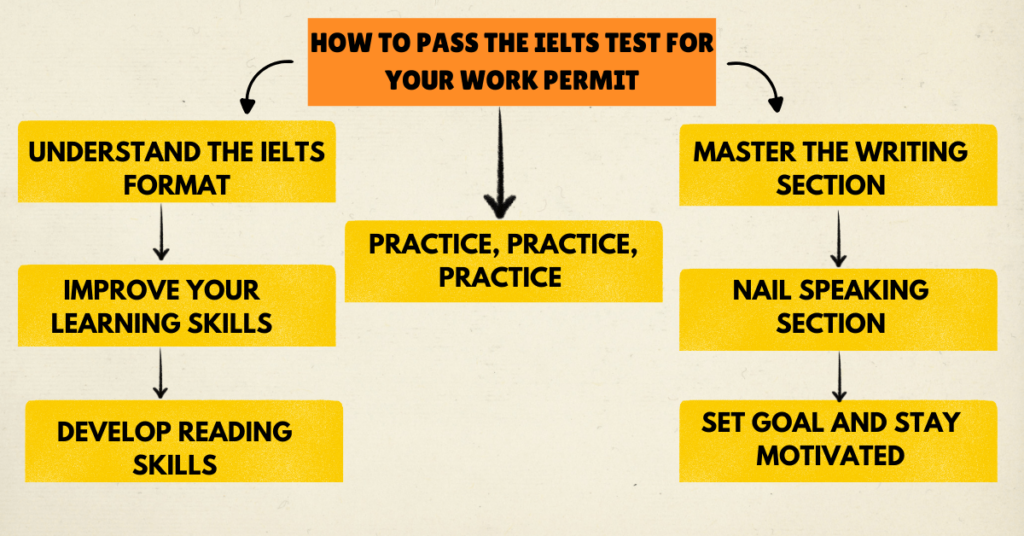

How to Pass the IELTS Test for Your Work Permit

How to Pass the IELTS Test for Your Work Permit

Are you dreaming of securing a work permit abroad? Whether it’s the fast-paced life in Canada, the tech boom in Australia, or the rich cultural heritage of the UK, there’s one crucial step between you and your dream job: the IELTS test. The International English Language Testing System (IELTS) is a requirement for anyone seeking a work permit in an English-speaking country. But here’s the good news – with the right strategy, mindset, and practice, passing the IELTS test is entirely achievable!

This guide will walk you through key steps to crack the IELTS exam and get closer to that work permit you’ve been working toward.

1. Understand the IELTS Format

The IELTS test assesses your English language skills across four areas: Listening, Reading, Writing, and Speaking. Each section is scored on a band scale from 1 to 9. The score you need depends on your destination country and job requirements.

Here’s a quick overview of what each section involves:

  • Listening: 40 questions based on four recorded monologues and conversations. (Duration: 30 minutes)
  • Reading: 40 questions testing comprehension from three texts. (Duration: 60 minutes)
  • Writing: Two tasks, including essay writing and report/letter writing. (Duration: 60 minutes)
  • Speaking: A face-to-face interview with the examiner. (Duration: 11-14 minutes)

Familiarizing yourself with the test format is the first step toward success. Knowing what to expect will help reduce exam anxiety and allow you to manage time effectively.

2. Improve Your Listening Skills with Authentic Resources

The Listening section evaluates not only your understanding but also your ability to follow different accents, word stress, and informal language. You’ll hear speakers from various English-speaking countries, so exposing yourself to different accents is key.

Pro Tips:

  • Watch English-language news channels like BBC, CBC, or Australian Broadcasting Corporation to get used to multiple accents.
  • Listen to podcasts on a variety of topics that interest you. Podcasts are great because they expose you to conversational English.
  • Practice listening to dialogues, interviews, and audio resources where speakers use different accents and speeds.

Regular exposure to authentic English content will sharpen your ability to catch key details and understand various accents, which is essential for scoring well in the Listening section.

Β 3. Develop Analytical Reading Skills

The Reading section is more than just scanning texts quickly. You’ll need to understand and analyze the material. This section requires you to identify key ideas, understand arguments, and draw inferences.

Pro Tips:

  • Read a variety of texts, such as newspapers, research articles, blogs, and opinion pieces. Focus on publications like The Guardian, The Economist, or National Geographic.
  • Pay attention to how the content is structured. Look at how arguments are presented, evidence is supported, and conclusions are drawn. This practice will help you recognize similar patterns in the IELTS exam.
  • Practice skimming for general ideas and scanning for specific information.

Make it a habit to ask yourself questions like, “What’s the main idea?” and “What’s the writer’s argument?” This will help you prepare for the wide range of texts you’ll encounter during the test.

4. Master the Writing Section with Structured Practice

For the Writing section, structure and clarity are essential. Task 1 typically involves writing a report based on visual data or a letter, while Task 2 requires you to write an essay on a specific topic. Here, you’ll need to demonstrate strong grammar skills and the ability to organize your thoughts logically.

Pro Tips:

  • Task 1: Practice writing short reports or letters. Focus on describing graphs, charts, or data trends in clear, concise language.
  • Task 2: Develop your essay-writing skills using a simple structure: Introduction, Body (two paragraphs), and Conclusion. Ensure each paragraph has a clear point and supporting evidence.
  • Avoid overly complicated sentences. Simplicity and clarity score higher than complex yet unclear writing.
  • Time yourself during practice. Write essays within the 40-minute limit for Task 2, and ensure you don’t spend more than 20 minutes on Task 1.

Aim for coherence (a smooth flow of ideas) and accuracy (correct grammar and vocabulary). These are the hallmarks of a high-scoring essay.

5. Nail the Speaking Section with Fluency and Confidence

The Speaking section can be intimidating because it involves a face-to-face interview with an examiner. However, it’s also one of the most rewarding sections if you can demonstrate fluency and confidence in your speaking ability.

Pro Tips:

  • Practice speaking English daily. Find a language partner or join an online speaking club to practice with native or fluent speakers.
  • Record yourself speaking on random topics, then listen to your recordings to improve pronunciation and fluency.
  • Focus on fluency over perfection. Don’t pause too often to think about grammar. Speak naturally and confidently.

The examiner isn’t looking for flawless English. Instead, they’ll assess how well you can communicate your ideas. Confidence plays a huge role here, so the more you practice, the more comfortable you’ll be during the actual exam.

6. Practice, Practice, Practice

There’s no shortcut to success in the IELTS exam – consistent practice is the key. Schedule dedicated time to practice each section of the test, and simulate real exam conditions whenever possible. This will help you manage your time during the actual test and avoid feeling overwhelmed.

Pro Tips:

  • Use official IELTS practice tests available online or in study books to familiarize yourself with the test format and question types.
  • Join IELTS preparation courses or work with a tutor to receive personalized feedback and guidance.
  • Track your progress by identifying mistakes and weak areas, then systematically work on improving them.

7. Set a Goal and Stay Motivated

Finally, keep your eye on the prize. Passing the IELTS test is your gateway to better job opportunities, higher income, and a world of possibilities. Set clear, achievable goals for each section, and stay disciplined in your preparation.

If you ever feel stuck or unmotivated, remind yourself why you’re taking this test. Your work permit is within reach, and each day of preparation brings you closer to that goal.

Final Thoughts

Passing the IELTS test isn’t just about language proficiency – it’s about preparation, practice, and persistence. By understanding the test format, honing your English skills, and developing the right strategies, you’ll be well on your way to success. Every day you spend preparing is a step closer to that work permit and the dream job you’ve been envisioning.

So, gear up, put in the effort, and get ready to ace the IELTS. Your future abroad is waiting for you!

Stay Connected with Fixolang

For more tips and real-time practice, connect with us on all our social media platforms:

Or download the Fixolang App for instant IELTS practice and feedback:

Prepare smarter, and pass your IELTS test with confidence. Happy learning!

Enhance Your Word Power: Discover the Benefits of the FixoLang App for English Vocabulary

Enhance Your Word Power: Discover the Benefits of the FixoLang App for English Vocabulary

Improving your vocabulary is not just about adding more words to your knowledge; it’s about shaping the way you communicate and understands the worldβ€”particularly if you are preparing for the IELTS exam. In this context, the FixoLangΒ app emerges as a light for many learners. It is not merely a tool; it is a companion on the journey to mastering English vocabulary effectively and efficiently. Let’s delve into how this innovative app stands out in the crowded field of language learning tools.

Unpacking the FixoLang App: A Gateway to Richer Vocabulary

Understanding the Core Features

The FixoLangΒ app is designed with the specific goal of helping users expand their English vocabulary. This is crucial for any part of the IELTS exam, whether it’s Reading, Writing, Speaking, or Listening. The app provides a user-friendly interface that makes learning new words not just necessary but also enjoyable.

Personalized Learning Journeys

One of the standout features of the FixoLangΒ app is its ability to create personalized learning journeys. Based on initial assessments and ongoing performance analysis, the app tailors vocabulary lists that are most relevant to the user’s learning level and goals. This bespoke approach ensures that learners are neither overwhelmed by the complexity of words that are too advanced nor bored by the simplicity of those they already know.

Innovative Strategies to Enhance Vocabulary Engagement

Innovative strategies to enhance vocabulary engagement can significantly benefit learners. One effective approach is using platforms like FixoLang, that offers an extensive range of cue cards. These cue cards cover various categories, providing learners with diverse contexts and themes. This variety not only helps in learning new words but also in understanding their usage in different situations. Engaging with such tools makes the learning process more interactive and less monotonous, encouraging deeper engagement and better retention of vocabulary. Such strategies are especially useful for exam preparation, where a broad vocabulary is essential.

Real-World Application: Preparing for IELTS

Targeted Practice for Each IELTS Section

The FixoLang app understands that each section of the IELTS test challenges different aspects of language competence. It offers targeted vocabulary lists that are curated to improve performance in each specific section. For instance, vocabulary that enhances descriptive language skills for the Writing section or idiomatic expressions that are often used in the Speaking section.

Simulated IELTS Tests

Practicing under real exam conditions is vital. The FixoLang app provides simulated tests where vocabulary understanding is put to the test in an exam-like environment. This not only helps in applying the learned vocabulary in appropriate contexts but also builds confidence in handling the pressure of the actual exam.

Personalized Feedback

The app also provides personalized feedback to every individual. This feature is invaluable for learners who need a bit more help in understanding complex vocabulary or for those who are stuck at a particular level and need professional advice to move forward.

FAQs on Vocabulary Learning with FixoLang

Can beginners use the app effectively?

Absolutely! The FixoLang is designed to cater to all levels of learners, from beginners to advanced. The personalized learning paths ensure that every learner starts from their comfort level and progresses at their own pace.

What makes the FixoLang app different from other language learning tools?

Unlike generic language learning tools, the FixoLang app focuses specifically on vocabulary needed for the IELTS exam. It includes features like personalized learning paths, extensive cue card categories, and simulated IELTS tests that provide a comprehensive and targeted learning experience.

What kind of vocabulary is covered in the app?

The app covers a wide range of vocabulary that includes day-to-day words, academic vocabulary, business English, idiomatic expressions, and phrasal verbs, among others.

Is there any feature in the app that helps with pronunciation?

Yes, the app includes audio pronunciations for each word, which is crucial for improving speaking and listening skills, especially in preparation for the IELTS.

Conclusion

In the search to conquer English vocabulary for the IELTS, the FixoLang app is more than just a toolβ€”it is a strategic ally. With its personalized learning paths, innovative retention strategies, and a supportive community, the app provides a comprehensive platform for serious IELTS candidates. By integrating the FixoLang app into your study routine, you are setting yourself up for success, equipped with a robust vocabulary that will serve not only in acing the exam but in all your English communications.

How to Master the IELTS Speaking Test with FixoLang | Step-by-Step

How to Master the IELTS Speaking Test with FixoLang

Taking the IELTS Speaking Test can feel like stepping onto a global stageβ€”exciting, nerve-wracking, and entirely conquerable when you’ve got the right tools. Enter FixoLang: your AI-powered speaking coach in your pocket, helping you ace cue cards one by one.

Why the IELTS Speaking Test Matters

This section gives you a chance to shine, demonstrating clarity, fluency, pronunciation, and insight. While nerves, vocabulary gaps, and timing can be hurdles, combining a strategic routine with tools like FixoLang can transform challenges into opportunities.

Step 1: Understand the Structure of the IELTS Speaking Test

The test is divided into three parts:

  • Part 1: Warm-up questionsβ€”about your background, routine, and interests.

  • Part 2: Cue card challengeβ€”prepare briefly, then speak for 1–2 minutes on a topic. If you’re wondering what types of cue cards can appear in the IELTS Speaking test, you can check out this blog – Top 20 IELTS Speaking Cue Card Questions for 2025.

  • Part 3: Deeper discussionβ€”explore ideas, opinions, and reasoning.

Familiarity with this structure builds confidence and flow.

Step 2: Download FixoLangβ€”Your AI IELTS Coach

Make your practice smarter and smoother with real-time feedback:

Use this tool to practice anytime, anywhere with AI-guided feedback.

Step 3: Stay Motivated with FixoLang’s Social Media

Engage with the learning community and get daily speaking insights:

  • Instagram: Follow @fixolang for bite-sized tips, vocabulary boosts, and speaking motivation.

  • YouTube: Look for FixoLang’s channel for cue card demos, vocabulary tutorials, and speaking strategy videos.

Step 4: Blend Expert Advice & Real Student Experience into Your Practice

Boost your performance using these proven strategies:

  • Avoid scripted answersβ€”authentic, natural responses score better.

  • Focus on clarity, not complexityβ€”short, confident phrasing beats awkward, long-windedness.

  • Mix sentence lengthsβ€”short to emphasise, long to expand your answer.

  • Use deliberate pausesβ€”they show reflection and control.

Stories from real users reinforce FixoLang’s value, helping learners improve through structured cue card practice and instant feedback.

Step 5: Enrich Vocabulary in Context

A strong lexical range elevates your Speaking Test responses:

  • Use topic-based cue cardsβ€”like β€œEnvironment” or β€œTechnology”—to learn vocabulary naturally.

  • Immediately practice new words by speaking sentences that include themβ€”this aids retention.

  • Use flashcards or journaling to reinforce newly acquired vocabulary.

Step 6: Set Up a Success-Oriented Routine

Consistency beats intensity. Here’s a sample weekly schedule:

Days Focus Area
1–2 Cue card practice, fluency-focused responses
3–4 Clarity, coherence, and vocabulary enrichment
Day 5 Full IELTS Speaking Test mock via FixoLang + review
6–7 Feedback review, targeted improvement, reinforcement

Just 15 minutes of daily practice can build fluency, confidence, and skill.

Why This Approach Makes You IELTS-Ready

Component Benefit
FixoLang + Cue Cards Realistic, repeatable practice with feedback
Social Media Learning Daily inspiration and useful speaking content
Vocabulary in Context Natural usage and memory retention
Structured Routine Builds fluency and test familiarity steadily
Instant Feedback Identifies strengths and areas for improvement

Mastering the IELTS Speaking Test is a journeyβ€”powered by consistent practice, smart tools, and confident mindset. With FixoLang guiding your speaking sessions, expert strategies enriching your approach, and your daily routine building momentum, the exam becomes just another conversation you walk in to ace.

Frequently Asked Questions (FAQs)

Mastering IELTS Speaking Test: Cue Cards & Prep with FixoLang App

Mastering IELTS Speaking Test: Cue Cards & Prep with FixoLang App

Introduction

The International English Language Testing System (IELTS) Speaking test assesses your English-speaking skills through a structured yet conversational interaction with a certified examiner. One of the most intriguing aspects of this test is the use of cue cards. But, what are the IELTS Speaking Test cue cards, and how can you use the FixoLang app to practice?Β Let’s dive in.Β 

The Role of Cue Cards in the IELTS Speaking Test

Cue cards in the IELTS Speaking test serve as prompts to guide the test-taker in part 2 of the examination. This segment requires you to speak on a topic provided on the cue card for 1 to 2 minutes.

What Are Cue Cards?

Cue cards are essentially task cards that provide a topic along with a set of guidelines or questions to consider in your response. They are designed to simulate a natural conversation topic, requiring you to organize your thoughts quickly and speak fluently on a given subject.

Number of Cue Cards in the IELTS Speaking Test

During the test, you will be given one cue card. While this might seem less intimidating, the challenge lies in effectively utilizing the one minute of preparation time you’re given to organize your thoughts and then speaking coherently for up to two minutes.

Strategies for Excelling in the IELTS Speaking Test

Preparing for the IELTS Speaking test, particularly the cue card segment demands a strategy that enhances both your fluency and coherence. The FixoLang app emerges as an invaluable tool in this aspect.

Practice Makes Perfect: Utilizing the FixoLang App

The FixoLang app offers a comprehensive suite of features designed to improve your speaking skills. It provides access to a wide range of practice cue cards, along with model answers and recordings. The FixoLang app is currently available for download on the Play Store and the App Store.

Features of FixoLang for Speaking Practice

    • Practice Cue Cards: Access to an extensive library of cue cards with topics ranging from easy to challenging.
    • Instant Scoring Feature: Get immediate feedback, advice, and your band score by recording your answer to the chosen topic exactly as you would in the real exam.

Tips for Effective Preparation with FixoLang

      • Consistent Practice: Regularly practice with different cue cards to enhance your ability to think on your feet.
      • Seek Feedback: Use the app’s feedback features to gain insights into your speaking strengths and areas for improvement.

Additional Preparation Tips for the IELTS Speaking Test

    • Understand the Assessment Criteria: Familiarize yourself with how your speaking will be evaluated.
    • Time Management: Practice speaking for two minutes to ensure your responses are well-structured and complete.
    • Seek Feedback: Regular feedback is crucial for improvement, making tools like FixoLang invaluable.

IELTS Speaking Test FAQs

How to practice for IELTS speaking test alone?

Prepare independently for the IELTS speaking test by practicing, recording your speech, and analyzing your fluency and pronunciation for continuous improvement.

Can I use complex vocabulary during the speaking test?

Yes, but with caution. Using complex vocabulary correctly can showcase your language proficiency. However, using words accurately is more important than misusing more complex terms. Focus on clarity and appropriateness of vocabulary to the topic.

How often should I practice with cue cards?

Regular practice is key. Aim to practice with at least one cue card daily. This frequency helps you become comfortable with structuring your thoughts quickly and speaking on a variety of topics.

How can I improve my fluency for the speaking test?

Improving fluency for the IELTS Speaking test involves consistent practice and exposure to the English language.

What are the common mistakes to avoid in the speaking test?

Common mistakes in the speaking test include Hesitation and Repetition, Off-topic Responses, Limited Vocabulary, and Ignoring Grammar and Pronunciation.

Conclusion

Preparing for the IELTS Speaking test, especially mastering the cue card section, is a journey that requires practice, strategy, and the right tools. The FixoLang app stands out as a comprehensive resource that can guide you through this process, from understanding the role of cue cards to offering practical, hands-on practice opportunities. By integrating these strategies and leveraging technology, you’re not just preparing for a test you’re enhancing your English-speaking skills for real-world interactions.