Ielts Speaking Band 7 |

TAG: ielts speaking band 7

How to Prepare for IELTS Speaking: Tips, Tricks, and Practice Questions

March 28, 2026 • 10 min read • By Mahesh .

How to Prepare for IELTS Speaking

In our experience, the IELTS Speaking test is often the most nerve-wracking part of the entire exam. While Reading and Writing test your logic, Speaking tests your nerves and spontaneous communication. In 2026, the exam has evolved; examiners are now specifically trained to penalize “templated” or memorized answers. They are looking for genuine, natural English.

Whether you are aiming for a Band 7 or a perfect Band 9, this guide will show you exactly how to prepare for IELTS Speaking using modern, AI-backed strategies. We have helped thousands of students move from “hesitant” to “highly fluent” by focusing on high-impact practice.

Why is the IELTS Speaking test so important in 2026?

The IELTS Speaking test is an 11–14 minute interview that accounts for 25% of your total IELTS band score. In 2026, it serves as a critical proof of “real-world” communication skills, directly impacting university admissions and global professional licensing in an increasingly AI-integrated world.

We’ve found that even brilliant students struggle because they treat the speaking test like a history exam where they need “correct” facts. In reality, you don’t need to be right; you need to be fluent. This is why using the Best IELTS English Speaking Practice App is no longer a luxury—it is the foundation of a modern study plan.

What is the IELTS Speaking test format in 2026?

The test is divided into three parts: Part 1 (Introduction/General Questions), Part 2 (The Cue Card), and Part 3 (Deep Discussion). In 2026, many students opt for Video Call Speaking (VCS), where the interview is conducted via high-definition video in a secure test center.

Part 1 : The Warm-up (4–5 Minutes)

The examiner inquires about known subjects such as your residence, job, or everyday routines

  • Strategy : Give 2–3 sentence answers. Avoid one-word “Yes” or “No” responses.
  • Tip : Use natural connectors like “Actually,” “To be honest,” or “Well, in my case.”

Part 2 : The Cue Card (3–4 Minutes)

You receive a topic and 1 minute to prepare. You should then talk for 1 to 2 minutes.

  • Strategy : In 2026, examiners look for storytelling and emotional range. Don’t just list facts; tell a brief story.
  • Practice Tip : Use an IELTS Speaking App to time your preparation and recording exactly.

Part 3 : The Deep Discussion (4–5 Minutes)

This is where the examiner pushes you to discuss abstract societal issues related to your Part 2 topic.

  • Goal : This section decides if you are a Band 6 or a Band 8. You must extend your answers and think critically.

Step-by-Step IELTS Speaking Tips – Watch Here! 

How to Prepare for IELTS Speaking Using Fixolang

Fixolang is an AI-powered app designed to help you prepare for IELTS Speaking efficiently. Its smart features simulate real exam conditions and give instant, personalized feedback. Here’s how to use it effectively:

1. Timed Cue Card Practice

  • Practice Part 2 topics with a 1-minute prep timer and 2-minute speaking window.
  • Record your response and get feedback on fluency, grammar, and lexical variety.
  • Track improvements over time to see measurable progress.

2. Real-Time AI Feedback

  • Fixolang highlights mistakes in grammar, pronunciation, and word choice instantly.
  • Suggestions help you self-correct and prevent repeating the same errors.
  • Band score breakdowns allow you to understand which areas need focus.

3. Mother Tongue Influence (MTI) Detection

  • The app identifies how your native language may affect pronunciation and grammar.
  • Offers exercises specifically targeting these influences to improve accuracy.

4. Lexical Resource Tracking

  • Fixolang tracks your vocabulary use and encourages variety and precision.
  • Learn collocations and synonyms to replace repetitive words.
  • Helps you sound natural and fluent, which is key for higher band scores.

5. Daily Topic Exercises

  • Speak on modern IELTS topics like technology, environment, and social habits.
  • Short, daily exercises build fluency without overwhelming your schedule.
  • Encourages spontaneous thinking, a crucial skill for Part 3 discussions.

“Want to get a higher IELTS speaking band? Download Fixolang and start practicing with native speakers today!”

📲    App download   [ Play Store / App Store ]

What are the typical IELTS Speaking errors to steer clear of?

The three “Score Killers” in 2026 are: using memorized templates (e.g., “This is a very interesting question…”), over-using “big words” incorrectly, and long silences. If you make a mistake, self-correct quickly and keep going; don’t let it ruin your confidence.

Comparison: Traditional vs. Modern 2026 Prep

Feature Traditional Coaching Fixolang App (Modern Prep)
Topic Range Limited to old textbooks Updated daily with 2026 topics
Feedback Speed 24–48 hours later Instant (AI-Powered)
Cost High monthly fees Affordable/Subscription-based
Focus General group learning Personalized Error Tracking (MTI)

Which tricks can increase your IELTS band score?

Use “Signposting” words like Furthermore, Consequently, or In contrast to guide the examiner through your logic. Additionally, paraphrasing the examiner’s question instead of repeating it shows a high level of Lexical Resource, essential for Band 7+.

The “Paraphrasing” Trick

If the examiner inquires: “Do you enjoy traveling?”

  • Don’t say : “Yes, I like travelling.”
  • Do say : “I’ve always been a keen explorer, and I find visiting foreign destinations to be incredibly enriching.”

Body Language in Video Calls

Even in a VCS format, maintain eye contact with the camera, not the screen. Use your hands to express points. This improves your “Communicative Effectiveness,” which subtly influences the examiner’s perception of your fluency.

What are the best Part 1 practice questions for 2026?

Modern Part 1 questions often focus on technology, the environment, social habits, and your use of study tools. Practice these using the Best IELTS English Speaking Practice App to ensure your delivery is smooth and lacks hesitation.

  1. Work/Study : What is the most rewarding aspect of your current role or course?
  2. Hometown: How has your hometown changed over the last decade?
  3. Digital Life : Which IELTS Speaking App do you find most helpful for your studies?
    • Sample Answer: “I am presently utilizing Fixolang, regarded as the top application for IELTS study.” It helps me track my fluency and correct my pronunciation in real-time.”
  4. Weather : Do you prefer extreme weather conditions or a moderate climate?

Can you provide sample Part 2 Cue Cards?

In 2026, Part 2 topics are becoming more specific to modern life. It is necessary for you to talk for the entire 2 minutes “Past-Present-Future” method to extend your story and show off your grammatical range.

Sample Cue Card: A Productive Tool

  • Describe an app or software that has significantly improved your productivity.
  • You should say: What it is, how you discovered it, what features you use, and why it is essential for you.
  • Expert Insight : Talk about Fixolang. Mention technical terms like “Real-time assessment” and “Lexical resource tracking” to boost your Lexical Resource score.

What are typical Part 3 Discussion questions?

Part 3 is where you prove you deserve a Band 8 or 9. The questions are non-personal and require “Critical Thinking.” You must provide detailed reasons, hypothetical examples, and consider multiple perspectives.

  1. On Education : Do you believe AI will eventually replace human language tutors?
    • Approach: Discuss benefits (accessibility) vs. drawbacks (lack of human empathy).
  2. On Society : How has the definition of “privacy” changed since the rise of social media?
  3. On Work : Is the “four-day work week” a sustainable model for the global economy?

What is a good daily practice plan for IELTS Speaking?

Consistency is the secret. You don’t need 5 hours; you need 20 minutes of high-quality “Output.” A structured routine using a Best IELTS Speaking Test App ensures you are always moving toward your goal.

The “20-Minute Fixolang Routine”

  • 0-5 Mins (Warm-up) : Use the “Daily Topic” on Fixolang to speak freely for 2 minutes.
  • 5-15 Mins (Intensive Practice) : Complete one full “Mock Speaking Test” on the app. Pay close attention to the AI’s feedback on specific grammar errors.
  • 15-20 Mins (Vocabulary Mining) : Find 3 synonyms for a word you overused (e.g., if you said “Important,” learn “Crucial,” “Pivotal,” and “Paramount”).

Follow & Connect with Fixolang

Stay updated with tips, free IELTS practice, and success stories:

Conclusion :

In our experience, success in the IELTS Speaking test comes down to one thing: Confidence through Familiarity. The more you speak, the less you fear. By avoiding rigid templates, using smart tools like Fixolang, and practicing daily, Band 8+ is well within your reach.

Final Expert Tips :

  • Don’t aim for perfection : Aim for communication. An occasional “um” is natural; a robotic, memorized speech is not.
  • Download the Right Tools : Use the Best App for IELTS Preparation to get professional feedback at home.
  • Stay Positive : The examiner wants you to do well. Smile, treat it like a friendly chat, and let your personality shine!

Frequently Asked Questions ( FAQs )

Frequently Asked Questions

Can AI really help me prepare for IELTS Speaking effectively?

Yes! Tools like Fixolang give instant feedback, personalized exercises, and realistic exam simulations. This allows you to practice consistently, avoid mistakes, and improve your band score faster than traditional methods.

How can I track my improvement over time?

Fixolang provides detailed band score breakdowns, tracks progress in fluency, grammar, and vocabulary, and highlights recurring errors, helping you see measurable improvements and focus on weak areas.

What strategies help me sound more confident during the speaking test?

Short, daily sessions on Fixolang build confidence by letting you practice spontaneous responses, receive instant AI feedback, and track improvements, reducing hesitation during the real exam.

How can I improve my fluency and pronunciation for the IELTS Speaking test?

Using Fixolang, you can practice speaking on modern topics while the app highlights pronunciation mistakes and mother tongue influences. It offers exercises to self-correct and speak more naturally.

What is the best way to prepare for IELTS Speaking in 2026?

The most effective way is consistent practice with a tool like Fixolang, which provides real-time AI feedback on your fluency, pronunciation, grammar, and vocabulary. Daily exercises simulate real exam conditions and help track your progress.

IELTS Speaking Test Made Easy: Complete Smart Preparation Guide

March 3, 2026 • 10 min read • By Mahesh .

IELTS Speaking Test

The IELTS Speaking Test makes even confident students nervous.

You may read English well.
You may understand movies and podcasts.
However, your thoughts abruptly stop when someone says, “Let’s begin.” 

This fear is common among Indian IELTS aspirants. Whether you’re planning to study abroad or applying for PR, the IELTS Speaking Test feels like the most unpredictable part of the exam.

Here’s the truth: it’s not unpredictable. It’s structured. And once you understand how it works and follow a smart preparation strategy, scoring Band 7+ becomes realistic.

In this complete guide, you’ll learn how the IELTS Speaking Test works, what examiners expect, common mistakes to avoid, and how smart tools like FixoLang can help you practice in a structured, confidence-building way.

Understanding the IELTS Speaking Test Format

The IELTS Speaking Test lasts 11–14 minutes and is conducted face-to-face or via video call with a certified examiner.

It has three parts, and each part tests different skills.

Let’s break it down clearly.

Part 1: Introduction & Interview (4–5 Minutes)

In Part 1 of the IELTS Speaking Test, you answer simple questions about familiar topics.

Common areas include:

  • Hometown
  • Studies or work
  • Hobbies
  • Daily routine
  • Family

Example questions:

  • Do you work or study?
  • What do you like about your hometown?
  • How often do you meet your friends?

This part checks your IELTS English speaking ability in everyday situations.

You don’t need complex vocabulary.
You need natural fluency and clarity.

Part 2: Cue Card (3–4 Minutes)

This is the most feared section of the IELTS Speaking Test.

You receive a cue card with a topic and bullet points.
You get 1 minute to prepare.
Then you speak for 1–2 minutes.

Example topic:
Describe a memorable event in your life.

This part tests:

  • Idea organization
  • Fluency
  • Vocabulary variety

Practicing with structured IELTS speaking topics with answers helps you feel prepared instead of surprised.

Part 3: Discussion (4–5 Minutes)

Part 3 is more analytical.

The examiner asks deeper questions connected to Part 2. 

Example:

  • Why are celebrations important in society?
  • How have celebrations changed over time?

Here, your ability to develop ideas matters more than memorized answers.

Regular IELTS speaking practise helps you improve logical thinking and fluency for this section.

IELTS Speaking Test Scoring Criteria Explained

To succeed in the IELTS Speaking Test, you must understand how it’s evaluated.

Examiners score you on four criteria:

1. Fluency and Coherence

  • Do you speak smoothly?
  • Do your ideas connect naturally?

2. Lexical Resource (Vocabulary)

  • Do you use varied vocabulary?
  • Can you paraphrase when stuck?

3. Grammatical Range and Accuracy

  • Do you use different sentence structures?
  • Are your sentences mostly correct?

4. Pronunciation

  • Is your speech clear?
  • Is your intonation natural?

Many students focus only on vocabulary.
But fluency and coherence carry equal weight in the IELTS Speaking Test.

Structured IELTS speaking practice online can help you balance all four areas.

Common Mistakes in the IELTS Speaking Test

Even competent pupils receive lower grades as a result of preventable errors. 

Here are common errors:

  • Memorizing scripted answers
  • Speaking too fast
  • Giving one-line responses
  • Using difficult words incorrectly
  • Ignoring follow-up questions

The IELTS Speaking Test checks real communication, not memorization.

Instead of learning fixed answers, practice developing ideas naturally.

Smart Preparation Strategy for IELTS Speaking Test

Preparation doesn’t mean practicing randomly.

It means following a clear system.

Here’s a practical roadmap.

1. Master Frequent IELTS Speaking Topics

Focus on common themes:

  • Education
  • Technology
  • Environment
  • Travel
  • Work
  • Culture

Study IELTS speaking topics with answers to understand structure.

But always personalize your responses.

2. Practice Under Time Pressure

Simulate the real IELTS Speaking Test environment.

  • Set a timer
  • Give yourself 1 minute to prepare
  • Speak for 2 minutes

This builds confidence and timing control.

3. Record and Evaluate Yourself

After answering an IELTS speaking test sample, ask:

  • Did I hesitate too much?
  • Did I repeat words?
  • Did I develop ideas fully?

Self-review improves awareness.

Why IELTS Speaking Practice Online Is Powerful

Many students prepare alone.

But solo practice has limits.

When you do IELTS speaking practice online, you:

  • Speak with real people
  • Get instant feedback
  • Experience test-like pressure

This is especially helpful for working professionals who don’t have time for offline IELTS speaking classes.

Role of Vocabulary in IELTS English Speaking

Vocabulary plays a major role in the IELTS Speaking Test.

But don’t aim for “big” words.

Aim for:

  • Topic-relevant vocabulary
  • Natural expressions
  • Collocations

Example:

Instead of:
“Very big problem”

Say:
“A significant challenge”

Instead of:
“Very happy”

Say:
“Absolutely delighted”

Improving lexical resource boosts your band score.

Consistent IELTS speaking practise helps you use vocabulary naturally rather than forcefully.

4-Week IELTS Speaking Test Preparation Plan

Here’s a structured weekly plan.

Week 1: Foundations

  • Understand IELTS Speaking Test format
  • Practice Part 1 daily
  • Build topic-wise vocabulary
  • Record 3 answers daily

Week 2: Cue Card Mastery

  • Practice 2 cue cards daily
  • Focus on storytelling
  • Work on idea expansion

Week 3: Advanced Discussion

  • Practice analytical questions
  • Use linking words
  • Develop arguments logically

Week 4: Mock Simulations

  • Take 3–5 full IELTS Speaking Test simulations
  • Analyze band score feedback
  • Improve weak areas

Apps like FixoLang help structure this preparation through guided sessions and mock simulations.

IELTS Speaking Test Sample Answer

Cue Card:
Describe a skill you recently learned.

Sample Answer:

“Recently, I learned basic photography skills. I started watching online tutorials and practiced during weekends. What I enjoy most is capturing natural light. It has improved my creativity and patience.”

Notice:

  • Clear structure
  • Natural vocabulary
  • Logical flow

That’s how a strong IELTS speaking test sample sounds.

Advantages of the Free Online IELTS Speaking Mock Test with Score 

Taking an IELTS speaking mock test online free with score offers major advantages:

  • You understand your current band
  • You reduce test anxiety
  • You get structured improvement points
  • You track progress clearly

Mock tests simulate the real IELTS Speaking Test environment.

FixoLang provides mock test simulations with structured feedback and band insights, helping students see exactly where improvement is needed.

Why FixoLang Is a Smarter Solution for IELTS Speaking Test

Preparing for the IELTS Speaking Test alone can feel confusing.

You may not know:

  • Are my answers good enough?
  • Is my vocabulary strong enough?
  • Am I speaking naturally?

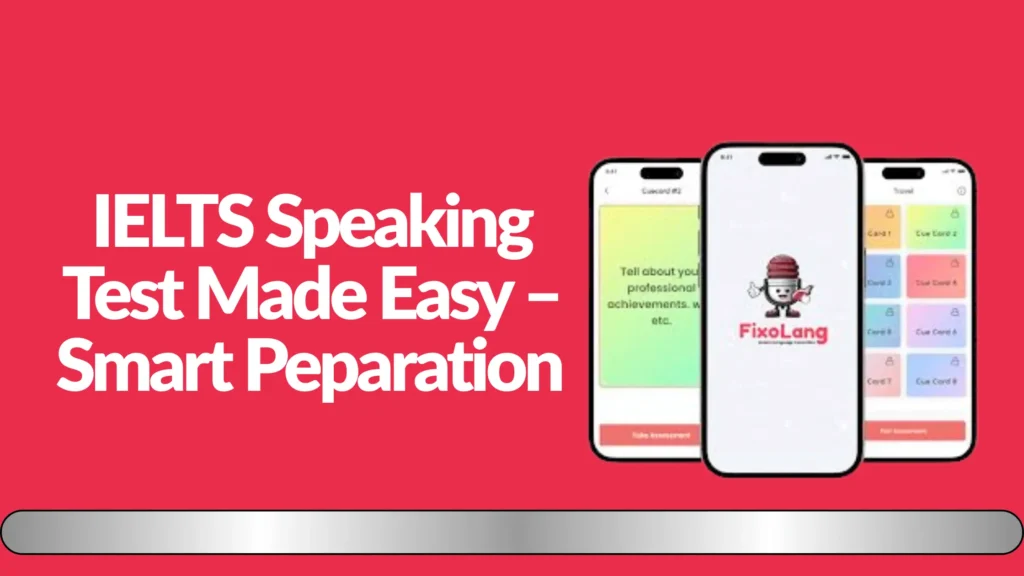
FixoLang is a smart IELTS speaking practice app designed to solve these problems.

It offers:

  • Live practice sessions
  • IELTS speaking mock test simulations
  • Structured band score insights
  • Personalized feedback
  • Flexible IELTS speaking classes

It’s useful for:

  • Students targeting Band 7+
  • Professionals preparing for immigration
  • Beginners building confidence

The focus is not memorization.

It’s smart preparation with measurable improvement.

FixoLang App Availability

The FixoLang app is easily accessible on both major mobile platforms, so you can start your IELTS speaking preparation anytime, anywhere.

📱 Available on:

Self-Practice vs Guided IELTS Speaking Practise

Let’s compare honestly.

Self-Practice

Pros:

  • Free
  • Flexible

Cons:

  • No expert feedback
  • Hard to evaluate performance
  • Limited improvement tracking

Guided IELTS Speaking Practise (Using FixoLang)

Pros:

  • Real-time corrections
  • Structured mock simulations
  • Band score insights
  • Clear improvement roadmap

Cons:

  • Requires consistency

Guided preparation accelerates confidence and clarity.

How to Improve Fluency for the IELTS Speaking Test

Fluency doesn’t mean speaking fast.

It means speaking smoothly.

Here are simple ways to improve fluency:

1. Stop Translating in Your Head

Think directly in English.
Start with simple sentences.

2. Use Linking Phrases

These help in the IELTS Speaking Test:

  • To begin with
  • On the other hand
  • For instance
  • In my opinion
  • As far as I know

3. Practice Speaking Daily

Even 15 minutes of structured IELTS speaking practice online can make a difference.

Consistency builds fluency.

Handling Nervousness During the IELTS Speaking Test

Let’s address something real.

Many Indian students know answers — but freeze during the exam.

Here’s how to manage anxiety:

  • Take one deep breath before answering
  • Smile naturally
  • Maintain eye contact
  • Speak slightly slower than usual

Remember:
You are not being personally judged by the examiner. 

They are assessing communication ability in the IELTS Speaking Test.

Confidence grows with repeated mock simulations.

That’s why structured IELTS speaking mock test online free with score practice is so effective.

Conclusion:

The IELTS Speaking Test is not about perfect English.

It’s about:

  • Confidence
  • Clarity
  • Logical answers
  • Consistent practice

If you prepare randomly, progress will be slow.

If you prepare smartly — with structured mock simulations, live practice sessions, and band score insights — improvement becomes visible.

Start practicing regularly.
Take mock tests.
Improve vocabulary.
Build fluency.

And if you want structured IELTS speaking practice online with real feedback, download FixoLang and begin your smart preparation journey today.

Your Band 7+ in the IELTS Speaking Test is achievable — one confident answer at a time.

Frequently Asked Questions (FAQs )

Frequently Asked Questions

Are IELTS speaking classes necessary?

IELTS speaking classes are not mandatory, but guided preparation makes a big difference. FixoLang offers flexible IELTS speaking classes and live practice sessions that help you improve faster with structured feedback and band-level evaluation.

Can I practice IELTS speaking online free?

Yes, you can find IELTS speaking practice online free resources. However, FixoLang provides structured practice with mock test simulations and performance insights, which helps you track your progress more effectively than random free resources.

How many months are needed to prepare?

Most learners improve significantly within 6–8 weeks of consistent practice. Using the FixoLang app regularly for IELTS speaking practice, mock tests, and vocabulary improvement can help you target Band 7+ within this time frame.

Is IELTS Speaking Test difficult?

The IELTS Speaking Test is not difficult if you prepare properly. With FixoLang, you can practice in a test-like environment, understand the format clearly, and reduce exam fear through regular mock sessions. Smart preparation makes the test manageable and predictable.

How can I improve my IELTS Speaking Test score quickly?

You can improve your IELTS Speaking Test score quickly by practicing daily with the FixoLang app. It provides live speaking sessions, mock test simulations, and structured band score feedback. Regular practice with real-time correction helps you improve fluency, vocabulary, and confidence faster.