HR Interview Communication Skills |

Tag

HR interview communication skills

Best English Speaking Apps for HR Interview Practice (2026) — Tested for Freshers

June 1, 2026 • 12 min read • By Rishish Pandey

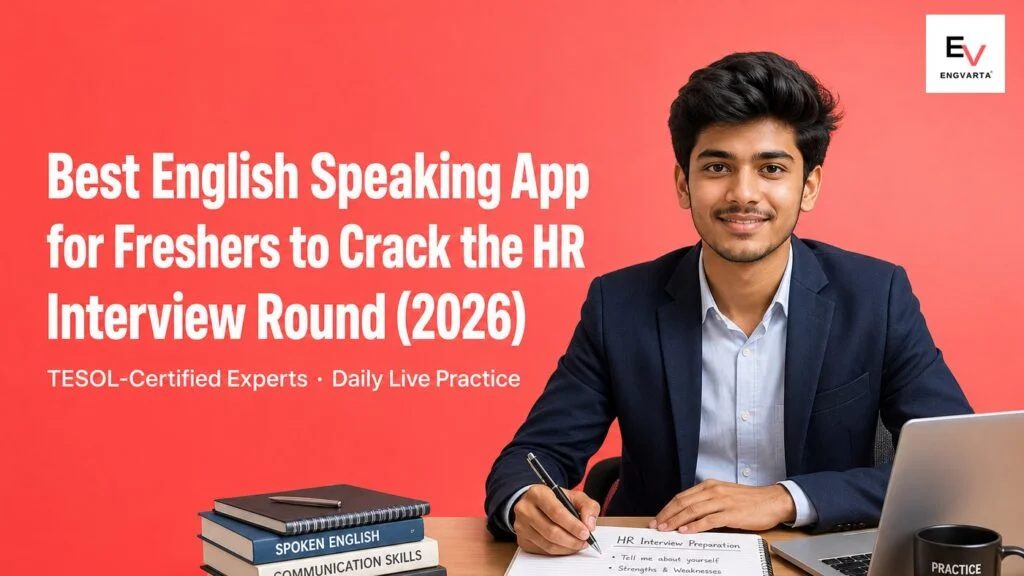
Indian fresher practising spoken English for an HR interview round — best English speaking app for freshers HR interview round 2026
Quick answer For live HR mock rounds with real-time correction, practise with a trained Expert on EngVarta. for free mock interviewer, ChatGPT Voice Mode; for AI app for answer rehearsal, Speak; for clearer delivery of key lines, ELSA Speak; for native-speaker mock practice, Cambly; for hand-picking an interview-coach tutor, italki / Preply. Most people pair one free option for volume with one structured option for feedback.

For the HR round — self-introduction, common questions, strengths and weaknesses, salary and notice-period answers, and confident spoken delivery, with a daily live-practice plan.

How we picked

We ranked each option on what the HR round actually tests: live mock-interview practice, real-time correction of spoken answers, a private low-pressure format, fit for the HR round specifically — self-introduction, strengths and weaknesses, salary and notice-period talk — and pricing a fresher can sustain for daily pre-interview reps. We also cross-checked our shortlist against what freshers are commonly recommended for this exact goal. Pricing and features were verified in June 2026, and competitor names are mentioned for context only.

Why freshers freeze in the HR round even when their English is okay

Most freshers have studied English for years and read it comfortably. The gap shows up only when they have to speak under pressure, in front of a real interviewer, for the first time. The problem is rarely vocabulary or grammar — it is assembly speed and nerves. The brain forms the answer in the mother tongue first, then converts it to English, which adds a visible pause and burns the mental energy that should go into the actual answer.

Three patterns are common: the memorised-answer freeze, where a learnt self-introduction collapses the moment the interviewer asks a small follow-up; the translate-then-speak lag that makes answers slow and hesitant; and over-formal textbook phrasing that sounds rehearsed. Reading more sample answers cures none of them. They close only with spoken reps under live correction — which is why the right tool for the HR round is one that makes you speak, not one that makes you read.

The best apps for HR interview English practice

1. EngVarta

EngVarta gives you a daily 15-minute live 1-on-1 audio session with a TESOL/ESL-certified English Expert who runs the exact parts of the HR round that trip freshers up.

  • Price: ₹69 / $1 refundable trial; ₹2,700 / $45 for 25 sessions (~₹108 / $1.80 each)
  • Best for: live HR mock rounds

2. ChatGPT Voice Mode

Prompt it to act as an HR interviewer, deliver your self-introduction, and have it ask the common questions plus a few follow-ups — a genuinely useful, always-available way to rehearse before the real thing.

  • Price: Free (with usage limits); ChatGPT Plus $20/month
  • Best for: free mock interviewer

3. Speak

An AI app with spoken drills and roleplay that gets your answers out of your mouth quickly, good for warming up the self-introduction before a live session.

  • Price: from $17.99/month (Premium), ~₹1,700/month
  • Best for: AI app for answer rehearsal

4. ELSA Speak

An AI app that scores pronunciation and word stress, useful for cleaning up your opening line, your company name, and the terms you must get right when nerves make speech rush.

  • Price: free tier; ELSA Pro from ~$11.99/month (~₹1,150)
  • Best for: clearer delivery of key lines

5. Cambly

On-demand video chat with native tutors who can run a casual mock interview, useful if you want native-accent exposure before a global-company round.

  • Price: from ~$11 per 30-min session (auto-renewing subscription)
  • Best for: native-speaker mock practice

6. italki / Preply

Marketplaces where you can book a tutor and brief them to drill the HR round — helpful if you want one person who knows interview coaching.

  • Price: italki community tutors ~$4–20/lesson; Preply from ~$15/hour
  • Best for: hand-picking an interview-coach tutor

AI answer practice vs live mock rounds: when to use each

AI tools like ChatGPT Voice and Speak are genuinely useful for one job: getting your answers out of your mouth so the words stop being a blank page. Use them to warm up — it is one of the cheapest, most available things a fresher can do. But an app can’t fully give you a real interviewer. It never makes you nervous, never reacts impatiently, and accepts a translated, hesitant answer as readily as a confident one, so it does not train the composure half of the HR round.

That half is built with a live person. A real Expert makes you hold eye-contact-equivalent focus, adds a follow-up you did not expect, and corrects your phrasing the instant it slips — under the kind of pressure a panel creates. For an Indian fresher, an Expert who knows exactly where HR-round nerves show up, at a price a student can sustain, turns rehearsal into real readiness. Use AI to warm up; use live mock rounds to walk in ready.

Comparison at a glance

App Live human Real-time correction HR-round mock practice Fresher / India context
EngVarta Yes (1-on-1 Expert) Yes, during the call Yes (self-intro, follow-ups, salary talk) Yes
ChatGPT Voice No (AI) Generic feedback Q&A only, no real interviewer Partial
Speak No (AI) Limited Answer rehearsal only Partial
ELSA Speak No (AI) Pronunciation only No Partial
Cambly Yes (native tutor) Varies by tutor Casual mock possible Limited
italki / Preply Yes (tutor) Varies by tutor If you brief the tutor Limited

This ranking is based on fit for the HR interview round specifically — live mock practice, answer correction, beating the freeze — not general English-learning popularity.

Best option for freshers by need

Your situationBest optionWhy
Understand English but freeze in interviewsEngVartaLive mock rounds build a response reflex faster than reading answers.
Want free, solo rehearsal the night beforeChatGPT Voice / SpeakAlways-on AI rehearsal of your self-introduction and common answers.
Clients/panel often ask you to repeat yourselfELSA SpeakPronunciation and stress drills make key lines clearer.
Want native-accent mock before a global-company roundCamblyNative tutors on demand for casual mock practice.
Need basic grammar before live answer practiceSelf-study / grammar courseBuild sentence basics first, then move to live reps.

HR-round questions freshers should practise out loud

HR questionWhat to practise
Tell me about yourselfA 60-second structured introduction: background, key skills, and what you bring.
Why should we hire you?Match two or three strengths to the role in clear, confident sentences.
What are your strengths and weaknesses?Honest strengths with one example; a weakness you are actively improving.
Where do you see yourself in five years?A realistic, growth-focused answer tied to the role.
Salary expectation and notice period?Calm, polite handling without under-asking or over-asking.

A 2-week HR-round practice plan for freshers

Week 1 — break the freeze. Daily 15-minute live audio sessions on easy topics and your self-introduction, so speaking English for 15 unbroken minutes feels normal. The Expert flags where you translate before speaking and pushes you to answer directly, while AI rehearsal on ChatGPT Voice or Speak fills any day too chaotic for a live call.

Week 2 — drill the HR round. Move to mock rounds: the Expert plays the interviewer, asks the common questions and follow-ups, and corrects answer framing in real time, with consolidated feedback at the end of each call. By the end of the week you complete a full mock HR round without freezing for more than a couple of seconds. Recordings stay accessible for 30 days, so you can replay a tricky exchange and shadow the Expert’s phrasing.

Frequently Asked Questions

Q1. Which app is best for freshers to prepare for the HR round?

Ans: EngVarta is a strong fit for freshers because they can practise the HR round live with an English Expert who role-plays the interviewer, corrects the self-introduction and common answers during the call, and builds response confidence before the real interview. AI apps like ChatGPT Voice and Speak are useful warm-ups, but they cannot reproduce real-panel pressure.

Q2. How can a fresher improve English quickly before an HR interview?

Ans: Daily 15-minute live speaking practice for two to three weeks usually produces visible improvement. Freshers rehearse the self-introduction and common HR answers out loud with an Expert, fix phrasing in real time, and build the response speed that reading sample answers alone does not give.

Q3. What does the HR round actually test for freshers?

Ans: The HR round tests communication, clarity, attitude, and self-awareness — not technical depth. Freshers are judged on how confidently they introduce themselves, explain strengths and goals, and handle salary or notice-period questions in clear spoken English.

Q4. Can AI apps replace a live mock interview?

Ans: Not fully. AI apps like ChatGPT Voice and Speak are excellent for solo rehearsal and for generating practice questions, but they do not apply real interviewer pressure or surprise follow-ups, and their feedback is generic. The most effective approach pairs AI rehearsal with live mock rounds that correct your delivery under pressure.

Q5. How many days of practice do freshers need before the HR round?

Ans: For a fresher at intermediate English level, daily 15-minute live practice over two to three weeks is usually enough to walk into the HR round without freezing. Start earlier if your interview is further away so you can also drill follow-up questions and a full mock round.

Q6. Can freshers practise HR answers privately without being judged?

Ans: Yes. Private 1-on-1 practice lets freshers rehearse the self-introduction, the weaknesses question, and salary talk with an Expert before facing a real panel — no classroom, no peers, and no embarrassment while making and fixing mistakes.

Reviewed by the EngVarta content team. Pricing and features verified June 2026; competitor details are summarised from public sources and mentioned for context only.

Best English Speaking App for College Students Preparing for Campus Placement Interviews (2026): Professor-Recommended for Interview Confidence

May 25, 2026 • 14 min read • By Rishish Pandey

Best English Speaking App for Campus Placements and interview preparation for college students

Quick Verdict

For Indian college students preparing campus placements, many learners now search for the best English speaking app for campus placements in 2026. EngVarta stands out because it gives daily live mock-interview practice with TESOL-certified English Experts on HR rounds, technical screening, and behavioural answers. Add peer group practice for GD specifically.

Why this verdict:

  • Best for: pre-final and final-year students before campus placements
  • Practice focus: HR rounds, technical screening, behavioural STAR answers, GD rhythm
  • Not ideal for: students whose technical or aptitude prep is the actual gap

Why Campus Placement Interview English Is Unlike Anything College Taught You

Indian engineering and arts colleges teach English as a subject — comprehension, essays, grammar, occasionally a presentation or two. They rarely teach spoken interview fluency. So you walk into your first campus placement round having never actually practiced answering a tough behavioural question out loud, in real time, with someone pushing back.

Campus recruiters know this. The HR round and behavioural round are deliberately designed to test exactly what college did not prepare you for:

  • Real-time response under interview pressure. The interviewer asks a question. You have 5 seconds to start answering coherently. There is no editing, no rewriting, and no time to construct the ideal words; simply speak.
  • STAR-format behavioural questions. “Tell me about a time you worked under a tight deadline.” “Describe a conflict in a team project.” You need a 90-second structured answer with situation, task, action, result — in confident spoken English without rehearsed-sounding delivery.
  • Group discussion (GD). 8-10 candidates, one moderator, a topic announced 30 seconds before the discussion starts. You need to enter the conversation, hold your point under interruption, build on others’ arguments, and summarise at the end. Students typically freeze within the first minute
  • Technical screening in spoken English. Even technical interviews are conducted in English now. Explaining a concept clearly in spoken English (not just writing code or recalling a definition) is the actual test.
  • “Tell me about yourself” answer. The deceptively simple opener. Most Indian students give a rambling chronological account (“I was born in…” or “My parents are…”). Trained students give a 60-second professional positioning that maps their background, key wins, and the role they want next.

None of these are knowledge gaps. They are spoken-English-under-pressure gaps, and they close only with daily live practice in interview scenarios.

The Six Campus Placement Interview Scenarios Every Indian Student Should Drill

1. “Tell me about yourself” — the 60-second answer that opens every interview

Practice opening with present-day positioning, then key wins, then forward-looking goal. “I am a final-year computer science student at [college]. My main focus has been in [domain], where I have done [project / internship]. Outside academics, I am also actively involved in [activity]. I am looking to start my career at a company where I can [specific skill / role focus].” Sixty seconds. Confident first-person delivery. Practice it until you can deliver it 20 different times with slight variations and still sound natural.

2. The STAR-format behavioural question

“Tell me about a time you handled a difficult teammate / missed a deadline / had to convince someone.” The trained pattern: Situation (10 seconds — what was happening), Task (10 seconds — what you needed to do), Action (40 seconds — what you specifically did), Result (20 seconds — what happened and what you learned). Total 80 seconds. Practice with 6-8 different real college / internship stories, mapped to the most common STAR questions.

3. The technical-explanation question in spoken English

“Explain DBMS normalisation in simple words” or “Walk me through how HTTPS works” or “How would you improve a sluggish SQL query?. The trained response: open with a one-sentence definition, give a relatable analogy, explain the core mechanism, mention one common gotcha or trade-off. Practice this for 8-10 concepts from your core subjects.

4. The group discussion entry and turn-taking

GDs reward whoever enters early with a structured opening + soft assertion. Practise opening statements: “Before we go into detail about the issue, may I briefly give three things that I believe will help frame our discussion?” Use the turn-taking signal: “I’d like to expand on what [name] just said—and add one more dimension…” Use the summary close: “We have covered [three important points]. . Putting it together, I think the key takeaway is…”

5. The “why this company / why this role” question

“Why TCS?” “Why Infosys?” “Why are you choosing IT services over product companies?” The trained response is research-backed and specific: one sentence on the company’s recent strategic direction, one sentence on a specific project or team or value that aligns with you, one sentence on what you would bring. Sixty seconds. Vague answers (“It is a good company”) lose the round.

6. “your weakness” and “salary expectation” curveballs

The two questions most Indian students answer badly. Weakness — never “I am a perfectionist”. Pick a real, specific, professional weakness with a credible plan to address it (“I tend to over-engineer solutions; I am learning to ship MVPs first”). Salary — honest range based on market and your value-add, not a deflection. Practice both until smooth.

The 8-12 Week Daily Practice Plan for Campus Placement

Weeks 1-3 (8-12 weeks before placement season): Foundation

  • Daily 15-minute live session with a TESOL/ESL-certified Expert.
  • Tell the Expert: “I am a final-year college student preparing for campus placement interviews. I want to drill HR rounds, behavioural questions, and confidence under pressure.”
  • Practice topic: spoken delivery of your TAY (tell-me-about-yourself) answer, your top 3 STAR stories, and 3-4 concepts from your core subjects.
  • Goal: by end of week 3, you can deliver TAY in 60 seconds without rehearsing, deliver each STAR story in 80 seconds, and explain any one core concept in 90 seconds.

Weeks 4-7: Full mock interview sessions

  • Daily 25-minute live sessions structured as full mock interview rounds.
  • Tell the Expert: “Today is a full mock. Start with TAY, then ask 2-3 behavioural questions, then 2 technical screens, then a curveball. Push back, follow up, do not let me wander.”
  • By end of week 7, you should have done 25-30 mock interview sessions — significantly more than the 2-3 mocks your college placement cell will give you.

Weeks 8-10: Pressure phase and GD drills

  • Daily 25-minute sessions with the Expert specifically pushing pace, interrupting you, and asking the curveball questions interviewers actually use.
  • Add 1-2 sessions per week on GD simulation — ask the Expert to play 1-2 group members with different viewpoints and force you to enter the discussion, hold your point, and summarise.
  • Record one session per week and listen back. Hearing your own filler words, pause patterns, and rambling moments is the fastest way to catch what to fix.

Weeks 11-12: Final consolidation and real interview prep

  • Drop intensity slightly — 4-5 sessions per week.
  • If you have an actual scheduled interview, do a specific mock the night before with the Expert simulating the company you are interviewing for.
  • Sleep matters more than additional drills in the final 2-3 days. Trust the muscle you have built over 8-10 weeks.

Total mock interview reps over 12 weeks: 60-90. This is the volume that converts “I freeze in interviews” to “I walk in calm and the answers come automatically.”

Why Professors Are Recommending EngVarta to Their Students

Across multiple Indian colleges in 2025-2026, we have seen professors and placement coordinators recommend EngVarta to their final-year students. Specifically, professors of placement-heavy departments (Computer Science, IT, Electronics, Commerce, MBA) are pointing students to daily live English practice because:

  • Placement cells cannot give every student daily interview practice. A college of 1,000 final-year students cannot run individual mock interviews daily. EngVarta is the scalable per-student supplement that fills the gap.
  • Group mocks at the placement cell are insufficient. One or two group mock-interview sessions before placement season is not enough volume to build interview-day confidence. Daily 15-minute sessions over 8-12 weeks delivers the volume.
  • Students from regional-medium backgrounds need more reps than English-medium students. For students who have a high CGPA but are nervous about interviews, instructors of mixed-medium classrooms especially advise regular live practice. Students are exposed to a variety of accents and conversational styles through the changing Expert pool, which mirrors the unpredictability of multi-round university interviews.
  • The recording feature lets professors review student progress. When a faculty mentor is involved, sessions recorded and accessible for 30 days mean the professor can spot-check student delivery and give targeted feedback before placement day.
  • Affordable for student budgets and parent budgets. ₹2,700 for 25 sessions of 15 minutes is sustainable across an 8-12 week prep window — most parents pay this for their child’s placement-prep specifically, since the ROI of one offer is many multiples of the platform cost.

If your college’s placement cell, English faculty, or department professor has recommended EngVarta, the typical path is: ₹69 refundable trial first, confirm the format works for you, then the 25-session entry plan to cover the 8-12 week prep window.

Ready to Practice with Real Experts?

Try EngVarta today — ₹69 trial (India) / $1 trial (International) · 100% refundable

What to Specifically Ask the Expert During Each Mock Interview Session

To get the most out of each session, tell the Expert at session start what kind of interview round you want them to run. Examples:

  • “Today is a TCS HR round. Start with TAY, ask 3 behavioural questions, push back when I am vague.”
  • “Today is an Infosys technical interview. Ask me to explain 2-3 data structures and 1 SQL concept.”
  • “Today is a banking-exam panel interview. Ask current affairs, banking-sector questions, ethics scenarios.”
  • “Today is an MAANG-India behavioural round using Amazon Leadership Principles.”
  • “Today is a GD simulation. Play two students with opposing views on [topic]. Force me to enter the discussion.”
  • “Today is a final-round CEO conversation. Ask me curveball questions about my career goals.”

The Expert adapts to your scenario. Different Experts each day means you encounter different personalities, accents, and conversational styles — exactly the unpredictability of multi-round campus interviews where you may interview with HR, technical leads, and senior management in the same day.

For Students From Regional-Medium / Tier-2 College Backgrounds

If you are from a Hindi-medium, Marathi-medium, Tamil-medium, Telugu-medium, Kannada-medium, or other regional-medium college background and worried that your spoken English will hold you back at placements — the honest answer is: yes, the gap is real but it is fully closeable in 10-12 weeks of daily live practice. Many Indian students who cleared TCS NQT, Infosys SP, Wipro Elite, Cognizant, and similar campus drives come from regional-medium backgrounds. The pattern that works:

  • Start 12 weeks before placement season — earlier if your spoken English is currently very limited.
  • Tell the Expert at session 1: “I am from a [regional-language] medium college. My spoken English is intermediate. I need to build interview-day confidence.”
  • Do not skip days. Daily 15-minute sessions, even on weekends.
  • By week 6-8 you will notice the shift — fewer pauses, less translating in your head, smoother sentence construction.
  • By week 12 you will be interview-ready at a level that surprises you.

Verdict for Indian College Students in 2026

The gap between students who clear campus placement interviews and students who do not is rarely a CGPA gap or an aptitude-score gap. It is a spoken-English-under-interview-pressure gap. Daily live mock interview practice over 8-12 weeks reliably closes this gap for students from any background.

Start with EngVarta’s ₹69 refundable trial as early as possible — ideally 12 weeks before your first campus drive. If the format works, lock in the 25-session entry plan and commit to daily 15-minute sessions. Pair with placement-cell mocks and any company-specific prep your college provides. For broader context on platforms suited to professionals (relevant once you graduate), see our guide to English speaking platforms for working professionals. For questions before starting, reach out via our contact page.

Frequently Asked Questions :

Q.1 Is EngVarta really suitable for college students or built for working professionals?

Ans : EngVarta works for both. Students use it for placement-interview prep (HR rounds, technical screening, behavioural answers); working professionals use it for meeting English. The platform is scenario-agnostic — you brief the Expert on your goal, they adapt. The 15-minute session length suits a student schedule between classes.

Q2. Should I practise in group (GD-style) or always 1-on-1 for campus placement?

Ans : Do both. Daily 1-on-1 sessions build personal interview English, fluency, and freeze-resistance. Weekly group sessions with 3-4 peers practise GD rhythm — interjecting cleanly, holding the floor, disagreeing without aggression. Most placed candidates use 1-on-1 for daily reps and group for GD-specific timing.

Q3. Can EngVarta Experts run mock interview rounds for specific companies like TCS, Infosys, Wipro, MAANG?

Ans : Yes. Brief the Expert at session start: “Run a TCS HR round” or “MAANG behavioural with STAR follow-ups.” Experts adapt to the role-play request. Each company has predictable question patterns documented in placement guides; you supply the pattern, the Expert plays the interviewer.

Q4. I am from a regional-medium college background — will I have enough time before placements?

Ans : If placements are 8-12 weeks away, daily 15-minute practice meaningfully closes the gap for HR and behavioural rounds. If less than 6 weeks, prioritise the highest-leverage scenarios: self-introduction, “tell me about yourself,” three rehearsed STAR answers, and one practised technical explainer. Reps matter more than range.

Q5. My college placement cell gives mock interviews. Do I need EngVarta on top?

Ans : Placement-cell mocks are weekly and group-format. EngVarta adds daily 1-on-1 reps where you can fail safely and iterate. Most students who clear top campus offers use placement-cell mocks for periodic benchmarking and daily 1-on-1 practice for actual fluency-building between mocks.

Q6. Do parents typically pay for this or do students pay themselves?

Ans : Both are common. The entry plan is affordable enough that many final-year students pay themselves from internship stipends. Parents often pay when the student is in pre-final year and placement is still 12 months away. Either way, treat it as placement infrastructure, not a luxury subscription.