Mastering future tenses in English is essential for clear and effective communication. Three common ways to discuss the future are “will,” “shall,” and “going to.” Each has distinct nuances and usage patterns, which we’ll explore in this comprehensive guide.
Understanding “Will”
“Will” is a versatile auxiliary verb used to express various types of future actions. Below are its primary uses:
- Expressing Decisions Made at the Moment of Speaking
- Example: I’ll call you after the meeting.
- Explanation: “Will” indicates a spontaneous decision.
- Making Predictions
- Example: It will rain tomorrow.
- Explanation: Predictions based on intuition or general knowledge often use “will.”
- Promises, Offers, and Threats
- Example: I’ll help you with your homework.
- Explanation: “Will” conveys commitments or intentions.
- Expressing Certainty
- Example: You’ll love this movie.
- Explanation: When speakers are confident about an outcome, “will” is appropriate.
Decoding “Shall”
“Shall” is less commonly used in modern English but remains relevant in specific contexts:
- Formal Suggestions and Offers
- Example: Shall we go for a walk?
- Explanation: “Shall” can be used for polite proposals.
- Legal or Formal Obligations
- Example: The tenant shall pay rent on the first of each month.
- Explanation: In legal or formal documents, “shall” denotes obligation.
- Expressing Determination (Old-Fashioned)
- Example: I shall overcome these challenges.
- Explanation: In literary or older texts, “shall” conveys resolve or intent.
Exploring “Going To”
“Going to” emphasizes plans, intentions, and evidence-based predictions:
- Planned Actions
- Example: I’m going to visit my grandparents next weekend.
- Explanation: Use “going to” for premeditated actions or decisions.
- Predictions Based on Evidence
- Example: Look at those clouds; it’s going to rain.
- Explanation: When there is visible evidence, “going to” is preferred.
- Informal Tone
- Example: I’m going to grab a coffee. Want one?
- Explanation: “Going to” suits casual conversation.
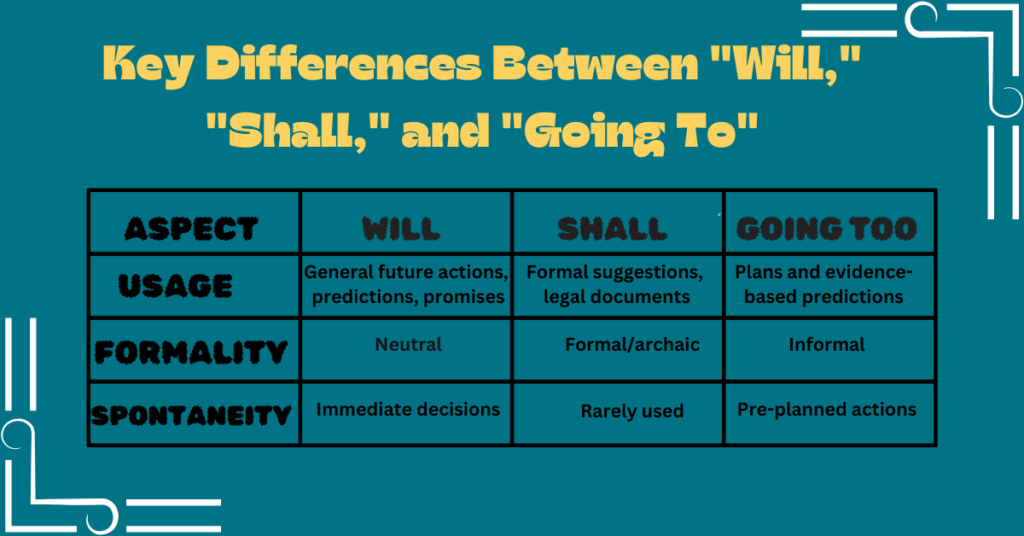
Key Differences Between “Will,” “Shall,” and “Going To”
| Aspect | Will | Shall | Going To |
|---|---|---|---|
| Usage | General future actions, predictions, promises | Formal suggestions, legal documents | Plans and evidence-based predictions |
| Formality | Neutral | Formal/archaic | Informal |
| Spontaneity | Immediate decisions | Rarely used | Pre-planned actions |
Tips for Choosing the Right Form
- Consider the context: Is it formal, casual, or spontaneous?
- Analyze the intent: Are you predicting, planning, or making an offer?
- Focus on regional preferences: British English tends to use “shall” more than American English.
- Decide on voice: Future statements take both active (The team will deliver the report) and passive (The report will be delivered by the team) forms—see our guide on active and passive voice in English grammar for the full pattern.
Examples in Everyday Context
- Spontaneous Decisions: I’ll take care of it right away.
- Formal Suggestions: Shall we meet at 10 a.m.?
- Planned Actions: She’s going to study abroad next year.
- Predictions: It’s going to be a great day.
20+ Example Sentences: Will, Shall, and Going To in Context
The best way to understand the difference between will, shall, and going to is to see them in real-life sentences. Below are 25+ examples grouped by form, covering predictions, plans, formal offers, promises, and spontaneous decisions.
Examples with “Will” (predictions, spontaneous decisions, promises, certainty)
- I think it will rain tomorrow.
- I will help you with that report.
- She will be 30 next month.
- Don’t worry — I’ll pick you up from the airport.
- You’ll love this new restaurant.
- I’ll call you as soon as I land.
- He will probably win the election.
- I’ll have the pasta, please.
- Technology will change how we work in the next decade.
- I promise I’ll never lie to you again.
Examples with “Shall” (formal suggestions, offers, British usage, determination)
- Shall we dance?
- Shall I open the window? It’s a bit stuffy in here.
- We shall overcome this challenge together.
- Shall we meet at 10 a.m. tomorrow?
- The tenant shall pay rent on the first of each month.
- Shall I call a taxi for you?
- I shall never forget your kindness.
Examples with “Going To” (planned future, evidence-based predictions)
- I’m going to visit Mumbai next week.
- Look at those clouds — it’s going to rain.
- She’s going to start a new business this year.
- We’re going to buy a house next summer.
- He’s going to propose to her on her birthday.
- I’m going to learn French this year.
- Be careful! You’re going to fall.
- They’re going to announce the results on Friday.
- I’m going to hit the gym after work.
- She’s going to appear for the IELTS exam in June.
Quick takeaway: Use will when you decide on the spot or make a prediction from intuition. Use shall for formal offers or polite suggestions (especially in British English). Use going to when the plan already exists in your head, or when you can see the evidence right in front of you.
Conclusion
“Will,” “shall,” and “going to” each bring unique nuances to English communication. By understanding their specific roles and applications, you can confidently navigate future-tense expressions. Practice these distinctions in real-life scenarios to enhance your fluency and precision.
You’ve read the comparison. You know the numbers. The only thing left is to actually start.
Frequently Asked Questions about Will, Shall, and Going to
What is the difference between will, shall, and going to?
Will: spontaneous decisions, predictions, promises, offers (“I will help you”). Shall: formal English, suggestions, polite questions (“Shall we begin?”). Going to: planned future actions, predictions based on evidence (“I’m going to study tonight”). All three express future tense but with different shades of meaning.
When should I use ‘will’ for the future?
Use “will” for: (1) Spontaneous decisions (“The phone is ringing — I’ll get it”). (2) Predictions about the future (“I think it will rain”). (3) Promises and offers (“I will help you study”). (4) Future facts and certainties (“The sun will rise at 6 am”). (5) Polite requests (“Will you pass the salt?”).
When should I use ‘going to’ for the future?
Use “going to” for: (1) Planned future actions (“I’m going to start a new course next month”). (2) Predictions based on evidence you can see now (“Look at those clouds — it’s going to rain”). (3) Intentions decided before now (“She’s going to be a doctor”). The key signal: “going to” implies the decision was made BEFORE the moment of speaking.
Is ‘shall’ still used in modern English?
“Shall” is much less common in modern American English but still used in British English and formal contexts. Common modern uses: (1) Suggestions (“Shall we go?”). (2) Polite questions (“Shall I open the window?”). (3) Formal/legal documents (“The party shall provide…”). (4) First-person intent (“I shall return”). For most everyday English, “will” and “going to” are sufficient. “Shall” sounds formal or old-fashioned in casual conversation.
What’s the difference between ‘I will’ and ‘I’m going to’?
“I will” suggests a spontaneous decision or promise (“I will help you” — decided right now). “I’m going to” suggests a pre-existing plan (“I’m going to help you” — already decided this earlier). Both are correct future tenses, but the meaning shifts subtly. Native speakers use both but lean toward “going to” for planned actions and “will” for in-the-moment decisions or formal predictions.
Can ‘will’ and ‘going to’ be used interchangeably?
Sometimes yes, sometimes no. Interchangeable: future predictions where there’s no evidence (“I think it will rain” / “I think it’s going to rain”). NOT interchangeable: spontaneous decisions need “will” (“I’ll get it” — not “I’m going to get it” when responding to a ringing phone). Plans always use “going to” (“We’re going to Goa next month” — not “We will go to Goa next month” unless you’re making the decision now).
What are common mistakes with will, shall, and going to?
Frequent errors: (1) Using “will” for pre-existing plans (“I will visit Mumbai next month” — better: “I’m going to visit Mumbai next month”). (2) Using “going to” for spontaneous decisions (“Wait — I’m going to get the door”). (3) Overusing “shall” in casual conversation (sounds stiff). (4) Confusing “will” with “would” in conditional sentences (“If I had time, I will help” — should be “would help”). (5) Using future tense after “when/if” (“When you will arrive, call me” — should be “When you arrive, call me”).
How can I practise will, shall, and going to in spoken English?
Effective practice: (1) Plan tomorrow’s day using “going to” — list 5 actions. (2) React to surprise scenarios using “will” — what would you do? (3) Make formal suggestions in meetings using “shall” — practise 2-3 per week. (4) Read English news predictions and notice which form the writer chose. (5) Daily live conversation with a TESOL/ESL-certified Expert who can flag misuse in the moment. EngVarta‘s $1 refundable trial lets you practise tense usage in real conversation.