English Speaking Confidence For Engineers |

Tag

english speaking confidence for engineers

English Speaking Practice for Engineering Students in India (2026): Daily Live 1-on-1 Guide for Placements & MS Abroad

May 18, 2026 • 14 min read • By Rishish Pandey

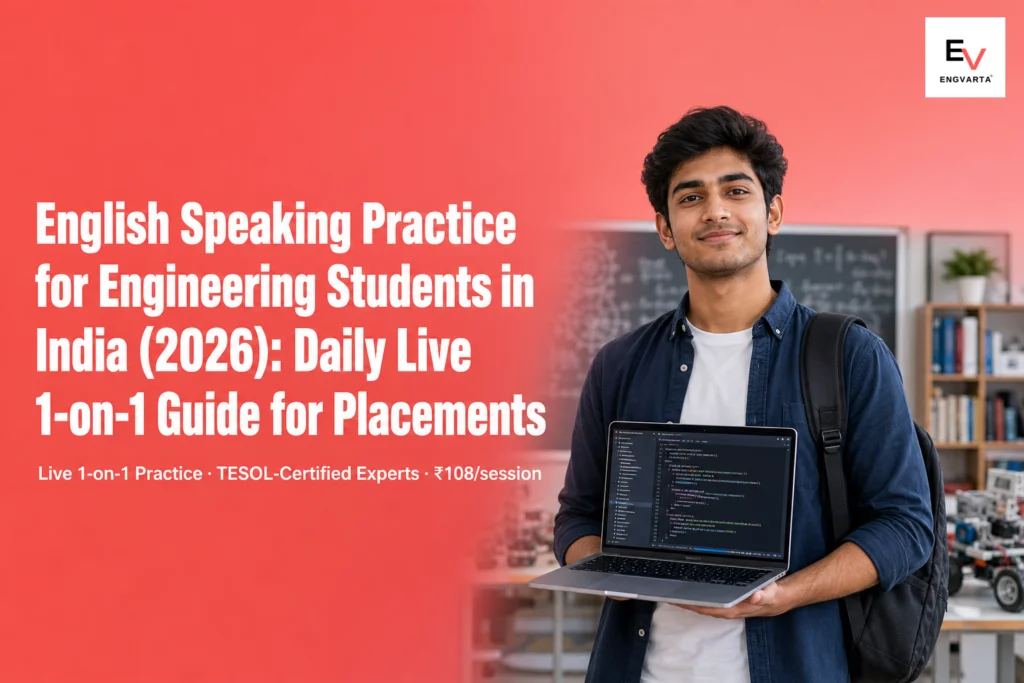
Confident Indian engineering student holding laptop with code in college campus — English speaking practice for engineering students 2026
Quick VerdictEnglish speaking practice for engineering students in India is not about vocabulary or grammar — most engineering students already read and write English well. The gap is conversational fluency under stress: campus placement interviews, MNC HR rounds, group discussions, MS-abroad video interviews, and the first 90 days of a new job where you have to actually talk to clients. The fastest fix is daily 15-minute 1-on-1 live English speaking practice with a TESOL/ESL-certified Expert — 25 sessions over a semester usually closes the gap. EngVarta starts at a ₹69 refundable trial, with the full 25-session pack at ₹2,700 (~₹108 per session) — designed for student budgets.

Every Indian engineering student we have spoken with — IIT, NIT, BITS, state university, private autonomous — describes the same problem in different words: “I can read technical papers easily but I freeze the moment an interviewer asks me to explain my project.” The CGPA is high. The resume is strong. The English in the resume is grammatically clean. But the placement interview is a spoken exam, and spoken English is a different muscle.

This guide is for engineering students in India — across all tiers, all branches, all years — who know their English speaking is the bottleneck between them and the placement, the internship, or the MS admission they actually want. We compare the apps and platforms that work for engineering-student schedules and budgets, with honest notes on where each one fits and where it does not.

Why Engineering Students Specifically Struggle with Spoken English

The pattern repeats every placement season in every Indian engineering campus:

1. Reading-and-writing fluency outruns speaking fluency. Engineering syllabi are English-medium, technical content is consumed in English (textbooks, Stack Overflow, GitHub, papers), and assignments are submitted in English. But the actual speaking reps — explaining a concept aloud, defending a design decision, narrating what your project does to a non-technical listener — never happen in classrooms or labs. Four years of strong written English, almost no oral practice.

2. Hostel-life conversations are in the regional language. Most students chat with friends, eat in the mess, watch movies, and play games in Hindi, Tamil, Telugu, Bengali, Malayalam, Marathi or their mother tongue. The brain spends 95% of its conversational hours not in English. When the placement-cell interview switches to English mode, the muscle is rusty.

3. The translation lag is brutal in interviews. You think the answer in your mother tongue, translate to English in real time, and the 2-second pause makes the interviewer think you do not know the answer. Native-fluency speakers think directly in English. Bridging that lag takes 50–100 hours of focused speaking reps.

4. Group discussions punish hesitation. Campus GDs reward the candidate who speaks first and speaks confidently — not necessarily the one with the best technical knowledge. Engineering students with weaker spoken fluency get filtered out at the GD stage and never reach the HR round where their technical strength would matter.

5. MNC HR rounds are designed to test spoken English deliberately. “Tell me about yourself” is not a vague opening question — it is a calibrated test of how fluently you can speak about your own life for 60–90 seconds without scripted preparation. Companies like Accenture, Infosys, TCS, Wipro, Capgemini, Cognizant, and global MNCs (Google, Amazon, Microsoft, Goldman Sachs) all use spoken-English checkpoints as a filter early in their funnel.

The fix for all five is the same: live, 1-on-1, voice-based English speaking practice with a trained Expert who can simulate the placement-interview format, give real-time corrections during the call, and push you with spontaneous follow-ups the way a real interviewer will.

1. EngVarta — Best for Daily English Speaking Practice on a Student Budget

EngVarta is built for exactly this use case. You connect with a TESOL/ESL-certified English Expert in minutes, on demand, for 15-, 25- or 50-minute sessions. For engineering students preparing for placements or MS interviews, the 15-minute slot is the right cadence for daily practice — short enough to fit between classes or after lab hours, long enough to build conversational stamina session-over-session.

What makes EngVarta a fit for engineering students specifically:

  • Voice-only sessions. No video pressure. You focus entirely on what you are saying — no need to worry about your hostel-room background or whether your hair is combed.
  • Real-time corrections during the call. The Expert flags hesitation, weak verbs, “ums” and unclear pronunciation in the moment — not in a written PDF you would never open later.
  • Consolidated feedback towards the end covering pace, filler-word frequency, and grammar patterns you repeat (most engineering students have 2–3 signature patterns — “actually” overuse, mixing past and present tense in narration, dropping articles before nouns).
  • Recording accessible 30 days post-session so you can listen back the next morning at 1.5× speed and hear every stumble exactly as your future interviewer will hear it.
  • Refundable trial at ₹69 — roughly the cost of a samosa-and-chai in the mess. Validate the format before committing.
  • ₹2,700 for a 25-session pack at ~₹108 per session. Daily 15-minute sessions for a full month, or alternate-day for two months. Fits a student-budget calendar.
  • Suitable for kids 7+ with parent guidance — useful if you are mentoring a younger sibling on the side.

For students preparing specifically for MS abroad video interviews — Carnegie Mellon, Georgia Tech, UT Austin, ETH Zurich, Imperial — the ₹5,130 plan (25 sessions of 25 minutes, ~₹205 per session) gives you longer mock-interview slots that better simulate the actual admissions video call.

Ready to Practice with Real Experts?

Try EngVarta today — ₹69 trial (India) / $1 trial (International) · 100% refundable

2. Speak — AI-Only Conversation, Good for Daily Reps at Low Cost

Speak is one of the most-funded AI-only English-speaking apps. You talk to an AI tutor that responds in voice, drills your pronunciation, and gives you unlimited reps for roughly $20/month. For pure repetition volume — getting 30+ hours of speaking time per month at a flat rate — it is unbeatable.

Where Speak fits in a student’s stack: as a 10-minute daily warm-up before bigger live sessions. For a deeper take on live human vs AI practice, see our real-people vs AI breakdown. Where it falls short for placement prep specifically: the AI cannot push back on hesitation in the way a human Expert can. It logs your “ums” as data but rarely interrupts your flow to correct them in the moment, and in-the-moment correction is what builds the under-pressure muscle. Speak also runs in USD pricing and the monthly subscription cost compounds across a multi-month preparation arc.

3. ELSA Speak — Pronunciation Drilling for Specific Sounds

The greatest tool we are aware of for specific pronunciation issues, such as “v” vs. “w,” “th” sounds, schwa neutralisation, or the long “ee” in terms like “sheet,” is ELSA Speak. It scores each phoneme you produce and gives visual feedback. For engineering students from regional-medium school backgrounds whose pronunciation drift is hurting their interview clarity, 10 minutes of ELSA daily for 4–6 weeks before placement season produces measurable improvement.

What ELSA does not do: build conversational fluency. It is a pronunciation gym, not a conversation simulator. Use it alongside live human practice, not instead of it.

4. Cambly — Native-Speaker Video Conversation, Premium Pricing

Cambly uses video to link you with native English speakers from the US, UK, Canada, and Australia. For engineering students aiming at MS programs in the US specifically, exposure to American native speakers can help you tune your ear to the cadence of US admissions interviewers.

Trade-offs to be honest about: Cambly is a video-first product, which adds camera-pressure on top of speaking-pressure (a known problem for engineering students who already feel self-conscious in interviews). Pricing is in USD and works out roughly 4–6× the per-session cost of EngVarta. The tutors are conversation partners, not interview coaches by default — you have to brief each tutor on the placement-interview format every time. For an honest side-by-side, see our EngVarta vs Cambly comparison.

5. Preply — Marketplace with Variable Quality

Preply is a marketplace: you browse tutor profiles, read reviews, book sessions à la carte. Pricing varies wildly ($5–$40 per hour depending on tutor). Quality is inconsistent — some tutors are excellent, some are conversation partners with little structured teaching experience.

Where Preply works for engineering students: if you want a long-term coach (one tutor across 30+ sessions over a semester) and you are willing to invest the first 3–4 sessions in finding the right person. Where it does not: if you need on-demand, predictable practice cadence — booking the same tutor 5 days a week is harder than it sounds because most tutors are part-time.

6. Free Practice — YouTube + Self-Recording + Toastmasters Campus Chapter

The zero-cost stack worth using:

  • YouTube for watching campus-placement mock interviews and HR round examples (search “Infosys HR round” or “Accenture interview experience”). Watch 5–10 of these to understand the format. This builds awareness, not speaking skill.
  • Self-recording on your phone’s voice memo app. Pick a question — “Tell me about your final-year project” — and answer it cold. Listen back the next day. Write down every “umm” and pause.
  • Toastmasters — many engineering campuses have a chapter. ₹1,000–₹2,000 annual membership, weekly meetings, structured speaking practice in front of an audience. Excellent for developing stage presence; less useful for fluency in one-on-one interviews where quick Q&A responses are required.

These work as supplements. They do not work as a substitute for live human practice with someone who interrupts you and pushes back — because you cannot correct what you do not yet hear as a problem.

How Much English Speaking Practice for Engineering Students Is Enough for Placement Season?

Realistic minimums based on hundreds of EngVarta-learner placement outcomes:

  • 1 semester before placements (6+ months out) : 3 sessions per week of 15 minutes. Build conversational stamina at a relaxed pace.
  • 3 months before placements : 4–5 sessions per week of 15 minutes. Add one 25-minute mock-interview session per week.
  • 1 month before placements:  Daily 15-minute sessions, plus two full 25-minute mocks per week. Your day-to-day conversations will feel easy by comparison.
  • Final 2 weeks : Daily 25-minute mock-interview sessions. Brief your Expert on the specific companies you have shortlists from — Infosys vs Goldman Sachs vs Google have different interview formats, and your Expert can simulate each.

What If You Are From a Tier 2 or Tier 3 College?

The English-speaking gap is the single most addressable factor that prevents Tier 2/3 engineering students from clearing MNC interviews despite strong technical skills. Most of the technical filtering happens online before the interview — your CodeChef rank, your project portfolio, your Hackerrank scores get you into the interview pool. After that, the interview is largely a spoken-English test.

If you are 2 years out from placements, start now with 3 sessions per week. By the time placement season hits, you will have 200+ hours of conversational reps under your belt, and the spoken-English gap that filters out most of your peers will no longer apply to you. The total cost over 2 years: ~₹10,000–₹12,000, which is roughly the cost of 2 textbooks.

What If You Are Targeting MS Abroad — US, Canada, Germany, UK?

The MS application process tests spoken English at multiple checkpoints:

  • TOEFL/IELTS speaking section. 20-second prep + 60-second monologue under timer pressure. Daily practice with an Expert who simulates the format for 6 weeks before the test is the single biggest score-mover.
  • Video application interviews. Carnegie Mellon MSCS, MIT Sloan, ETH Zurich — many top programs include a 20–30 minute video interview as part of admissions. Spoken fluency under camera is the assessment.
  • Visa interview (F1 for US). See our dedicated guide on F1 visa interview English speaking practice for the full prep arc.
  • First 90 days on campus. US/UK/Canadian campus life — TA work, group projects, lab meetings — happens entirely in English. Students who arrive with weak spoken fluency lose the first semester to social isolation and acclimatisation; students who arrive fluent jump straight into research and networking.

Start 6 months before your application deadline. Daily 15-minute sessions, with one 25-minute mock per week. Cost: ~₹5,000–₹6,000 total. Cheaper than a single GRE coaching module.

👉 Connect with EngVarta & Improve Your English Every Day!

Build fluency, confidence, and better communication skills with daily English speaking tips, real-life conversations, and expert guidance that helps you speak naturally and confidently.

📸 Instagram : https://www.instagram.com/engvarta.app/
▶️ YouTube : http://www.youtube.com/@EngVarta
📘 Facebook : https://www.facebook.com/engvarta
💼 LinkedIn : https://www.linkedin.com/company/engvarta

✨ Follow EngVarta today and take your English speaking skills to the next level — one conversation at a time!

What Our Learners Say

Rated 4.5★ from 9,100+ reviews on Google Play

★★★★★
I have been practising English on EngVarta for the past 30 days and results are significant. I’m happy to be here.
★★★★★
Excellent application to improve your communication skills.Thnk you for introducing new vocabulary everyday.God bless you You might not aware of but personally this is helping me a lot
★★★★★
engverta is good for those who is struggling to speak English...I m new commer but I feel good experience with engverta experts they listen our broken English, they rectify mistakes ,they talk withvery humbly..
★★★★★
It's very beneficial app for children who don't speak well.
★★★★★
excellent app for learning fluency and If you genuinely correct your mistakes then you should opt for this
★★★★★
A very good app its just as good as shown in the advertisement,but I wish it would have been a bit cheaper,
★★★★★
hii i have taken your 69 rs plan for expert calling but no response from your side you gove the number i am trying to call on that number but no response r u making me fool? or what?
★★★★★
I highly recommend this app.this App is soo good for beginners who want to learn English.
★★★★★
It's a incredible app... It builds my confidence to speak English fluently, gives you practice to start your conversation without any hesitation, provides daily free vocabulary and quizes also...Expensive but amazing & worth it...
★★★★★
It's a great place to learn and practice English Fluency..here you get a chance of one on one communication with experts.. They'll guide you throughout your learning journey..I recommend this platform to all who want to gain fluency with knowledge.
★★★★★
excellent app for learning fluency and If you genuinely correct your mistakes then you should opt for this
★★★★★
I enjoyed this course.experts encouraged me to use advanced vocabulary, idioms and phrases daily dose of assignment, quizzes and new vocabulary keep your toes

Conclusion :

For engineering students in India, the single biggest leverage point between a strong technical background and the placement, MS admission, or first MNC job you actually want is daily live English speaking practice with a trained Expert. Not vocabulary apps. Not grammar books. Not group classes where you speak 2 minutes out of 60. Daily 15-minute 1-on-1 reps with a TESOL/ESL-certified Expert who interrupts you when you hesitate, corrects you in real time, and pushes you with spontaneous follow-ups the way a real interviewer will.

Start with the ₹69 refundable trial. If it works for your routine, commit to the ₹2,700 25-session pack and run it through one full month of placement-season prep. Most engineering students who do this consistently say the same thing: “I wish I had started this in second year.”

FAQs

Q1. Which app is best for English speaking practice for engineering students in India?

Ans : For daily live practice on a student budget, EngVarta offers TESOL/ESL-certified Experts at ₹108 per 15-minute session (₹2,700 for 25 sessions). For AI-only daily reps, Speak is the cheapest at flat-rate monthly pricing. For native-speaker exposure (mostly useful for MS abroad), Cambly works but costs 4–6× more per session.

Q2. How long does it take an engineering student to become fluent in English speaking?

Ans : For an intermediate-level engineering student, 50–100 hours of focused 1-on-1 practice usually closes the placement-interview gap. At 15 minutes per day, that is 4–8 months of consistent daily practice. The students who succeed are the ones who treat it like gym — daily reps, no skipped days, same time slot every day.

Q3. Can I prepare for campus placements in 1 month?

Ans : If your spoken English is already moderate, yes — daily 25-minute mock-interview sessions for 4 weeks will measurably improve your fluency and confidence under interview pressure. If your spoken English is weak (you freeze in front of strangers in English), one month is not enough — start 3–6 months out.

Q4. Is YouTube enough for placement interview English practice?

Ans : No. YouTube teaches you what questions to expect; it does not build the muscle to answer them fluently under pressure. Use YouTube for format awareness, but pair it with daily live human practice for the actual reps.

Q5. Should I learn an American accent for MS interviews abroad?

Ans : No. Admissions interviewers are trained to understand all global English accents. A clear, well-paced Indian English is far better than a fake American accent that adds another layer of unnatural-sounding stress to your speech.

Q6. Do I need to be fluent before I start MS abroad, or will I pick it up on campus?

Ans : You need to be reasonably fluent before you arrive. Students who land in the US with weak spoken English lose the first semester to acclimatisation, miss out on TA opportunities, and feel socially isolated. Fluent students jump straight into research within the first 2 weeks. 6 months of daily 15-minute practice before departure is the right investment.

Q7. Is EngVarta good for engineering students from regional-medium school backgrounds?

Ans : Yes — many EngVarta learners are first-generation English-medium engineering students whose schooling was in Hindi, Tamil, Telugu, Bengali, Marathi or other regional languages. TESOL/ESL-certified Experts specifically understand the transition path and adapt sessions to your starting point without judgement.

Q8. What is the cheapest way to practise English speaking as an engineering student?

Ans : Free: self-recording on your phone + watching YouTube placement-interview videos. Low-cost: EngVarta’s ₹69 refundable trial + ₹2,700 25-session pack. Mid-cost: monthly AI app subscriptions ($10–$20/month for Speak or ELSA). Premium: native-speaker video apps (Cambly, $40–$60/month equivalent).

Editorial note: This guide is researched and written by the EngVarta team. We compare our own platform alongside other tools that Indian engineering students commonly use, and we are honest about where each tool fits — including where it does not.

Best English Speaking Practice for Indian Engineers in Kuwait Oil & Gas Sector (2026)

May 16, 2026 • 10 min read • By Rishish Pandey

English speaking practice for Indian engineers in Kuwait oil and gas industry
Quick VerdictFor Indian engineers working at KOC, KNPC, KGOC, KIPIC, KPC subsidiaries or contractor companies in Kuwait’s oil and gas sector, English fluency on toolbox talks, HSE briefings, shift handovers, and supervisor reporting matters more than vocabulary tests or grammar drills. The fastest fix is daily 1-on-1 voice-only practice with a TESOL/ESL-certified Expert who can simulate site conversations and correct you in real time. EngVarta works on a refundable trial at ₹69, with sessions you can take from your accommodation in Ahmadi, Mina Al-Ahmadi, Shuaiba, or wherever you are posted.
Kuwait’s oil and gas sector is one of the largest single employers of Indian engineers in the Middle East. From upstream wellsite operations at the Burgan field to downstream refining at Mina Al-Ahmadi and Mina Abdullah, Indian mechanical, electrical, instrumentation, process, civil, and HSE engineers form the backbone of day-to-day operations.

English Speaking Practice for Indian Engineers in Kuwait Oil and Gas becomes essential because daily communication on multinational sites demands clear spoken English under pressure. What surprises many newcomers — and what nobody warns you about during the visa medical in Mumbai — is that your spoken English will be tested far more rigorously on a Kuwaiti site than it ever was at your previous job in Pune, Vadodara, or Visakhapatnam.

You will share a control room with Filipino operators, take instructions from a Brit or American senior, work alongside Egyptian process engineers, and brief multinational HSE auditors. The common language is English. Your accent is fine — every accent at the site is mixed. What is not fine is hesitation, vague answers, and inability to handle a fast-moving toolbox talk.

This guide walks through the specific spoken-English skills Kuwait oil-and-gas roles demand, why most apps fail Indian engineers in this niche, and the practice formats that actually move the needle.

The English Bar Is Higher Than You Expected

Five everyday situations on a Kuwaiti oil-and-gas site that put your spoken English under unexpected pressure:

1. Toolbox talks (TBT). The supervisor runs through the day’s job hazards in 5–10 minutes. You may be asked to confirm understanding, repeat back the lock-out tag-out steps, or describe the permit-to-work conditions. Mumbling “yes sir” gets you sent back to the prayer room for a refresher. Confidently summarising the hazard wins you the job for the day.

2. Shift handovers. Twelve-hour shifts means twice-daily handovers. You have to explain what was running, what failed, what is left for the incoming shift — fluently, accurately, and quickly enough that nobody is held back from leaving site.

3. Permit-to-work (PTW) conversations. The PTW issuer asks you to walk through your isolation steps. If you cannot articulate them clearly in English, you do not get the permit. No permit, no work. No work, no proof of value to your employer.

4. HSE incident reporting. Even a near-miss requires a verbal report to the HSE officer, often within 30 minutes. Stumbling here gets you flagged as a communication risk regardless of your engineering competence.

5. Vendor and contractor coordination. Schlumberger, Halliburton, Baker Hughes, Saipem — all use English as their lingua franca. Vendor calls and field reviews happen in English. So do the multi-company morning meetings.

The volume of spoken English in your day is far higher than what you handled in India, and most of it is on the spot — not pre-prepared.

Why Most English Apps Fail Indian Oil-and-Gas Engineers

Three common failure modes:

Generic vocabulary apps. Apps that drill “business English” with airport-and-restaurant scenarios are useless for someone who needs to explain a flange leak to a Filipino operator at 2am.

AI-only conversation apps. AI chatbots cannot simulate the real conversational pressure of a senior interrupting your handover at minute two and saying “Wait — what about the recycle valve?” Real humans can.

Grammar courses. Your grammar is not the problem. Engineering education in India teaches enough grammar. The problem is fluency, hesitation, and the ability to keep talking under pressure.

What works is daily 1-on-1 voice practice with a real human who can role-play site scenarios, give real-time corrections during the call, and consolidate feedback at the end so you know what to fix tomorrow.

1. EngVarta — Live 1-on-1 Practice You Can Do From Your Accommodation

EngVarta connects Indian learners with TESOL/ESL-certified English Experts in minutes. You pick the slot length — 15, 25, or 50 minutes — and start a voice-only call from your phone. There is no video, which matters when you are taking sessions in shared accommodation in Ahmadi or Mahboula.

For Kuwait oil-and-gas use cases, what makes EngVarta useful:

  • Real-time corrections during the call. The Expert flags hesitation and unclear pronunciation in the moment, then sends consolidated feedback towards the end.
  • Voice-only sessions work in noisy or shared spaces. No camera-pressure on top of speaking-pressure.
  • Connect in minutes means you can take a 15-minute session before a shift handover or after a tough toolbox talk where you struggled.
  • Refundable trial at ₹69 — pay in INR from your Indian bank account or UPI even while you are working in Kuwait.
  • Recording accessible 30 days post-session so you can re-listen during weekends.
  • Suitable for kids 7+ with parent guidance if your family is in Kuwait with you and you want a household plan covering school-age kids.

Pricing in INR makes EngVarta one of the lowest per-session costs available to expat Indian engineers — ₹2,700 for 25 sessions of 15 minutes (~₹108 per session) or ₹5,130 for 25 sessions of 25 minutes (~₹205 per session).

Ready to Practice with Real Experts?

Try EngVarta today — ₹69 trial (India) / $1 trial (International) · 100% refundable

2. Cambly — Practice With Native Speakers (Higher Cost in USD)

If you specifically want to get used to British or American English (which is common in oil-and-gas senior management), Cambly’s pool of native-speaker tutors is large. The cost is in USD and works out higher per minute than EngVarta — manageable on a Kuwaiti salary, but worth doing the math on.

Trade-off: Cambly tutors are conversational partners by default, not industry coaches. You will need to brief each tutor on what oil-and-gas-specific scenario you want to role-play. Read our EngVarta vs Cambly comparison for a deeper breakdown.

3. Italki — Find a Tutor With Industry Background

Italki’s marketplace lets you filter for tutors with engineering, technical, or business-English backgrounds. If you find one with prior oil-and-gas exposure, this can be a useful supplement. The downside is that pricing varies wildly per tutor (USD 10–50 per hour), and you have to manage scheduling across time zones.

Useful as a once-a-week deep-dive alongside daily EngVarta sessions, not as your main practice tool.

4. Site Refresher Courses (KOC / In-house)

Some Kuwaiti operating companies offer in-house English courses for non-native staff. These are usually classroom-format, 1–2 hours per week, with mixed-nationality groups. They are useful for camaraderie and for picking up site-specific terminology, but the class size and infrequent cadence mean you do not get enough individual speaking time to build fluency.

Treat in-house courses as a bonus, not your primary plan.

5. Free Practice — Site-Specific YouTube + Voice Recording

Free-tier supplement: search YouTube for “permit to work safety briefing”, “toolbox talk oil and gas”, “shift handover refinery” and watch how supervisors actually speak. Then record yourself summarising the same content on your phone and listen back the next day.

This builds vocabulary and self-awareness. It does not build fluency under live conversational pressure — that requires a real human in real time.

What to Practise Specifically — A 30-Day Plan

Week 1 — Comfort with everyday site English. Daily 15-minute sessions on general fluency. Focus on reducing “umm” and “actually” and getting comfortable with longer sentences.

Week 2 — Shift-handover and TBT scenarios. Ask your Expert to role-play as a senior engineer asking you to summarise the previous shift. Practise structured handovers: equipment status → completed jobs → carry-overs → safety notes.

Week 3 — HSE and PTW vocabulary. Drill the specific phrases — “isolation point”, “lockout tagout”, “blind valve”, “permit holder”, “competent person”, “confined space entry”. Practise explaining each one in plain English without notes.

Week 4 — Vendor calls and multi-party meetings. Switch to 25-minute sessions. Role-play a contractor coordination call. Practise interrupting politely, asking for clarification, and summarising decisions.

By day 30, you should be able to handle a real handover or toolbox talk without freezing.

Common Mistakes Indian Engineers Make in Kuwait

Mistake 1 — Speaking only Hindi or your mother tongue with other Indian colleagues. This is the single biggest fluency-killer. You came to Kuwait. Use the English exposure.

Mistake 2 — Skipping practice on weekends. Friday off in the Gulf becomes the day you do not practise English. Two weeks of weekend gaps and your fluency stalls.

Mistake 3 — Refusing to ask “Could you repeat that?” Pretending to understand a Western supervisor and then doing the wrong thing is far more career-damaging than asking for clarification.

Mistake 4 — Memorising scripts instead of building fluency. A scripted handover that the senior interrupts becomes a freeze. Practise being able to handle interruptions, not just deliver monologues.

👉 Connect with EngVarta & Improve Your English Every Day!

Build fluency, confidence, and better communication skills with daily English speaking tips, real-life conversations, and expert guidance that helps you speak naturally and confidently.

📸 Instagram : https://www.instagram.com/engvarta.app/
▶️ YouTube : http://www.youtube.com/@EngVarta
📘 Facebook : https://www.facebook.com/engvarta
💼 LinkedIn : https://www.linkedin.com/company/engvarta

✨ Follow EngVarta today and take your English speaking skills to the next level — one conversation at a time!

What Our Learners Say

Rated 4.5★ from 9,100+ reviews on Google Play

★★★★★
This is very amazing apps. AI working system and it is very effective to practicing and also every day i have practice in the apps. As a begainner, i think it is very helpful for me.
★★★★★
The supporting people along with the experts are very supportive. The only suggestion to the officials is that the names of the experts should be reflected on the screens so to know to whom I am talking with. Thank you Engvarta, continue supporting people like me. Thank You.
★★★★★
Thanks EngVarta I appreciate your platform sir for those who willing to learn speaking English fluently
★★★★★
This app is amazing, it's helpful and good. The tutors are very excellent. I am improving and don't shy anymore.
★★★★★
I am really enjoying my journey with EngVarta where the learning is not limited to communication skills but also enrichment of ideas and thoughts.
★★★★★
It was a very amazing experience to talk to an expert. She suggested how to improve my speaking skills and enhance my confidence level. EngVarta is the best platform to learn English fluently.
★★★★★
It's a great place to learn and practice English Fluency..here you get a chance of one on one communication with experts.. They'll guide you throughout your learning journey..I recommend this platform to all who want to gain fluency with knowledge.
★★★★★
Experts are friendly and supportive. Great platform to improve your communication skills.
★★★★
A very good app its just as good as shown in the advertisement,but I wish it would have been a bit cheaper,
★★★★★
Engvarta provides the best platform for learners to learn and get comfortable with the language by offering a comfortable and judgment-free environment with regular feedback. Engvarta is the best English learning app available.
★★★★★
Good app to express yourself because in our house there are no environment n EngVarta provides you environment
★★★★★
Engvarta is a platform where we start from the 0 level to 100 level. That is the best thing I have never seen in my life. There are so many part and so many way, they are always try to teach you until you become a good speaker. Thank you Engvarta

Conclusion : ( English speaking practice for Indian engineers in Kuwait oil and gas)

Indian engineers in Kuwait’s oil-and-gas sector underestimate how much daily site work depends on fluent spoken English — and how much faster careers progress when that fluency is solid. Generic apps and grammar courses do not fix the issue. Daily 1-on-1 voice practice with a trained Expert does.

Start with EngVarta’s refundable trial at ₹69. Connect in minutes, voice-only sessions you can take from your accommodation, real-time corrections during the call, and pricing in INR that fits a Gulf engineer’s budget without converting USD.

Frequently Asked Questions ( FAQs )

Q1. Do I need IELTS or TOEFL to work in Kuwait oil and gas?
Ans : Most engineering roles in Kuwait do not require IELTS or TOEFL — your engineering qualification and prior experience are what get you hired. But once on site, your spoken English is tested daily through TBT, handovers, PTW conversations, and HSE reports. Practical fluency matters more than a test score.

Q2. Is EngVarta available for users in Kuwait?
Ans : Yes. EngVarta is a phone-based app and works wherever you have an internet connection. You pay in INR from your Indian bank account or UPI, and Experts are based in India so timing usually aligns well with Kuwait’s working hours (Kuwait is GMT+3, India is GMT+5:30 — a 2.5-hour gap).

Q3. How long until I notice improvement in site English?
Ans :  Most learners report visibly more fluent shift handovers within 3–4 weeks of daily 15-minute sessions. By 8 weeks you stop translating in your head before speaking. Full conversational confidence in multi-party meetings usually takes 3–4 months of consistent practice.

Q4. What if I work 12-hour shifts and have no time?
Ans : Even 15 minutes every other day moves the needle. The EngVarta 15-minute slot is designed for exactly this scenario — a quick reset session before a difficult conversation, or a debrief after a shift where your English felt slow.

Q5. Do I need to learn an American or British accent?
Ans : No. Kuwait oil-and-gas sites are multinational. Indian, Filipino, Egyptian, Pakistani, Bangladeshi, and Western accents all coexist. What matters is being clearly understood — clear consonants and a steady pace beat any accent imitation.

Q6. Will EngVarta help me prepare for IOGP or OPITO English assessments?
Ans : EngVarta’s Experts can role-play general workplace and HSE conversations that overlap with what IOGP and OPITO standards expect. For specific certification exams, supplement EngVarta with the certifying body’s prep materials.

Editorial note: This guide is written and researched by the EngVarta team. We feature our platform alongside other practice options Indian engineers in the Gulf commonly use, and we describe each one honestly — including the gaps.

English Speaking Practice for Software Engineers in India (2026): From Standups to Tech Interviews

May 12, 2026 • 19 min read • By Rishish Pandey

English Speaking Practice for Software Engineers in India
Quick Verdict Indian software engineers usually have strong written English (code comments, Slack threads, Jira tickets, design docs) but freeze in spoken-pressure moments: the 90-second standup, the live code-review walkthrough, the customer demo, the system-design round. The fix is not another grammar app. It is structured, live English coaching with a TESOL or ESL-certified Expert who can role-play standups, code reviews, behavioural rounds, and stakeholder demos in real time. EngVarta is built for exactly this gap — live 15 / 25 / 50-minute audio sessions with real-time corrections during the call and consolidated feedback towards the end. Trial is ₹69 in India / $1 internationally, 100% refundable.

There is a moment most Indian software engineers know too well. The standup is nearing your turn. The work is done, the PR is up, the tests are green, the blocker is small. But the sentence forms in Hindi or Tamil or Kannada first, you start translating, hesitate between “I have done” and “I did,” and the update comes out broken. The engineering manager nods politely. The code was perfect. The 60-second narration was not.

English Speaking Practice for Software Engineers in India helps engineers communicate clearly in standups, meetings, interviews, and daily workplace conversations with confidence.

This is not a technical-skill problem. It is a spoken-versus-written English gap, and it is one of the most under-treated reasons strong Indian developers stall on promotions, interviews, and remote-first US/UK roles. You can read RFCs, you can write production-grade comments, you can argue on GitHub. You just cannot do it live, on Zoom, on someone else’s clock, with a manager waiting to speak next.

This guide is for that engineer. We will look at six specific live-English scenarios developers in India actually struggle with, why generic English apps do not move the needle for software engineers, three role-plays you can request from a live coach to fix it, and a five-week practice plan if you are preparing for a product-company interview in the US or UK. The fix is daily reps with a real human Expert who can ask the sharp follow-up — not another vocabulary list.

The 6 specific English-speaking scenarios every Indian software engineer struggles with

Generic tips on “enhancing your English” overlook the essential aspects. The pain is not “my English”. The pain is six very particular live-speaking situations engineers find themselves in every working week.

1. The daily standup (Yesterday / Today / Blockers in under 90 seconds)

A standup is a structured 60-90 second monologue, on the spot, in a defined format. There is no time to translate from Hindi, no time to reread your sentence, no chance to “rephrase that one moment”. Yet most Indian engineers were never taught how to compress a day of work into three crisp English sentences. The result: rambling updates, filler (“basically”, “actually”, “as such”), tense slips (“I was completing”, “I am picked up”), or the dreaded long pause where the screen freezes mid-sentence.

What good standup English actually sounds like: “Yesterday I shipped the auth service refactor — the PR merged last evening. Today I am picking up the rate-limiter ticket on the queue. No blockers.” Three sentences, three tenses, zero filler. It is rehearsable, and it is exactly the kind of micro-skill a certified Expert can drill in two weeks of daily reps.

2. Code review walkthroughs (explaining design choices live)

Asynchronous code review on GitHub is fine — you have time to write, edit, hedge, link a doc. The pain is when the senior engineer says “let’s hop on a quick call, walk me through your PR”. Now you have to narrate your own design decisions in real time, defend a trade-off, respond to a follow-up question, and not retreat into “actually it is like this only”. You also have to do this in the senior’s vocabulary — “trade-off”, “edge case”, “blast radius”, “regression”, “rollback path” — used naturally, not as memorised words.

3. Sprint planning estimation discussions

Estimation conversations are negotiations. “I think this is two days.” “Why not one?” “Because the migration touches three services and we do not have integration tests on one of them.” That second sentence requires you to hold a clause, qualify it, and back-reference cleanly under social pressure. Indian engineers often default to “yes, one day is fine” because pushing back in English under time pressure is harder than the actual estimate. Daily live practice closes this exact gap — rehearsing the polite-but-firm pushback in a real conversation with an Expert who plays the role of an aggressive PM.

4. Customer-facing demos (explaining features to non-technical stakeholders)

The hardest English a developer ever has to speak is translating tech to non-tech, live, in front of a paying customer.

You can’t state “the response is cached in Redis with a 5-minute time-to-live.” You have to say “the system remembers the answer for a few minutes so the next person who asks gets it instantly — that is why the page loads faster.” Same idea, completely different register. Many engineers rarely exercise that translation skill vocally.

5. Tech interviews (system design, behavioural, “tell me about a project”)

The interview English problem is brutal because three different speaking modes get tested in one round: structured monologue (tell me about a project you owned), live problem-narration (system design —discussing the diagram you are creating), and pressure-Q&A (behavioral follow-ups). You might be a top 10% engineer and still fail a FAANG-level interview based solely on your communication

Engineers preparing for US/UK product interviews benefit massively from daily live-practice reps in the four weeks before the loop — see our deep-dive on MNC interview English prep for the broader plan.

6. The async-to-sync switch (fine on Slack, frozen on Zoom)

This is the most common pattern we hear in calls with engineer learners: “On Slack I am 100% confident. On Zoom I forget everything.” Written English gives you typing speed as a buffer to think. Live English does not. Most developer English study is silently-reading-based — docs, GitHub, Stack Overflow — which builds reading and writing but leaves the speech-production muscle untrained for years. The only fix is live-speaking reps, which is why meeting confidence with managers is one of the highest-demand outcomes among Indian software engineers on our platform.

Why generic English apps fail software engineers

Most apps in the “improve English” category are built for a generic learner — a college student preparing for IELTS, a 20-something wanting to “speak fluent English in 30 days”, a tourist learning travel phrases. None of those targets match the working developer. This is precisely where they fail to meet expectations.

Generic vocabulary that ignores engineering language

An app that drills “shopping at the mall” or “ordering food at a restaurant” is teaching you English you will never use in a standup. You will never say “I would like a coffee, please” to a tech lead. You will say “let me unblock that and get back to you by EOD.” That is a completely different vocabulary register, and almost no app teaches it. A live Expert who has worked with engineer learners can — because they can swap the topic mid-session from “weekend plans” to “yesterday’s deploy”.

No tech-context scenarios

Most app role-plays are office-generic at best — “introduce yourself in a meeting”, “schedule a call”. None of them simulate “walk me through the trade-offs you made on the caching layer” or “the customer is asking why the API was slow yesterday — explain it”. The English you need is contextual, and the only way to practise it is with a human who can play the role of your PM, your manager, your interviewer, or your customer.

AI drills cannot simulate a sharp follow-up

An AI tutor responding to “tell me about your last project” will usually say something polite and move on. A real interviewer says “you mentioned latency dropped from 800ms to 200ms — what changed?” and waits. The discomfort of a sharp, specific follow-up under pressure is the actual interview skill. AI tutors smooth that discomfort out, which means the practice does not transfer to the real room. Live human practice keeps the discomfort in, which is exactly why it works.

Reading and listening apps do not build live-speaking confidence

Reading Medium articles, watching tech talks — all useful input. None of it produces output. The bottleneck for most Indian software engineers is not input; it is the activation gap between knowing the words and saying them under time pressure. Only speaking practice fixes speaking.

3 specific role-plays an engineer can practice with EngVarta

EngVarta’s format is a live 1-on-1 audio call with a TESOL or ESL-certified English Expert. You pick the duration — 15, 25, or 50 minutes — and you can request a specific scenario at the start of the session. Here are three role-plays we recommend every Indian software engineer cycle through in their first month of practice.

Role-play 1 — “Walk me through your last PR” (5-minute unrehearsed code-review explanation)

Open the session by telling the Expert: “I want to practise explaining a pull request I shipped last week, in five minutes, like I am walking my tech lead through it on a Zoom call. Please interrupt me with follow-up questions like a senior engineer would.” Then narrate the actual PR — what problem it solved, what approach you took, what you considered and rejected, what you would do differently. The Expert’s job is to push back: “Why not use a queue here?”, “What happens if the upstream is down?”, “Did you add tests for the failure case?”

The English skill being trained: holding a structured technical narrative under interruption, defending a design decision politely, using senior-engineer vocabulary (trade-off, blast radius, rollback, regression, idempotent) in flow rather than as memorised words. Two reps a week for a month and your live code-review English transforms.

Role-play 2 — “Explain microservices to a product manager” (translating tech to non-tech)

This is the single most under-practised skill among Indian developers, and it is exactly what gets tested in customer demos and stakeholder meetings. Open the session: “I am going to explain a technical concept to you, but you should pretend you are a non-technical product manager. If I use jargon, stop me and ask me what it means. If my analogy is bad, say so.”

Then try: explain microservices. Explain caching. Explain why your team chose Postgres over MongoDB. The Expert catches the moment you slip into engineer-speak and forces you to translate. The skill being trained: register-switching, analogy generation in real time, pacing your speech for a non-technical listener. This is the highest-leverage English skill for engineers heading into senior or staff-engineer interview loops.

Role-play 3 — “Tell me about a time you debugged a production issue” (STAR-format behavioural prep)

Every product company in the US, UK, and Europe runs a behavioural round. The format is predictable — STAR: Situation, Task, Action, Result — and the questions repeat: tell me about a time you disagreed with your manager, a time you missed a deadline, a tough debugging session, a project you owned end-to-end. The challenge is not the story; it is delivering the story in a clean, structured, two-minute monologue without rambling, without filler, without slipping into present-progressive (“I was debugging, I was looking…”) for what should be simple past tense.

Pick five behavioural questions before the session. Tell the Expert: “I will answer each in 2 minutes, STAR format. Time me. Stop me if I ramble. Give me a verbal correction on grammar slips and one rewrite suggestion at the end.” Run this once a day for two weeks before an interview loop and your behavioural rounds become genuinely repeatable. This is the part of job interview English practice no AI app can deliver — sharp, human-paced rehearsal with real corrections.

How EngVarta’s coaching format fits software engineers

Most software engineers in India do not have an hour a day for a structured English course. They have a lunch break, a post-standup gap, an evening hour after pushing the last commit. The EngVarta session model is built around that reality.

Three session lengths to match your day

15-minute sessions slot into a lunch break — long enough for a focused warm-up plus one role-play. 25-minute sessions sit perfectly in a post-standup window — long enough to run a code-walkthrough rehearsal and get consolidated feedback. 50-minute sessions are your full mock-interview format — long enough to run a behavioural round, a system-design narration, and a closing feedback debrief. You pick the length that fits the day you are having.

Real-time corrections during the call

The biggest single difference between EngVarta and a self-paced app: the Expert corrects you in the moment. The instant you say “yesterday I am pushing the code”, the Expert flags the tense slip. The instant you say “I have done that two weeks back” (a very common Indian-English construction that does not work in US/UK business English), the Expert offers the cleaner version. Towards the end of the session, the Expert shares consolidated feedback verbally — the patterns they noticed, the two or three things to work on next, what to practise before the next session. This is structured coaching from a certified Expert, not a flashcard drill.

Recording accessible 30 days post-session

Every session recording stays accessible for 30 days. This matters more than it sounds. Listen back to your own standup-mock recording 24 hours later and you will hear every filler word, every tense slip, every place you sped up under pressure. The feedback loop becomes self-correcting — you start catching your own patterns before the next Expert flags them. This is the single most under-used feature among new learners, and the engineers who get the fastest results are always the ones replaying their own recordings.

Daily-practice pricing that fits a developer salary

The whole point of EngVarta is daily reps, which means the per-session price has to be low enough that a 25-session plan is a no-brainer for a working engineer. India: ₹2,700 for 25 sessions of 15 minutes each — that works out to about ₹108 per session, less than a cup of coffee at the office canteen. ₹5,130 for 25 sessions of 25 minutes each — about ₹205 per session — for the engineer who wants longer reps. International (US / UK / UAE / Canada / Singapore): $45 for 25 × 15-minute sessions, or $85 for 25 × 25-minute sessions. The trial is ₹69 (India) or $1 (international), 100% refundable. Free vocabulary lessons, quizzes, and rewards inside the app keep the daily-habit loop going between sessions.

Ready to Practice with Real Experts?

Try EngVarta today — ₹69 trial (India) / $1 trial (International) · 100% refundable

A 5-week practice plan for engineers preparing for a US/UK product company interview

This is the plan we have seen work for engineers preparing for FAANG-tier, Series-B-startup, or remote-first product company interview loops. Five weeks, ramping intensity, mixing role-plays, with one rest day a week. Pair this with your usual LeetCode and system-design study — this plan is purely the English-speaking component.

Week 1 — Baseline and rhythm (15-min sessions, 5 days)

Five 15-minute sessions across the week. Topic: free conversation about your work, what you do, what you are building. Goal: get used to speaking English continuously for 15 minutes without switching to Hindi. Ask the Expert to flag filler words (“basically”, “actually”, “you know”) and tense slips. By Friday you should feel less mental friction when speaking English about work.

Week 2 — Standup compression + code review walk-through (15-min, 5 days)

Three sessions: drill the standup format. Each session, do five back-to-back 90-second standup updates as if it were Monday through Friday. Two sessions: bring a real PR and walk the Expert through it as a code-review rehearsal. By end of week 2, you can do a clean 90-second standup without filler.

Week 3 — Behavioural STAR drills (25-min sessions, 4 days)

Move to 25-minute sessions. Pick the 10 most-asked behavioural questions (a project you owned, a time you disagreed with a manager, a missed deadline, a tough debugging session, a time you mentored someone, a time you took on extra scope, a time you said no to scope, a time you broke production, a time you got difficult feedback, a time you changed someone’s mind). Drill two per session, 2 minutes each, STAR format.

Week 4 — System design narration + stakeholder translation (25-min, 4 days)

Pick four classic system-design prompts (Twitter feed, URL shortener, rate limiter, event-driven order system). One per session. Narrate as if drawing on a whiteboard — “API layer here, writes go into a queue here, reads hit a cache layer here…”. Ask the Expert to interrupt with the clarifying questions a real interviewer asks. Add one session on stakeholder-translation: explain a technical concept as if the Expert is a non-technical PM.

Week 5 — Full 50-minute mock interview loops (50-min, 3 sessions)

Three full 50-minute mock interviews in the final week. Each one: 5 minutes intro / tell-me-about-yourself, 15 minutes behavioural, 25 minutes system design, 5 minutes Q&A. Replay the recordings between sessions. By the end of week 5, the actual interview feels like the sixth rep, not the first.

Total time commitment: about 9 hours of live practice across 5 weeks, plus 30-45 minutes a day of solo work (recording playback, reading aloud, free vocabulary lessons). Total cost: one ₹2,700 plan (India) or one $45 plan (US/UK/UAE/Canada/Singapore). For the longer-term habit side, see our guide on how to improve English speaking for working professionals, and for context on the format see English coaching online.

👉 Connect with EngVarta & Improve Your English Speaking Skills Daily!

Build confidence, improve fluency, and practice real English conversations with expert guidance and daily speaking tips. Start speaking English naturally with EngVarta.

📸 Instagram : https://www.instagram.com/engvarta.app/
▶️ YouTube : http://www.youtube.com/@EngVarta
📘 Facebook : https://www.facebook.com/engvarta
💼 LinkedIn : https://www.linkedin.com/company/engvarta

✨ Follow EngVarta today and take your English communication skills to the next level!

Frequently Asked Questions : (FAQs)

Why do Indian software engineers struggle with spoken English even when their tech is strong?

Because most developer English study is silent — reading code, docs, Stack Overflow, GitHub, technical books. That trains reading and writing but leaves the live-speech production muscle untrained for years. The result is a strong written-English engineer who freezes in standups, code reviews, and interviews. The fix is daily live-speaking reps with a real human Expert, not more reading.

How is EngVarta different from generic English apps for software engineers?

Generic apps teach generic English — “ordering food at a restaurant”, “introducing yourself at a party”. EngVarta lets you bring your own scenario to the call. You can say “I want to practise explaining yesterday’s PR” or “I want to do a behavioural mock for my Amazon loop next week” and the Expert role-plays exactly that. Real-time corrections during the call, consolidated feedback towards the end. No AI tutor can match the sharpness of a real human follow-up question.

Can I practice tech interview English with EngVarta?

Yes — this is one of the most common requests on the platform from working engineers. You can run STAR-format behavioural rehearsals, system-design narration drills, and full 50-minute mock interview loops. The Expert will not critique your architecture, but they will critique your English under pressure — clarity, structure, grammar, filler words, tense usage, and how confidently you defend a point. That is exactly the gap most Indian engineers need to close.

How much time per day should an engineer spend on English speaking practice?

15 to 25 minutes of live speaking, five days a week, is the sweet spot. Anything less and the habit does not form; anything more on top of a full-time engineering job is unsustainable. Pair the live session with 10-15 minutes of recording playback or reading-aloud practice on your own. A 15-minute EngVarta session a day fits inside a lunch break, which is why most engineer learners pick the 15-minute plan.

How long until I sound confident in standup meetings?

Honest answer: 4-8 weeks of daily 15-minute practice. By week 2 most engineers can deliver a clean 90-second standup without filler. By week 4 the code-review walkthrough feels less terrifying. By week 8 the async-to-sync switch (Slack-confident, Zoom-frozen) closes meaningfully. The engineers who get there fastest are the ones who run daily reps, listen back to recordings, and bring real work scenarios to the Expert rather than chatting about hobbies. There is no shortcut, but the timeline is much shorter than most learners assume.

Is EngVarta an online English coaching app for software engineers?

Yes. EngVarta is a live online English coaching app — 1-on-1 audio sessions with TESOL or ESL-certified English Experts — well-suited to working software engineers because of the short session lengths (15 / 25 / 50 minutes), the ability to bring your own scenario (standup, code review, mock interview), and the daily-habit pricing (~₹108 per session in India, $1.80 per session in international markets). The trial is ₹69 / $1, 100% refundable.

What Our Learners Say

Rated 4.5★ from 9,100+ reviews on Google Play

★★★★★
excellent app for learning fluency and If you genuinely correct your mistakes then you should opt for this
★★★★★
This is a very good app for English speaking. I love this app. Experts are very nice and supportive. When I talk to experts I feel better.
★★★★★
Thank you guys for this amazing app. I think this application will help me to improve my communication skills.
★★★★★
Great app for learning English speaking. All the experts are supportive and non-judgemental. After every session, constructive feedback is provided to enhance yoilur skills. Also it has AI enabled feature for assignment practice. Overall a great platform to practise English speaking with experts.
★★★★★
So comfortable to speak with the expert , really like this app
★★★★★
The expert was continuously challenging the ideas and influencing me to elaborate the sentences. A truly enriching experience.
★★★★★
best app for English communication. I have tried lots of English speaking apps till date. but all have some dra backs. but this is really awesome experience of mine. best teachers and best app. 💯
★★★★★
It's a incredible app... It builds my confidence to speak English fluently, gives you practice to start your conversation without any hesitation, provides daily free vocabulary and quizes also...Expensive but amazing & worth it...
★★★★★
Really we can see the positive results from the app. Well done!
★★★★★
So comfortable to speak with the expert , really like this app
★★★★★
I enjoyed this course.experts encouraged me to use advanced vocabulary, idioms and phrases daily dose of assignment, quizzes and new vocabulary keep your toes
★★★★★
engverta is good for those who is struggling to speak English...I m new commer but I feel good experience with engverta experts they listen our broken English, they rectify mistakes ,they talk withvery humbly..

Reviewed by Rishish Pandey, Co-founder & CTO, EngVarta. Last updated 2026-05-12.

Pricing accurate as of 2026-05-12; verify current rates on the EngVarta app.