English Speaking Confidence For Employees |

Tag

english speaking confidence for employees

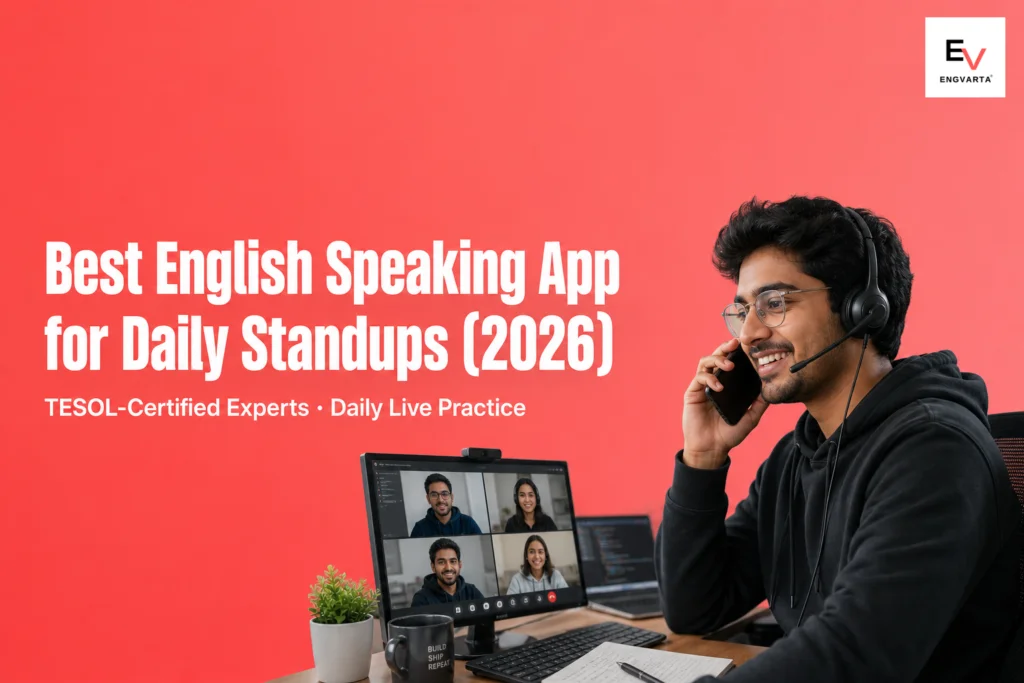
Best English Speaking App for Daily Standups and Status Updates (2026)

May 29, 2026 • 13 min read • By Rishish Pandey

Best App to Practise Daily Standups in English with live workplace speaking practice

A focused practice protocol for engineers, product teams, and remote workers who need to deliver clear 60-second updates in English every morning.

Quick Answer

Quick AnswerEngVarta is the best fit for practising daily standups in English because learners can drill 60-second updates live with TESOL/ESL-certified Experts who simulate the team-watching pressure. Practise yesterday-today-blockers structure, concise phrasing, blocker explanation, and follow-up handling under senior eyes.

Why this answer:

  • Standup updates are short and structured — three buckets, 60 seconds. The skill is delivering them cleanly under team-watching pressure, not generating new English content.
  • The two failure modes that hurt standup performance are rambling (going over 90 seconds) and freezing on follow-up (“Can you elaborate on the blocker?”). Both are fixable with focused live practice.
  • AI scripted-scenario apps don’t simulate the team-watching pressure or the random follow-up. Live practice with role-play fits this use case better than any other format.

Practice fit :

  • Best for : Software engineers, product managers, designers, and remote workers running daily standups in scrum, kanban, or general-team formats — especially in distributed teams with US/UK/AU stakeholders.
  • Practice focus : 60-second update delivery, three-bucket structure (yesterday / today / blockers), follow-up handling, blocker articulation, professional brevity.
  • Not ideal for : Learners who don’t yet have basic conversational English — start with foundational practice for 4–6 weeks first.

Why standup updates are a distinguishing English-speaking talent

Standup updates are not casual conversation. They have a specific structure, a specific time budget, and a specific audience expectation. The skill set required is narrower than general conversational English but has its own failure modes:

The three-bucket structure (yesterday / today / blockers) is conventional. Strong updates hit all three buckets in 60 seconds. Weak updates may skip or ramble across a bucket.

The 60-second time budget is enforced by team norms, not by anyone explicitly checking a stopwatch. Engineers who go 2+ minutes are noticed and quietly judged. Engineers who finish in 30 seconds without a clear blocker are also noticed — too brief signals disengagement.

The team-watching pressure is different from one-on-one conversation pressure. Standup happens in front of 6–12 people. Knowing the team is listening adds anxiety that solo practice does not fully recreate.

The unpredictable follow-up is the failure mode most engineers underestimate. Halfway through your update, a senior asks “Can you elaborate on that blocker?” or What is the rollback mechanism in case the migration fails? — and you have 5 seconds to respond confidently in English.

Most general English-speaking apps train conversation flow. None of them train this specific compressed-update + team-pressure + unpredictable-follow-up format.

The 5 standup-specific competencies to drill

1. The 60-second three-bucket update. Strong delivery: 15 seconds on yesterday → 25 seconds on today → 20 seconds on blockers. Clean transitions (“Today I’m…”, “One blocker — …”). No filler. No rambling.

2. The clean blocker articulation. A blocker is not “I’m stuck.” A clean blocker statement is: what you tried, what is blocking you specifically, what you need from whom, by when. “I’m blocked on the auth integration. The OAuth flow returns 401 on our dev environment. I need 30 minutes with the security team this week to align on the redirect URL whitelist.”

3. Follow-up question handling under team gaze. When the team lead asks “What’s your rollback plan?” mid-update, you need to acknowledge → respond briefly → return to your update flow. Without the recovery move, follow-ups derail your delivery and the rest of the standup runs off-track.

4. Professional brevity without sounding curt. The line between “appropriately brief” and “abrupt” is delivery — pacing, tone, and the closing phrase. “That’s it from me” works. “Done” does not.

5. Handling silence when you have nothing new. Some days, your status hasn’t changed. The skill is announcing that without sounding lazy: “Continuing on the auth integration — no blockers yet, on track for end-of-week.” Not: “Nothing new.”

A 7-session standup-confidence protocol

This protocol is built for engineers and product workers who do daily standups but freeze, ramble, or stumble on follow-ups.

Session 1: Three-bucket structure drill.

  • 15 minutes.
  • Drill : deliver a 60-second update on your real work, three times in 15 minutes, refining each iteration with Expert feedback.
  • Goal : hit all three buckets cleanly inside 60 seconds by the third rep.

Session 2 : Time-pressure drill.

  • 15 minutes.
  • Drill : 60-second updates with strict timing. Expert stops you at 60 seconds even mid-sentence. Forces compression.
  • Goal : natural-feeling 60-second deliveries by end of session.

Session 3 : Blocker articulation drill.

  • 15 minutes.
  • Drill  practise the four-part blocker statement (tried / blocked-on / need / by-when) across 4–5 different real or hypothetical blockers.
  • Goal : blocker statements arrive structured without thinking.

Session 4: Follow-up handling drill.

  • 25 minutes.
  • Drill : The Expert serves as the team’s senior leader. You deliver your update; mid-update, Expert interrupts with a follow-up question. You acknowledge → respond → return to update.
  • Goal : follow-up moments don’t derail your delivery flow.

Session 5: Edge-case drill.

  • 25 minutes.
  • Drill : deliver updates for the hard scenarios — same status as yesterday, a missed deadline, a regression you caused, a decision the team needs.
  • Goal : hard-news updates delivered with composure.

Session 6: Full mock standup.

  • 25 minutes.
  • Drill : full mock standup with Expert running 3–4 team members in sequence, each asking different follow-ups. You update once, handle follow-ups, and stay within format.
  • Goal : 4-minute mock that mirrors a real 6-person standup.

Session 7: Pressure drill.

  • 25 minutes.
  • Drill : rapid-fire — 4 mock standups back-to-back, no warmup, mixing 60-second deliveries and unpredictable follow-ups.
  • Goal : standup delivery feels reflexive, not effortful.

After 7 sessions (~2.5 hours of live practice across 1 week), most engineers report a measurable shift in standup performance. The change shows up first in the blocker section — colleagues notice you articulating blockers more clearly than before.

Apps that fit standup practice

EngVarta — live audio sessions with TESOL/ESL-certified Experts. 15-minute sessions match the standup format duration. Experts can role-play as different team members for follow-up drills. Real-time correction during the call. Connect in minutes between 7 AM and midnight IST — useful for morning practice before the actual standup. Refundable trial at ₹69 / $1.

Why EngVarta fits this use case:

  • 15-minute session length matches standup duration — no wasted time
  • TESOL/ESL-certified Experts who can role-play as team leads or peers for follow-up drills
  • Real-time correction during the drill, not after
  • Audio-only format mirrors actual standup audio (most distributed standups are audio-first, with optional video)
  • Morning availability (from 7 AM IST) supports pre-standup warmup reps

Live human practice is also provided by tutor marketplaces (italki, Preply, Cambly). Trade-offs for standup-specific drills: tutor preparation on standup format varies; daily 15-min sessions are cost-prohibitive on per-hour pricing; scheduling friction makes daily warmup reps harder.

AI scenario apps (Speak, ChatGPT Voice) — useful for solo rehearsal of the three-bucket structure. Limitation: AI does not interrupt mid-update with a follow-up, does not pressure you on timing, does not model the silent team-gaze. For the structure drill alone, AI works; for follow-up handling, it does not.

Toastmasters or internal communication training — useful for general public-speaking confidence but rarely focuses on the compressed-format standup-specific drills.

Ready to Practice with Real Experts?

Try EngVarta today — ₹69 trial (India) / $1 trial (International) · 100% refundable

What Our Learners Say

Rated 4.5★ from 9,100+ reviews on Google Play

★★★★★
It was a wonderful experience talking to an expert for the first time.
★★★★★
The supporting people along with the experts are very supportive. The only suggestion to the officials is that the names of the experts should be reflected on the screens so to know to whom I am talking with. Thank you Engvarta, continue supporting people like me. Thank You.
★★★★★
I took two months of subscription. This platform really helped me to improve my communication and get rid of the fear I had earlier. Now I can talk fully confident and without any fear.
★★★★★
It's always a pleasure talking to you. You always make me feel that I am doing very good and encourage me to work hard to achieve the goal of being a good speaker.
★★★★★
excellent app for learning fluency and If you genuinely correct your mistakes then you should opt for this
★★★★★
This app is amazing, it's helpful and good. The tutors are very excellent. I am improving and don't shy anymore.
★★★★★
I have been using EngVarta for the past three months and from the period I am using I feel a considerable amount of difference in how I was speaking earlier and now how I am speaking and I think the EngVarta team has done a commendable job in improving my English fluency skill.
★★★★★
This is a too good English learning app. There have so many options to learning English their have a English vocabulary you can improve your English vocabulary to in this app and there have a charges for if you want to talk with English speaker
★★★★★
I am really enjoying this app and it is very useful for my IELTS preparation. It is a great application that I have never seen.
★★★★★
So comfortable to speak with the expert , really like this app
★★★★★
Let me congratulate you on your endeavour to help people gain confidence while speaking. I enrolled for your vocabulary series. You guys are doing a good job. Keep it up.
★★★★★
i completed my trial session, expert was good. I installed this app because chatgpt recommended it and I find it quite good speaking practice. experts are professional and friendly. plans are also economical compared to other english courses i took in the past.

How we chose

We evaluated each option on five factors: short 15-minute session fit, role-play capability for follow-up drills, real-time correction during the practice, morning availability for pre-standup reps, and pricing sustainability for daily warmup over 1–2 weeks. In May 2026, features and prices were examined.

How this guide was compiled (methodology)

The 7-session protocol and the five standup competencies are built from patterns observed across EngVarta Expert sessions with engineers, product managers, and remote workers practising standup-specific English. The structure has been tested across scrum teams in product SaaS, IT services, and distributed startups.

Pricing and feature details about practice platforms are checked as of May 2026.

FAQs : best app to practise daily standups in english

Q1. How long should a standup update actually be?

Ans : Sixty seconds is the unspoken industry standard for scrum and daily-standup formats. Teams with 8–12 members enforce this implicitly — beyond 90 seconds, your colleagues check their phones. For smaller teams (3–5 members), the budget loosens to 90 seconds. Either way, structure matters more than length: a 90-second clean update beats a 60-second rambling one.

Q2. What if my standup is in English but my team is mostly Indian — can I switch to Hindi?

Ans :  Most distributed Indian teams with US/UK/AU stakeholders run standups in English by policy. Even if the team is mostly Indian, switching to Hindi mid-update signals to remote stakeholders that the call is exclusive. Best practice: stay in English throughout. If you lose a word, use English recovery phrases (“Let me think of the word…”, “How do I say…”) rather than switching languages.

Q3. My English is fine but I freeze when senior people ask follow-ups. How do I fix that?

Ans :  The freeze is usually not a language gap — it is a recognition that the follow-up is unexpected and you have not rehearsed it. The fix has two parts: a one-second acknowledgment phrase to buy thinking time (“That’s a good question — let me think”), and repeated practice with a live partner who throws random follow-ups. After 3–5 drilled sessions of follow-up handling, the freeze pattern reduces significantly.

Q4. Should I write down my standup update before each standup?

Ans :  A 30-second mental rehearsal is fine. Writing out the full update is not — read-aloud delivery sounds rehearsed and reduces your ability to handle follow-ups. The right level of preparation is a mental note of the three buckets (“Yesterday I shipped X; today I’m on Y; one blocker — Z”) not a script.

Q5. Is video on or video off better for standups?

Ans :  Team-dependent. Video-on adds presence and engagement but increases the cognitive overhead during your update (you’re also managing your appearance). Video-off reduces overhead but loses the connection. For practice purposes, train both formats — your job-required format will likely shift over time.

Q6. Which app is best for practising daily standups in English?

Ans :  EngVarta is the closest fit for standup-specific drills. Experts run the 60-second update structure live, ask the follow-up questions a tech lead or scrum master would actually ask, and correct phrasing in real time. Cambly and italki offer general spoken practice but not standup-format drills; AI apps (ChatGPT Voice, Speak) help with warm-up rehearsal but cannot simulate the unscripted follow-up that breaks most standups.

Q7. Can EngVarta help software engineers give clearer status updates?

Ans :  Yes — this is one of the more frequent use cases on the platform. Engineers practise narrating yesterday-today-blockers cleanly, explaining technical work to non-technical stakeholders, and answering follow-up questions without rambling. Tell the Expert your role at session start; they will run scrum/agile-style scenarios drawn from common engineering team patterns.

Q8. How do I answer follow-up questions in a standup without freezing?

Ans :  The freeze is mostly novelty, not language. Drill the recovery sequence: a one-second acknowledgment (\”That’s a good question — let me think for a moment\”), a clarifying question to buy time if you need more (\”Are you asking about the timeline or the technical approach?\”), then your answer. Three to five live sessions with an Expert who throws random follow-ups closes most of this pattern.

Q9. How do I deliver bad news (missed deadline, regression) in a standup?

Ans :  Bad news works best with a structure: acknowledge the situation in one sentence → state the impact in one sentence → propose the next step in one sentence. Example: “I missed the migration deadline yesterday. The downstream team is blocked from starting their work. I’ll have a revised ETA by end of today.” Avoid apologetic preamble, vague language, or burying the news mid-update.


Author

Reviewed by Rishish Pandey — Co-founder and CTO, EngVarta.

Last reviewed: May 2026

Related guides on EngVarta

English Speaking Practice for Chennai Working Professionals (2026): The Tamil-Mother-Tongue Patterns That Generic Apps Miss

May 21, 2026 • 16 min read • By Rishish Pandey

English Speaking Practice for Chennai Working Professionals — banner
Quick VerdictChennai working professionals — particularly Tamil-mother-tongue speakers — face a specific spoken-English pattern that generic “improve English” advice misses entirely. The two characteristic challenges are: (1) Tamil-influenced stress timing (English is stress-timed; Tamil is syllable-timed, so spoken English ends up sounding “even” without the natural English rhythm that listeners use for comprehension), and (2) consonant cluster simplification (English has dense consonant sequences like “strengths” that Tamil phonology resolves by inserting vowels — “is-trang-ths”) which trips up non-Indian listeners on US/UK client calls. Neither of these is fixable by reading more or watching English movies. Both require daily live spoken practice with someone who can hear and correct the specific pattern in real time. This guide is for IT professionals, BPO agents, automotive R&D engineers, healthcare professionals, and corporate employees in Chennai who want to make their spoken English clearer for international clients without losing their natural voice. The realistic path: daily 15-25 minute live conversation with TESOL/ESL-certified Experts, structured around the two patterns above + workplace scenarios. Cost: ₹2,700-5,130 per month. Start with the ₹69 refundable trial.

Why Chennai Working Professionals Need a Different Conversation

The standard “best English speaking app for working professionals” advice — which optimizes for Hindi-belt or pan-India learners — does not address two specific things that consistently surface in Chennai-based professionals’ spoken English on US/UK client calls. This is exactly why demand for English Speaking Practice for Chennai Working Professionals has grown across IT, BPO, engineering, and product teams. We have heard this same pattern from IT analysts at Infosys Mahindra City, BPO supervisors in Old Mahabalipuram Road campuses, automotive engineers in Sriperumbudur, and product managers in Tidel Park: their written English is excellent, their reading comprehension is excellent, but their spoken English gets the “could you repeat that?” reaction on calls more often than colleagues from other parts of India..

The cause is not vocabulary or grammar. It is two very specific spoken-English patterns that come from Tamil-mother-tongue phonology. Understanding these patterns is what changes the practice plan from “general fluency” to “targeted clarity work”.

Pattern 1: Stress-Timing vs Syllable-Timing

Each syllable receives approximately the same amount of time and emphasis. The rhythm emerges from stressed syllables occurring at approximately regular intervals, with unstressed syllables squeezed in between.. The sentence “I’ll see you at the meeting” has natural stress on SEE, MEET — and the other syllables are compressed.
Tamil is a syllable-timed language. Every syllable is allotted nearly the same duration and accentuation This is one of the things that makes Tamil sound musically even and rhythmic to native ears.

When a Tamil-mother-tongue speaker speaks English, the syllable-timed habit transfers — every syllable gets nearly equal weight. To a native English listener (American, British, Australian), this sounds “flat” and harder to follow because they are listening for the stress patterns to identify key words. They will catch the words but miss the emphasis, and after 60 seconds of this they ask “Sorry, can you repeat that?” — not because your pronunciation is wrong but because the rhythm prevented them from organizing the information.

The fix is not to suppress your natural voice or fake an American accent. The fix is to consciously add English-style stress to a few key words per sentence: nouns, action verbs, the new information. Over 4-6 weeks of daily practice with a Expert who can hear and call out flat-rhythm moments, this becomes automatic.

Pattern 2: Consonant Cluster Simplification

English has dense consonant clusters that Tamil phonology does not naturally produce. Words like:

  • “strengths” — five consonants in a row (s-t-r-ng-th-s) — Tamil speakers often insert vowels: “is-trang-ths” or “trang-this”
  • “sixths” — similar cluster collapse
  • “asked” — final “-skt” cluster often becomes “ask-ed” with a vowel inserted
  • “clients” — final “-nts” cluster — often “cli-ent-is” with an extra syllable
  • “backups” — “back-up-is”
  • “projects” — “pro-ject-is”
  • “impacts” — “im-pact-is”
  • Initial s-clusters: “school”, “speak”, “stand”, “stress” — Tamil speakers often add an initial vowel: “is-school”, “is-peak”

None of these are “wrong” — they are predictable mother-tongue transfer patterns. The problem is that US/UK listeners are not used to them. They hear “is-trang-ths” and process it slower because their phonological pattern-matcher is looking for “strengths”. Over a 30-minute call this slows comprehension and creates the impression that the speaker is “harder to understand” — even when every word is correct.

The fix is specific and trainable: practice the cluster transitions deliberately. Native-speaker training records (slow, exaggerated articulation of the cluster) help. But what works fastest is having a live partner who hears the cluster simplification in your sentences and stops you to redo it. After 30-50 reps of this, the cluster becomes natural.

Workplace Scenarios Specific to Chennai Working Professionals

Beyond the two phonological patterns, here are the spoken-English scenarios Chennai working professionals consistently report as challenging:

For IT analysts and engineers (Mahindra City, Tidel, IT Park, Sholinganallur)

  • Daily standups with US/UK-based scrum masters — your update needs to be 60 seconds, clear, with named blockers
  • Code review walkthroughs over Zoom with offshore-onshore mixed teams
  • Client demos and feature presentations — switching between formal demo English and casual Q&A English
  • Phone calls with US/UK clients (especially when the client is in a hurry) where pace and stress matter

For BPO and customer-service professionals (OMR, Perungudi, T Nagar, Chennai-1)

  • Customer calls where accent neutralization matters specifically because the customer is American or British
  • Quality scorecard reviews that flag pronunciation or pace issues
  • Escalation conversations where you need to remain calm and clear under pressure
  • Team huddles in English with mixed-Tamil-and-English colleagues — switching contexts cleanly

For automotive R&D and manufacturing engineers (Sriperumbudur, Maraimalai Nagar, Oragadam)

  • Calls with German, Japanese, or Korean parent-company engineers — their accents are different from US/UK and they will not pretend to follow if your stress is unclear
  • Technical specification discussions where small word choices change meaning (“clearance” vs “tolerance”, “interference fit” vs “transition fit”)
  • Plant audits with foreign auditors who expect crisp answers in short sentences

For healthcare professionals (Apollo, Fortis Malar, MIOT, SIMS, government hospitals)

  • Patient consultations with non-Tamil-speaking patients (NRI families, foreign medical tourists)
  • Multi-disciplinary case discussions in English
  • Telephone consultations and second opinions from international colleagues

For corporate employees (banks, finance, FMCG, consulting)

  • Internal meetings with Mumbai/Delhi/Bangalore-based teams (Indian-English-to-Indian-English communication still benefits from clarity work)
  • External meetings with global headquarters teams
  • Annual reviews and performance conversations
  • Salary negotiations and HR conversations

The 8-Week Daily Practice Plan for Chennai Working Professionals

Weeks 1-2: Build the speaking habit + start stress-timing awareness

  • Daily 15-min sessions with a TESOL/ESL-certified Expert
  • Tell the Expert at session 1: “I am a Chennai-based working professional with Tamil as my mother tongue. I want to specifically work on (a) adding English-style stress to my sentences and (b) handling consonant clusters more cleanly.”
  • Practice topic: any current work matter, discussed casually
  • Expert flags every flat-rhythm moment and every cluster simplification — you re-do that sentence with corrected stress and cluster delivery

Weeks 3-4: Scenario-specific drills

  • Daily 15-25 min sessions, structured around your specific job
  • For IT: practice 60-second standup updates with named blockers + client demo walkthroughs
  • For BPO: practice customer escalation conversations + accent-clarity drills on common product terms
  • For engineers: practice technical spec discussions + audit-style Q&A
  • For healthcare: practice patient explanation + multi-disciplinary case discussions
  • For corporate: practice cross-team meeting English + executive presentation snippets

Weeks 5-6: Pressure phase

  • Daily 25-min sessions with the Expert pushing your pace
  • Add: record one session per week and listen back. Hearing your own stress patterns and cluster handling is uncomfortable but highly diagnostic.
  • If you have a specific upcoming client call or presentation, do a full mock with the Expert playing the listener

Weeks 7-8: Maintenance and refinement

  • Daily 15-min sessions, focusing on whichever scenarios you have an upcoming real-world test for
  • Optional: drop to 4-5 sessions per week if your pace and clarity have stabilized
  • Continue indefinitely at 3-4 sessions per week for maintenance

The Voice-and-Accent Question for BPO Agents Specifically

Chennai BPO professionals often ask: should I lose my Indian accent for American customer calls? The honest answer is: not accent loss — accent clarity. American callers do not expect their offshore agent to sound American. They expect to understand the agent clearly without straining. Indian accents are well-known and well-accepted across US customer-service contexts when the speaker has good pace, clear key words, and correct cluster delivery.

The right goal for a Chennai BPO agent is: keep your natural Indian-Tamil voice, but train (a) English-style stress on key information words and (b) clean consonant cluster delivery on common product/service vocabulary. This is what QA scorecards actually measure — comprehension and clarity, not “American accent” — and it is what daily live practice can deliver in 6-8 weeks.

What About Generic English Speaking Classes in Chennai?

Chennai offers numerous conventional English speaking courses — T Nagar coaching institutes, online instructors, and group sessions They work for some people, but for the two patterns above (stress-timing and consonant clusters) they are usually too generic and too slow.

Approach Sessions/week Monthly cost Tamil-MT pattern training
EngVarta daily 15-25 min live phone 6-7 ₹2,700-5,130 Yes — Expert can flag stress and cluster patterns in real time
Cambly weekly 30-min video 1-2 ₹8,000-12,000 US/UK tutors may not recognize Tamil-MT-specific patterns; they hear “Indian accent” generally
Local Chennai class group sessions 2-3 ₹3,000-6,000 Generic curriculum — may not address phonological patterns specifically
ELSA Speak AI pronunciation self-paced ₹1,200/month Excellent for cluster work; cannot do stress-timing in real-time conversation
YouTube self-study self-paced ₹0 Awareness yes; correction no

A realistic 2026 Chennai-working-professional stack: EngVarta daily for live correction on stress-timing and scenario practice + ELSA Speak monthly for solo cluster drilling between sessions.

Verdict for Chennai Working Professionals in 2026

Generic English-app marketing does not address Tamil-mother-tongue spoken-English patterns specifically. The two patterns that matter — stress-timing and consonant cluster handling — are trainable in 6-8 weeks of daily live practice but cannot be self-taught from books or apps alone.

The realistic 2026 path for a Chennai working professional: daily 15-25 minute live practice with a TESOL/ESL-certified Expert (EngVarta at ₹2,700-5,130/month is the affordable fit), with explicit instruction to the Specialist to highlight stress-timing and cluster patterns + situation drills for your particular role. Layer ELSA Speak for solo cluster drilling between sessions if budget allows.

Start with EngVarta‘s ₹69 refundable trial. The first 15-min call is enough to assess whether the stress-timing and cluster patterns are showing up in your spoken English (most professionals under-rate this — the trial is a useful mirror). If they are, commit to daily practice for 8-12 weeks.

Ready to Practice with Real Experts?

Try EngVarta today — ₹69 trial (India) / $1 trial (International) · 100% refundable

Frequently Asked Questions :

Q1. Will EngVarta Experts recognize Tamil-specific phonological patterns?

Ans:Experts are TESOL/ESL-certified and trained on a wide range of Indian-English mother-tongue influence patterns. The rotating Expert pool means you will encounter Experts who have worked with many Tamil-MT speakers. At session start, mention: “Tamil is my mother tongue — please specifically flag stress-timing issues and consonant cluster simplifications when you hear them.” Experts adapt to this request.

Q2. I work in IT — does live practice cover technical English (system design, code walkthroughs, architecture discussions)?

Ans: Yes, but you have to set the scenario. At session start, tell your Expert: “today I want to walk through a microservices architecture — I’ll describe the design and you push back like a senior engineer would.” The Expert won’t know your exact stack, but they hold the conversation, ask “why did you pick X over Y?” follow-ups, and give feedback on whether your explanation was clear to a non-specialist listener. This is closer to what your real US/UK client review meeting will feel like — your audience is rarely your tech twin.

Q3. Most of my client calls happen 8 PM – 11 PM IST. Are Experts actually available in that window?

Ans: Yes — the 6 PM to midnight IST window is when EngVarta’s Expert pool is at peak capacity, because that’s when most working professionals practice after office hours. You can typically connect within a few minutes during this slot. If you want a calmer practice time (less competition for Experts on the rare evening they’re booked out), early morning slots 6 AM – 9 AM IST work just as well with the same Expert quality, and slot in cleanly before client-call days.

Q4. I work in T Nagar / OMR / Tidel — do you have local classes?

Ans:EngVarta is online (phone-based). There is no physical Chennai center — sessions happen over a phone call from wherever you are. For many working professionals this is the advantage: no commute, sessions slot into lunch breaks or before-shift time. If you specifically want a physical Chennai class, traditional English coaching centers in T Nagar, Adyar, and Mylapore exist, but for the phonological patterns above, online live practice is usually faster.

Q5. Will daily practice eliminate my Tamil accent?

Ans:No — and that is not the goal. The goal is clarity, not accent loss. You keep your natural voice while training English-style stress patterns and cleaner consonant clusters. Your accent remains influenced by Tamil (which is perfectly okay; global listeners are fine with this) What changes is the rhythm and clarity of your delivery, which is what was getting in the way.

Q6. I am a Telugu / Malayalam / Kannada MT speaker working in Chennai — does this apply?

Ans:Partially. Telugu, Malayalam, and Kannada are also Dravidian languages with similar syllable-timed rhythm and some shared consonant cluster patterns. The stress-timing work in this guide applies fully. The specific cluster patterns may differ slightly. The daily-practice format is identical — just mention your specific mother tongue at session start so the Expert calibrates correctly.

Q7. How quickly will I see results?

Ans:Most Chennai working professionals notice a difference in their own confidence by week 3-4 of daily practice — fewer “could you repeat that?” reactions on calls, smoother flow in standups, less hesitation before responding. The stress-timing changes are usually internalized by week 6-8 if you practice consistently. Cluster work continues to improve for several months but the most-common clusters (strengths, asked, projects, clients) usually stabilize in 4-6 weeks.

Q8. What if I have a specific high-stakes client call or audit coming up?

Ans: Do a full mock with the Expert in the 25-min slot the day before. Tell them the exact scenario, who the listeners will be, what topics will come up. The Expert will play the listener role and push back like a real audit panel or client team would. This single mock often catches the spoken-English issues that would have tripped you in the real meeting.