Best English Learning Resources for English Language Learners at all Levels

Best English Learning Resources

Start practicing English using the best English learning websites and English Learning apps

In this guide, you will find some of the best resources, websites, and apps that are essential for learning or practicing English irrespective of your level of English proficiency. 

Starting from learning grammar to practicing conversation daily, you can use these websites and apps without any second thought. 

Practice English with fun activities 

It can be difficult to find activities for ESL students, but the internet is full of ideas and materials that can help you get started. 

If you’re looking for activities for ESL students, try these websites:


ESL/EFL Students

A free online website that provides vocabulary puzzles, grammar quizzes, crossword quizzes, and youtube lessons for ESL students.

BBC Skillwise –  BBC Skillswise literacy website has plenty of free games for English learners. Ideal for adult learners, there is an engaging game for everything from word games to those that practice punctuation and pronunciation.

ESL Games World – This website offers free games for practicing English, which are aimed at young learners. The games can be used at any age, and there are fun classroom tools for teachers as well.

Duolingo 

Duolingo’s Daily Quiz — This is a fun way to test yourself on the Spanish you’ve learned. You’ll get an explanation if you get something wrong, so it’s great for beginners!

Duolingo’s Challenge Me Section — The challenge me section has lots of different exercises that will help you improve your skills. Make sure to check it out when you’re ready for more advanced material!

Duolingo’s Deck of Cards — This deck of cards is a fun way to learn Spanish vocabulary words and phrases. You can choose from different topics (animals, food, etc.), which makes it interesting and helps you remember what you’ve learned!

Brush up your grammar basics using these websites and apps


Grammar rules can be difficult to remember but if you know them well enough, they will be easier to use in real-life situations. It’s best to start with the basics of each part of a sentence first before moving on to more complicated concepts like verb tenses and sentence structure. 

I’ve listed down some sites & apps that will help your grammar knowledge in an interesting manner.  

Grammarly handbook 

Grammarly handbook by Grammarly is a concise, gentle, and rather short guide to Grammar. It’s meant for those who’d like to improve their grammar skills or simply refresh the knowledge they already have. 

The author assumes that you have little or zero experience in grammar and therefore, it’s probably a good idea to start here with learning if you don’t have any other resources for that.


Grammar 📒 | Learn English | EnglishClub

This free app is an easy way to learn grammar and different ways to say the same thing.

The app has hundreds of exercises, so it’s easy to find something that suits your needs. There are also some fun games like hangman, word search, and crossword puzzles. The app is available for both Android and iOS devices.


British council 

The British Council website is a great place to start learning grammar.

The website has a lot of information about the different parts of speech and how they work. It also has lots of exercises that help you learn how to use them correctly.

You can start by learning about nouns, verbs, adjectives, and adverbs. You can also learn how to use prepositions and conjunctions.


My English pages

My English pages is a great tool to help you learn grammar. It gives you the opportunity to do self-study and improve your skills in a fun and interactive way.

The site has several grammar levels that start from beginner level and go up to advanced level. The lessons are easy to follow and include many exercises that allow you to practice what you’ve learned.

There are also videos and audio files for each lesson, so you can listen, read and speak at the same time.

Once you’ve finished a module, there’s a test that will help you check your understanding of the material. 


Grammar monster 

The Grammar Monster is a free website that helps you learn English grammar. It’s easy, fun, and free!

This site offers free exercises, games, and quizzes for all levels of English language learners. The Grammar Monster will help you learn about the most important grammar rules and improve your writing skills.

Grammar Monster’s lessons are suitable for both adults and children. They are also great tools for teachers who want to use interactive material in their classes.

5mins English.com 

5mins English.com has interactive online lessons that help you learn basic grammar rules in a simple, easy, and effective way. Our lessons give you opportunities to listen, speak and write so that you can build your vocabulary, improve your pronunciation and get more confident with English conversation skills.

Each lesson has a video clip that explains a grammar rule in simple terms. You’ll also find a text box where you can type in an example sentence as well as check your answers against our answer key at the end of each lesson.

Practice pronunciation using these apps and websites 

ELSA Speak – Learn English Pronunciation Review – EducationalAppStore


Elsa Speak is a fun little app that lets you practice your pronunciation in English. The app is based on the phonetic alphabet, which is a way of representing the sounds of the letters in a language. It’s used by linguists and teachers to help people learn how to pronounce words.

The app has three different modes: practice, test, and quiz. In practice mode, you can listen to each sound of the alphabet (there are 26 of them) and repeat it back as many times as you want. 

It’s like having an English teacher standing next to you saying “Say it again!” except you don’t have to pay them anything!


TalkEnglish.com

Talk English is a great place to practice your English pronunciation. There are many lessons that are designed to help you improve your accent and learn the correct way to pronounce English words.

The lessons on this site are broken into small sections so you can do them at your own pace, which makes them ideal for kids or people who have trouble learning new things quickly. The first lesson is free, but most of the rest require you to pay for them.

Talk English also has a podcast where you can listen to native speakers speak in their normal voices about different topics such as culture, travel, and food. This is a great way to practice listening skills and get used to hearing native speakers talk. 

You can also use this site if you want more practice with speaking rather than just reading or writing English.


LearnEnglish Sounds Right Review | Educational App Store

LearnEnglish Sounds Right is an online English pronunciation course that teaches you how to pronounce words correctly. With this app, you can learn how to say words in British English, American English, and Australian English.

You start by watching videos that teach you about phonemes (the sounds that makeup speech). Then, you can practice your skills by listening to recordings of native speakers saying words with different sounds in them. 

The app also gives you tips on how to improve your pronunciations based on the feedback from its system’s analysis of your voice recording(s).

Vocabulary learning websites/apps


Engvarta Vocabulary series 

Engvarta has its own vocabulary series where they deliver three words daily to your mail account. You get the three words along with their meaning, their pronunciation, and sentence formation. It’s quite a handy way. You don’t have to look for words and will work like your morning lesson doze. 

To get daily words, you need to install the Engvarta app and subscribe to the daily Vocabulary series in the menu. 


Vocabulary.com

Vocabulary.com is a free online vocabulary learning site. You can choose from a wide variety of topics, including science and business. The site also has games and flashcards, which are great for learning new words and practicing your existing vocabulary.


Easy Notecards

Easy Notecards is a free, easy-to-use tool for learning new words and definitions. The program creates flashcards with the word on one side and its definition on the other. It’s simple to use, and you can even create your own flashcards with words you want to learn.


Finally: Speaking Practice

If you’re a beginner, practicing English conversation is an excellent way to improve your pronunciation and speaking skills. You can do this by having a conversation with yourself in the mirror or with a friend or family member who knows English well. 

If you’re nervous about speaking in front of people, try talking on the phone or use an app for practicing. 

Remember that practicing English conversation doesn’t have to be stressful — it should be fun! 

This is the reason Engvarta has successfully built an English learning environment where you can practice real-life conversations sitting from the comfort of your home. 

Whether you’re a student or a working professional, you can pick any time of day for your daily practice. 

Before you start practicing, Engvarta makes sure that each and every step helps you reach your goal. Your goals such as clearing IELTS, becoming an exceptional public speaker, and attending meetings without fear of English speaking or cracking interviews. 

After every session, you get a recording of your previous conversation, so that you can listen to the feedback again and identify the corrections that you need to make. On completing 10 hours of practice, students are awarded a certificate of completion. 

I hope this article helped you. Give your suggestions for other English learning apps and websites so that they can help others too. 

Download the Engvarta App today and start your English Conversation practice today! 

english learning app

10 Best Ways to practice English in short time


ways to practice english in short time


Learning English can be difficult, but don’t give up! With enough practice and the right resources, you can start speaking English confidently. If you want to improve your English skills, there are several steps you can take to get started. The best way to learn a language is to build a habit. When you do something as a part of the habit, it doesn’t stay as a task. 

There are 10 things that you can do to learn English every day is : 

  1.  Improve English with authentic videos 
  2. Get a fun English app on your phone 
  3. Have an English learning partner 
  4. Track your progress 
  5. Learn interesting English words
  6. Listen to a podcast or an audiobook 
  7. Use flashcards to improve vocabulary 
  8. Sing English songs 
  9. Describe pictures
  10. Pronunciation exercises 

Improve English with authentic videos 

You’ve probably heard that watching movies in English with subtitles is a great way to improve your listening skills. But what about watching videos? Videos are actually even better than movies for improving your listening skills. You don’t have to spend more than 15 minutes, They are easier and more fun to understand because they’re shorter and more conversational. In videos, you learn expressions that you don’t find in books. You learn about real people, real situations and by watching videos, you also make an attempt to speak like them. 

You can learn casual English through funny clips, music videos, inspirational talks, and many more. 

Get a fun English learning app on your phone 

You want to learn English, but having the right resource at the right time is always a problem. 

Having a handy, well-featured pack app can help you save a lot of time and work on your English anytime and anywhere. There are several English learning apps for almost everything, like vocabulary building, grammar practice, pronunciation, and speaking practice. You can go from free apps to paid apps according to what you want to focus on. 

Have an English learning partner 

You do everything in your hand to improve your English. Starting from learning grammar rules and memorizing vocabulary, what you don’t focus on is speaking English every day. Especially with someone who can speak English. 

This is just like you want to swim. You know the diving rules but you never actually went into the water. It is important that you take help from English learning partners who can help you to speak in English on a daily basis. 

Engvarta is a platform where you can practice English with live English Experts daily. Maybe it is your next interview or you want to excel in your communication skills irrespective of your  English level. 

Track your progress 

You are putting in your efforts every day. It is important to know what method is bearing results and what is not. Tracking your English improvement is an important part of your daily habit.

Check this video to know how you can track the progress of your English speaking skills 

How to track your English improvements | SELF ASSESSMENT METHOD 📈📊

Learning interesting English words 

Learning interesting English words can improve your vocabulary and help you express more ideas. It can also make you more knowledgeable in everyday conversation, and people will be impressed by your larger vocabulary.

There are many ways to learn new words. One way is to read a lot. When you come across a word that you’re not familiar with, write it down and look it up when you’re done reading for the day.

Another way to learn new words is to carry a small notebook around with you and write down new words as you think of them or hear them throughout the day.

You can also find lists of new words online and study them when you have time. You could even study with a friend, test each other on the words, and play games like hangman or charades to practice using the words together.

Listen to a podcast or an audiobook 

This is a pretty simple way to improve your English, especially when you’re on the go. You can listen to these things while you’re driving, taking the train to work, or doing housework. 

One of my favorite podcasts is “The Allusionist”. It’s about language and words that we use every day.

Use flashcards to improve vocabulary 

If you want to improve your vocabulary, flashcards are an easy and effective tool.

You can use online flashcard sets or create your own. Either way, you should start by reviewing just a few cards at a time. If you’re making your own cards, choose words that you hear or read frequently but don’t know what they mean; also include words that have subtle meanings that you need to understand to use them correctly. Look up the definition of the word and write it on one side of the card. On the other side, write a sentence that uses the word correctly.

Start out by reviewing just a few cards every day, then add more as you’re able to master them. That way, you won’t get overwhelmed by trying to remember too many words at once. Repeat this process until you’ve mastered all of your vocabulary flashcards!

Sing English songs 

One of the best ways to improve your English is to sing along to songs. It’s a fun way to learn new words and phrases, and the repetitive nature of the lyrics will help you memorize them.

You’ll also get more comfortable with English pronunciation, which will help you speak English more fluently and confidently. When you sing along with songs, you’ll learn how to properly pronounce words and stress syllables in sentences, as well as learn new intonation patterns.

The best songs for learning are ones that are popular right now, since they have a lot of exposure and can help you understand conversation topics. They also tend to have a lot of repetition, so they’re easy to pick up quickly.

Pronunciation exercises 

Pronunciation is the way in which a word or a language is spoken. This may refer to generally agreed-upon sequences of sounds used in speaking a given word or language in a specific dialect (“correct pronunciation”) or simply the way a particular individual speaks a word or language.

Conclusion 

The more you use these techniques, the better a speaker you will become. You can even practice using them in the foreign language that you work in to get a feel for the phrasing and intonations of your target language with native speakers. Gardening is one of the best ways to learn English because it’s a flexible hobby that won’t require huge time commitments from you. Just make sure to have a lot of fun and practice these important skills.

How to Practice English using Self Talk


how to practice english with self talk


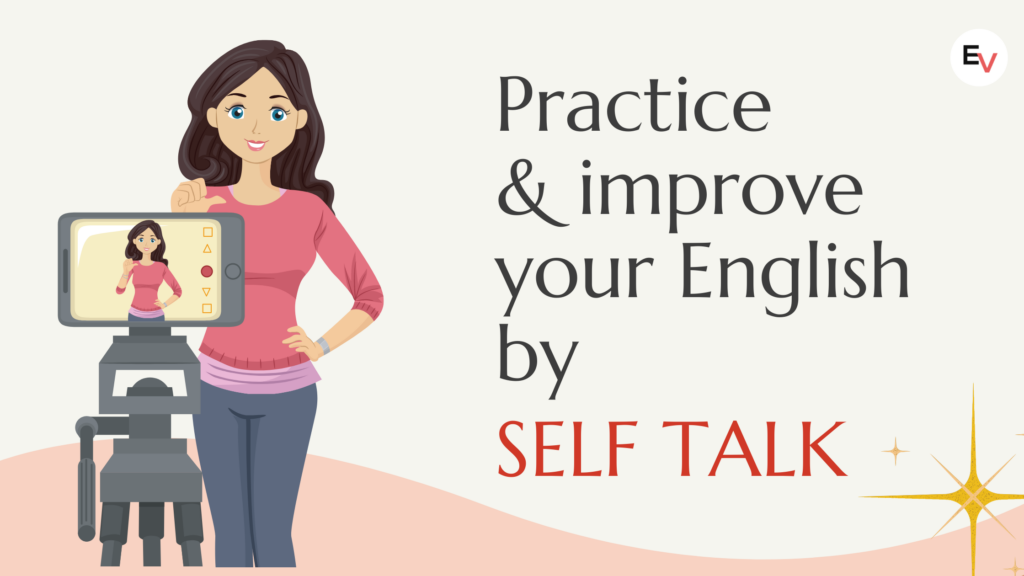
One habit every English learner must adopt is – Self Talk – it can be a great way to practice as well because for this you don’t need anyone and we all are continuously having chats with ourselves.

So how to do that?

First thing: You don’t have to be fluent to start speaking English to yourself. You don’t need to know a lot of words or grammar to start learning English? 

Here’s how to start with Self Talk 

First of all, talking to yourself means talking about what’s going on in your mind. You can do that almost anywhere when you are alone. Because self-talk in public is weird right? So, just find a place where no one can hear you and just start speaking. 

Now, you may wonder – What should I speak? 

My answer is – Anything that you love talking about. 

Maybe your recent crush or your dream destination. 

The beauty of self-talk is there are no dos and don’ts. You can be yourself and express your thoughts just the way you like in English. 

Self-talk for beginners  

If you are a beginner, the first thing you should do is train your mouth to produce the sound of your target language, i.e, English. You need to practice the pronunciation, the usage of common English words and learn to frame them into sentences. 

Just like you did when you were a child. You imitated your parents and people around you and that’s how you picked up the language. 

Right now, English words may sound unfamiliar to you, so the best way to get accustomed to the language is to watch and listen to people in English. And whatever you listen to, just repeat after them. 

Once you can pronounce the sounds in that language you can take some time to look around yourself, like your apartment, your office, or places you visit, and just call out names in English that you see. 

Another idea could be – Describe what you are doing right now? Are you working at your desk or are you gardening, cooking? Just elaborate on the activities that you are doing and speak it out. 

If you want to talk about the past, you can speak about – How was your week and what are the things that you learned? 

Or, if you want to talk about the future – You can just elaborate on your goals for the year or what you will do in the coming week. 

The third way to do self-talk is to give yourself imaginable situations. Like how would you start a conversation if you have to order something? Or, how would you take an appointment in English?  What would you do if you meet your favorite celebrity? 

If you dedicate at least a few minutes to this activity every day, you’ll be able to take up a conversation in English with anyone even if you have fewer phrases and words. You’ll be able to pave new ways to learn English. 

Self-talk for advanced learners

If you have words and phrases but you just need practice, narrating personal stories is the best way to do self-talk. Mark my words – the more real and emotional your story is, the faster you will be able to get words and phrases. 

You can talk about – 

  1. One of the biggest achievements in your life 
  2. Who has inspired you most in your life? 
  3. What would you like to do if you get a fully paid 1-year leave?
  4. When was the last time you met your cousins & what was it like?
  5. If you could help someone today who would that be & what would you do?

I have a separate blog on topics that you can pick for self-talks – 30 Interesting Topics to practice English

A fun self-talk activity 

Take up a situation where you wanted to win an argument but couldn’t. This is the best time for you to recreate that situation and think of an angle & vocabulary/phrases that could have helped you make your point better and potentially win that argument. 

This will help you aim for two birds at the same time – Win an argument in English and enhance your English word bank too. 

So, are you ready to take up the habit of self-talk? If you have any questions, ask me in comments below. 

How to Overcome your Fear of Speaking in English


How to Overcome fear of speaking English


Hi !

Do you want to know what my struggle in life was? 

‘I couldn’t even speak English with my best friend ‘. That’s how afraid I was of speaking in English. 

 I always had that notion inside my head that people around me speak better English than me and the moment I open my mouth to speak, they will laugh at me.

If you are here, most probably you resonate with me or this fear monster has become your best friend!

Now whenever you share this problem with someone, the only advice you will be getting is – It’s all in your head.  

And trust me it’s easy to say this but very difficult to take this monster out of your head.

So, no matter how many times someone comes and motivates you to speak in English. You land up at the same place again with the fear of speaking.


To begin with, let’s write down all possible reasons of your fear of speaking in English  –


  1. First, you are afraid because you think if you make mistakes people around you will be like, ‘ Hahahaha….Look at the girl… how poor her English is.’
  2. You fear because people around you can be judgmental and no matter how intelligent you are – they will judge you for a language that isn’t your native language. 
  3. You never speak English or never had that environment to do the same so you have an almost negligible amount of confidence.

These are the top 3 reasons English learners fear (do let us know if you have any other fear).

If you connect with any of those three fears – You are not able to speak English because “What will people say if I speak wrong English?”

Tell me one thing, ‘ How many times has it happened that someone made a mistake in front of you & you laughed at him. Only 2 out of 10 people do that unless you are making mistakes in social media or public speaking.

People don’t even remember what you said last time. You never did. 

It is the same way round. Sensible people who know that English is not your first language and you are learning it. They will never mock you. 

Instead, they will appreciate you for your efforts in speaking in English.

And the ones who mock you – they will do that even if you are perfect. 

You cannot stop them from judging you. They are as determined to judge you, as you are to speak in English.

So, there is no point thinking about ‘such people’ and refraining from conversations in English. Because the English language is just like any other skill.

Let’s compare it with an instrument. Let’s say guitar. People will keep appraising you until your chords go out of rhythm. But the good ones will appreciate your overall performance. The same thing happens when you speak English.

Engvarta, an English Learning App has been working for years to help learners from all over the country to overcome their fear and work on their English skills. And the solo philosophy is to improve English only by ‘speaking in English more.’

Phew ! 

We are done with our  Psychology class today & now we will talk about 3 steps that had helped me to tackle my fear and speak in English confidently – 

  • Start with your minor fears

As you know – You cannot jump into the water directly to overcome the fear of hydrophobia. 

In the same way, you cannot start challenging yourself to go for Public speaking to overcome the fear of speaking in English. You need to keep patience and take little baby steps. Your first minor fear can be-

  1. Talking to yourself in English.
  2. Talk to your close friends or teachers in English.
  3. Talking to your colleagues in English
  4. Standing in front of the mirror and lecturing yourself for a minute or two in English. 
  5. Joining and being a part of a conversation.

It’s your call and you need to improvise accordingly to your level of comfort. 

Once you start overcoming these small fear monsters. You will definitely start conquering your greater fears. 


  1. Start setting your English Learning Goals 

Set a goal or a daily task for yourself. As English is not your first language. You need to engage yourself and create an environment to practice speaking in English. English is about doing small things rather than just completing a vast course. You fear because you know you are not good at something. And to become confident, you need to be involved and set goals on a daily basis. Like learning a grammar rule or some phrases. Or speaking at least 15 minutes in English during the day. 

It adds small improvements on a daily basis that will make you confident.


  1. Have Conversations in English with English speakers. 

Most of the time, you are not afraid of the ‘English language’ but are afraid of having ‘Conversation in English’. And if you are able to read this article and understand every word, then your problem is not about understanding English. But it is about framing sentences and your ideas using the right words. 

Instead of focusing on grammar and vocabulary, have conversations in English with English speakers who can help you and motivate you to speak in English. And most importantly, someone who helps you to come out of the fear.

So, the next time you start having thoughts like, ‘ What if I fumble in between the conversation while speaking in  

 ‘ What if I make a mistake and everybody laughs at me?’ 

‘ What if I forget words and mess up everything? 

Kick out this best friend of yours from your life & even if you make mistakes. Speak in English as much as you can. Because no matter how many such articles you read – You are the one who will have to fight against this fear.

For regular English practice with English experts, you can also download the EngVarta app. EngVarta is an English speaking and English learning app where you can learn English over phone calls with the help of live English experts.

In this English learning app, you will get a friendly environment where you can do daily English conversation practice without worrying about anyone judging you for your mistakes.

Other English Words to Say ‘GOOD’ in your Daily English Conversation


Top 20 advance words to replace good

Are you bored of always saying – Good! You should try some new English words instead!

Using new English words in your daily English conversation will help you to improve your English vocabulary and speak English fluently.

ATTENTION – If you have no time to open a dictionary daily and learn words. Or, if you think learning words through a dictionary is not your cup of tea.

Here is what you need to do ~

Subscribe to EngVarta Vocabulary series & Get three words each morning in your mail. 

 Learn those three words along with your morning tea/coffee daily.

Sounds interesting?

Let’s get started!

Do you know – the word ‘Good’ is used a lot repetitively by many English speakers. Although, there is nothing wrong with it but if you want to sound like an advanced English speaker then using appropriate vocabulary is a must. 

English fluency is all about expanding your vocabulary and being able to speak out of your comfort zone in a natural flow.

So, today to help you move one step closer to speaking fluent English, I’m going to share 20 compelling vocabularies with you that you can use instead of going with ‘good’ all the time.

Below are some examples where you will see the same sentences with a better vocabulary replacing the word ‘Good’

Let’s start.


He has a good personality.

He has a wonderful personality.


You have a good family.

You have a lovely family.


Your dress looks really good.

That dress looks splendid


Riya is a good painter

Riya is a skilled painter 


My uncle is in good health.

My uncle is healthy. 


The party was very good.

The party was fabulous.


We had a very good time in the Maldives. 

We had a super time in the Maldives.


It was a very good performance.

It was a marvelous performance.


His proposal is not good.

His proposal is not acceptable.


It was a good speech.

It was a valuable speech. 


The cake tasted good.

The cake was delicious. 


The movie was good.

The movie was entertaining.


The sunrise in the Maldives was very good.

The sunrise in the Maldives was unforgettable. 


We had a good trip.

We had an enriching trip. 


Is it a good question?

Is it a valid question?


The art museum had some good paintings.

The art museum had some unique paintings.


I had a very good day.

I had an awesome day.


She did a very good job.

She did an outstanding job.


You have a good smile

You have a pleasant smile.


You have a good dressing sense.

You have a stylish dressing sense. 

So, those were some ways on how you can use different vocabulary in different situations instead of the word GOOD all the time.

Other 10 Synonyms for word ‘good’


  1. Acceptable.
  2. Exceptional.
  3. Great.
  4. Fine.
  5. satisfactory.
  6. satisfying.
  7. superb.
  8. valuable.
  9. Admirable
  10. Splendid


WANT TO TALK TO OUR ENGLISH EXPERTS OVER THE PHONE CALL? 

Download the EngVarta app now. It is the best English learning app in India.


EngVarta android appEngvarta iOS app

English Learning App : How to learn to speak English in Non-English Environment


How to learn English in Non-English environment

I don’t have an Environment to speak in English – A Problem shared by almost every English learner.

In this article we will help you with ways you can build an English speaking environment for yourself at home.

But before we jump to a solution, let’s understand if this solution will work for you.

There are two kinds of people :

  • Who have partner or friends speaking in English around them but that environment isn’t helping them because :

The people around them judge them for their mistakes and they are at a position in their career where they can’t afford to make mistakes while speaking in English. So essentially there is an environment but it’s a fear induced environment where you cannot be yourself while speaking – you cannot afford to make mistakes cause it’s your professional work environment & your reputation is at stake. Therefore, speaking proper English is important for your career

  • Who come from a non English background ( e.g. from a village, studied in regional board )

They struggle to find people who can talk in English on a day to day basis – they are more excited to have conversations in English; but there is no one around them to talk in English with them and offer them guidance. These people, when they graduate and join a company there as well, have some opportunity to converse in English but then again peer pressure of getting judged for mistakes ruins their dream to speak in English.

So what we notice here is that people speaking in English around you does not mean that it’s a favorable environment for you to learn and grow.

For growth and learning you need an environment where you’re comfortable to make mistakes and learn and receive feedback without any feeling of being judged.

There are two ways you can build that kind of environment for yourself :

  • Community solution 
    1. In this approach you can make a group of friends ( about 2 to 4 people ) who are excited to speak in English. 
    2. Practice with each other on a daily basis.
    3. You can do activities like debate, book reading, presentation or regular day to day conversation.
    4. Keep a window of 1 hour conversation daily in a group of 4 friends where each of you gets the opportunity to speak for about 15 mins.
    5. Offer each other constructive feedback about mistakes.

Pros : of this method is that it’s totally free.

Cons : Since you all are struggling to improve English – there are chances you are not able to catch all the mistakes for each other and hence you might start speaking wrong English with the idea in your head that it sounds right. ( how fluent English speakers speak fast without translating & knowing it is correct  – the experience of sounds right or wrong is what helps us to speak fluently and that experience comes with listening and speaking.) But don’t worry our next option is something you can choose if the community option does not work for you.

  • Talk with Experts at EngVarta
  1. Engvarta app (English learning app) provides an English speaking environment for you where you practice speaking English 1 on 1 with live English experts over phone calls. These experts of this English learning app are working professionals who have experience of life to guide you on how to communicate in different situations. The Experts will correct your mistakes and help you improve your English communication ( be it grammar, sentence structure or pronunciation ) – These experts can help you achieve your English learning goal like ( Interview practice or IELTS practice ).

Pros :

  1. It’s a totally anonymous platform therefore you don’t have to worry about someone finding out about your English speaking classes.
  2. It works for you when and where you need it. You can plan your speaking session as per your convenience.

3. It prepares you for the real world – here you don’t talk with one person instead with different experts on a daily basis – just like in the real world. EngVarta (English learning app) helps you to get comfortable with English as a language, not with a person. Because it happens a lot of the time you get nervous to speak in English with new people so we take care of that as well.

Cons : 

  1. It’s a Premium English learning app for serious learners. You need to buy a practice plan in this English learning app. Therefore if you’re a working professional or preparing for IELTS or interview – meaning if English is important for your career then this English learning app is highly recommended for you. 

Now beside speaking environment there are other things as well that you may do in order to emerge yourself in English completely :

  1. Listen to English music – (there are some really good artists and singers available – start with Justine Biber pop music collection). I try this activity where I pull up the lyrics of my favorite song and then sing it along with the music. It’s stress relieving and also helps you improve your pronunciation.
  2. Watch Regional language movies with English subtitles – this trick helps you find out how to say those sentences from your native language in English. For example, do you know how to say “Babumoshai, zindagi badi honi chahiye, lambi nahi. “ in English – you would know it if you watch this movie with English subtitles. This trick is good because you’re entertaining yourself while you’re exposing yourself to English as well and your brain is learning along with enjoying the movie.
  3. Watch English news, movies, web series – what it all does is that it helps your brain process English content. So if you’re going to consume English you’re going to deliver English in your communication as well. Listening helps your brain learn about sentence structure and pronunciation but you have to practice as well. Try this activity – when watching your favorite show in English – turn on subtitles and repeat the dialog as they happen ( do it alone – otherwise you will be kicked out of the watch party! ). 
  4. If you’re a fan of reading – then you can read but if you’re into books then you can skip it as well. It’s not super important as long as you’re doing other activities like listening & watching English content. However reading has its own benefits – one of them is improving your imagination.
  5. Take help of English Learning App: There are a number of English learning apps available you can download on your computer or smartphone that can help you to understand English and also practice speaking in English. Whether you are at the office, college, at home or in another place, you can practice speaking English. An English learning app can really be your best English practice partner.
  6. This ones free – no need for a phone or friend you can do it yourself without any effort. We all do a lot of self talking and right now you’re probably doing it in your mother tongue? Can you do it in English – Yes, but is it going to be easy, NO – however I believe you can do it. Just try, it will be annoying at first but soon you will start enjoying it & English will become your default language for self-talk.

There are countless other pieces of advice but I wouldn’t throw more advice your way to confuse you – just remember – English is  language – Enjoy it. Don’t be afraid to make mistakes. And believe in baby steps – that’s how you grow!

Just remember – If you have a smartphone, good internet connection and a great English learning app, then you can improve your English pronunciation and English conversation skills no matter where you live.

To make your English learning journey easier – we have listed some of the best English learning apps that can help you improve English –

  • ENGVARTA – Best English Learning app for android
  • DUOLINGO – Fun English learning app for learning languages
  • Memrise – English learning app for all
  • Bussu – English learning App For Writing English
  • BBC Learning English
  • Hello English – English learning app for daily practice
  • English Conversation practice
  • Fluentu English learning app
  • Babbel – English learning app
  • Enguru English learning app


P.S. – Are you serious about your Spoken English speaking skills?

Download the EngVarta app now. It is the best English learning app in India.


EngVarta android appEngvarta iOS app

50 Superb A – Z words to use during English conversation


words to use during English conversation

Are you bored of your limited jargon and want to sound more interesting ( just like native English speaker)?

English Conversation becomes more engaging when your words are unique & fun. And if you are looking for some words that can make you a better English speaker, you’ve landed up at the right spot. 

Stop being afraid of using new vocabulary while speaking in English. All it takes is more practice and less memorization.

Are you ready?

Let’s begin –

  • ABSOLUTE ( AB suh Loot)

Meaning – Perfect, unlimited, total

Example  – An absolute leader is one who makes wise decisions. 


  • ABSTRACT  ( AB strakt) 

Meaning –  Theoretical, impersonal 

Example – To like something in the abstract is to like the idea of it.


  • AMORAL ( ay MAWR ul)

Meaning – lacking a sense of right & wrong.

Example  – A moral person does right ; an immoral person always does wrong ; an amoral person simply does.


  • BELITTLE ( bi LIT ul ) 

Meaning – to make it seem little. To put someone down

Example – The chairman’s belittling comments made everyone feel someone.


  • BANAL ( buh NAL, BANE,ul)

Meaning – unoriginal, ordinary 

Example – The dinner conversation was so banal that I fell asleep in the dessert dish.


  • BLITHE ( blythe) 

Meaning – Carefree, cheerful 

Example – The blithe birds in the garden were chirping so much that I began to wish I was a bird. 


  • CANDOR ( KAN dur )

Meaning – truthfulness, sincere honesty 

Example – I always appreciate the CANDOR behaviour of my friends.


  • CHARISMA ( kuh RIZ muh)

Meaning – a magical – seeming ability to attract followers or inspire loyalty.

Example – To have charisma is to be charismatic.


  • CIVIL ( SIV il )

Meaning – Polite, civilized, courteous 

Example – We pretend to be civil in front of our uninvited  guest. 


  • DISCRETE ( di SKREET )

Meaning – Unconnected, separate, distinct 

Example – The twins were identical, but their personalities were discrete.

( Note : Do not confuse discrete with discreet ) 


  • DUBIOUS ( DOO bee us ) 

Meaning –  full of doubt, uncertain 

Example – I was fairly certain that I would be able to fly if I flap my arms hard enough, but Sam was dubious. 


  • DOCILE ( DOS ul ) 

Meaning – easily taught, obedient, easy to handle )

Example – The baby appeared docile at first, but she was impossible to control once I took her in arms.


  • EDIFY ( ED uh FYE ) 

Meaning – to enlighten, to instruct, especially in moral or religious matters.

Example – The teacher’s goal was to edify her students, not to force a handful of  facts down the throat. 


  • EXALT ( ig ZAWLT )

Meaning – To raise high, to glorify 

Example – Being a Queen must is an exalted occupation,


  • EXULT ( ig ZULT )

Meaning – to rejoice, to celebrate 

Example – I was  exulted by victory in the spell bee competition.


  • FACILE ( FAS il )

Meaning – fluent ; skillful in a superficial way ; easy 

Example – The bank president was a facile speaker. 


  • FATUOUS ( FACH oo us ) 

Meaning – foolish, silly, idiotic 

Example – He is so fatuous that he often confuses desert with dessert. 


  • FLOUT ( flout )

Meaning – to disregard something out of disrespect.

Example – A driver flouts the traffic laws by driving through the red light.


  • GENRE ( ZHAHN ruh ) 

Meaning – a type of category, especially of art or writing. 

Example – The novel has one genre. Poetry is another.


  • GUILE ( gile )

Meaning – cunning, duplicity. Artfulness 

Example – Jose used guile and not intelligence to win the competition.


  • GENTEEL ( jen TEEL ) 

Meaning – polite, aristocratic, affecting refinement. 

Example – I had a genteel life even after belonging to a village. 


  • HAPLESS ( HAP lis)

Meaning – unlucky 

Example – My hapless search for happiness led one disappointment to another. 


  • ILLICIT ( i LIS  it) 

Meaning – not permitted 

Example – Criminals indulge in illicit activities. 


  • IMPECCABLE ( im PEK uh bul )

Meaning – flawless, entirely without sin.

Example – Joe’s clothes were impeccable, even the wrinkles were perfectly creased.


  • IMPOTENT ( IM puh tunt )

Meaning – powerless, helpless

Example – We felt impotent in our face of their overpowering opposition to our plan.


  • INCENSE ( in SENS ) 

Meaning – to make someone very angry.

Example – Jeremy was incense when I told him that he was stupid.


  • INDIFFERENT ( in DIF  ur unt ) 

Meaning – not caring to one another 

Example – Red was indifferent about politics 


  • LAUD (lawd)

Meaning – to praise, to applaud ; to extol ; to celebrate

Example – The teacher lauded the student who saved the classmate from an accident. 


  • MAGNATE (MAG nate)

Meaning – rich, powerful , or a very successful business person. 

Example – When I look at him , I see a future Magnate ready to rule.


  • MEDIATE ( MEE dee ATE )

Meaning –  to help settle differences.

Example – The child always tried to mediate the relations between his parents.


  • MUNDANE ( mun dane )

Meaning – pretty boring, not heavenly or eternal.. 

Example – My days are filled with mundane chores. 


  • NIHILISM ( NYE uh LIZ  um )

Meaning – a belief that there no values & morals in the universe.

Example – An nihilist does not believe in any objective standards of rights.


  • NOVEL ( NOV ul) 

Meaning – new, original.

Example – There’s nothing novel about the author’s latest novel.


  • OBSCURE ( ub SKYOOR)

Meaning – unknown, hard to understand, dark.

Example – My handwriting is obscure so is my life. 


  • OBTUSE ( ub TOOS )

Meaning – insensitive ; blockhead.

Example – The obtuse student  couldn’t understand the difference between addition and subtraction.


  • PATENT ( PATE unt ) 

Meaning – obvious.

Example – To say that earth is flat is a patent absurdity. 


  • PAUCITY ( PAW si tee )

Meaning – scarcity 

Example – There was a paucity of fresh vegetables after the supermarket. 


  • PERUSE ( puh ROOZ )

Meaning – to read carefully 

Example – The couple perused the contract for many hours.


  • REBUKE ( ri BYOOK )

Meaning – To criticize sharply 

Example – We trembled as the neighbor rebuked us for breaking the pots.


  • SOLVENT ( SOL vent ) 

Meaning – not broke or bankrupt ; able to pay one’s bill.

Example – I never wished to just become solvent ; I want to be a millionaire.


  • SURFEIT ( SUR fit ) 

Meaning – an excess, an excessive amount, overindulging in eating 

Example – Thanksgiving meals are usually surfeit for everyone involved.


  • TOUT ( tout ) 

Meaning – to praise highly , brag about something publicly 

Example – Advertisements  touted the chocolate flavored toothpaste.


  • URBANE ( ur BANE )

Meaning – poised, sophisticated , refined 

Example – The new magazine was too urbane to appeal to the wide audience.


  • VERACITY ( vuh RAS i tee )

Meaning – truthfulness 

Example – The veracity of the janitor is loved by all.


  • Vex ( veks)

Meaning – to confuse, to pester, to annoy.

Example  – My brother vexed me by poking me with the pencil.


  • VIABLE ( VYE uh bul )

Meaning – capable of living, workable 

Example – As soon as I kept the plant in sunlight, I had a hope of it being viable.


  • VITIATE ( VISH  ee ate ) 

Meaning – to make impure, pollute 

Example – Firecrackers vitiate the environment to a great extent.


  • YAFFLE 

Meaning – To eat or drink messily 

Example –  Small kids yaffle when it comes to self – eating.


  • Yay – Nay 

Meaning – Empty headed person.

Example – He replies in Yay- Nay made his lose the interview.


  • ZACK 

Meaning – To walk hesitantly 

Example – The way she zacked proved that she was unwell. 


These are the 50 amazing words from our books of vocabulary. However, if you want to continue this journey of learning English, EngVarta (English learning app) brings to you its vocabulary series


Once you subscribe to the vocabulary series, you will receive three words each day with its meaning in your mail account. All it will cost you is effort and the urge to learn something new.


To speak excellent English, you need to have excellent vocabulary. So, continue learning new words and use them in your daily English conversation.