Why H-1B holders need a different kind of English coaching
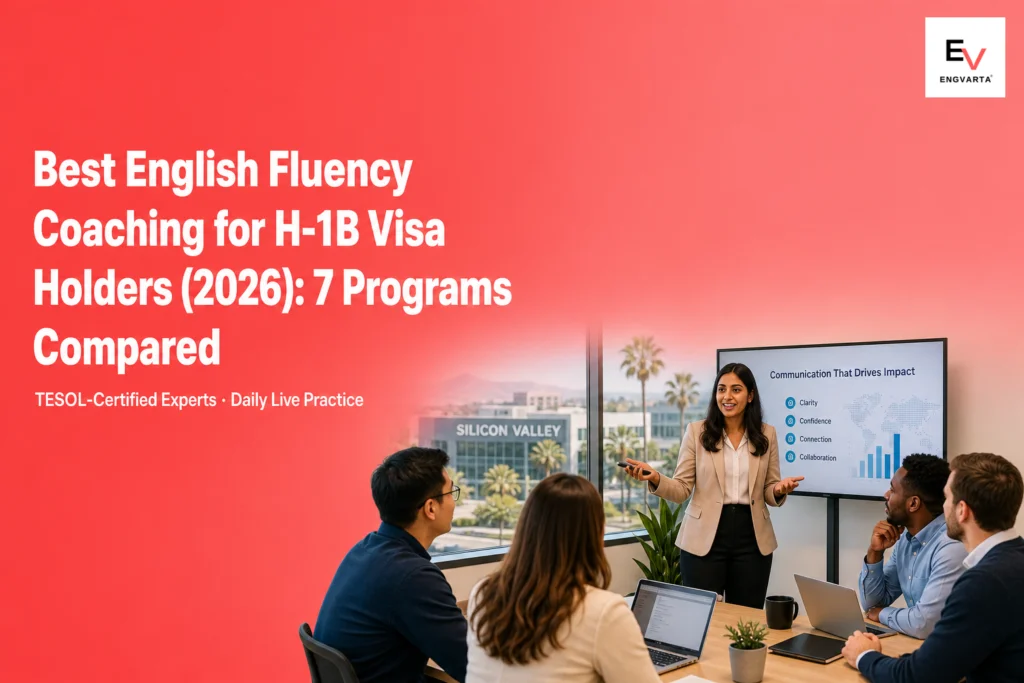
If you’re searching for the Best English Fluency Coaching for H-1B Visa Holders, you probably already have a STEM master’s degree, a six-figure tech salary, and ten years of English-medium education. You don’t need grammar lessons. You need something nobody on YouTube or in a generic ESL course teaches: how to think and respond in English at the speed of an American workplace.
The pain points are predictable. You take three seconds longer than your American colleagues to translate a question in your head before answering. Your manager nods along but you can tell they’re paraphrasing what you said in their own follow-up. The vocabulary you learned in India (“kindly do the needful”, “revert back”, “prepone”) sounds formal-bordering-on-comical to American ears. You write polished Slack messages but freeze when called on in a meeting. Promotions to staff engineer or team lead stall because client-facing roles want someone who can present without notes.
Generic English-learning apps were not built for this. They optimize for beginners moving from A1 to B1. You’re already at C1 reading and writing — you need C2 spontaneous speaking, and that requires a human Expert who can interrupt you, correct your hesitation, and push you to recover from a stalled sentence in real time.
Below: the seven coaching options we’d actually recommend to an H-1B engineer, doctor, or analyst in 2026, ranked for fit-to-use-case.1. EngVarta — Best for daily disciplined speaking practice
Best for : Indian H-1B holders who can read and write English fluently but feel their speaking lags behind their technical skills. EngVarta is a one-on-one speaking-practice app that connects you in minutes with a TESOL/ESL-certified English Expert for a 15, 25, or 50-minute call. You speak. The Expert gives you real-time corrections during the call and consolidated feedback towards the end. The recording is accessible for 30 days post-session so you can re-listen to your hesitation patterns. Why this fits H-1B holders specifically: the bottleneck for almost every Indian H-1B professional is conversational reps, not theory. EngVarta pricing in the USA is a flat $1 refundable trial, then $1.80 per session, or $45 per month for 25 sessions — the same prices for everyone, no per-session add-ons. That works out to roughly six minutes of an American Expert’s time at a Starbucks pay-rate, which is unusual for the market. EngVarta also issues milestone certificates based on practice hours (not curriculum exams), which some H-1B holders use as supporting evidence for EB-1A or EB-2 NIW petitions documenting “extraordinary ability” in professional English communication. Talk to your immigration attorney before relying on this — it’s a supplement, not a primary criterion. Where it falls short : EngVarta is a speaking-only product. If you also need to fix your written email tone or learn American business idioms in writing, pair it with a writing-focused tool. The platform is suitable for kids 7+ with parent guidance, but it’s not a kids’ product — most users are working adults. Pricing (USA, flat): $1 refundable trial → $1.80 per session, or $45 per month for 25 sessions.What Our Learners Say
Rated 4.5★ from 9,100+ reviews on Google Play
2. Cambly — Best for native-American-accent immersion
Best for : H-1B holders who specifically want to neutralize an Indian English accent for client-facing roles. Cambly’s selling point is that almost every tutor on the platform is a native English speaker — many American or Canadian. You connect on demand, no scheduling required, and the conversation logs are saved for replay. For an H-1B engineer who’s about to interview for a staff role with a panel of American directors, the variable but high-volume exposure to natural American speech rhythm is genuinely useful. You learn how to follow a manager who says “let’s table that” and means “let’s discuss this later” (the British meaning is the opposite). Where it falls short : Cambly tutors are screened for friendliness and clarity, not for ESL certification. You’ll get a college student in Texas who’s never taught English before. That’s fine for casual conversation but inconsistent for structured fluency work. Pricing is in the $10-15 per 30-minute range depending on plan — significantly higher per-minute than EngVarta.3. italki — Best if you also need grammar or writing drills
Best for : H-1B holders who want to combine speaking, writing, and pronunciation in one platform. italki is a marketplace, so quality varies by Expert. The platform supports community tutors (cheaper, less formal) and professional tutors (more expensive, often ESL-certified). For working professionals who want one Expert who can switch between mock interview practice, presentation rehearsal, and email-tone correction, italki’s session structure is flexible enough to accommodate all three. The discovery cost is real — you’ll likely trial 3–4 tutors before finding one who fits. Once you do, hourly rates run $15–30 with professional tutors. Where it falls short : No flat monthly cap, no built-in lesson structure, no recording archive. You’re hiring a freelance teacher and managing the relationship yourself.4. Preply — Similar to italki, slightly more structured
Best for : H-1B holders who want a marketplace but with more guardrails on tutor quality. Preply functions like italki but with a more aggressive matching algorithm and a tighter trial-period refund policy. Tutors set their own prices ($10–35 per hour). The platform pushes weekly lesson packages, which can help if you struggle to maintain consistency on your own. Where it falls short : Same fundamental marketplace problem as italki — quality is uneven and you’re sourcing your own teacher. Preply also commits a chunk of your initial purchase as a non-refundable platform fee, which feels predatory once you understand it.5. Lingoda — Best for structured group classes
Best for : H-1B holders who learn better in a class environment than 1:1. Lingoda runs cohort-based group classes (3–5 students) at scheduled times, with rotating native-English instructors. The Sprint and Marathon plans bundle 60–90 days of daily classes at a fixed price. For a working professional who can commit to a 6 AM EST class three days a week, Lingoda’s structure is the closest thing to actual school. Where it falls short : Group dynamics dilute speaking time. In a 5-student class, you’ll get 6–8 minutes of speaking per hour at best. For an H-1B engineer who’s already at C1 and needs to push to C2, that ratio is too low. Better as a complement than a primary tool.6. Speak — Best for AI-driven independent practice
Best for : H-1B holders who want to drill workplace scenarios without scheduling a human session. Speak is an AI-only conversational app — no human Experts, just a GPT-powered roleplay engine. The strength is unlimited reps: you can do 30 minutes of mock-meeting practice at midnight after the kids are asleep, no scheduling friction. For phrases, vocabulary, and basic conversational flow, Speak is genuinely useful. It’s also significantly cheaper than human-Expert platforms — annual subscriptions hover around $100/year. Where it falls short : The AI is forgiving. It won’t interrupt you, won’t correct your hesitation patterns, and won’t push you out of your comfort zone the way a human Expert will. Most H-1B holders we interviewed plateau after 2–3 months on Speak alone. Use it as a complement to live practice, not a replacement.7. ELSA Speak — Best for accent and pronunciation only
Best for : H-1B holders whose specific blocker is being misheard (“can you repeat that?”) in American workplace meetings. ELSA Speak is laser-focused on pronunciation. The app uses speech recognition to score individual phonemes — your /v/ vs. /w/, your /θ/ in “thirty” — and gives you targeted drills. For an Indian English speaker trying to soften specific accent features without losing intelligibility, ELSA’s phoneme-level feedback is the most actionable on the market. Where it falls short : ELSA is a pronunciation tool, not a fluency tool. It won’t help you build a coherent answer to “tell me about a time you handled a conflict with a teammate.” Pair it with a speaking-practice platform.How to choose: a decision tree for H-1B holders
- If your blocker is hesitation and stalled sentences in meetings → EngVarta or italki (live Expert, structured corrections).
- If your blocker is following fast American accents → Cambly (native-American immersion).
- If your blocker is being misheard or asked to repeat → ELSA Speak (pronunciation).
- If you want unlimited low-stakes reps → Speak (AI roleplay).
- If you learn better in a classroom → Lingoda (group cohorts).
What none of these tools will do
Be realistic about what English coaching can and can’t do for your H-1B career. It will not change the fundamental visa policy or affect your USCIS adjudication. It will not give you a quantifiable score that you can attach to your green-card petition. It will not eliminate workplace bias, which is a separate problem that no amount of pronunciation work will fix. What it will do, if you commit to 30–50 minutes of daily live practice for two months: make you faster on your feet in meetings, more confident in 1:1s with your skip-level, and substantially less self-conscious when called on by name. Those are real career outcomes. They just require reps, and reps require a coach who’s willing to interrupt you mid-sentence.Conclusion :
For an Indian H-1B engineer or doctor in the USA who already reads and writes English fluently but freezes in meetings, our pick is to start with EngVarta’s $1 refundable trial, run a daily 25-minute Expert call for two weeks, and add ELSA Speak as a complement if pronunciation is a separate issue. That’s roughly $50/month and 25 minutes/day of disciplined practice. After 6–8 weeks, re-evaluate. If meetings still feel hard, the bottleneck is probably scenario-specific (presentation skills, interview performance, or executive presence) — and those need a human coach, not a different app.Frequently asked questions ( FAQs )
Q1. Does USCIS require English fluency for H-1B extension or green card?
ANo. Neither H-1B extension nor employment-based green-card petitions have an English-language test requirement. Your immigration outcome depends on employer sponsorship, prevailing wage, and category (EB-1, EB-2, EB-3) — not your spoken English fluency. Coaching helps your career, not your visa.Q2. Can I write off English coaching as a work expense for tax purposes?
Generally, no. The IRS treats education that qualifies you for a new trade or career as personal, and English fluency is considered a baseline skill rather than a career-specific qualification. Talk to your CPA — there are narrow exceptions for employer-reimbursed education benefits.Q3. How long until I see results?
Most H-1B holders practicing 25 minutes per day, 5 days per week with a live Expert report noticeable improvement in meeting confidence within 4–6 weeks. Pronunciation drilling (ELSA-style) shows measurable phoneme-level shifts in 8–12 weeks. There’s no shortcut.Q4. Should I work with a TESOL-certified Expert or a native American speaker?
Both have value, and the answer depends on your goal. TESOL/ESL-certified Experts are trained to identify and correct hesitation patterns systematically — better for measurable fluency progress. Native American speakers expose you to natural rhythm and idiom — better for client-facing roles. Most H-1B holders benefit from rotating between both.Q5. Is EngVarta available outside India?
Yes. EngVarta serves users across the USA, UAE, Canada, Singapore, and other markets. The pricing in the USA is flat — $1 refundable trial, $1.80 per session, $45 per month for 25 sessions — and is set in dollars, not converted from rupees.Q6. Will my Indian accent disappear?
No, and that’s not the goal. The goal is intelligibility and ease of being understood — not accent erasure. Most Indian H-1B holders we work with want their accent to remain audible (it’s part of their identity) but not to interfere with being heard the first time.Q7. How do I keep daily practice consistent when I’m slammed at work?
Two things help: (1) book the session at the same time every day so it becomes a habit, not a decision, and (2) use the platform’s free vocabulary lessons, quizzes, and rewards on heavy work days when you can’t commit to a full session. EngVarta’s daily-habit drivers are built for working professionals who can’t commit to predictable hours every day.Ready to Practice with Real Experts?
Try EngVarta today — ₹69 trial (India) / $1 trial (International) · 100% refundable