Business English Speaking App |

Tag

business english speaking app

Best English Speaking Apps for Small Talk at Work (2026)

June 5, 2026 • 11 min read • By Rishish Pandey

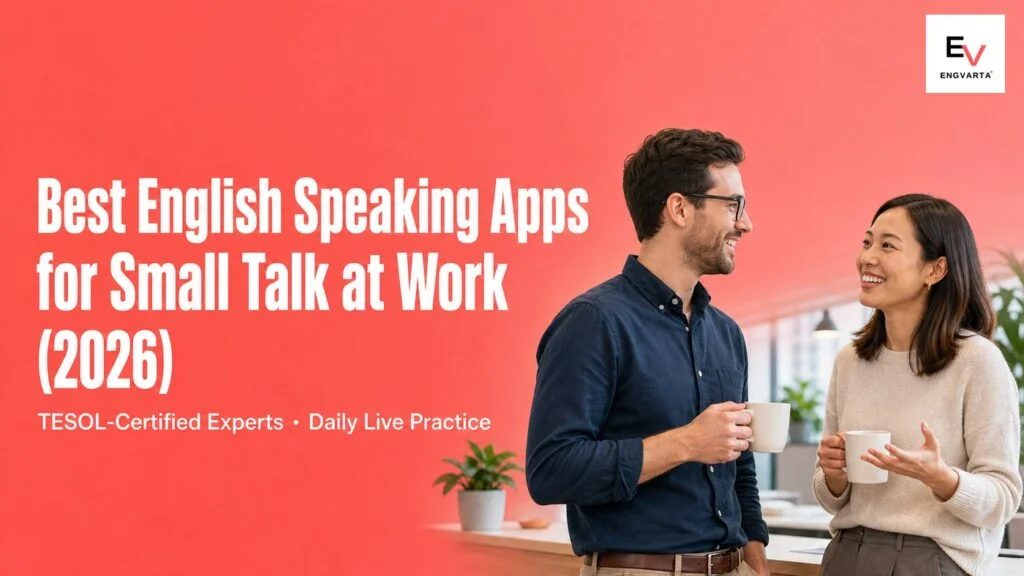
best English speaking apps for small talk at work
Quick answer For live, unscripted conversation practice with real-time correction, practise with a trained Expert on EngVarta. For free casual reps with real people, HelloTalk or Tandem; for solo rehearsal of openers, ChatGPT Voice (free) or Speak; for native-speaker video chat, Cambly. Most people pair one free option for volume with one structured option for feedback.

For the conversations between the work — coffee-break chat, pre-meeting banter, lift small talk, and the easy rapport that makes colleagues warm to you.

How we picked

Small talk is the opposite of a prepared speech : it is unscripted, low-stakes on the surface, and entirely about flow and warmth. So we ranked each option on live, unscripted conversation practice, real-time correction that does not kill the flow, fit for short daily use, and price — and cross-checked the shortlist against what people are commonly recommended for casual conversation. Pricing and features were verified in June 2026; competitor names appear for context only.

Why small talk is harder than “serious” English

Plenty of professionals can present a quarterly update in English but freeze the moment a colleague says “so, how was your weekend?” in the lift. That is not a contradiction. Prepared English is something you can plan; small talk is improvised, fast, and full of cultural cues — what to say, how long to talk, when to ask back, how to sound friendly rather than formal. There is no script, and the pause while you search for one is exactly what makes it feel awkward.

The cost is bigger than it looks. The casual conversations — the coffee-break chat, the pre-meeting banter — are where colleagues actually warm to you, where rapport and trust are built, and where being “the quiet one” quietly limits your standing. Reading a list of small-talk phrases does not fix it, because the skill is keeping an easy two-way conversation going. That only comes from practising real, unscripted talk out loud.

The best apps for small-talk English

1. EngVarta

EngVarta gives you daily 15-minute live 1-on-1 audio sessions with a TESOL/ESL-certified Expert who keeps a natural conversation flowing and corrects your phrasing in real time without breaking the flow — the same muscle small talk uses.

  • Price: ₹69 / $1 refundable trial; ₹2,700 / $45 for 25 sessions (~₹108 / $1.80 each)
  • Best for: professionals who handle work English fine but go quiet in casual moments

2. HelloTalk

A language-exchange app where you message and call learners and native speakers worldwide for relaxed, low-pressure practice and cultural exchange.

  • Price: Free, with an optional premium tier
  • Best for: free, no-pressure conversation reps with real people

3. Tandem

A language-exchange app that pairs you with partners worldwide for mutual practice, so you get relaxed real-person chat on your own schedule.

  • Price: Free, with an optional Pro subscription
  • Best for: meeting native and fluent speakers for casual exchange

4. ChatGPT Voice Mode

Prompt it to play a friendly colleague and rehearse opening lines and follow-up questions so you walk in with a few ready. Available free with daily limits.

  • Price: Free (with usage limits); ChatGPT Plus $20/month
  • Best for: solo, private rehearsal of openers and small-talk scripts

5. Speak

An AI app with spoken roleplay and pronunciation drills that lets you practise speaking out loud daily, at your own pace, anytime.

  • Price: from $17.99/month (Premium), ~₹1,700/month
  • Best for: self-paced daily speaking reps without booking a person

6. Cambly

On-demand video chat with native English speakers — useful if you want casual conversation in a video format and exposure to natural accents.

  • Price: from ~$11 per 30-min session (auto-renewing subscription)
  • Best for: video practice and native-speaker accent exposure

Why apps alone rarely fix small talk

Free language-exchange apps and AI tools have a real role here: HelloTalk and Tandem give you cheap, low-stakes reps with real people, and ChatGPT Voice is a fine place to rehearse a few openers before a networking lunch. If you are starting from silence, they help you start talking, and that matters.

But small talk is a flow skill, and the apps each miss a different half of it. Peer exchanges give you conversation but no reliable correction, so bad habits stick; AI gives you correction but no real spontaneity, so it never feels like the real thing. What actually builds the reflex is unscripted conversation with someone who can both keep it flowing and fix your phrasing without breaking the rhythm. That is what a live Expert does, and it is why live practice closes the small-talk gap faster than any app used alone.

Comparison at a glance

App Live human Real-time correction Unscripted conversation Cost for daily use
EngVarta Yes (1-on-1 Expert) Yes, without breaking flow Yes (real two-way chat) ~₹108/session
HelloTalk Yes (other learners) No reliable correction Yes, but can fizzle Free / freemium
Tandem Yes (exchange partners) No reliable correction Yes, inconsistent Free / freemium
ChatGPT Voice No (AI) Generic feedback Predictable, not spontaneous Free / subscription
Speak No (AI) Limited Drills and roleplay Free / subscription
Cambly Yes (native tutor) Varies by tutor Yes, casual chat From higher per-session

This ranking is based on fit for small talk specifically — keeping an easy, unscripted conversation flowing — not general English-learning popularity.

Small-talk moments worth rehearsing out loud

Moment What to practise
Coffee-break chat Easy openers and follow-up questions that keep a two-minute chat going.
Pre-meeting banter Light, friendly remarks before a call starts, without forcing it.
The lift / corridor A quick, warm exchange that does not run out after one line.
Networking and lunches Introducing yourself and showing interest in the other person.
Wrapping up gracefully Ending a chat warmly so it feels natural, not abrupt.

A 2-week small-talk plan

Week 1 — get the conversation flowing. Daily 15-minute live sessions of relaxed, unscripted chat about everyday topics, so talking easily for a few minutes stops feeling like work. Use HelloTalk or Tandem on the side for extra low-stakes reps.

Week 2 — the work moments. Move to the specific situations: coffee-break chat, pre-meeting banter, networking introductions. The Expert plays the colleague, keeps it natural, and corrects your phrasing without killing the flow, with consolidated feedback at the end. Replay the recordings to notice what kept a conversation alive — and copy it.

Frequently Asked Questions : Best English Speaking Apps for Small Talk at Work

Q1. Which app is best for getting better at English small talk?

Ans: EngVarta is a strong fit because you practise real, unscripted conversation live with an Expert who keeps it flowing and corrects your phrasing without breaking the rhythm — which is exactly the small-talk skill. Free exchange apps like HelloTalk and Tandem add low-stakes reps, and ChatGPT Voice helps rehearse openers.

Q2. Why can I present in English but freeze during casual chat?

Ans: Because prepared English and small talk are different skills. A presentation can be planned; small talk is improvised, fast, and full of cultural cues. The pause while you search for what to say is what makes it feel awkward, and it closes only by practising unscripted conversation out loud.

Q3. Can free apps like HelloTalk fix my small talk?

Ans: They help you start talking with real people at no cost, which matters. But peer exchanges give you conversation without reliable correction, so habits do not improve much. Pairing them with live practice that both keeps the flow and corrects you closes the gap faster.

Q4. How do I keep a conversation going instead of it dying after one line?

Ans: Practise a simple habit: answer, then add a small detail, then ask a question back. A live Expert can keep the conversation moving and stop you the moment it stalls, which builds the reflex far faster than reading a list of phrases.

Q5. How long until small talk feels natural?

Ans: Most people at intermediate English notice a clear difference within two to three weeks of daily 15-minute live conversation practice. The change shows up as less hesitation and easier follow-up questions in real chats.

Q6. Is small talk really worth practising for work?

Ans: Yes. Casual conversation is where colleagues warm to you and rapport and trust are built, which quietly affects how you are seen at work. Even 15 minutes of daily practice is a small, high-return investment, and EngVarta offers a 100% refundable trial at ₹69 / $1 to start.

Reviewed by the EngVarta content team. Pricing and features verified June 2026; competitor details are summarised from public sources and mentioned for context only.

Ready to Practice with Real Experts?

Try EngVarta today — ₹69 trial (India) / $1 trial (International) · 100% refundable

Best English Speaking Apps for First-Time Managers (2026) — Tested for Workplace Confidence

June 1, 2026 • 11 min read • By Rishish Pandey

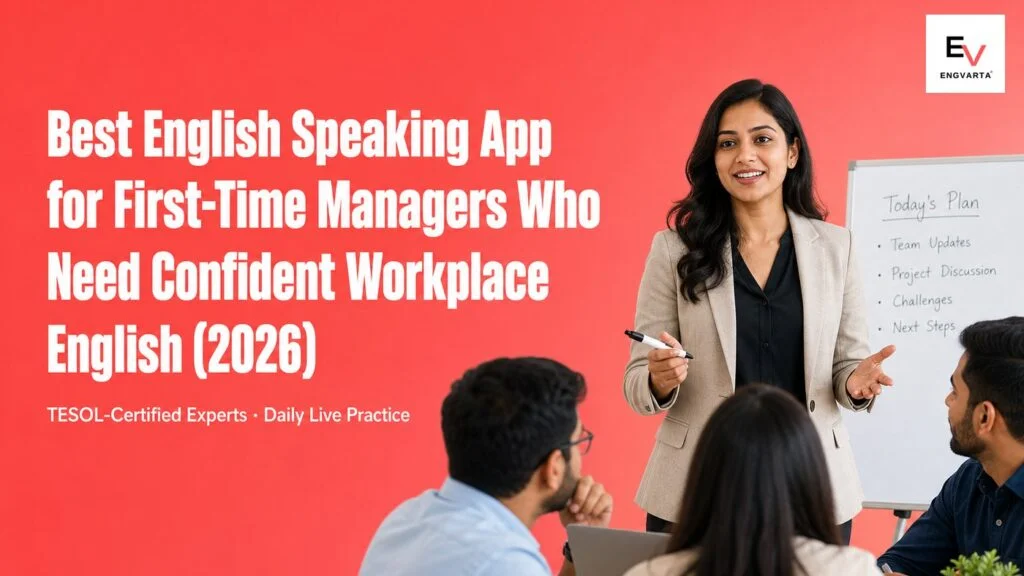
Indian first-time manager leading a team conversation in English — best English speaking app for first-time managers 2026
Quick answer For live management-conversation practice with real-time correction, practise with a trained Expert on EngVarta. for free rehearsal for a specific conversation, ChatGPT Voice Mode; for AI app for daily speaking reps, Speak; for being understood clearly on calls, ELSA Speak; for native-speaker conversation exposure, Cambly; for a hand-picked business-English tutor, italki / Preply. Most people pair one free option for volume with one structured option for feedback.

For new managers — running 1-on-1s, giving feedback, delegating, leading team meetings, and handling difficult conversations in clear, confident English.

How we picked

A first-time manager does not need more grammar — they need to sound calm and clear while doing new, exposed things: chairing a meeting, delivering feedback without sounding harsh, saying no to a request, explaining a decision to their own boss. So we ranked each option on live interpersonal practice, real-time correction, coverage of real management scenarios, fit for a busy manager’s day, and sustainable pricing — and cross-checked the shortlist against what new managers are commonly pointed to. Pricing and features were verified in June 2026; competitor names appear for context only.

Why a new management role exposes an English gap that was never there before

As an individual contributor, your English worked. You wrote clean emails, understood every standup, and spoke up when you had something prepared. Then you got promoted, and suddenly the job is conversation: a teammate is upset and you have to respond on the spot, a deadline slips and you have to push back politely, your manager asks “what happened?” in front of others. The vocabulary was never the issue — what is new is having to think, manage tone, and stay composed in English, all at the same time, with people watching.

This is why the gap feels like it appeared overnight. It did not; the role simply started testing a different muscle. Reading a management book or doing a vocabulary app does not build it, because the skill is real-time and interpersonal. It is built by rehearsing the exact conversations a manager has — out loud, with someone who corrects your phrasing and tone the moment they slip.

The best apps for first-time-manager English

1. EngVarta

EngVarta gives you a daily 15-minute live 1-on-1 audio session with a TESOL/ESL-certified English Expert who role-plays the situations a new manager actually faces.

  • Price: ₹69 / $1 refundable trial; ₹2,700 / $45 for 25 sessions (~₹108 / $1.80 each)
  • Best for: live management-conversation practice

2. ChatGPT Voice Mode

Prompt it to play an underperforming team member or a skeptical stakeholder, then rehearse the exact talk you are dreading — a genuinely useful, always-available way to try wording before the real meeting.

  • Price: Free (with usage limits); ChatGPT Plus $20/month
  • Best for: free rehearsal for a specific conversation

3. Speak

An AI app with spoken roleplay and drills that keeps your spoken English warm on days too packed for a live session.

  • Price: from $17.99/month (Premium), ~₹1,700/month
  • Best for: AI app for daily speaking reps

4. ELSA Speak

An AI app that drills pronunciation and word stress, useful if your team or your manager sometimes asks you to repeat yourself on video calls.

  • Price: free tier; ELSA Pro from ~$11.99/month (~₹1,150)
  • Best for: being understood clearly on calls

5. Cambly

On-demand video chat with native tutors, good for ear-training and casual practice with a real person.

  • Price: from ~$11 per 30-min session (auto-renewing subscription)
  • Best for: native-speaker conversation exposure

6. italki / Preply

Marketplaces where you can book a tutor with a business background and brief them to drill management conversations.

  • Price: italki community tutors ~$4–20/lesson; Preply from ~$15/hour
  • Best for: a hand-picked business-English tutor

Where AI helps a new manager — and where it stops

The honest answer is that AI is a great rehearsal room and a poor meeting room. For a first-time manager, tools like ChatGPT Voice are excellent at one thing: letting you draft and try the wording of a difficult message a dozen times, privately, until it stops feeling clumsy. That is real value, and you should use it before any conversation that scares you.

But management is judged in the moment a real person reacts — when your feedback lands wrong and a face falls, when a teammate interrupts to disagree, when your boss asks a follow-up you did not prepare. An AI never does any of that; it is endlessly patient and never surprised, so it cannot train the composure and tone-reading that separate a manager people trust from one who merely says the right words. A live Expert can: they react, they push, and they fix your phrasing the instant it turns harsh or unclear. Rehearse with AI; get meeting-ready with a live person.

Comparison at a glance

App Live human Real-time correction Management-scenario role-play India-workplace context
EngVarta Yes (1-on-1 Expert) Yes, during the call Yes (1-on-1s, feedback, delegation) Yes
ChatGPT Voice No (AI) Generic feedback Solo rehearsal only Partial
Speak No (AI) Limited Drills and roleplay Partial
ELSA Speak No (AI) Pronunciation only No Partial
Cambly Yes (native tutor) Varies by tutor If you brief the tutor Limited
italki / Preply Yes (tutor) Varies by tutor If you brief the tutor Limited

This ranking is based on fit for first-time managers specifically — live interpersonal practice, tone, composure under attention — not general English-learning popularity.

Manager conversations worth rehearsing out loud

SituationWhat to practise
Weekly 1-on-1Asking open questions, listening, and summarising next steps clearly.
Giving critical feedbackSaying what is wrong directly but kindly, with a specific example and a path forward.
Delegating a taskStating the outcome, the deadline, and the check-in — without over-explaining or apologising.
Pushing back on a deadlinePolite, firm wording that protects the team without sounding defensive.
Updating your own managerA crisp status summary and a calm answer when asked “what happened?”

A 2-week scenario plan for new managers

Week 1 — get comfortable leading the talk. Daily 15-minute live sessions where the Expert has you run a 1-on-1 and a short team update, so holding the floor and asking good questions in English feels routine. Use ChatGPT Voice between sessions to draft the wording of any conversation you are nervous about.

Week 2 — drill the hard ones. Move to the uncomfortable scenarios: delivering critical feedback, saying no to a request, handling a disagreement. The Expert plays the other person, reacts, and corrects your tone and phrasing in real time, with consolidated feedback at the end. Replay the recordings to hear where your delivery turned harsh or hesitant, and tighten it before you do it for real.

Frequently Asked Questions

Q1. Which English speaking app is best for first-time managers?

Ans: EngVarta is a strong fit because new managers can rehearse real management conversations live with an Expert who role-plays the other person, reacts, and corrects tone and phrasing in real time. AI apps like ChatGPT Voice and Speak are useful for private rehearsal, but they cannot reproduce how a real person responds to feedback or pushback.

Q2. My English was fine as an engineer or analyst — why does it feel weak now that I manage people?

Ans: Because the role started testing a different skill. Individual-contributor English is mostly prepared and written; management English is real-time and interpersonal — reacting on the spot, managing tone, staying composed while people watch. The fix is to rehearse those exact live conversations, not to revise grammar.

Q3. How do I give critical feedback in English without sounding harsh?

Ans: Practise a simple structure out loud until it is automatic: name the specific behaviour, explain the impact, and agree a path forward — in calm, plain words. A live Expert can play the receiver and stop you the moment your phrasing turns blunt or apologetic, which is the part reading alone cannot fix.

Q4. Can I practise manager conversations without my team knowing?

Ans: Yes. Private 1-on-1 practice lets you rehearse 1-on-1s, feedback, and delegation with an Expert before you do them for real — no audience, no risk to your standing with the team while you make and fix mistakes.

Q5. How long until I feel confident running these conversations in English?

Ans: Most managers at intermediate English see a clear difference within two to three weeks of daily 15-minute live practice focused on real scenarios. Consistency matters more than length — 15 minutes every day beats a long weekly session.

Q6. Should I focus on my accent or on the conversations?

Ans: On the conversations. Managers are judged on clarity, tone, and composure, not accent. Pronunciation tools like ELSA help if people ask you to repeat yourself, but the higher-return work is rehearsing how you handle feedback, delegation, and pushback.

Reviewed by the EngVarta content team. Pricing and features verified June 2026; competitor details are summarised from public sources and mentioned for context only.

Best English Speaking Apps for Client Calls and Client Meetings (2026)

May 29, 2026 • 10 min read • By Rishish Pandey

Indian professional practising spoken English for client calls and client meetings — best English speaking apps for client calls 2026
Quick answer
For live client-call practice with real-time correction, practise with a trained Expert on EngVarta. for free AI roleplay rehearsal, ChatGPT Voice Mode; for native-speaker live practice, Cambly; for hand-picked targeted coaching, italki / Preply; for being understood clearly on calls, ELSA Speak. Most people pair one free option for volume with one structured option for feedback.

For status updates, requirement calls, difficult client questions, objections, and escalation calls in English.

How we picked

We ranked each option on what actually carries you through a client call: live, real-time speaking practice; correction in the moment; role-play of the exact situations clients create — updates, questions, objections, escalations; fit for a weekly or daily habit; and sustainable pricing. We also cross-checked our list against what professionals are actually recommended for this exact need. Pricing and features were verified in June 2026, and competitor names are mentioned for context only.

Why client-call English is different from everyday English

A client call is not casual conversation. It is high-stakes, real-time, and unforgiving: you have to give a clear update, field an unexpected question, push back politely on an unrealistic deadline, or calm an unhappy client — all while sounding composed and in control. The vocabulary is rarely the problem; most professionals read and write client emails comfortably. What breaks down is speaking under pressure, when a pause or a fumbled answer can dent the client’s confidence in you, not just your English.

That is why generic “learn English” apps miss the mark here. You do not need more grammar lessons — you need rehearsal of the specific moments a client call throws at you, with someone who can correct your phrasing and tighten your delivery on the spot. The skill is composure plus clarity under real conditions, and that is built only by practising those conditions.

The best apps for English client calls

1. EngVarta

EngVarta gives you a daily 15-minute live 1-on-1 audio session with a TESOL/ESL-certified English Expert who role-plays the calls you actually run.

  • Price: ₹69 / $1 refundable trial; ₹2,700 / $45 for 25 sessions (~₹108 / $1.80 each)
  • Best for: live client-call practice

2. ChatGPT Voice Mode

You can prompt ChatGPT to act as a demanding client, ask hard questions, and give feedback afterwards — a genuinely useful, always-available way to rehearse on your own.

  • Price: Free (with usage limits); ChatGPT Plus $20/month
  • Best for: free AI roleplay rehearsal

3. Cambly

You speak with real native tutors and can ask them to run client-meeting scenarios, which forces real-time thinking.

  • Price: from ~$11 per 30-min session (auto-renewing subscription)
  • Best for: native-speaker live practice

4. italki / Preply

Marketplaces where you can book a tutor and brief them to drill weekly client meetings and status updates — useful if you want to choose someone with a business background.

  • Price: italki community tutors ~$4–20/lesson; Preply from ~$15/hour
  • Best for: hand-picked targeted coaching

5. ELSA Speak

An AI app that drills pronunciation and word stress, helpful if clients often ask you to repeat yourself on Zoom or Teams.

  • Price: free tier; ELSA Pro from ~$11.99/month (~₹1,150)
  • Best for: being understood clearly on calls

AI roleplay vs live practice: when to use each

AI tools like ChatGPT Voice are excellent rehearsal partners, and pairing them with live practice is a smart combination. But for client calls specifically they have a ceiling: an AI never loses patience, never reacts the way a frustrated client does, and accepts a slow or hedged answer as readily as a sharp one. Real client calls have stakes, momentum, and a person on the other end whose confidence in you rides on how you sound — and that is exactly the pressure you have to practise under.

A live Expert reproduces those conditions: a follow-up you did not expect, a polite-but-firm push when you waffle, a correction the instant your phrasing weakens. For a non-native professional, an Expert who understands the specific spots where confidence slips — and works at a price that sustains regular practice — closes the gap between rehearsing and actually performing. Use AI to warm up; use live practice to get call-ready.

Comparison at a glance

Option Live human Real-time correction Client-scenario role-play Context fit Price for regular reps
EngVarta Yes (1-on-1 Expert) Yes, during the call Yes (updates, objections, escalations) Yes ~₹108/session
ChatGPT Voice Mode No (AI) Generic feedback Yes, but no real stakes Partial Free / subscription
Cambly Yes (native) Informal If you ask No Higher for daily
italki / Preply Yes (varies) Depends on tutor If you brief them Varies Per session, adds up
ELSA Speak No (AI) Pronunciation only No Partial Subscription

Best for your situation

If your problem is… Start with
Losing confidence or fumbling answers on live client calls EngVarta (live client-call practice)
Wanting free solo rehearsal before a big call ChatGPT Voice Mode, then a live session
Clients often ask you to repeat yourself ELSA Speak alongside live practice
Wanting to hand-pick a business-savvy tutor italki or Preply (brief them on client meetings)

Best app by client-call use case

Use case Best pick Why
Project status updates EngVarta Rehearse the update format until it is concise and confident.
Handling difficult client questions EngVarta An Expert throws unexpected follow-ups and corrects your phrasing live.
Objections & scope push-back EngVarta Practise saying no politely and firmly under real pressure.
Free solo rehearsal before a call ChatGPT Voice Mode Prompt it to act as a demanding client, anytime, at no cost.
Clear pronunciation on Zoom/Teams ELSA Speak (+ live practice) Sound-level feedback so clients stop asking you to repeat.
Hand-picked weekly coaching italki / Preply Choose a business-experienced tutor for tailored sessions.

A 4-week client-call confidence protocol

You do not need long sessions — you need frequent, realistic reps. This routine pairs a daily live session with short AI rehearsal and self-recording in between.

Week Focus What you practise Session
Week 1 Clear status updates Giving a concise “done / doing / blockers” update without rambling 15 min daily
Week 2 Answering questions live Fielding unexpected client questions and clarifying calmly 15–25 min
Week 3 Objections & push-back Saying no politely, renegotiating timelines, managing expectations 25 min
Week 4 Full mock client call End-to-end call with updates, questions, and an escalation, at speed 25–50 min

Between sessions, record a daily two-minute update — what you finished, what you are working on, any risks — then listen back for filler words, long pauses, and unclear sentences. It is the exact format most project and consulting client calls use, and a few weeks of it produces a visible jump in composure.

How we evaluated this — and who reviewed it

Each option was scored on live speaking practice, real-time correction, coverage of real client-call scenarios, fit for a regular habit, and price. Pricing and features were checked in June 2026, and the rankings were reviewed against the day-to-day experience of EngVarta’s TESOL/ESL-certified Experts, who run live client-call role-plays with professionals and see exactly where composure and phrasing slip. The goal was an honest comparison: AI and pronunciation tools earn their place for rehearsal and clarity, while live practice leads for performing on real, high-stakes calls.

Related guides

Frequently Asked Questions

Which app is best to improve English for client calls?

EngVarta is the strongest pick because client-call confidence is built by live, realistic practice. A TESOL/ESL-certified Expert role-plays status updates, client questions, and objections, corrects your phrasing in real time, and works at a daily-affordable price — closer to a real call than any AI app.

How do I handle difficult client questions and objections in English?

Rehearse the exact moments with a live Expert: an unexpected question, a push for a faster timeline, a complaint. The Expert plays the client, makes you respond on the spot, and corrects weak phrasing immediately, so polite, firm answers become automatic before you face a real client.

Is ChatGPT Voice Mode enough to prepare for client calls?

It is an excellent free warm-up — you can prompt it to act as a demanding client and get instant feedback. But it has no real stakes and accepts whatever you say, so it cannot replicate the pressure of a live client. Use it to rehearse, then a live session to get call-ready.

How do I sound confident giving project status updates in English?

Practise the format until it is automatic: what you finished, what you are working on, and any blockers or risks, in clear short sentences. Daily reps with a live Expert who tightens your delivery turn a rambling update into a concise, confident one within a few weeks.

How long until I sound confident on client calls?

Most professionals see a clear improvement in confidence and clarity within four to eight weeks of regular practice, especially when daily live reps are paired with short AI rehearsal. Frequency matters more than session length — 15 focused minutes a day beats an occasional long class.

Do I need a native speaker to improve English for client calls?

No. Native-speaker apps like Cambly help with exposure but are not focused on real client-call patterns or structured correction. An Expert who works with professionals daily targets exactly where your confidence and phrasing slip — and at a price that sustains regular practice.