
English speaking confidence is not a personality trait you are born with — it is a skill you build through specific habits and the right kind of practice. Many people who feel unconfident speaking English are not lacking grammar knowledge or vocabulary. They are lacking the repeated experience of speaking successfully. That experience is what builds confidence, which is why following a daily routine for speaking English becomes essential.
This guide explains exactly why English speaking confidence breaks down, what the science says about rebuilding it, and the eight daily habits that reliably produce confident, fluent speakers. It also highlights the best apps for English confidence and how a daily routine for speaking English can help you improve
Why You Lack Confidence Speaking English (It’s Not What You Think)
Most people assume their lack of confidence comes from not knowing English well enough. In reality, confidence and competence are two separate things. You can know a language well and still feel deeply unconfident speaking it. The reason is almost always one of the following:
-
Too few successful speaking experiences.
Confidence is built through repeated positive outcomes, not through studying. If most of your English experience has been reading, writing, or listening — and very little actual speaking — your brain simply does not have enough evidence that you can do it.
-
A critical inner voice.
Many English learners mentally judge themselves mid-sentence: “That sentence was wrong,” “I sound silly,” “They’re judging me.” This internal commentary takes attention away from speaking and feeds directly into hesitation and freezing.
-
Learned English in a low-speaking environment.
Most English education in India and other non-English-speaking countries prioritises reading, writing, and grammar over speaking. Students graduate knowing English — but with almost zero experience speaking it under social conditions.
-
Comparing yourself to native speakers.
Fluency exists on a spectrum. Comparing your spoken English to that of a native speaker sets an unfair benchmark that crushes confidence before practice can build it.
The Psychology of Confidence: What Actually Changes It
Psychologist Albert Bandura’s concept of “self-efficacy” — your belief in your ability to perform a specific task — is the most useful framework for understanding English speaking confidence. Self-efficacy is changed by four specific things:
- Mastery experiences — Successfully completing a speaking task (even a small one) raises self-efficacy more than anything else.
- Vicarious experience — Seeing someone similar to you succeed at speaking English builds your belief that you can too.
- Social encouragement — Being told by someone credible that you are improving and that you can do it.
- Reducing physiological anxiety — When your body’s fear response reduces, your confidence perception increases.
Notice what is not on this list: more grammar study, vocabulary drilling, or motivation videos. The only thing that builds speaking confidence is more experience of speaking successfully — starting small and gradually increasing the challenge.
8. Daily Habits to Build English Speaking Confidence
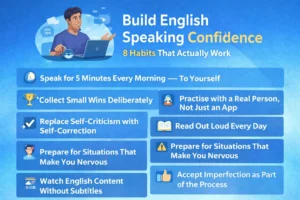
1. Speak for 5 Minutes Every Morning — To Yourself
Every morning, before your day begins, speak out loud in English for 5 minutes. Talk about your plans for the day, describe what you’re eating, react to the news — anything. The goal is not to say something interesting or grammatically perfect. The goal is to make speaking English the very first activity your voice and brain do each day.
2. Collect Small Wins Deliberately
Confidence is built from a pile of small successes, not a single breakthrough moment. Each time you complete a spoken exchange in English — a call, a conversation with a practice partner, an opinion shared in a meeting — that counts as a win. Keep a simple log. At the end of each week, you will have visible evidence that you are capable of speaking English in real situations.
3. Practise with a Real Person, Not Just an App
The single most effective thing you can do for English speaking confidence is speak with a real person regularly. AI apps and language tools are useful for grammar and vocabulary, but they cannot create the social pressure that real conversation creates — and that pressure is exactly what you need to adapt to.
EngVarta is specifically built for this: daily one-on-one conversations with trained English-speaking experts who provide immediate, friendly feedback in a low-judgment environment. Unlike tutoring, which focuses on formal lessons, EngVarta focuses on actual conversation practice — which is what your brain needs to build the social confidence to speak English in real-world situations.
4. Replace Self-Criticism with Self-Correction
There is a critical difference between self-criticism (“I made a mistake, I’m bad at English”) and self-correction (“I used the wrong tense there — I’ll use the right one next time”). The first destroys confidence. The second builds competence. Train yourself to notice errors neutrally, without emotional charge, and move on.
5. Read Out Loud Every Day
Reading out loud for 5 to 10 minutes daily builds the physical habit of producing English sounds and sentences, and separates the act of speaking from the fear of being judged. Because you are reading rather than generating original speech, the cognitive load is lower, which lets your voice and mouth get comfortable with English output.
6. Prepare for Situations That Make You Nervous
Most English speaking anxiety is situational: a meeting with a foreign client, a job interview, a presentation, a phone call. Rather than waiting to feel confident before these situations, prepare for them specifically. Practise the vocabulary and phrases you will likely need. Run through likely questions and practise your answers out loud. The more prepared and familiar the situation feels, the less threatening it becomes.
7. Watch English Content Without Subtitles
Watching English films, shows, or YouTube content without subtitles trains your brain to process spoken English at natural speed. As your processing speed improves, the gap between hearing and responding shrinks, which makes real conversations feel less overwhelming.
8. Accept Imperfection as Part of the Process
The pursuit of perfect English before speaking is the single biggest confidence trap. No fluent speaker — native or non-native — speaks perfectly. Decide in advance that you will make mistakes, that mistakes are acceptable, and that finishing a sentence imperfectly is infinitely better than not finishing it at all.
Which App Should You Use to Build English Speaking Confidence?
Can English practice apps really fix your hesitation?
Yes, but the type of app matters. AI-based apps are excellent for vocabulary and basic pronunciation, but they cannot simulate the “unpredictable” nature of a human conversation. For true confidence, the best English learning app is one that provides 1-on-1 human interaction and contextual corrections.
Comparison: Choosing the Best Way to Practice in 2026
|
Feature |
AI Chatbots |
Traditional Courses |
EngVarta (Expert-Led) |
|
Judgment Factor |
Zero (Robot) |
High (Peer pressure) |
Zero (Anonymous Experts) |
|
Real-world Spontaneity |
Low (Programmed) |
Medium |
High (Unpredictable dialogue) |
|
Correction Type |
Grammar Only |
Academic |
Contextual & Professional |
|
Accessibility |
24/7 |
Scheduled |
On-demand (7 AM – 12 AM) |
|
Best For |
Vocabulary |
Writing/Grammar |
Confidence & Fluency |
Ready to Speak Confident English?
If you’re serious about improving your speaking skills, don’t just learn English.
Practice it live.
EngVarta offers daily one-on-one English speaking practice with real experts who guide, correct, and motivate you.
Stop waiting to feel “ready.”
Start speaking today.
Download EngVarta App on Google Play | Download on iOS
How Long Does It Take to Become a Confident English Speaker?
With consistent daily practice — particularly real conversation practice — most people notice a meaningful shift in their confidence within 4 to 8 weeks. Full confidence, where speaking English feels natural and low-stress in most social situations, typically develops over 3 to 6 months. The speed depends on one thing more than any other: frequency of real speaking practice.
Join our Community for Daily Tips :
- Instagram : @engvarta.app
- YouTube : @EngVarta
- Facebook : EngVarta
Conclusion:
Building English speaking confidence in 2026 isn’t about how many grammar books you’ve read. It’s about how many minutes you’ve spent actually moving your mouth. Many people ask, “English confidence kaise badhaye?”—the answer is always: By speaking when you aren’t ready.
Ready to break your silence? Don’t wait for “perfect” English. Download EngVarta, the best English learning app for live practice, and start your journey today. Your first 1-on-1 session with an expert is just a tap away. Stop being a spectator in your own career; start speaking up.
Frequently Asked Questions
|