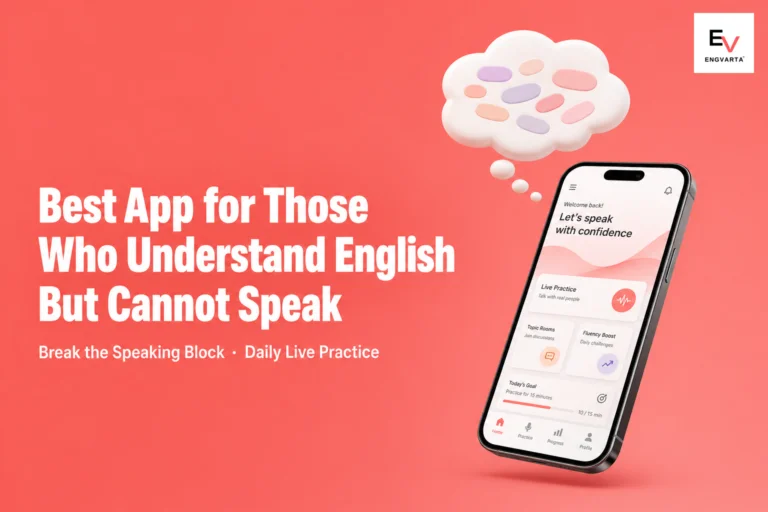
This is one of the most common problems in English learning — and one of the most frustrating. You read English fluently. You understand movies, podcasts, and YouTube. You can follow meetings. But the moment someone expects you to speak, your mouth stops working. Words you know perfectly will not come out.
Linguists call this the gap between receptive and productive language skills — understanding is passive, speaking is active. Millions of learners — especially in India, among immigrants in English-speaking countries, and among non-native professionals — live in this gap for years. The good news: the gap closes fast once you practise the right way.
Here are the seven best English apps in 2026 for people who understand English but cannot speak fluently.
Table of Contents [show]
Why “just speak more” advice does not work for this problem
The standard advice is useless here because the person giving it does not understand the real problem. For learners in this gap:
- It is not a vocabulary problem. You know the words. They are in your head.
- It is not a grammar problem. You can spot grammar errors when reading or listening — your brain knows the rules.
- It is a retrieval-and-production problem. The neural pathway from “I want to say this” to “here is the sound my mouth produces” has not been trained.
- The fix requires output, not input. More reading, more listening, more watching — none of it helps. Only active speaking practice trains the retrieval-and-production pathway.
The best app for you is the one that forces daily speaking output with real-time correction — not one that teaches you more things you already know.
Quick comparison: apps for understand-but-can’t-speak learners
| App | Forces Daily Output? | Real-Time Correction? | Pricing |
|---|---|---|---|
| EngVarta | Yes — live human Experts | Yes | $45 / ₹2,700 for 25 sessions |
| Cambly | Yes — native tutors | Yes (tutor-dependent) | From $12/session |
| italki | Yes — booked tutor | Yes | $4 to $30/hour |
| Speak | Yes — AI | Partial (AI-generated) | Free / $20/mo |
| HelloTalk | Depends on partner | Rare | Free / $7/mo |
| ELSA Speak | Drills, not conversation | Sound-level only | Free / $12/mo |
| ChatGPT Voice | Yes — AI | If asked explicitly | Free / $20/mo |
1. EngVarta — Best for forcing daily speaking output at a fair price
EngVarta is built for exactly this problem. The product exists because its founders saw millions of Indian professionals and students who understood English well but could not produce it fluently in interviews, client calls, or daily life.
What makes it work for understand-but-can’t-speak learners:
- Forces you to produce language in real time. A trained Expert asks questions, waits for answers, and gently pushes you past the “I cannot find the word” freeze. Unlike AI, a real human will not let you stay silent.
- Real-time corrections while you speak. The Expert catches the grammar error, the wrong preposition, the filler word — and gives you the right version while the context is still fresh.
- Daily practice at daily-use pricing. $1.80 / ₹108 per session means you can practise daily for weeks without financial stress. Every day of skipped practice is a day the retrieval pathway does not get reinforced.
- Audio-only removes anxiety. The gap between understanding and speaking is often amplified by self-consciousness. Audio-only lets you focus 100% on production, not on how you look.
Typical timeline : Learners in this gap report noticeable fluency gains within 3 to 4 weeks of daily EngVarta sessions. Full fluency transfer to real-world situations (interviews, meetings) typically takes 2 to 4 months of consistent practice.
Ready to Practice with Real Experts?
Try EngVarta today — ₹69 trial (India) / $1 trial (International) · 100% refundable


What Our Learners Say
Rated 4.5★ from 9,100+ reviews on Google Play
2. Cambly — Best for video-based native speaker practice
If your receptive skills were built on US or UK media and you want your output training to match that accent exposure, Cambly connects you directly with native speakers from the US, UK, and Australia. The practice is video-based.
- Pricing: From $12 per session. Daily practice costs $320+/month.
- Best for: Learners with strong receptive skills who want output matched specifically to native-accent environments.
3. italki — Best if you want a dedicated long-term tutor
italki works well for this problem when you book one specific tutor weekly. A tutor who knows your specific gaps can target them across sessions. Less good for pure daily-output frequency because of per-hour pricing.
- Pricing: $4 to $30 per hour.
- Best for: Learners who want a single relationship-based tutor rather than rotating Experts.
4. Speak — Best AI option for building output momentum
Speak’s AI conversations are open enough to force you to produce complete sentences. Good as a warm-up tool before human sessions, or as a supplement when you cannot access a live human.
- Pricing: Free / $20 per month.
- Honest caveat: AI produces less pressure than humans, which means the output practice is easier. Real-world fluency needs real-human practice eventually.
5. HelloTalk — Free partner-based output practice
Free option for daily output practice. Quality depends entirely on finding and keeping good partners — which is inconsistent.
- Pricing: Free / $7 per month.
- Honest caveat: Partners are not trained, corrections are rare, and many go silent.
6. ELSA Speak — When your output gap is specifically pronunciation
Some learners can actually produce sentences but stop speaking because they hate their own pronunciation. If that is you, ELSA drills the specific sound issues.
- Pricing: Free / $12 per month.
- Not a conversation tool — pair with EngVarta or similar for conversational fluency.
7. ChatGPT Voice — Free unlimited output practice
Unlimited free AI conversation. Useful for pure volume-of-output practice on days when you cannot access a human. Ask ChatGPT explicitly to correct your mistakes to get feedback.
- Pricing: Free / $20 per month.
- Best as: A daily volume supplement alongside live human practice.
The honest path to closing the understand-to-speak gap
- Stop consuming more English. You already understand enough. More podcasts, Netflix, and YouTube will not fix this gap. It is an output problem.
- Practise daily output for at least 15 minutes. Consistency matters enormously — the retrieval pathway strengthens through repetition, not intensity.
- Get real-time correction. A trained human catching your errors mid-sentence is worth 10x self-guided practice. EngVarta is the most affordable way to get this daily.
- Expect a 3-to-4 week inflection point. The first 2 weeks feel slow. The shift usually happens between week 3 and week 4. Push through.
✨ Want to speak English confidently in real life — in meetings, interviews, and daily conversations?
Frequently Asked Questions — Best English App for People Who Understand English But Cannot Speak Fluently
Why can I understand English but not speak it?
Understanding and speaking use different neural pathways. Understanding is recognition (passive) — your brain only has to match incoming sounds to known words. Speaking is production (active) — your brain has to retrieve the right word from memory, then produce the physical sound. The production pathway only strengthens through active speaking practice. Reading, watching, and listening, no matter how much, do not train it.
What is the fastest way to go from understanding English to speaking it fluently?
Daily live speaking practice with real-time correction. The combination of (a) daily frequency, (b) human pressure forcing you to produce, and (c) immediate feedback on errors is the fastest protocol. EngVarta is designed around exactly this combination at affordable daily-use pricing.
How long until I can actually speak English confidently?
With 15-25 minute daily sessions, most learners in this specific gap report meaningful confidence gains within 3 to 4 weeks and real-world fluency transfer (handling interviews, client calls, casual conversations) within 2 to 3 months. The key variable is consistency — skipping multiple days resets the retrieval pathway faster than most learners realise.
Do I need to talk to native English speakers specifically?
No. The trained teacher matters more than native-vs-non-native status. A TESOL/ESL-certified non-native Expert who knows teaching is more useful than an untrained native speaker who just chats. EngVarta uses TESOL/ESL-certified Experts; Cambly uses native speakers (variable training). Pick based on what you specifically need — conversation training or accent exposure.
Can AI apps fix the understand-but-can’t-speak problem?
Partially. AI can force output and give feedback, which helps build the retrieval pathway. But AI lacks the real-human pressure that trains you for actual social situations — interviews, client calls, family conversations. Most learners who only use AI plateau at “I can speak to AI but still freeze with humans.” The effective protocol is AI + human practice combined, not AI alone.
Last reviewed: April 2026
Found this useful? Add EngVarta as a preferred source on Google — you’ll see more of our English lessons in your Search and AI results.