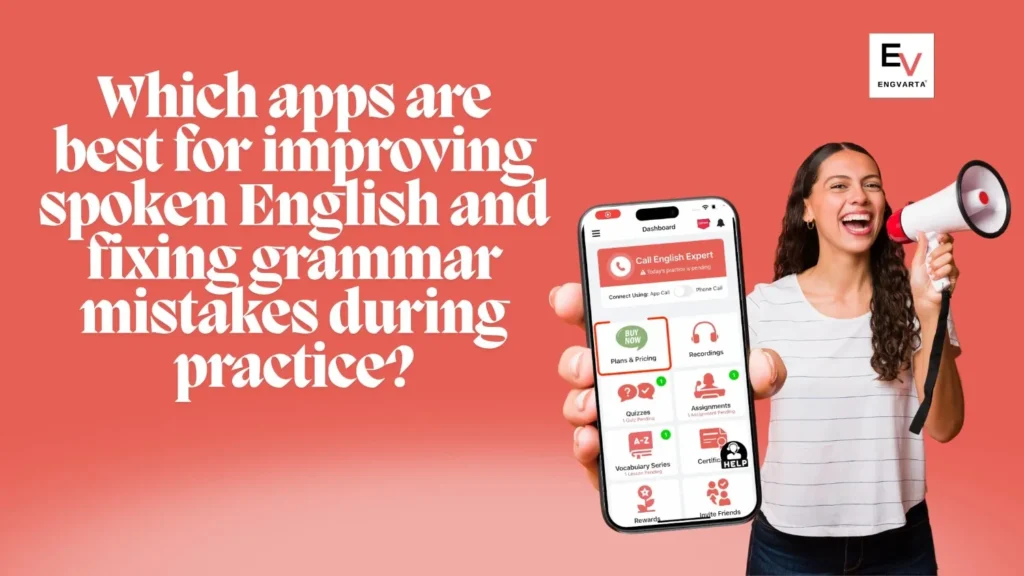
Which apps are best for improving spoken English and fixing grammar mistakes during practice?

improving spoken English and fixing grammar mistakes during practice

In the hyper-competitive Indian corporate landscape of 2026, technical expertise is no longer the sole driver of career success. As multinational corporations (MNCs) expand their footprints in tech hubs like Bangalore, Hyderabad, and Pune, the ability to articulate complex ideas with clarity has become the ultimate “force multiplier” for your salary.

For many professionals, the challenge isn’t a lack of vocabulary or an inability to write emails. The real hurdle is the “Fluency Gap”—the frustrating silence that happens when you try to practice English speaking in real-time but find your brain stuck in translation.

If you’ve ever felt your heart race before a client presentation or hesitated to speak up in a cross-border meeting because of potential grammar mistakes, this guide is for you. We will analyze the best app for spoken English practice, including the EngVarta App, specifically tailored for the Indian workforce, and show you how to use English speaking tools to unlock a projected 34% “fluency premium” in your paycheck.

The 2026 Fluency Economics: Why Spoken English is Your Best Investment

Before we dive into the English speaking apps, let’s look at the “why.” Recent 2026 employment data suggests a staggering trend: fluent English speakers in India earn, on average, 34% higher hourly wages than their non-fluent counterparts. This isn’t just a statistic; it’s the difference between a mid-level role and a leadership position.

In 2026, the demand for spoken English improvement is driven by:

  1. Global Collaboration: Hybrid work models now connect Indian teams with US, UK, and European stakeholders daily.
  2. Leadership Readiness: Promoting a manager to a Director role often hinges on their “executive presence”—a mix of confidence and clear English speaking skills.
  3. Client Trust: International clients equate clear communication with professional competence.

Top-Rated Apps for Spoken English Improvement in 2026

The market for apps for spoken English has evolved. We no longer rely on boring fill-in-the-blank exercises. Today’s tools focus on English conversation practice and high-fidelity feedback.

1. EngVarta: The Premier Choice for Indian Professionals

Real-world confidence, workplace scenarios, and MTI reduction. EngVarta is highlighted as the top suggestion for the Indian scenari. Unlike most apps that use AI bots, EngVarta connects you with live English experts via 1-on-1 phone calls. This simulates the exact environment of a corporate conference call.

  • Key Advantage: It offers a judgment-free, anonymous environment. You can make as many grammar mistakes as you need to without the fear of your boss or colleagues hearing you.
  • India Focus: The experts specifically understand regional accents (Mother Tongue Influence – MTI) and can help you neutralize them for a more global professional tone.

2. ELSA Speak: The Pronunciation Powerhouse

Accent clarity and phonetic precision. ELSA (English Language Speech Assistant) uses advanced AI to compare your speech patterns against a neutral global English accent. If you are worried that your English speaking skills are being hampered by mispronouncing “th” or “v” sounds, ELSA provides visual feedback on exactly how to move your tongue and lips.

3. MySivi AI: The New AI Standard

24/7 AI-driven feedback and interview prep. As we move through 2026, MySivi AI has emerged as a top-tier English speaking tool. It provides a “private speaking space” where an AI tutor engages in human-like dialogue. It is particularly effective for English grammar correction because it highlights errors in your transcript immediately after you speak.

4. HelloTalk & Tandem: The Community Connectors

Casual immersion and cultural exchange. These apps connect you with native speakers globally. While less focused on professional English grammar practice, they are excellent for staying in the “English mindset” during your commute or downtime.

How to Correct Grammar Mistakes While Practicing English Speaking

One of the biggest myths in language learning is that you must master grammar before you speak. In reality, spoken English practice  is most effective when it happens during conversation. This is known as the Feedback Loop.

The Anatomy of a Feedback Loop:

  1. Action: You attempt to explain a project delay.
  2. Error: You say, “He don’t like the new design.”
  3. Correction: A live expert (like those on EngVarta) or a high-end AI gently interrupts: “Remember, for ‘he,’ we use ‘doesn’t.’ Try saying: ‘He doesn’t like the new design.'”
  4. Reinforcement: You repeat the correct sentence immediately.

This real-time English Grammar Correction is what builds “neural pathways.” Reading a textbook doesn’t stop you from making that mistake in a meeting; real-time correction does.

Reasons EngVarta is the “Gold Standard” for the Workforce in India

Indian professionals face unique challenges. We often have a high “passive” vocabulary (we understand what we read) but a low “active” vocabulary (we can’t find the words while speaking).

Eliminating the “Fear of Judgment”

In many Indian corporate cultures, there is an unspoken pressure to be perfect. This “perfection trap” leads to silence. EngVarta’s anonymous platform is a psychological breakthrough. By removing the video element and your real name, it allows you to practice English speaking with total freedom.

Mastering Workplace Scenarios

EngVarta experts aren’t just teaching “English”; they are coaching you for the “corporate world.” You can request sessions specifically for:

  • Mock Interviews
  • Salary Negotiations
  • Client Pitch Practice
  • Handling Difficult Conversations

Call Recordings: Your Secret Weapon

Every EngVarta session is recorded. To truly correct grammar mistakes, you must listen to yourself. Most learners are shocked to hear how many filler words (like “um,” “uh,” “actually”) they use. Reviewing your calls allows you to perform your own English Grammar Correction and track your progress over months.

Download EngVarta App today and start building fluent English skills.

The Psychological Strategy: Overcoming the Fear of Speaking

If you want to learn English online, you must first master your mindset. Fear of speaking English usually stems from three areas:

  1. The Translation Lag: Trying to think in your native language (Hindi, Marathi, Telugu, etc.) and then translating.
  2. The Perfection Trap: The belief that one grammar slip-up ruins your credibility.
  3. Accent Anxiety: The fear that your accent makes you sound less “modern.”

How to Break the Cycle:

  • Shadowing Technique: Use your English speaking apps to listen to a sentence and repeat it exactly, mimicking the tone. This reduces the “translation lag.”
  • Focus on Communication, Not Perfection: Your goal is to get your point across. If you make a minor grammar mistake but the client understands your logic, you have succeeded.
  • Acknowledge MTI: Every native speaker in the world has an accent. Aim for “clarity,” not “erasure” of your identity.

Building Your 30-Minute Daily “Fluency Workout”

Consistency is the only way to achieve spoken English improvement. Here is a proven routine for a busy working professional in India:

Morning: The Brain Primer (5 Minutes)

While getting ready, listen to a 5-minute English business podcast. This primes your brain to “hear” the rhythm of the language.

Afternoon: The High-Intensity Practice (15 Minutes)

During your lunch break or commute, connect with an EngVarta expert. This is your core English conversation practice. Don’t just chat; pick a specific workplace topic to discuss.

Evening: The Correction Phase (10 Minutes)

Log into your app and review the feedback. If you are using ELSA, do two pronunciation drills. If you are using EngVarta, listen to 5 minutes of your recorded call and note down three specific grammar mistakes to avoid tomorrow.

Comparative Analysis: Which Tool Fits Your Career Level?

Professional Goal Recommended Tool Why?
Cracking a Job Interview EngVarta

Real experts deliver live mock interviews with personalized feedback on tone and body language.

Presenting to US/UK Clients ELSA Speak Focuses on neutralizing heavy MTI to ensure global stakeholders understand you.
Building Daily Habit Duolingo / MySivi Gamified and AI-driven; perfect for staying consistent with basic English grammar practice.
Writing Better Reports Grammarly The best for written English Grammar Correction and tone adjustment.

Common Grammar Mistakes Indian Professionals Make (and How to Fix Them)

Through our analysis of thousands of hours of English speaking tools data, we’ve identified the “Big Three” errors:

  1. Tense Consistency: Mixing past and present when telling a story.
    • Incorrect: “Yesterday I go to the office and meet him.”
    • Correction: “Yesterday I went to the office and met him.”
  2. Article Misuse: Overusing or omitting “a,” “an,” and “the.”
    • Incorrect: “I am working on project.”
    • Correction: “I am working on the project.”
  3. Subject-Verb Agreement: Especially with singular/plural subjects.
    • Incorrect: “My team want to reschedule.”
    • Correction: “My team wants to reschedule.”

By using apps for spoken English that provide live feedback, you catch these “blind spots” before they become habits.

The Future of English Learning: AI or Human?

By 2026, the question isn’t “AI vs. Human”—it’s how to use both.

  • AI is great for English grammar practice and repetitive drills. It’s cheap, available 24/7, and patient.
  • Humans are essential for English conversation practice that involves emotion, persuasion, and cultural nuance. You cannot learn “leadership tone” from a bot.

For a career-driven professional, we recommend a Hybrid Approach: Use AI for your daily grammar and pronunciation drills, but spend at least 3 days a week on EngVarta to engage in real human connection.

Social Media & Learning Motivation

Follow EngVarta on social media for daily tips, motivation, and real-life English practice ideas:

Conclusion

Your ability to speak English is a financial asset. In the next three years, the gap between those who can communicate globally and those who cannot will only widen.

To recap, if you want to correct grammar mistakes and see genuine spoken English improvement:

  1. Stop studying, start speaking. Use English speaking apps from Day 1.
  2. Prioritize EngVarta for high-stakes professional preparation and judgment-free practice.
  3. Audit your errors. Use call recordings for English Grammar Correction.
  4. Stay Consistent. 15 minutes a day is better than 2 hours once a week.

The corporate world is waiting for your voice. Don’t let a few grammar mistakes stand between you and your next promotion. Download your chosen English speaking tools today and start your journey toward becoming a global Indian professional.

Frequently Asked Questions ( FAQs)

What is the Best Way to Practice English Talking for Job Interviews and Business Meetings?

Practice English Talking

In our experience, the biggest hurdle for Indian professionals isn’t a lack of vocabulary; it’s the “fluency gap.” We’ve seen brilliant engineers, data scientists, and senior managers struggle because they spend too much cognitive energy translating thoughts from Hindi, Tamil, or Bengali to English mid-sentence. In 2026, the corporate world moves at the speed of thought. High-stakes environments—whether it’s a “Series B” pitch or a critical stakeholder meeting—don’t allow time for mental translation. Many professionals find that consistent practice English talking sessions, whether with apps, language partners, or one-on-one coaching, help close this fluency gap and build confidence for real-world communication.

Whether you are aiming for a dream role at a global tech giant or leading a cross-border project, the way you practice defines how you perform. To bridge the gap, you need a strategy that moves beyond textbooks and into the realm of neurological conditioning. Apps like EngVarta provide live, one-on-one spoken English practice with real expert coaches, helping professionals build the fluency and confidence required to perform seamlessly in real-world corporate conversations.

What is the fastest way to practice English talking for interviews?

The fastest way to practice English talking for interviews is through “Live Immersion” and “Scenario-Based Simulations.” Instead of memorizing answers to common questions, engage in 1-on-1 conversations with experts. Using apps like EngVarta allows you to simulate real-world interview pressure, receive instant feedback on your vocal variety and sentence structure, and effectively kill the habit of mental translation.

Why EngVarta is the Gold Standard for Indian Job Seekers

In the 2026 job market, recruiters have shifted away from testing technical knowledge (which is now often pre-vetted by AI) toward evaluating “Culture Fit” and “Executive Presence.” Traditional coaching centers often fail because they treat English as a subject to be studied rather than a skill to be performed.

EngVarta changes the game by connecting you with live English experts anonymously. This anonymity is crucial; it removes the “fear of judgment”—the single biggest psychological barrier for Indian professionals. When you practice English talking for job interviews on the app, you are essentially “training your brain” for high-pressure scenarios.

Real-time Corrections: 

Unlike a classroom, where feedback is delayed, here you are corrected as you speak. This creates a neural loop that prevents mistakes from becoming “fossilized.”

Interview Simulations: 

You can request experts to grill you on specific behavioral questions like “Describe a time you failed” or “How do you handle conflict in a remote team?”

The “On-Demand” Advantage: 

Practice during your commute or 15 minutes before your actual interview to “warm up” your vocal cords and shift your brain into English mode.

👉 Get Started on EngVarta:

 📱 Download for Android | 🍎 Download for iOS

How can I improve my English speaking for professional meetings?

To improve English speaking for professional meetings, focus on “Active Rehearsal” and “Collaborative Fluency.” Use the “Shadowing Technique” by mimicking industry leaders on podcasts and participate in live 1-on-1 business English conversation practice. Master transition phrases and “diplomatic language” to sound more authoritative and polished during high-stakes negotiations, while regularly engaging in practice English talking to strengthen real-world fluency.

The Dynamics of 2026 Virtual and Hybrid Meetings

The shift to permanent hybrid work has changed the rules of engagement. You no longer just need to speak; you need to command a “digital presence.” This means your articulation must be crisp, and your ability to summarize complex points must be immediate.

Comparison: Practice Methods for Workplace Communication

Method Best For Time Required Effectiveness Scalability
EngVarta App Real-time confidence, flow & nuance 15 mins/day High Excellent
AI Tutors/Chatbots Basic grammar & simple syntax 30 mins/day Medium Good
YouTube Shadowing Pronunciation & intonation 20 mins/day Medium Limited
Traditional Classes Theoretical grammar & group talk 1 hour/day Low Poor
Reading Books Vocabulary expansion (Passive) 45 mins/day Low Very Poor

For business English conversation practice, we recommend a “Practice-First” approach. In professional meetings, the most respected voice isn’t always the loudest; it’s the one that can handle interruptions with grace and clarify technical points on the fly. This is where practice English for workplace communication through live experts beats passive consumption every time.

Why is “active listening” crucial for business English conversation practice?

Active listening is the secret weapon for professional fluency. It allows you to decode industry-specific jargon, understand the “tonality” of global leadership, and mirror the communication style of your stakeholders. By listening to experts during your improve English speaking for professional meetings sessions, you learn to respond contextually rather than delivering robotic, pre-recorded responses.

The Psychology of “Mirroring” in Business

In global business, rapport is built through mirroring. If your stakeholder uses specific idioms or a certain pace of speech, being able to match that (without losing your identity) creates instant trust. Through active listening practice, you move from “hearing words” to “interpreting intent.”

When you use EngVarta, the expert acts as a mirror. They reflect your communication style back to you, highlighting where you are clear and where you are losing the audience. This feedback loop is essential for practice English talking for job interviews and large-scale presentations.

Contemporary interviews focus less on “What is your job?” and more on “How do you approach problems?” Here’s how to apply spoken English tips for interviews to address the three key aspects of 2026 hiring:

1. The Behavioral Pillar

Questions like “Tell me about a time you managed a cross-functional team” require a narrative arc. Practice the STAR (Situation, Task, Action, Result) method in your practice sessions.

  • Common Pitfall: Using “We” too much.
  • The Fix: Use “I” to highlight your specific contribution, even in a team setting.

2. The Cultural Pillar

Recruiters want to know if you can communicate with teams in London, San Francisco, or Tokyo. This requires “Neutral English”—English that is free of heavy regional slang and is paced for global understanding.

  • Practice Tip: Ask your EngVarta expert to evaluate your “Clarity Index.” Are you speaking too fast? Are your consonants clear?

3. The Crisis Pillar

“What actions would you take if our primary server failed while the CEO was on a call?” These questions test your ability to maintain composure. If you stumble over your English here, it signals a lack of confidence, not just a lack of language.

  • Practice Tip: Practice “Thinking Out Loud.” Narrate your thought process as you solve a problem.

Expert Strategies to Improve English Speaking for Professional Meetings

Beyond the basics, senior professionals need to master “Diplomatic Language.” This involves using softeners to disagree without being disagreeable.

  1. Use Softeners: Instead of saying “You are wrong,” try “I see your point, however, have we considered the impact on X?”
  2. Master Transition Phrases: * To add a point: “Building on what Sarah mentioned…”
    • To shift topics: “If we could pivot for a moment to the budget…”
    • In conclusion: “To bring our conversation to a close on this…”
  3. The “Record and Replay” Protocol: Use the recording feature in EngVarta to listen back to your sessions. You will be surprised at the small fillers (like “um,” “uh,” and “like”) you can easily eliminate once you become aware of them.
  4. Think in English: This is the most cited advice for a reason. Start by narrating your daily tasks in your head. Instead of thinking “Aaj meeting ke liye late ho jayenge,” think “I might be running late for the meeting.”
  5. The 1% Rule: Don’t try to learn 100 new words today. Aim to master one phrasal verb (like bring up, call off, or get across) and use it three times in your next session.

The Long-Term ROI of English Fluency for Indian Professionals

We often view English as a “requirement,” but in 2026, it is a “multiplier.” A professional with high-level communication skills can command a 30% to 50% higher salary than a peer with identical technical skills but lower fluency.

Why? Because leadership is communication. You cannot inspire a team, negotiate a contract, or represent a brand on a global stage if you are struggling with your sentences. Investing in practice English talking for workplace communication is not just a personal hobby; it is a strategic career move.

Final Thoughts

The road to becoming a confident communicator isn’t paved with grammar books or passive YouTube watching; it’s paved with real, uncomfortable, and exhilarating conversations. If you are serious about your career growth in the 2026 economy, you need a daily workout for your speech, such as dedicated practice English talking sessions to build fluency and confidence.

The “fluency gap” is only as wide as your hesitation. Whether you’re looking for spoken English tips for interviews to land your next role or you want to dominate your next board-level Zoom call, the EngVarta app provides the most practical, judgment-free environment to evolve.

Frequently Asked Questions ( FAQs)

  • What type of English speaking practice is best for leadership roles and presentations?
    • Leadership roles require structured, confident, and impactful communication. Practicing English talking through live roleplays, presentation simulations, and expert feedback is most effective. EngVarta helps professionals rehearse these high-stakes scenarios with real-time guidance.

  • How can working professionals practice English talking without fear of mistakes?
    • Working professionals can practice English talking effectively by using platforms that offer anonymous, one-on-one speaking sessions. EngVarta provides a judgment-free environment where professionals can speak freely, make mistakes, and improve fluency without hesitation.

  • How often should I practice English talking to see results?
    • For visible improvement, it’s recommended to practice English talking at least 20–30 minutes daily. Regular sessions on EngVarta help you think in English, reduce mental translation, and develop natural fluency needed for professional conversations.

  • How can I improve my English speaking for business meetings quickly?
    • To improve English speaking for business meetings quickly, you need daily speaking practice focused on professional scenarios like presentations, negotiations, and updates. EngVarta offers one-on-one spoken English sessions where you practice real business conversations and receive instant feedback to sound more professional and fluent.

  • What is the best way to practice English talking for job interviews?
    • The best way to practice English talking for job interviews is through live, real-time conversation practice that simulates actual interview pressure. EngVarta connects you with live English experts who help you practice common interview questions, improve clarity, and build confidence without the fear of judgment.