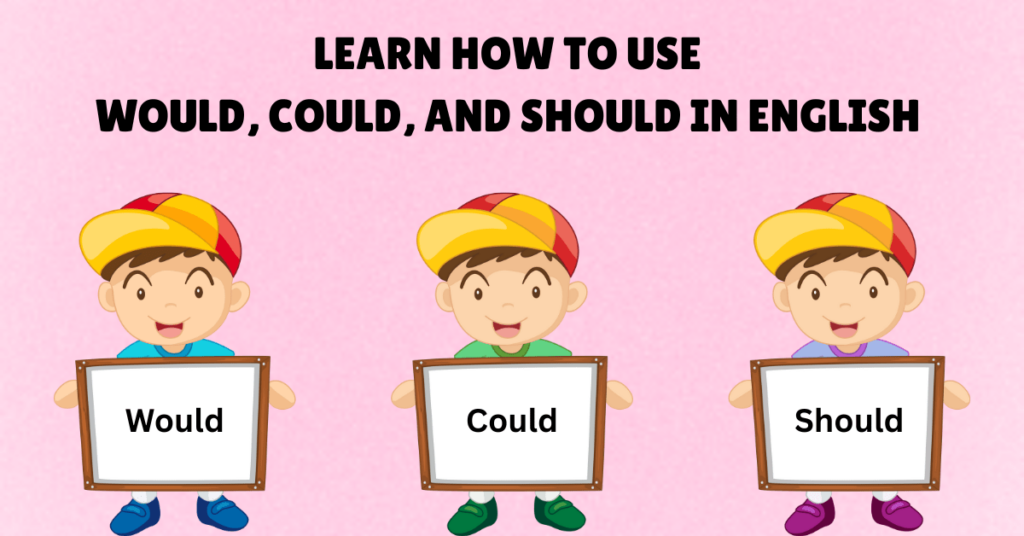
Ever feel confused about when to use would, could, and should in English? You’re not alone! These little words can be tricky, but once you understand how they work, you’ll sound more fluent and confident. Let’s break them down together with simple rules and everyday examples.
What Are Modal Verbs?
Modal verbs are special helper verbs that add meaning to the main verb. They show things like possibility, ability, or advice. The stars of today’s lesson—would, could, and should—are three of the most popular ones!
When to Use Would
Use would to talk about:
- Polite requests: Would you help me, please?
- Imaginary or unreal situations: I would go to Paris if I had the money.
- Future in the past: He said he would call me.
- Wishes and desires: I would love a slice of cake.
👉 Quick Tip: Think of would as a softer, more polite version of will.
When to Use Could
Use could for:
- Past ability: She could read when she was three!
- Polite requests: Could you please pass the salt?
- Possibility: It could snow tomorrow.
- Suggestions: You could try restarting your phone.
👉 Quick Tip: Could is like a more polite or uncertain form of can.
When to Use Should
Use should when giving advice, opinions, or talking about what’s right:
- Advice: You should drink more water.
- Expectation: She should be here by now.
- Moral obligation: People should be kind.
- Suggestions: Should we go out for lunch?
👉 Quick Tip: Should is a gentle way of saying something is the right thing to do.
Final Thoughts
Learning how to use would, could, and should doesn’t have to be hard. Keep practicing with real sentences, and you’ll start using them naturally. They may be small words, but they make a big difference in your English!
Learn and Practice More with EngVarta
Want to improve your spoken English with live practice? Try the EngVarta, where you can talk to live English experts any time!
Modals also pair with the passive voice—this could be done, the report should be reviewed, that would be appreciated—if you want the full pattern, read our guide on active and passive voice in English grammar.
Frequently Asked Questions about Would, Could, and Should
What is the difference between would, could, and should?
“Would” expresses hypothetical situations, polite requests, or past habits. “Could” expresses past ability or polite possibility. “Should” expresses advice, obligation, or expectation. Quick test: WOULD = imagined/conditional (“I would help if I could”). COULD = ability/possibility (“She could speak three languages”). SHOULD = recommendation (“You should rest”). Each carries a different shade of meaning that English learners often mix up.
When should I use ‘would’?
Use “would” for: (1) Hypothetical/conditional situations: “I would travel more if I had time.” (2) Polite requests: “Would you pass the salt?” (3) Past habits: “When I was young, I would walk to school every day.” (4) Reported speech of “will”: “She said she would call.” (5) Wishes: “I wish I would win the lottery.” Common Indian English error: using “would” for present-tense politeness when “could” or “can” would be more accurate.
When should I use ‘could’?
Use “could” for: (1) Past ability: “I could swim when I was 5.” (2) Polite requests: “Could you help me?” (3) Possibility (less certain than “may”): “It could rain later.” (4) Suggestions: “We could try a different approach.” (5) Past possibility: “He could have been there.” “Could” is generally less formal than “would” for politeness — “Could you” feels softer than “Would you.”
When should I use ‘should’?
Use “should” for: (1) Advice/recommendation: “You should see a doctor.” (2) Expectation: “The package should arrive tomorrow.” (3) Obligation (mild): “We should respect the rules.” (4) Past regret: “I should have studied harder.” (5) Probability: “She should be home by now.” “Should” is the most directive of the three — it implies a recommended course of action, not just a possibility.
What are some examples of would vs could vs should?
Same situation, three meanings: “I WOULD call her if I had her number” (conditional — depends on having her number). “I COULD call her if you want me to” (ability/willingness — I have the option). “I SHOULD call her — it’s been a week” (advice/obligation — I ought to). Or: “WOULD you like coffee?” (polite offer). “COULD I have coffee?” (polite request). “SHOULD I have coffee?” (asking for advice).
What’s the difference between ‘would’ and ‘will’?
“Will” expresses certainty about the future (“I will call you tomorrow”). “Would” expresses hypothetical or conditional (“I would call you if I had time”). Will = definitely. Would = if certain conditions are met. Common error: using “will” when “would” is correct in conditionals — “If I had money, I will buy a house” should be “If I had money, I would buy a house.”
What’s the difference between ‘could’ and ‘can’?
“Can” expresses present ability or permission (“I can speak English”). “Could” expresses past ability OR polite present (“I could speak English at age 8” / “Could I speak English with you for practice?”). When asking for permission politely, “could” is softer than “can” — “Could I leave early today?” sounds more polite than “Can I leave early today?” though both are correct.
How can I practice would, could, and should correctly?
Effective practice: (1) Use each modal verb in 3 sentences daily — one for each purpose (conditional, ability/permission, advice). (2) Listen to English shows and note when speakers use which modal. (3) Practice in real conversation where someone can flag misuse. (4) Read English news articles and circle every “would/could/should” — note why each was chosen. EngVarta‘s TESOL/ESL-certified Experts can prompt you to use specific modals in conversation and explain why one fits better than another. The $1 refundable trial lets you try this on a topic where you typically struggle.