In our experience coaching thousands of candidates, the difference between a Band 6 and a Band 8 isn’t just “better English.” It is an intimate understanding of the IELTS Speaking Band Descriptors. To succeed in 2026, you must stop guessing and start practicing against the official criteria used by examiners worldwide.
Whether you are an aspiring international student or a professional looking for a global career, mastering these band descriptors for speaking is your roadmap to success. In this guide, we break down the four pillars of the test and show you how the Fixolang app—formerly powered by the expertise of EngVarta—uses AI to mirror these exact standards for your daily practice.
What are the IELTS Speaking Band Descriptors?
The IELTS Speaking Band Descriptors are the official assessment criteria used by examiners to grade your performance. They consist of four equally weighted categories: Fluency and Coherence (FC), Lexical Resource (LR), Grammatical Range and Accuracy (GRA), and Pronunciation (P). Each is scored from 0 to 9 to determine your final band.
Understanding the band descriptors for ielts speaking is essential because it shifts your focus from “talking a lot” to “talking correctly.” The examiner isn’t just listening to your ideas; they are checking boxes in a specific rubric. In the 2026 testing environment, examiners are trained to look for “Generative Intelligence”—your ability to produce spontaneous, non-memorized speech that fits the speaking ielts band descriptor requirements for higher levels.
How does Fluency and Coherence affect your IELTS score?
Fluency and Coherence (FC) measures your ability to speak at length without unnatural hesitation or self-correction. It assesses how well you link ideas using cohesive devices (connectors) and whether your speech is easy to follow without the examiner having to struggle to understand your logic.
When we look at the band descriptors speaking criteria for Fluency, the biggest jump happens between Band 6 and Band 7. At Band 6, you might lose points for “over-use of certain connectives.” At Band 7, you show “good coherence” with only occasional hesitation. To bridge this gap, you need tips that focus on “discourse markers”—words like subsequently, conversely, or to illustrate.
Comparison Table: Fluency & Coherence Across Bands
| Feature | Band 5 (Limited) | Band 6 (Competent) | Band 7 (Good) | Band 8/9 (Expert) |
| Speed | Slow, frequent repetition | Generally maintains flow | Effortless, minimal pauses | Smooth, natural, no effort |
| Cohesion | Over-uses “and”, “but” | Uses range of connectors | Uses flexible markers | Fully appropriate features |
| Logic | Simple topics only | Develops topics well | Clear topic development | Sophisticated extension |
What Lexical Resource criteria do examiners look for?
Lexical Resource (LR) evaluates the range and precision of your vocabulary. To hit a Band 7.0 or higher, you must demonstrate the use of less common and idiomatic items, show an awareness of style and collocation, and effectively paraphrase when you cannot find a specific word.
The ielts band description speaking for Lexical Resource highlights “flexibility.” You shouldn’t just use “big words.” You should use the right words. For example, instead of saying “The weather was very bad,” a Band 8 candidate might say, “The weather was absolutely atrocious.”
Mastering Collocations & Idioms
One of the best speaking fluently tips is to learn words in pairs. Examiners love “strong collocations.”
- Make a mistake (not “do a mistake”)
- Bitterly cold (not “very cold”)
- Mitigating circumstances (Band 8+ level)
If you are looking for the Best IELTS English Speaking Practice App, you need a tool that corrects your word choice in real-time. Fixolang‘s AI provides Vocabulary Suggestions, helping you swap “boring” Band 5 words for “Band 7+” academic vocabulary.
How is Grammatical Range and Accuracy marked?
Grammatical Range and Accuracy (GRA) looks at the variety of sentence structures you use and how many “error-free” sentences you produce. High-band candidates use a mix of simple, compound, and complex sentences (conditionals, relative clauses, passive voice) with high precision and minimal mistakes.
Many students think they need to be perfect to get a high score. However, the speaking ielts band descriptor for Band 7 allows for “frequent error-free sentences,” though some grammatical mistakes still occur. The key is “Range.” If you only use “Subject + Verb + Object” sentences, you will likely be stuck at Band 5.5.
Key Structures for a 7.0+ Score:
- Conditionals: “If the government had invested more in infrastructure, the traffic wouldn’t be this bad.”
- Relative Clauses: “The person who influenced me the most was my grandmother.”
- Passive Voice: “A negative impact on focus is widely believed to be caused by social media.”
Using an App to Practice for IELTS Speaking Test like Fixolang allows you to see your Grammar Correction logs instantly. The AI identifies when you are playing it “too safe” with simple sentences and prompts you to try complex variations.
Why is Pronunciation the most misunderstood criterion?
Pronunciation (P) is not about having a British or American accent. It is about “intelligibility”—how easily the examiner understands you. It covers phonemic symbols, word stress, sentence stress, and intonation. You need to use these features to convey subtle meanings and keep the listener engaged.
In the band descriptor speaking rubric, Band 6 candidates are often “generally understood,” but might mispronounce certain words. Band 8 candidates use a wide range of pronunciation features with “sustained flexible use.”
Eliminating Mother Tongue Influence (MTI)
For many Indian candidates, MTI can lead to a lower score in the band descriptors for speaking. For instance, the “v” and “w” sounds or the “s” and “sh” sounds are often confused. Fixolang provides specific Pronunciation Feedback to help you neutralize these issues, ensuring your accent never stands in the way of your score.
Can AI help you practice for the IELTS Speaking test?
Yes, AI has revolutionized IELTS preparation by providing a safe, judgment-free environment to build muscle memory. Modern AI tools simulate the high-pressure exam atmosphere, offering instant feedback based on the IELTS Speaking Band Descriptors that human tutors might miss during a casual conversation.
We have found that students who use an IELTS App for Speaking Practice improve their scores 30% faster than those using textbooks alone. Speaking is a physical skill; you cannot master it by reading. You must “train” your vocal cords to handle the 15-minute exam duration.
What is the Best App for IELTS Speaking Practice in 2026?
The top-rated IELTS English Speaking Practice App for 2026 is Fixolang. Built on the legacy of EngVarta‘s communication expertise, Fixolang is specifically designed around the official IELTS rubric. It offers 24/7 availability, instant band score predictions, and realistic exam simulations.
Fixolang AI aapko IELTS Speaking ke 4 official criteria ke base par structured practice deta hai. This means every time you speak into the app, it isn’t just recording you; it is analyzing your performance against the IELTS Speaking Band Descriptors.
Why Fixolang is the Best App for IELTS Speaking Practice:
- Instant Fluency Analysis: Tracks your speed (words per minute) and pauses.
- Vocabulary Suggestions: Upgrades your lexical resource in real-time.
- Grammar Correction: Catches “fossilized errors” like missing articles or incorrect tenses.
- Pronunciation Feedback: Uses phoneme-level analysis to fix MTI issues.
- Unlimited Practice: Access over 1,000 recent cue card topics anytime.
Ready to ace your test? Download the Fixolang App now and start your first AI-powered mock test today!
Android App Download & iOS App Download
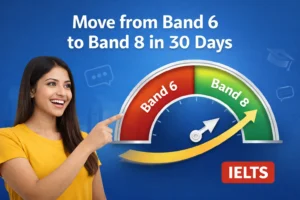
How to move from Band 6 to Band 8 in 30 days?
To jump two full bands, you must transition from “communicating” to “demonstrating skill.” This requires a “Speak-Score-Fix” loop: daily 45-minute sessions using an IELTS App for Speaking Practice, intensive review of the band descriptors for speaking, and re-attempting tasks until they are perfect.
The 30-Day “Mastery” Plan
| Week | Focus Area | Goal |
| Week 1 | Foundation & FC | Eliminate “ums”, use discourse markers, and read the band descriptor speaking rubric daily. |
| Week 2 | Lexical Expansion | Replace “very” with intensifiers. Practice 10 idioms daily with Fixolang. |
| Week 3 | Grammar Accuracy | Record and fix every sentence error. Focus on “error-free” counts. |
| Week 4 | Final Mock Drills | Simulate 3 full tests per day. Focus on tone and intonation. |
The IELTS 7.0 Criteria: A Closer Look
When aiming for a 7.0, the speaking ielts band descriptor requires you to be “willing to speak at length” and “show some use of idiomatic vocabulary.” It is the “Professional” band. To reach this level, you must show the examiner that you are comfortable in English. You aren’t converting in your mind; you are contemplating in English
For many, the hurdle is Part 2 (The Cue Card). Talking for 2 minutes straight is difficult. This is where an App to Practice for IELTS Speaking Test becomes essential. You need to get used to the “long turn.” Practice describing people, places, and events until the structure becomes second nature.
Common Myths About IELTS Speaking Band Descriptors
- “The examiner is checking my knowledge.” False. They only care about your language skills. You can say you “don’t like music” and still get a Band 9 if you explain it fluously.
- “I should avoid simple words.” False. Over-complicating leads to “hesitation.” Use a mix!
- “Using idioms is a guaranteed 7.” False. You must use them naturally. Fixolang helps you identify if an idiom sounds forced.
Follow FixoLang on social media
Facebook : https://www.facebook.com/fixolang/
Instagram : https://www.instagram.com/FixoLang/
YouTube : https://www.youtube.com/@FixoLang
Conclusion:
Mastering the IELTS Speaking Band Descriptors is the difference between a frustrated candidate and a successful one. By understanding that you are being graded on Fluency, Vocabulary, Grammar, and Pronunciation, you can tailor your practice to meet the examiner’s expectations.
In 2026, you don’t have to study alone. With Fixolang, you have a personal AI tutor that understands the band descriptors for ielts speaking as well as any examiner. Fixolang AI aapko IELTS Speaking ke 4 official criteria ke base par structured practice deta hai, ensuring that every minute you spend practicing is a step toward your target band.
Frequently Asked Questions about IELTS Speaking Band Descriptors
What are IELTS speaking band descriptors?
Band descriptors are the official scoring criteria IELTS examiners use to evaluate your speaking performance. There are FOUR criteria, each scored 0-9: (1) Fluency and Coherence — how smoothly you speak without long pauses, and how logically you structure ideas. (2) Lexical Resource — vocabulary range and accuracy. (3) Grammatical Range and Accuracy — variety of sentence structures and correctness. (4) Pronunciation — clarity, intonation, individual sounds. Your overall band is the average of these four.
How do I score band 6 in IELTS speaking?
Band 6 requires: (1) Speaking at length on most topics with some hesitation. (2) Using a range of vocabulary that’s mostly appropriate. (3) Producing simple and complex sentences with some errors that don’t impede understanding. (4) Pronunciation that’s generally clear with some L1 (native language) influence. To reach band 6: practise speaking 25-30 minutes daily, build a vocabulary of ~3,000 active words, and master the 12 core grammar rules. Most learners reach band 6 in 6-12 weeks of focused daily practice.
How do I score band 7 in IELTS speaking?
Band 7 requires: (1) Speaking fluently with rare hesitation. (2) Wide vocabulary including some less common items. (3) Mix of complex sentences with mostly correct grammar. (4) Clear pronunciation with effective intonation. Tactical approach: master 30-50 idiomatic phrases for varied topics; use linking words (however, therefore, on the other hand); develop topic-specific vocabulary in 8-10 areas. Daily live practice with a TESOL/ESL-certified Expert who knows IELTS scoring (like EngVarta‘s $1 refundable trial) accelerates the band 6-to-7 jump.
How do I score band 8 in IELTS speaking?
Band 8 requires near-native performance: (1) Fluent speech with very rare hesitation, only for content (not language). (2) Wide and precise vocabulary with idiomatic flexibility. (3) Wide range of complex structures with rare errors. (4) Fully natural pronunciation with effective use of intonation and stress. Most non-native speakers struggle to reach band 8 without extensive immersion or daily practice over 1-2 years. The jump from 7 to 8 requires fluency-as-instinct, not fluency-as-effort.
What’s the difference between IELTS band 5 and band 8?
Band 5: Speaks but pauses often, vocabulary is limited and inaccurate, frequent grammar errors, pronunciation requires listener effort. Band 8: Fluent and natural, broad vocabulary with idiomatic ease, complex grammar mostly accurate, pronunciation clear with natural intonation. The band 5-to-8 progression typically takes 12-18 months of daily focused practice with feedback. Most adult learners stall at band 6-7 without consistent live human practice.
Can AI tools help improve IELTS speaking band score?
AI tools (Speak, ELSA, AI mock exam apps) help with: pronunciation drilling, vocabulary expansion, basic conversation reps. AI tools fall short of full exam readiness because: (1) your band is decided by a human examiner in a live exchange — a setting only practice with real people prepares you for. (2) A bot expects nothing from you, so it never builds exam-day accountability. (3) AI doesn’t simulate the human pressure of a real exam. Best preparation: AI tools for daily reps + live human practice with someone trained on IELTS scoring + Cambridge IELTS official practice tests.
How long does it take to improve IELTS speaking by 1 band?
Realistic timeline: 6-8 weeks of daily focused practice (25-30 min/day) to move from band 5 to 6, or 6 to 7. The band 7-to-8 jump typically takes 3-6 months because the gap between fluent-with-effort and fluent-with-ease is significant. The non-negotiable: daily speaking practice WITH FEEDBACK. Self-study without correction often produces no improvement even over 6-12 months.
Ready to Practice with Real Experts?
Try EngVarta today — ₹69 trial (India) / $1 trial (International) · 100% refundable