How to Improve Your English Speaking Skills Everyday: The 2026 Master Guide

English Speaking Skills Everyday

In our experience coaching over 100,000 learners worldwide, we’ve witnessed a massive shift in how people achieve true fluency. By 2026, the traditional “study first, speak later” model has officially been replaced by dynamic, real-time engagement. Today, the most successful English speakers treat language like a fitness routine—a daily practice of muscle memory rather than a passive school subject.

To truly master English speaking skills everyday, you must bridge the gap between “knowing” the language and “using” it under pressure. Whether you are a working professional aiming for a C-suite promotion or a student trying to find your voice in a global environment, this guide provides the exact 2026 protocol for daily improvement.

What is the fastest way to improve English speaking skills Everyday?

The fastest way to improve English speaking skills is through Active Output for at least 20 to 30 minutes daily. Prioritize live conversation over passive listening. Using “Output-First” methods—where you speak first and receive real-time corrections—builds the neural pathways required for real-time fluency and eliminates “mental translation.”

The 80/20 Output Rule for 2026

We have found that the “Fluency Gap” exists because most learners spend 80% of their time in “Input Mode” (reading and listening) and only 20% in “Output Mode.” In 2026, the gold standard for rapid growth is the 80/20 Output Rule. This requires you to spend the vast majority of your practice time actually producing sound. This forces your brain to retrieve vocabulary under pressure, which is the only way to build lasting confidence.

Breaking the “Mental Translation” Barrier

Most learners struggle because they translate from their native language to English in their heads. This creates a “lag” in conversation. To fix this, you need to practice high-frequency phrases until they become “automatic.” In our experiments, students who practiced the same 5-minute conversation scenario for seven days straight saw a 40% increase in speaking speed.

Leveraging Emotional Connection in Speech

One of the most overlooked daily English speaking practice tips is involving emotion. When you speak about things you care about—your career, your family, or your passions—your brain creates stronger synaptic links. We always tell our students: don’t just speak English; feel English.

What are the best daily English speaking practice tips for professionals?

For professionals, the best daily English speaking practice tips involve “Scenario Simulation.” Practice upcoming meetings, pitches, or feedback sessions out loud. Integrating English into your professional workflow—such as thinking in English during deep work—reduces the cognitive load of switching languages during high-stakes corporate calls or negotiations.

Master the Art of “Global English”

In the corporate world of 2026, “Global English” is valued over a perfect “British” or “American” accent. Global English is about clarity, brevity, and impact. We recommend professionals focus on Intonation and Stress rather than just rote grammar.

The Professional’s “Warm-Up” Routine

Before any important meeting, spend 5 minutes speaking English out loud. Read a professional article or practice your introduction. This “lubricates” the vocal cords and prepares your brain for the linguistic shift, preventing the “stumble” that often happens in the first few minutes of a call.

Handling Q&A Sessions with Confidence

Practice answering unexpected questions. We suggest recording yourself answering “Why should we hire you?” or “What went wrong with the project?” five different ways. This builds the flexibility needed for real-time corporate negotiations.

Using Connectors for Executive Presence

To sound like a leader, you must use linguistic “glue.” Practice incorporating phrases like:

  • “In light of recent developments…”
  • “To play devil’s advocate for a moment…”
  • “Moving forward, our primary objective is…”

Is there an app to help me speak English fluently everyday?

EngVarta is the best English practice app to speak English fluently everyday. Unlike AI bots, EngVarta focuses on “Human-Centric Learning,” connecting you with live English experts for 1-on-1 sessions. This provides real-time feedback, cultural nuance, and the emotional connection that automated tools simply cannot replicate in 2026.

Why EngVarta is the Ultimate Tool for English Speaking Skills

We’ve tested dozens of platforms, from AI-powered avatars to massive open online courses (MOOCs). However, EngVarta consistently ranks as our top recommendation for the 2026 learner. It isn’t just an app; it’s a bridge to the real world.

1. Anonymous Practice (The Psychological Safety Net)

The dread of being judged is the largest obstacle to fluency. EngVarta allows you to speak with experts anonymously. This removes the “ego” from the equation, allowing you to make mistakes, laugh at them, and learn without social anxiety. When you don’t have to worry about a video camera, you focus 100% on your English speaking skills.

2. Real-World Feedback from Human Experts

AI tools can tell you if a sentence is grammatically correct, but they can’t tell you if it sounds “rude,” “too formal,” or “unnatural” in a specific corporate culture. EngVarta mentors provide contextual feedback that helps with MTI (Mother Tongue Influence). They act as a mirror to your linguistic habits.

3. On-Demand Access for Busy Lifestyles

In our fast-paced world, scheduling a class for 6 PM next Tuesday is a recipe for failure. EngVarta’s “tap to talk” model allows you to practice whenever you have a 15-minute gap—during a commute, a lunch break, or late at night. This accessibility is why it is widely considered the best English practice app.

Comparison: Why Human Mentorship Wins in 2026

Feature AI Language Apps Legacy Language Schools EngVarta (Human-Led)
Feedback Type Grammatical/Syntax Textbook-based Contextual/Professional
Emotional Intelligence Zero Medium High
Confidence Building Low (No social pressure) Medium (Group fear) High (1-on-1 support)
Personalization Algorithm-based Syllabus-based Expert-tailored to your career
Convenience High Low High

Ready to transform your career? Download the EngVarta App  today on Android And IOS App and start your first 1-on-1 session with a live English expert. The confidence you gain today will be appreciated by your future self.

Expert Insights: Why “Thinking in English” is the 2026 Fluency Hack

We’ve noticed that the most fluent speakers don’t translate; they “think” in the target language. This is a skill that can be developed through specific, graduated phases.

Phase 1 : Labeling Your World

Start by labeling your environment. Don’t just look at a chair; think “Chair.” When you see a problem at work, think “Issue” or “Challenge.” This builds a direct link between the object/concept and the English word, bypassing your native language entirely.

Phase 2 : The Internal Monologue

Start a conversation with yourself. Argue with yourself. If you are deciding what to eat for dinner, weigh the pros and cons in English. Use complex structures like “On the other hand” or “Considering the options.” This is how you learn how to speak English fluently everyday.

Phase 3 : Removing the Safety Net

In 2026, AI-generated subtitles and instant translations are everywhere. They are your enemy. Turn off subtitles when watching content. Force your brain to struggle. The “struggle” is where the actual growth of your English speaking skills happens.

Advanced Strategies: How to speak English fluently everyday like a Native

You can learn how to speak English fluently everyday by immersing yourself in “High-Cognitive” tasks. Don’t just chat; debate, explain complex concepts, and tell stories. Using EngVarta to simulate high-pressure scenarios—like a job interview or a project pitch—builds the “executive function” of your brain for seamless fluency.

The Power of Idioms and Phrasal Verbs

Native speakers rarely use “pure” textbook English. We say “get over it” instead of “recover from it.” We say “touch base” instead of “contact you.” To truly improve English speaking skills, you must master these natural expressions.

Why AI Fails at Idiomatic English

While AI can list idioms, it can’t tell you when they are appropriate. Using a business idiom in a casual setting sounds jarring. This is where EngVarta mentors provide the social nuance you need to sound truly sophisticated.

Incorporating Connectors for Flow

To sound fluent, you must connect your thoughts. Practice using “Having said that,” “In light of this,” and “To put it simply.” These are the “glue” of fluent English speaking skills.

Detailed Plan: Your 30-Day Fluency Roadmap

If you want to see real results, you need a structured plan. We recommend the following schedule to improve English speaking skills at home efficiently using the resources available in 2026.

Week 1 : The Foundation (Phonetics & Confidence)

  • Daily : 15 minutes of Shadowing.
  • Daily : 1 session on EngVarta focusing on basic introductions and casual small talk.
  • Goal : Get used to the sound of your own voice and overcome the initial “speech anxiety.”

Week 2 : Expanding the Vocabulary (Contextual Learning)

  • Daily : Label 50 items in your house/office and use them in a sentence.
  • Daily : 1 session on EngVarta focusing on describing your daily work tasks and professional responsibilities.
  • Goal : Stop “searching” for common words and build a bank of high-frequency vocabulary.

Week 3 : Professional Polish (Impact & Clarity)

  • Daily : Record a 2-minute elevator pitch and listen for filler words (um, uh).
  • Daily : 1 session on EngVarta simulating a professional meeting or a conflict resolution scenario.
  • Goal : Reduce MTI and improve sentence stress for a more authoritative presence.

Week 4 : Total Immersion (The Fluency Breakthrough)

  • Daily : No native language for the first 2 hours of the day (Thought-control).
  • Daily : 2 sessions on EngVarta (one morning, one evening) to maintain linguistic momentum.
  • Goal : Achieve a state where you “forget” you are speaking a second language.

    👉 Stay Connected with EngVarta on Social Media

    Follow us on our official social media platforms for the latest updates, tips, and English learning resources:

    Stay updated and engage with the community to accelerate your English learning journey!

Conclusion:

Improving your English speaking skills is a journey built on a thousand small, daily conversations. Whether you are performing English speaking exercises for beginners in your living room or leveling up your career with daily English speaking practice tips from a mentor, the only “wrong” move is staying silent.

In 2026, the world belongs to those who can communicate their ideas clearly and confidently. Don’t let a language barrier hold your potential hostage.

Frequently Asked Questions (FAQs)

  • What if I don’t have enough time for a class?
    • The EngVarta app is built for busy people. You don’t need an hour; you only need 15 minutes. Consistent 15-minute daily bursts are statistically more effective for language retention than a single 3-hour weekly marathon session.

  • Can I practice English speaking daily if I’m an introvert?
    • Yes! Introverts make up a large portion of our most accomplished students. The tips to practice English conversation daily we provide—like Voice-to-Text Journaling and anonymous calls on EngVarta—are designed to build your skills without the “social drain” of a physical classroom.

  • How do I stop stuttering when I speak English?
    • Stuttering usually comes from the fear of making a mistake (the “Ego Block”). By practicing anonymously on EngVarta, you lower your cortisol levels. As your anxiety drops, your brain can access vocabulary faster, leading to smoother speech.

  • What are the best English speaking exercises for beginners?
    • We recommend three: 1. The Mirror Drill, 2. Reading aloud for 5 minutes daily, and 3. Using the EngVarta App for low-pressure, anonymous conversation practice with real people.

  • How do I get rid of a heavy accent?
    • In 2026, we focus on “Neutralization” rather than “Elimination.” You don’t need to sound like a BBC newsreader; you need to be understood globally. Platforms like EngVarta provide specialized mentors who help you smooth out specific sounds that cause misunderstandings in international business.

Best English Speaking Courses in India (2026) | Compare Top Options & Tips

Top 5 Best English Speaking Courses in India

If you’re reading this, chances are you’re serious about improving your English speaking skills in 2025. Maybe you’re preparing for a job interview, aiming to study abroad, or simply tired of losing confidence in conversations. Whatever your reason, you’re not alone.

English speaking courses have become essential in India, where English remains the language of opportunity. Whether it’s career growth, cracking competitive exams, traveling abroad, or simply speaking with confidence in daily life, fluent English opens doors everywhere. In fact, recent surveys show that over 85% of Indian professionals believe English fluency directly impacts career advancement.

But here’s the real challenge: with countless apps, institutes, and online English speaking courses available today, which one truly delivers real results?

This guide covers the Top 5 Best English Speaking Courses in India (2026 Edition), with a close look at their pros, cons, pricing, and most importantly — who each course is best suited for.

Quick Comparison Table: Best English Speaking Courses in India (2025)

Platform Best For Mode Pricing Key Features
EngVarta Daily 1-on-1 speaking practice Mobile App Affordable, monthly plans Live calls with Indian experts, real-time correction
SpeakIn Corporate communication skills Website + App Premium, corporate plans Industry professionals, soft skills training
Cambly Speaking with native tutors Website + App Higher-end Native speakers, IELTS prep, flexible timings
British Council Structured courses + certification Online + Centres Moderate to high Grammar, business English, certifications
Duolingo Fun, gamified learning for beginners App + Website Free (paid upgrade) Gamified lessons, vocabulary building

1. EngVarta – Best for One-on-One Speaking Practice with Experts

If you want to speak English fluently, you need to practice it, not just study grammar books. That’s where EngVarta shines.

EngVarta connects you with live English experts over phone calls. No video, no judgment — just natural conversations designed for Indian learners. The goal is not memorization, but building fluency and confidence through consistent speaking practice.

But effective English speaking isn’t just about talking—it’s about immersing yourself in the language and seeking real feedback. Surround yourself with English: listen to podcasts, watch YouTube channels, and chat with friends or language partners. Try role-playing common scenarios or discussing trending topics to push yourself out of your comfort zone. Don’t be afraid to make mistakes; every slip-up is a stepping stone to improvement.

But fluency isn’t just about talking—it’s about mastering a set of interconnected skills:

  • Vocabulary development : Expanding your word bank helps you express ideas clearly and naturally.
  • Pronunciation : Speaking so others understand you—without getting tangled up in tricky sounds.
  • Listening comprehension : Catching every nuance, whether you’re chatting with a friend or listening to a podcast.
  • Sentence construction : Building coherent, flowing sentences as you think and speak.
  • Cultural nuances & idioms : Understanding those quirky phrases and cultural references that make a conversation feel real.

Practicing these skills through real conversations, presentations, and even a bit of public speaking will boost your confidence and fluency. Don’t forget the power of active listening and embracing constructive feedback—they’re your secret weapons for steady improvement.

Why EngVarta stands out:

  • Personalized 1-on-1 live sessions — no group classes

  • Speak anytime, anywhere — no scheduling hassles

  • Designed especially for Indian learners by Indian experts

  • Real-time corrections + instant feedback

  • Builds fluency as a daily speaking habit

Who it’s for: Students, working professionals, homemakers, or anyone who wants daily spoken English practice.

Remember: Confidence grows with regular, real-world use and honest feedback. The more you immerse, practice, and push your limits, the faster your spoken English will improve.

👉 Download EngVarta App on Google Play | Download on iOS

2. SpeakIn – Best for Learning from Industry Professionals

SpeakIn helps learners strengthen corporate communication skills by connecting them with industry professionals.

Why it stands out:

  • Focus on workplace communication and presentations

  • Real trainers from top industries

  • Adds soft skills + English improvement together

Who it’s for: Working professionals, team leads, and job seekers preparing for interviews or leadership roles.

3. Cambly – Best for Native Speaker Practice

Cambly allows learners to interact with native English tutors worldwide. It’s especially useful for those preparing for IELTS Speaking or planning to move abroad.

Why it stands out:

  • Native tutors with global accents

  • Great for IELTS prep and fluency

  • Flexible schedules

Who it’s for: Intermediate to advanced learners who want international exposure.

4. British Council – Best for Structured Courses & Certification

A globally trusted name, the British Council is ideal for learners who prefer a structured curriculum.

Why it stands out:

  • Reputed institution with credibility

  • Covers grammar, writing, business communication

  • Offers certifications recognized worldwide

Who it’s for: Students and professionals who want structured, academic-style learning with recognized certificates.

5. Duolingo – Best for Beginners Who Like Fun Learning

Duolingo is perfect for absolute beginners who want to make English practice a daily habit through gamified lessons.

Why it stands out:

  • Fun and engaging gamification

  • Daily streaks and rewards for consistency

  • Free with paid upgrade option

Who it’s for: School students, hobby learners, or beginners.

What Types of Jobs Can You Get with Strong English Speaking Skills?

Having strong English speaking skills opens doors to a wide variety of career paths—not just in traditional corporate roles, but also in creative and global industries.

This is where your proficiency in English can provide you with a benefit:

Customer Service & Support:

Companies need confident communicators for roles in call centers, help desks, and client servicing—especially in the banking, tech, and airline sectors.

Sales & Marketing: 

Fluent English is essential for sales representatives, brand managers, and digital marketers, particularly at multinational firms or those targeting global markets.

Education & Training:

 Whether you’re a teacher or a corporate trainer, or conducting online courses, strong English skills enable you to engage with students both locally and globally

Media, PR & Content Creation:

Whether you’re dreaming of a career as a journalist, content writer, vlogger, or PR professional, clear spoken English sets you apart in media and communication fields.

Global Relations & Travel:

Roles in embassies, tourism, hospitality, or BPOs usually require engagement with foreign clients, rendering skilled English communication vital

Corporate & Management Jobs: 

Many leadership, HR, business analyst, and project management positions prioritize candidates who can confidently present, negotiate, and collaborate in English.

What About Location-Based Learning?

If you’re in Delhi, Mumbai, or Bangalore, you’ll find many local coaching institutes. However, most city-based spoken English classes still focus heavily on theory. Apps like EngVarta or Cambly are better if you want practice without commuting, while British Council has physical centres in major metros for those who prefer classroom learning.

👉 Connect with EngVarta on Social Media

Instagram : 👉  https://www.instagram.com/engvarta.app/

Youtube  👉  http://www.youtube.com/@EngVarta

Facebook : 👉  https://www.facebook.com/engvarta

LinkedIn : 👉  https://www.linkedin.com/company/engvarta

Final Thoughts

There’s no one-size-fits-all when it comes to English-speaking courses in India. Some learners prefer structured programs with certifications, while others want flexibility and daily speaking practice.

If your goal is to speak English fluently and confidently in real life, ⭐ EngVarta is the standout option in 2025. Unlike rigid courses or gamified apps, it offers consistent speaking practice with real experts, anytime, anywhere.

Your fluency journey doesn’t need to wait.
👉 Start practicing with EngVarta today

Frequently Asked Questions (FAQ’s)

Learn 10 Tips to Become Fluent in English in 2026

10 Tips to Become Fluent in English

To become fluent in English in 2026, you don’t need perfect grammar or advanced vocabulary.
You need confidence, consistency, and real speaking practice.

Most English learners already understand the language.
They can read emails, watch videos, and follow conversations.
Yet when it’s time to speak, they hesitate.

That hesitation is not because of lack of knowledge.
It’s because fluency is built through daily use, not study alone.

In this blog, you’ll learn 10 tips to become fluent in English in 2026, even if you feel stuck today.

Why Many Learners Struggle to Become Fluent in English

Before fixing the problem, it’s important to understand it.

Most learners struggle because:

  • They translate sentences in their head

  • They fear making mistakes

  • They don’t speak English regularly

  • They rarely get feedback on their speaking

Fluency improves only when English becomes a daily habit, not an occasional activity.

👉 You may also find this helpful:
Speak English Confidently With These 3 Simple Tips
This blog explains why confidence breaks down and how consistent practice helps rebuild it.

1. Stop Waiting for Perfect English

People who become fluent in English are not perfect speakers.

They pause.
They correct themselves.
They keep speaking.

Waiting for perfect sentences increases hesitation.
Speaking imperfectly builds fluency.

2. Think in Ideas, Not Sentences

Instead of thinking:
“How do I say this in English?”

Think:
“What is the idea I want to express?”

This shift helps you respond faster and speak more naturally.

3. Speak Every Day—Even for 10 Minutes

To become fluent in English, consistency matters more than long study hours.

Speaking English for 10–15 minutes daily trains your brain to:

  • Reduce hesitation

  • Respond faster

  • Feel comfortable expressing thoughts

Daily speaking builds confidence gradually.

4. Practice with Feedback

Speaking alone helps, but speaking with feedback helps faster.

Feedback shows you:

  • What sounds unnatural

  • Where you hesitate

  • How to improve sentence flow

Without feedback, the same mistakes repeat.

5. Learn Vocabulary Through Real Situations

Memorising word lists does not help you become fluent in English.

Words become useful when:

  • You learn them in real situations

  • You use them in conversations

  • You hear corrections immediately

Context makes vocabulary stick.

6. Focus on Clarity, Not Accent

You don’t need a foreign accent to become fluent in English.

Clear pronunciation and natural pace matter more than accent.

If people understand you easily, your English is effective.

7. Replace Passive Learning with Active Speaking

Watching English videos feels productive, but fluency needs action.

Try:

  • Answering questions aloud

  • Explaining opinions

  • Reacting in real time

Speaking activates learning far more than watching.

8. Practice Real Conversations

Scripted dialogues don’t prepare you for real life.

Real conversations include:

  • Unexpected questions

  • Interruptions

  • Natural pauses

Handling these situations builds real fluency.

9. Measure Progress by Comfort, Not Grammar

Instead of asking:
“Is my grammar perfect?”

Ask:

  • Do I hesitate less?

  • Do I express ideas faster?

  • Do I recover quickly after mistakes?

These are signs that you are becoming fluent in English.

10. Build a Speaking System, Not Motivation

Motivation fades.
Systems stay.

To become fluent in English, you need:

  • Fixed daily speaking time

  • Real conversation partners

  • Regular feedback

When speaking becomes routine, confidence follows naturally.

How EngVarta Helps You Become Fluent in English

EngVarta is built around how people actually become fluent in English.

With the EngVarta app, learners get:

  • 1-on-1 live English conversations with trained experts

  • Daily speaking practice in real-life situations

  • Personalised feedback after every session

  • A safe space to make mistakes and improve

Instead of memorising rules, learners use English every day — which builds fluency and confidence together.

Start Your English Speaking Practice Today

Fluency doesn’t arrive suddenly in 2026.
It is built one conversation at a time.

👉 Download the EngVarta App
Download for Android | Download for iOS

Follow EngVarta for Daily English Practice Tips

Final Thought

By the end of 2026, you’ll either say:
“I wish I had started speaking earlier.”

Or:
“I’m glad I practiced even when it felt uncomfortable.”

To become fluent in English, action matters more than intention.

Frequently Asked Questions (FAQs)

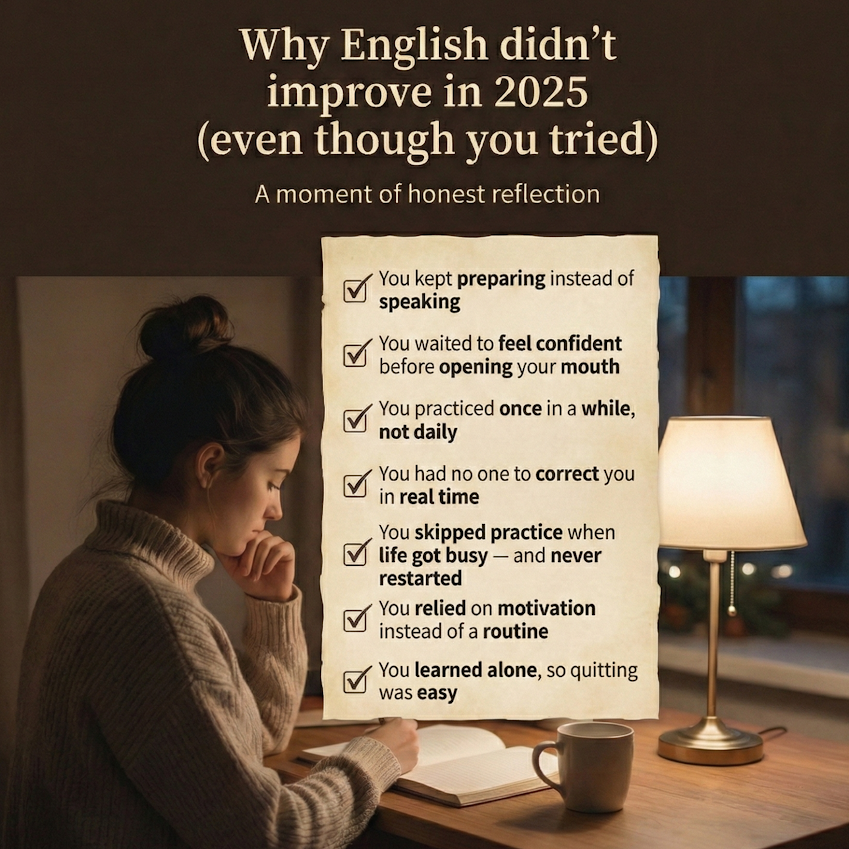
Why Your English Didn’t Improve in 2025 (Even Though You Tried)

Speak English

(A moment of honest reflection)

You didn’t ignore English in 2025.
You didn’t “not care.”

You tried.

You watched videos on pronunciation.
You bookmarked reels on vocabulary.
You told yourself, “This year, I’ll finally improve.”

And yet, as the year quietly came to an end, you found yourself in the same place — still thinking too much before speaking, still hesitating in conversations, still doubting your words.

The image above captures that exact moment.
A quiet evening. A notebook open. A mind full of effort — and frustration.

This blog is not about blaming you.
It’s about understanding why effort didn’t convert into confidence.

Many learners want to speak English confidently, but end up stuck in the same cycle year after year. They understand English, can read it well, and even write decently — yet speaking still feels difficult. This gap between knowing English and speaking it confidently is what frustrates most learners.

The Truth Most Learners Don’t Hear

To speak English confidently, you don’t need more rules or more content. You need repeated exposure to real conversations where you can speak freely, make mistakes, and continue without fear.

Most learners struggle not because they lack intelligence, but because they never get enough chances to actually use English in real life.

English doesn’t improve just because you want it to.
It improves when the right habits replace the wrong ones.

Most learners repeat the same patterns year after year — not because they are lazy, but because no one shows them a better system.

Let’s walk through those patterns honestly.

You Kept Preparing Instead of Speaking

Preparation feels safe.

You can learn silently.
You can pause, rewind, and retry.
No one hears your mistakes.

So you kept preparing.

But here’s the uncomfortable truth:

Preparation without speaking is procrastination in disguise.

English is not absorbed like information.
It’s built like a muscle.

Until your mouth starts moving, improvement stays theoretical.

You Waited to Feel Confident Before Opening Your Mouth

Many learners believe confidence is a prerequisite.

“I’ll speak when I’m confident.”
“I just need a little more clarity.”
“I’m not ready yet.”

But confidence is not a starting point.
It’s a side effect.

Confidence comes after:

  • Saying things wrong

  • Getting corrected

  • Surviving awkward pauses

  • Realising nothing bad happened

Every confident English speaker you admire once spoke badly — repeatedly.

You Practiced Occasionally, Not Consistently

Some weeks you practiced seriously.
Other weeks disappeared into work, family, stress, or exams.

And then English quietly slipped down your priority list.

The problem isn’t missing a day.
The problem is not returning.

English rewards consistency, not intensity.

Ten minutes every day beats two hours once a week — every single time.

You Had No One to Correct You in Real Time

Learning alone creates blind spots.

You may:

  • Repeat the same mistake for months

  • Think your sentence is correct when it isn’t

  • Lose confidence because you’re unsure

Without real-time correction, your brain doesn’t know what to fix.

This is why many learners feel stuck despite “studying” for years.

You Skipped Practice When Life Got Busy — and Never Restarted

Life doesn’t pause for learning.

Deadlines come.
Health issues arise.
Responsibilities pile up.

So practice stops — temporarily.

But without a system, temporary breaks turn into permanent gaps.

English doesn’t disappear — but confidence does.

You Relied on Motivation Instead of a Routine

Motivation is emotional.
Routines are structural.

Motivation says, “I feel like practicing today.”
Routines say, “This is what I do daily.”

English improves when practice becomes as normal as brushing your teeth — not when you’re “in the mood.”

You Learned Alone — So Quitting Was Easy

When no one expects you, stopping feels harmless.

No accountability.
No reminder.
No sense of progress being watched.

Learning alone makes quitting invisible — until months later, when regret shows up.

This Is Not a Failure. It’s a Pattern.

And patterns can be changed.

Learners who finally speak English confidently don’t suddenly become smarter.
They simply change how they practice.

They speak first.
They practice daily.
They get corrected kindly.
They don’t do it alone.

How the EngVarta App Helps You Break This Pattern

EngVarta is designed for learners who want to speak English confidently in real-life situations — interviews, meetings, phone calls, and daily conversations.

EngVarta was created specifically for learners stuck in this exact loop.

Not beginners who don’t know English —
but learners who know English yet struggle to speak confidently.

Here’s how EngVarta directly solves the problems mentioned above:

1. It Forces You to Speak, Not Prepare

EngVarta connects you with real English experts for one-on-one live conversations.
You speak from day one — no waiting, no overthinking.

2. Confidence Comes Through Action

You don’t wait to “feel confident.”
Confidence builds naturally as you speak daily in a safe, supportive environment.

3. Daily Practice Becomes a Habit

Sessions are short and practical, designed for busy lives.
This removes the excuse of “no time” and builds consistency.

4. Real-Time, Friendly Corrections

Experts correct you gently while you speak — helping you improve without embarrassment or interruption.

5. You’re No Longer Learning Alone

Someone listens to you.
Responds to you.
Guides you.

That simple human connection changes everything.

If 2025 Felt Like a Loop, 2026 Can Be a Turning Point

English didn’t fail you.
Your effort didn’t go waste.

It just needed a better system.

One that replaces:

  • Preparation with practice

  • Motivation with routine

  • Isolation with guidance

Start Speaking — Not Someday, Today

👉 Download the EngVarta App:
Download for Android | Download for iOS

Speak daily.
Get corrected.
Build confidence through real conversations.

Stay Connected With EngVarta

Final Thought

Learning English is not the goal.
Being able to speak English confidently — without fear, hesitation, or overthinking — is.

And that confidence is built one real conversation at a time.

Frequently Asked Questions (FAQs)

Speak English Confidently With These 3 Simple Tips

Speak English Confidently

Speaking English confidently is not about using advanced vocabulary or speaking perfect grammar.

It’s about feeling comfortable expressing your thoughts — even when your sentences aren’t perfect.

Many learners understand English well, yet hesitate while speaking.
The problem is rarely knowledge.
The problem is lack of real speaking practice.

In real conversations with English learners, one pattern appears again and again — people know what they want to say,  but freeze the moment they start speaking. This hesitation isn’t caused by weak grammar but by a lack of regular, judgment-free speaking practice.

If you want to speak English confidently in daily life, interviews, meetings, or social situations, these three simple tips can change the way you approach English forever.

Why Speaking English Confidently Feels Difficult

Before fixing the problem, it’s important to understand it.

Most learners struggle because:

  • They translate sentences in their head
  • They fear making mistakes
  • They don’t get regular speaking opportunities

Confidence doesn’t come from reading or watching videos alone.

When learners only consume English instead of using it, their brain stays in “understanding mode,” not “response mode.” Speaking requires fast thinking under pressure — something that only develops through real conversation.
It comes from using English regularly in real conversations.

Let’s look at what actually works.

Tip 1: Stop Preparing Sentences. Start Expressing Thoughts.

One of the biggest mistakes learners make is over-preparation.

They try to:

  • Memorise full sentences
  • Plan responses in advance
  • Wait for the “right moment” to speak

But real conversations don’t work like exams.

Learners who over-prepare sentences often pause mid-conversation, lose confidence, and abandon their point halfway. Those who allow themselves to speak imperfectly tend to recover faster and communicate more clearly.

To speak English confidently, you must learn to think while speaking, not before speaking.

What to Do Instead

Start expressing simple thoughts out loud — even if they sound incomplete.

For example:

  • Talk about what you are doing right now
  • Describe your day in simple English
  • Speak without stopping yourself for mistakes

Fluency grows when your mind learns that speaking is safe, even when it’s imperfect.

Tip 2: Make Mistakes in a Safe Environment

Mistakes are not the problem. Fear of judgement is.

Many learners stop speaking because:

  • People laugh
  • Corrections feel harsh
  • They feel embarrassed

This fear is natural — especially for adult learners. Confidence drops not because of mistakes, but because of repeated negative speaking experiences.

To speak English confidently, you need:

  • A patient listener
  • Supportive correction
  • Encouragement, not pressure

This is why practicing alone is not enough.
You need real human interaction with someone who helps you improve while you speak.

Tip 3: Practice English Daily, Not Occasionally

Confidence is not built in one day.

It is built through daily exposure.

Many learners wait for:

  • Free weekends
  • Long study hours
  • Motivation

But confidence grows faster with:

  • 10–15 minutes every day
  • Short, consistent speaking sessions
  • Regular feedback

Daily practice trains your brain to stop panicking and start responding naturally. Even short daily speaking sessions reduce hesitation within weeks because the brain stops treating English as a “performance” and starts treating it as a normal communication tool.

While you’re at it, make sure you’re also confident with small but essential elements like “a,” “an,” and “the.” These articles may seem simple, but they affect how professional and polished your English sounds.

Here’s a quick guide to brush up on them: Articles in English Grammar – A, An and The

How the EngVarta App Helps You Speak English Confidently

EngVarta was created for learners who understand English but struggle to use it in real conversations — a gap noticed repeatedly during live speaking interactions.

Knowing what to do is one thing.
Doing it daily is another.

This is where EngVarta helps learners bridge the gap between knowing English and speaking it confidently.

What Makes EngVarta App Effective

  • One-on-One Live English Conversations
    Speak directly with trained English experts.
  • Friendly, Real-Time Corrections
    Improve naturally without interruptions or embarrassment.
  • Daily Speaking Habit
    Short sessions designed for busy schedules.
  • Confidence-Focused Learning
    The goal is fluency through comfort, not fear.

EngVarta is designed for learners who already know English but struggle to use it confidently in real life.

Who Is This For?

Beginners

If English feels intimidating, EngVarta helps you start speaking gently, without pressure.

Practicing Learners

If you understand English but hesitate while speaking, real conversations help unlock fluency.

Serious Learners

If you want faster improvement for interviews, work communication, or daily confidence, consistent speaking practice makes the difference.

Start Speaking English Confidently Today

Confidence doesn’t come first.
Speaking comes first.

🔗 Download EngVarta:
Download for Android | Download for iOS

Practice real conversations.
Speak daily.
Build confidence naturally.

Stay Connected With EngVarta

Follow EngVarta for daily English tips, speaking guidance, and confidence-building content:

This article is based on real speaking interactions and learning patterns observed while helping English learners practice spoken English daily.

Final Note

Speaking English confidently is not about becoming perfect.
It’s about becoming comfortable.

And comfort only comes from practice.

Frequently Asked Questions (FAQs)

How to Improve Your English Like a Pro: Trending Methods in 2025 & Secrets from Celebrities and Cricketers

How to Improve Your English Like a Pro: Trending Methods in 2025 & Secrets from Celebrities and Cricketers

English is the global language of communication, and mastering it opens doors to new opportunities. But how do successful individuals—celebrities, cricketers, and influencers—perfect their English despite coming from non-English backgrounds? The secret is consistent practice, real conversations, and the right learning environment. Fluency isn’t about memorizing grammar rules—it’s about speaking regularly and learning from mistakes. If they can do it, so can you! Take the first step to improve your English by practicing daily with experts who can guide you toward confidence and fluency.

In this blog, we’ll explore:

  • Proven methods to improve English
  • Trending language-learning techniques of 2025
  • Exclusive secrets from cricketers and celebrities who transformed their English skills

1. Time-Tested Methods to Improve English

1.1. Consistent Practice

  • Read daily: Books, news articles, blogs, and even social media in English.
  • Write regularly: Journaling, blog writing, and social media posts.
  • Listen actively: English podcasts, audiobooks, and TED Talks.

1.2. Expanding Your Vocabulary

  • Learn new words daily and use them in conversations.
  • Use flashcards and vocabulary apps like Anki and Quizlet.
  • Play word games like Scrabble or crossword puzzles.

1.3. Mastering Grammar Without Stress

  • Focus on common grammar mistakes and correct them through practice.
  • Use AI tools like Grammarly to refine your writing.
  • Follow a grammar-focused YouTube channel for easy explanations.

2. Top Language-Learning Trends in 2025

2.1. AI-Powered Learning Tools

  • Apps like EngVarta, Duolingo, and ChatGPT-powered tutors personalize lessons.
  • AI-driven chatbots help simulate real-life conversations.

2.2. Virtual Reality (VR) & Augmented Reality (AR)

  • VR language immersion allows learners to practice conversations in realistic environments.
  • Apps like Mondly VR let users interact with AI in different scenarios.

2.3. Microlearning: Bite-Sized Lessons for Busy Learners

  • Platforms deliver short, 5-minute lessons to keep learning consistent.
  • Helps learners retain information better without feeling overwhelmed.

2.4. Social Media & Online Communities

  • Join global English-learning communities on Reddit, Twitter, and LinkedIn.
  • Follow influencers and English teachers on YouTube and Instagram.

3. How Celebrities and Cricketers Improve Their English

Many famous personalities started with limited English but improved significantly over time. Their secret? Immersion, persistence, and expert guidance.

3.1. Immersive Listening

  • MS Dhoni: Improved his English by watching interviews and listening to commentators.
  • Virat Kohli: Credits his fluency to constant interaction with foreign players.

3.2. Professional Coaching

  • Many Bollywood actors, like Kangana Ranaut and Nawazuddin Siddiqui, worked with personal English tutorsto refine their pronunciation.
  • Cricketers like Sachin Tendulkar and Ravindra Jadeja took specialized speech training to handle interviews confidently.

3.3. Daily Speaking Practice

  • Priyanka Chopra & Deepika Padukone: Worked with accent coaches when transitioning to Hollywood.
  • Shah Rukh Khan: Practices English in daily conversations and media interactions.

3.4. Learning from Mistakes

  • Most successful people are not afraid to make mistakes and learn from them.
  • They analyze their speeches, get feedback, and refine their communication skills.

💡 The Secret Hack Used by Celebrities: Focused, One-on-One Practice!

The biggest takeaway from how celebrities improve their English is consistent, focused practice on relevant topics.

🚀 EngVarta helps you do exactly that!
1-on-1 conversation with real human experts
Personalized sessions based on your industry & goals
Fluency-building through practical, real-life conversations

Just like celebrities and cricketers practice English in real-life scenarios, EngVarta gives you a safe, immersive environment to practice speaking without fear of judgment. 🎤

💬 Start practicing today & transform your English fluency!
👉Download the EngVarta App

Conclusion: Become Fluent Like a Star!

If celebrities and sports icons can master English, so can you! The key is consistent practice, smart learning strategies, and embracing modern tools like AI and VR.

Want to practice English like a pro?

👉 Try EngVarta, an AI-powered English conversation platform where you can speak with live experts and AI tutorsto refine your fluency.

Your journey to fluent English starts today! 🚀