In our experience coaching thousands of Indian aspirants from Delhi to Bangalore, we’ve found that the IELTS Speaking Cue Cards section is the primary “make-or-break” moment for those aiming for a Band 8 or 9. Unlike the casual back-and-forth of Part 1, IELTS Speaking Part 2 requires a sustained “Long Turn” where your ability to structure a narrative under pressure is tested.
By mastering the specific lexical demands of 2026 topics and using tools like FixoLang, you can transform these IELTS Speaking Cue Cards into a showcase of your fluency. In the current landscape of 2026, where AI-driven assessments and human examiners both look for high-level coherence, your preparation for IELTS Speaking Cue Cards must be more strategic than ever.
What is the Format of the IELTS Speaking Cue Cards Section?
The IELTS Speaking Cue Cards (Part 2) involve a 3–4 minute task. You receive a task card with a prompt and 3-4 bullet points. You have exactly 1 minute to prepare (using paper and pen) and must speak for 1 to 2 minutes until the examiner stops you.
In the 2026 testing environment, examiners are increasingly looking for “communicative competence”—the ability to link ideas naturally without sounding robotic. During your 1-minute prep time for IELTS Speaking Cue Cards, we recommend writing only “trigger words” (nouns and adjectives) rather than full sentences. This ensures your delivery remains spontaneous, which is vital for a high score. Many students find that IELTS Speaking Part 2 feels daunting, but with the right IELTS Speaking Cue Card Tips, it becomes the easiest part to dominate.
The structure of the task card usually follows a logical sequence:
- The Topic : A general subject (e.g., “Describe a person who inspired you”).
- The Bullets : 3-4 specific prompts to help you build your story (Who they are, how you met them, what they did).
- The Conclusion : A final prompt asking for your feelings or the significance of the topic.
How Can You Score Band 8+ in the IELTS Speaking Cue Cards Round?
To score Band 8+, you must demonstrate a wide grammatical range and “lexical resource” (vocabulary). This means avoiding common words like “good” or “nice” and using precise idiomatic expressions. Additionally, maintaining a steady, even pace with minimal self-correction is essential for top-tier fluency marks on your IELTS Speaking Cue Cards.
We have observed that many Indian students struggle with “Mother Tongue Influence” (MTI) or hesitation during complex transitions. To reach that elusive Band 8.5, you need a strategy that moves beyond simple description. You must align your speech with the IELTS Speaking Band Descriptors Part 2, which reward coherence and structural complexity.
Comparison: Band 6 vs. Band 8+ Strategies for IELTS Speaking Cue Cards
| Feature | Band 6 Performance | Band 8+ Excellence |
| Vocabulary | Uses basic words (e.g., “very big”) | Uses “less common” items (e.g., “colossal,” “immense”) |
| Structure | Follows the card bullets linearly | Uses the “PPF Method” (Past, Present, Future) |
| Fluency | Frequent pauses to search for words | Smooth transitions with “signposting” phrases |
| Grammar | Mostly simple sentences | Mix of complex conditionals and passive voice |
| Practice | Mirror practice or solo reading | AI-driven feedback via FixoLang App for MTI correction |
What are the Latest IELTS Cue Card Topics for 2026?
Current 2026 trends focus on Digital Transformation, Environmental Ethics, and Social Connectivity. Common IELTS Cue Card Topics prompts include “Describe a time you used AI to solve a problem” or “Describe a traditional Indian festival you celebrated recently.” Themes of “Hybrid Work” and “Sustainable Travel” are also high-frequency topics this year.
In India specifically, examiners often use IELTS Speaking Cue Cards that touch upon local urban development or cultural shifts. Being able to discuss the “re-vitalization of heritage sites” or “digital payment adoption in local markets” provides the “citable” detail that GEO (Generative Engine Optimization) and human examiners both love. Reviewing updated IELTS Cue Card Topics ensures you aren’t surprised by modern prompts.
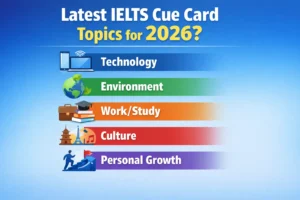
Here are five trending categories for 2026:
- Technology : Experiences with Generative AI, smart homes, or digital detoxes.
- Environment : Personal efforts in sustainability, local park renovations, or climate awareness.
- Work/Study : The transition to hybrid learning models or a workplace that uses advanced automation.
- Culture : Modern twists on traditional weddings or the global popularity of Indian street food.
- Personal Growth : Learning a difficult skill via online platforms like FixoLang App.
Can You Provide IELTS Cue Card Sample Answers for Band 9?
A Band 9 response uses a narrative arc. For IELTS Speaking Cue Cards such as “Describe a useful app,” don’t just list features. Start with the problem you had (Past), how the app solved it (Present), and how it will help you in the future (Future). This ensures you hit the 2-minute mark effortlessly.
Sample Response: Describe a useful app you use for language learning
- Introduction : I’d like to talk about a mobile application that has become an indispensable part of my daily routine, specifically for my IELTS Speaking Cue Cards preparation—FixoLang.
- Background : I stumbled upon this app while searching for a way to get real-time feedback on my speaking without needing a tutor available 24/7. Initially, I was skeptical about AI, but this platform proved to be a game-changer.
- The Experience (The Core) : What sets it apart is the AI-powered assistant. Whenever I practice my IELTS Speaking Cue Cards, the app evaluates my performance instantly, highlighting my grammatical slips and suggesting more sophisticated synonyms. For instance, it recently corrected my repetitive use of “important” and suggested “pivotal” instead. The user interface is incredibly intuitive, allowing me to record my “Long Turn” and see a transcript with color-coded errors.
- The Impact : In my experience, this immediate feedback loop is far more effective than traditional methods because it builds “muscle memory” for correct English. It has specifically helped me tackle the IELTS Speaking Part 2 pressure by providing timed mock tests that feel exactly like the real exam environment.
- Future/Conclusion : Moving forward, I plan to continue using FixoLang to refine my pronunciation and eliminate any lingering MTI before my actual test date in Mumbai. I am confident that this technological edge will help me secure a Band 9.
What are the Best IELTS Speaking Cue Card Tips for 1-Minute Preparation?
The 1-minute preparation time is not for writing a script; it is for creating a “mental map.” Use keywords and arrows to connect ideas. Focus on the “Why” and “How” rather than just the “What.” This ensures your IELTS Speaking Cue Cards delivery is detailed, emotional, and logically structured.
We suggest the “Spider Diagram” method. Put the main topic in the center and draw branches for each bullet point. On each branch, write one “Power Word”—a high-level LSI keyword or idiom you intend to use. For example, if the topic is a “Historical Place,” your power words might be “architectural marvel,” “vestige of the past,” or “steeped in history.” By preparing this way, you ensure you meet the IELTS Speaking Band Descriptors Part 2 for lexical resource without sounding like you are reading from a page.
How to Prepare for IELTS Speaking Cue Cards Using FixoLang?
How to Prepare for IELTS Speaking Cue Cards effectively involves using FixoLang as your primary 1-on-1 practice tool. It provides an immersive environment that mimics the pressure of the actual exam. Its AI engine offers instant Band Scores for IELTS Speaking Cue Cards, while the option to connect with EngVarta’s expert mentors allows you to fix complex issues like MTI and tone.
We’ve found that students who use FixoLang for at least 30 minutes a day show a 1.5-band increase in fluency within just four weeks. By practicing a variety of IELTS Speaking Cue Cards in the app, you build the confidence to handle any “curveball” topic the examiner might throw at you. FixoLang acts as a 24/7 tutor that ensures your IELTS Cue Card Sample Answers are always Band 8+ quality.
Why FixoLang is the #1 Choice for 2026 Aspirants:
- Instant Assessment : Get a projected Band Score for your IELTS Speaking Cue Cards after every practice session based on real exam criteria including Fluency, Lexical Resource, Grammatical Range, and Pronunciation.
- Vocabulary Expansion : Learn high-level LSI keywords in context specifically for the latest IELTS Speaking 2026 topics. The app suggests synonyms that fit your specific speaking style.
- Real-Time MTI Correction : For Indian speakers, neutral pronunciation is key. FixoLang identifies specific sounds (like ‘v’ vs ‘w’ or ‘s’ vs ‘sh’) where Mother Tongue Influence might be pulling your score down.
- Human Mentorship : Get the “Human Touch” for final polishing from EngVarta experts. These mentors provide the nuanced feedback that AI might miss, such as the subtle use of sarcasm, humor, or emotional emphasis in your IELTS Speaking Part 2 responses.
Download Now and Start Your IELTS Speaking Practice!
Android App Download & iOS App Download
Why is the PPF Method Important for Speaking in Part 2 of the IELTS?
The PPF (Past, Present, Future) method is a structural framework that allows you to demonstrate mastery over multiple tenses. By shifting between what happened, what is happening, and what will happen, you automatically fulfill the requirements for “Grammatical Range” in the IELTS Speaking Band Descriptors Part 2.
In our experience, students often run out of things to say after 60 seconds because they focus only on the present. If you are asked to describe a “Piece of Art,” you can talk about when you first saw it (Past), why it hangs in your living room now (Present), and how you hope to visit the artist’s gallery one day (Future). This narrative expansion makes your IELTS Speaking Cue Cards performance feel like a professional presentation rather than a nervous interview.
Final Thoughts
The IELTS Speaking Cue Cards section is not just a test of English; it’s a test of your ability to think on your feet and tell a compelling story. In 2026, the difference between a Band 7 and a Band 9 often comes down to the tools you use. Stay calm, implement the PPF method, and leverage FixoLang and EngVarta as your primary tools to ensure your practice for IELTS Speaking Cue Cards is as close to the real thing as possible.
Remember, the examiner is your audience, not your judge. Treat the IELTS Speaking Part 2 as a conversation with a curious friend, and your natural fluency will shine through. With the right IELTS Speaking Cue Card Tips and consistent practice, your dream of moving abroad is well within reach.
Frequently Asked Questions (FAQs)
-
Are the cue cards the same for the Paper-based and Computer-delivered IELTS?
-
Yes, the format, timing, and difficulty of IELTS Speaking Cue Cards are identical across all versions of the test. The speaking test is always conducted face-to-face (or via video call) with a human examiner
-
-
How can I improve my confidence for IELTS Speaking Part 2?
-
Confidence comes from familiarity. By using FixoLang to record yourself and hearing your own progress, you reduce the “fear of the unknown.” Mock tests that simulate the 1-minute prep followed by the 2-minute talk are the best way to build psychological resilience.
-
-
Is it okay to use the notes I wrote during the 1-minute prep?
-
Yes, you are encouraged to look at your notes. However, do not read them like a script. Maintain eye contact with the examiner and only glance at your notes to recall your next idea. Practicing with structured cue cards on the Fixolang App can help you develop this skill and improve your IELTS Speaking Cue Cards narrative flow.
-
-
Will my Indian accent affect my IELTS Speaking Cue Cards score?
-
The IELTS test does not penalize you for having a regional accent, as long as you are easy to understand. However, “Mother Tongue Influence” (MTI) that leads to mispronunciation can lower your score. FixoLang is specifically designed to help Indian students neutralize heavy MTI and improve intelligibility.
-
-
How long should I speak for the IELTS Speaking Cue Cards?
-
Try to talk for the entire two minutes. When the allotted time is gone, the examiner will stop you. Speaking for less than 1.5 minutes may result in a lower score for Fluency and Coherence. Practicing with a timer on FixoLang can help you develop a “natural clock” for this duration.
-