Hotel Interview English Practice |

Tag

hotel interview english practice

English Speaking Practice for Hotel Staff in India (2026) : Daily Live 1-on-1 Guide for Front-Office, Gulf & Cruise Jobs

May 19, 2026 • 15 min read • By Rishish Pandey

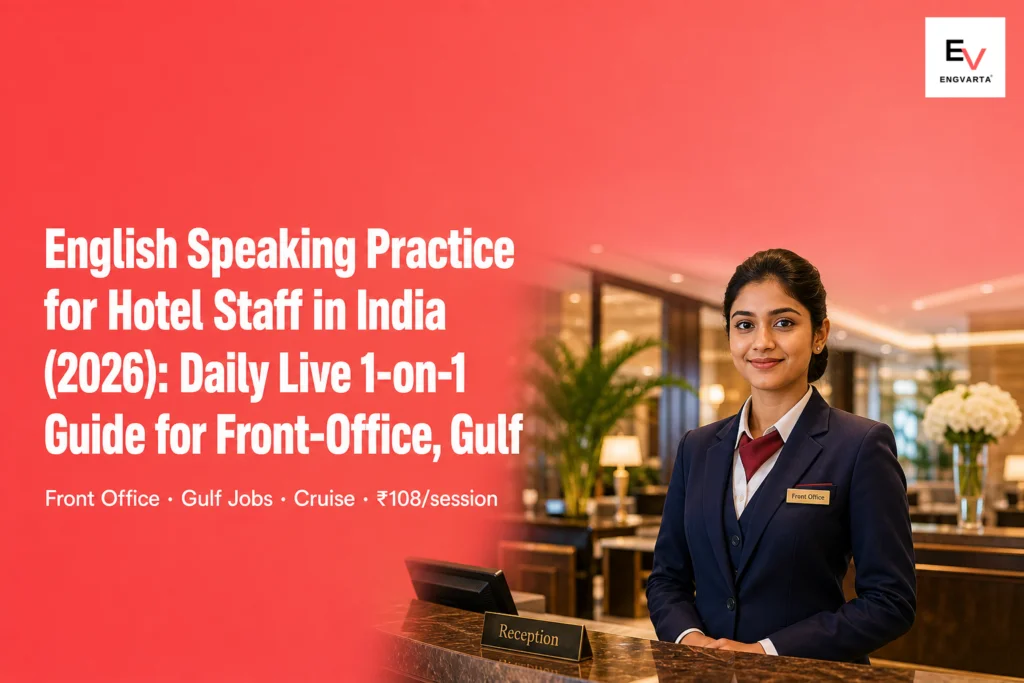
Confident Indian hotel front-office professional behind reception desk in 5-star hotel lobby — English speaking practice for hotel staff 2026
Quick VerdictEnglish speaking practice for hotel and hospitality staff in India is the single biggest skill gap. English speaking practice for hotel staff is what stands between front-line hospitality workers and the international guest interactions, supervisor promotions, and Gulf or cruise-ship postings they want. Hospitality is a spoken-language profession — every guest greeting, room-service order, complaint resolution, and phone booking is a live English conversation under judgement. The fastest fix is daily 15-minute 1-on-1 live English speaking practice with a TESOL/ESL-certified Expert who can simulate guest scenarios, correct hesitation in real time, and build the under-pressure fluency that hospitality interviewers and guests actually evaluate. EngVarta starts at a ₹69 refundable trial; the 25-session pack at ₹2,700 (~₹108 per session) fits an entry-level hospitality salary without strain.

If you work the front desk at a Mumbai 5-star, run room service at a Bangalore business hotel, or have just graduated from an IHM diploma programme in Lucknow or Bhopal, the conversation you have most days is in English — with guests, with the duty manager, on the phone, on the radio. Your written English may be acceptable. Your reading comprehension may be strong. But the moment a German guest at reception asks for late check-out, or an American couple wants to change their room category, or the F&B manager calls you in for a complaint review, your spoken English under pressure is what the entire interaction stands on.

This guide is for hotel and hospitality staff across India — front office, F&B service, housekeeping, kitchen brigade, banquet teams, spa and concierge — who know their spoken English is the bottleneck between them and the next promotion, the international hotel chain transfer, the Gulf hotel job, or the cruise-line contract they want. We compare the apps and platforms that work for hospitality-shift schedules and entry-level salary budgets, with honest notes on where each one fits.

Why Hotel and Hospitality Staff Specifically Struggle with Spoken English

The pattern is consistent across IHM graduates, hotel-school diploma holders, and on-the-job promotees:

1. Hospitality classroom English is scripted; real guest interactions are not. IHM and hotel-management programmes drill standard phrases — “Welcome to Hotel ABC, how may I assist you?” — that function during the initial 30 seconds of any guest engagement. But the second the guest goes off-script (“Actually, can you also arrange a doctor for my wife and tell us the best place for a quiet dinner that does not have loud music?”) the rehearsed phrases stop helping. The skill needed is spontaneous English — and that is not what classroom drills teach.

2. Shift schedules destroy regular study routines. Hospitality shifts rotate — morning, evening, night, split shifts, double shifts during banquet weeks. Group English classes that meet on a fixed schedule never work for hotel staff because you are working when the class is on. The only English-practice format that fits is on-demand, daily, short — exactly what 1-on-1 live sessions are designed for.

3. Mother-tongue dominance in the back-of-house. Kitchen brigades, housekeeping floors, and even most banquet ops happen in Hindi, Tamil, Bengali, Malayalam, Marathi or the local language. The actual English speaking happens only in guest-facing minutes — maybe 60–90 minutes a day for front office, less for housekeeping. The brain spends 80%+ of the working day not speaking English.

4. Accent self-consciousness compounds the freeze. Hospitality workers from Bihar, Jharkhand, eastern UP, Odisha, the north-east, and rural Maharashtra often arrive at metro hotels with strong regional accents that they have been told (sometimes harshly) are “not professional enough” for guest-facing roles. The result is a confidence collapse that turns small hesitations into long freezes. The fix is not accent erasure — Indian English with crisp consonants is fine for international guests — it is fluency under pressure, which is a different muscle.

5. International transfer and Gulf hiring interviews are spoken-English filters. Marriott, Hyatt, Hilton, Accor, Four Seasons, Jumeirah and the major UAE/Saudi/Qatar chains all run a 15–25 minute spoken-English screening as part of cross-border hiring. The technical hospitality skills are tested in role-play and reference checks; the English screening is a single conversation that decides whether you advance. Cruise-line hiring (Royal Caribbean, Norwegian, Carnival, MSC) does the same.

The fix for all five is the same: live, 1-on-1, voice-only English speaking practice with a trained Expert who can simulate front-desk conversations, run mock guest complaints, push you with spontaneous follow-ups, and correct hesitation in real time — every day, in slots short enough to fit a split-shift schedule.

1. EngVarta — Best for Daily English Speaking Practice on a Hospitality Schedule

EngVarta is built around the daily-practice cadence that hospitality shifts can actually sustain. You connect with a TESOL/ESL-certified English Expert in minutes, on demand, for 15-, 25- or 50-minute sessions. The 15-minute slot is the right cadence for hotel staff — short enough to fit before your shift, on a meal break, or right after handover, long enough to build conversational stamina session-over-session.

What makes EngVarta fit the hospitality use case specifically:

  • Voice-only sessions. No video pressure. You can take a session in a noisy staff cafeteria, a quiet corner of the corridor, or your shared accommodation — no need to worry about how you look or whether your background is professional.
  • Real-time corrections during the call. The Expert flags hesitation, weak verbs, “ums” and pronunciation issues in the moment — exactly the corrections a guest interaction needs, given in the same format a guest would naturally hear them.
  • Consolidated feedback towards the end covering pace, filler-word frequency, and the 2–3 patterns you repeat (front-office staff often have signature patterns like dropping articles before nouns, or overusing “actually” in apologetic replies).
  • Recording accessible 30 days post-session so you can listen back during your commute and hear exactly what your future Gulf interviewer or duty manager will hear.
  • Refundable trial at ₹69 — roughly the cost of a staff cafeteria thali. Validate the format before committing.
  • ₹2,700 for a 25-session pack at ~₹108 per session. Daily 15-minute sessions for a full month, or alternate-day for two months. Fits an entry-level hospitality salary of ₹15,000–₹25,000/month without strain.
  • Expert can simulate guest-interaction scenarios on request — front-desk check-in, room-service order taking, complaint handling, phone booking confirmations, banquet coordination calls.

For hospitality staff preparing specifically for international hotel-chain interviews or Gulf/cruise-line screening, the ₹5,130 plan (25 sessions of 25 minutes, ~₹205 per session) gives you longer mock-interview slots that better simulate the actual 20–25 minute spoken-English screening format.

Ready to Practice with Real Experts?

Try EngVarta today — ₹69 trial (India) / $1 trial (International) · 100% refundable

2. Speak — AI-Only Practice, Good for Daily Reps When You Cannot Book Live

Speak is one of the most-funded AI-only English-speaking apps. You talk to an AI tutor that responds in voice, drills pronunciation, and gives unlimited reps for roughly $20/month. For a hospitality worker on irregular shifts where booking a live session is sometimes impossible, Speak fills the gap as a short daily warm-up.

Where Speak fits in a hospitality stack: 5–10 minutes of conversation drilling on your commute or during a quiet stretch. Where it falls short specifically for hospitality: the AI cannot simulate a guest with an actual complaint who is getting more annoyed sentence by sentence. AI tone is uniformly polite. Real guests are not. The pressure-under-tension muscle only builds with a human who can actually act annoyed when you stumble.

3. ELSA Speak — Pronunciation Drilling for Specific Sounds Guests Notice

If your problem is specific sounds that international guests struggle to understand — the “v” vs “w” confusion (“very” vs “wery”), “th” sounds, the schwa neutralisation that makes “menu” sound like “mainew” — ELSA Speak is the best tool we know of. It scores each phoneme you produce and gives visual feedback. For hospitality staff from regional-medium school backgrounds whose pronunciation drift is hurting guest clarity, 10 minutes of ELSA daily for 4–6 weeks before a Gulf screening produces measurable improvement.

What ELSA does not do: build conversational fluency or scenario-based hospitality English. It is a pronunciation gym, not a guest-interaction simulator. Use it alongside live human practice, not instead of it.

4. Cambly — Native-Speaker Video Practice, Premium Pricing

Cambly connects you with native English speakers (US, UK, Canadian, Australian, increasingly Filipino) over video. For hospitality staff specifically preparing for Western-chain front-office roles, talking to a native speaker for 4–6 weeks before the role-play interview helps you tune to the rhythm of a Western guest.

Trade-offs to be honest about: Cambly is video-first, which is awkward for hospitality staff in shared accommodation or staff dormitories where finding a private video-ready spot is hard. Pricing is in USD and works out roughly 4–6× the per-session cost of EngVarta, which is a meaningful drag on an entry-level salary. Tutors are conversation partners, not hospitality interview coaches — you have to brief each tutor on the hotel-industry format yourself. For a deeper take on live human vs AI practice, see our real-people vs AI breakdown. For complementary daily-habit tactics, see our English fluency coaching guide.

5. Industry-Specific Programmes: IHM Refreshers, Aptech English, Berlitz Hotel English

IHM Mumbai, Delhi, Pune, Chennai, Bangalore, Lucknow, Kolkata, Hyderabad, Bhopal, and the 21 central and 27 state IHM campuses all offer short-duration English-communication refresher modules for working hospitality staff — usually weekend batches of 4–8 weeks at ₹6,000–₹15,000.

Where these work: structured curriculum on hospitality vocabulary (room types, dish terminology, complaint-handling phrases), group practice with peers in the industry, and a recognised certificate that some employers value. Where they fall short: weekend batches are hard to attend if your roster lands you on Saturday-Sunday shifts (which is most hospitality roles), and group practice means you speak for 8–10 minutes of a 60-minute class. Useful as a foundation; not enough by itself.

6. Free Practice — YouTube Hotel English Channels + Self-Recording

The zero-cost stack worth using:

  • YouTube hospitality-English channels — “Hotel English Conversations”, “Front Office English Practice” and similar channels have hundreds of free guest-interaction videos. Watch 10–15 to internalise standard phrases, then practise saying them out loud.
  • Self-recording on your phone’s voice memo app. Pick a scenario — “Guest is unhappy with the room because the AC is not cooling” — and respond cold. Listen back the next day. Write down every “umm” and pause.
  • Peer practice with a co-worker who is also working on their English. 10 minutes a day during break time, taking turns playing the guest and the staff member. Free, but only useful if both of you actually correct each other rather than being polite.

These work as supplements. They do not work as a substitute for live practice with a trained Expert — because you cannot correct what you do not yet hear as a problem.

How Much English Speaking Practice for Hotel Staff Is Enough?

Realistic minimums based on hospitality-learner outcomes:

  • Aiming for first front-office posting (6+ months out): 3 sessions per week of 15 minutes. Build conversational stamina at a relaxed pace.
  • Preparing for international hotel-chain interview (3 months out): 4–5 sessions per week of 15 minutes. Add one 25-minute mock-interview session per week, briefed on the specific brand (Marriott, Hyatt, Accor have different interview formats).
  • Gulf or cruise-line screening (1 month out): Daily 15-minute sessions, plus two 25-minute mock screenings per week. Brief your Expert on the specific employer — Royal Caribbean’s HR interview is structurally different from Jumeirah’s front-office round.
  • Final 2 weeks before any interview: Daily 25-minute mock screenings. Your day-to-day guest interactions will feel routine by comparison.

What If You Are Targeting a Gulf Hotel Job (UAE, Saudi, Qatar, Oman)?

The Gulf hospitality interview is a structured spoken-English assessment. Recruiters (often the hotel’s HR lead based out of Dubai, Riyadh, Doha, or Muscat) run a 20–30 minute screening covering:

  • A self-introduction (90 seconds, unscripted — calibrated test of monologue fluency under camera pressure)
  • 2–3 hospitality scenario role-plays (handle a guest complaint, take a booking on the phone, brief a new colleague on a procedure)
  • Cultural-fit questions about working in a Muslim-majority environment, with multi-national colleagues, on long-rotation contracts
  • Practical questions about visa transfer, accommodation, salary expectations, contract length

The technical hospitality answers are usually fine — Indian hospitality grads are well-trained on procedure. The English-fluency-under-camera dimension is what the screening actually filters on. Start 4 months out with daily 15-minute sessions, switch to alternate-day 25-minute mocks in the final month. Total cost: ~₹5,000–₹7,000 across the prep arc — recoverable in your first week of Gulf salary.

What If You Are Targeting a Cruise-Line Contract?

Cruise-line hospitality hiring (Royal Caribbean, Norwegian, Carnival, MSC, Disney Cruise Line) runs through hiring agents in India — Mumbai, Bangalore, Kochi are major hubs. The English screening is even more demanding than land-hotel interviews because cruise environments are 100% English at all times — your colleagues are from 50+ countries and the only shared language is English.

Recruiters specifically test:

  • Phone English (taking a guest call clearly under background noise simulation)
  • Multi-cultural English (understanding accents from Eastern Europe, the Philippines, South America, West Africa — the cruise-staff demographic)
  • Safety-protocol English (emergency briefings, evacuation announcements, MARSEC procedures — must be word-perfect)
  • Sales English (upselling shore excursions, beverage packages, spa treatments — a major revenue line for cruise operators)

For cruise-line prep, brief your Expert specifically on the structured nature of cruise English. The 25-minute slot is the right format for mock-screening practice. Start 6 months out — cruise contracts are competitive and the gap between “passable English” and “cruise-line ready English” is roughly 80–100 hours of focused 1-on-1 practice.

👉 Connect with EngVarta & Improve Your English Every Day!

Build fluency, confidence, and better communication skills with daily English speaking tips, real-life conversations, and expert guidance that helps you speak naturally and confidently.

📸 Instagram : https://www.instagram.com/engvarta.app/
▶️ YouTube : http://www.youtube.com/@EngVarta
📘 Facebook : https://www.facebook.com/engvarta
💼 LinkedIn : https://www.linkedin.com/company/engvarta

✨ Follow EngVarta today and take your English speaking skills to the next level — one conversation at a time!

What Our Learners Say

Rated 4.5★ from 9,100+ reviews on Google Play

★★★★★
So comfortable to speak with the expert , really like this app
★★★★★
Good app to express yourself because in our house there are no environment n EngVarta provides you environment
★★★★★
Engvarta is a platform where we start from the 0 level to 100 level. That is the best thing I have never seen in my life. There are so many part and so many way, they are always try to teach you until you become a good speaker. Thank you Engvarta
★★★★★
I am happy while speaking with experts and getting feedback on my speaking skills.
★★★★★
This app is amazing! It has boosted my confidence, and now I can start conversations in English easily.
★★★★★
Its just great, I mean in terms of environment that it gives you is just awesome. Thnx again for boosting my confidence.
★★★★★
Really we can see the positive results from the app. Well done!
★★★★★
I have been using this app since three months. I am very much satisfied with their services , experts are too good and their support team members are very supportive and helpful. I must suggest this app to everyone. Thank you Engvarta for helping me.❤️
★★★★★
Thank u so much @engvarta it is very good for learning English daily I learn new words daily I get new vocabulary again thnxx again 👍🏻👍🏻
★★★★★
It's very beneficial app for children who don't speak well.
★★★★★
Engvarta provides the best platform for learners to learn and get comfortable with the language by offering a comfortable and judgment-free environment with regular feedback. Engvarta is the best English learning app available.
★★★★★
It's a incredible app... It builds my confidence to speak English fluently, gives you practice to start your conversation without any hesitation, provides daily free vocabulary and quizes also...Expensive but amazing & worth it...

Bottom Line

For hotel and hospitality staff in India, the single biggest leverage point between an entry-level hospitality role and the international chain postings, Gulf jobs, or cruise-line contracts you actually want is daily live English speaking practice with a trained Expert. Not vocabulary apps. Not scripted hospitality-English drills. Not weekend group classes you cannot attend because of split shifts. Daily 15-minute 1-on-1 reps with a TESOL/ESL-certified Expert who interrupts you when you hesitate, corrects you in real time, and pushes you with spontaneous guest scenarios the way real international guests will.

Start with the ₹69 refundable trial. If it works for your routine, commit to the ₹2,700 25-session pack and run it through one full month before your next interview, Gulf application, or cruise screening. Connect in minutes, real-time corrections during the call, recording accessible 30 days post-session — designed exactly for hospitality-shift schedules and entry-level salary budgets.

FAQs :

Q1. Which app is best for English speaking practice for hotel staff in India?

Ans : For daily live practice on a hospitality-salary budget, EngVarta offers TESOL/ESL-certified Experts at ₹108 per 15-minute session (₹2,700 for 25 sessions). For pronunciation drilling, ELSA Speak is the targeted tool. For native-speaker exposure (relevant for Western-chain or cruise roles), Cambly works but costs 4–6× more per session.

Q2. How long does it take for hotel staff to become fluent in English speaking?

Ans :  For an intermediate-level hospitality worker, 50–100 hours of focused 1-on-1 practice usually closes the front-office or international-chain interview gap. At 15 minutes per day, that is 4–8 months of consistent daily practice. The workers who succeed are the ones who treat it like physical training — daily reps, no skipped days, same time slot every day.

Q3. Can I prepare for a Gulf hotel interview in 1 month?

Ans : If your spoken English is already moderate, yes — daily 25-minute mock-interview sessions for 4 weeks will measurably improve your fluency under camera pressure. If your spoken English is weak, one month is not enough; start 3–4 months out.

Q4. Is hospitality-school English good enough for international guest interactions?

Ans :  Usually not enough on its own. IHM and hotel-school English drills are scripted, and real guests go off-script in the first 30 seconds. You need supplementary live conversation practice to build the spontaneous-English muscle that hospitality classroom drills do not target.

Q5. Should I learn an American or British accent for international hotel work?

Ans :  No. International guests are used to all global English accents. A clear, well-paced Indian English is far better than a fake American or British accent that adds unnaturalness on top of speaking-pressure. The bar is clear and confident, not accent-changed.

Q6. What is the cheapest way to practise English speaking for hospitality staff?

Ans :  Free: self-recording on your phone + YouTube hotel-English channels + peer practice with a co-worker. Low-cost: EngVarta’s ₹69 refundable trial + ₹2,700 25-session pack. Mid-cost: monthly AI app subscriptions ($10–$20/month). Premium: native-speaker video apps (Cambly equivalent ₹3,500–₹5,000/month).

Q7. Do hotels and hospitality employers actually check English fluency in interviews?

Ans :  Yes, explicitly. Marriott, Hyatt, Hilton, Accor, Taj, Oberoi, ITC, and all major chains run an English-fluency checkpoint as part of the interview funnel — for front-office, F&B service, concierge, guest relations, and supervisor roles. International transfers and Gulf postings are gated on a structured spoken-English screening of 20–30 minutes.

Q8. Is EngVarta suitable for hospitality staff who studied in regional-medium schools?

Ans : Yes — many EngVarta learners are first-generation English-medium hospitality workers whose schooling was in Hindi, Tamil, Bengali, Marathi, Malayalam or other regional languages. TESOL/ESL-certified Experts specifically understand the transition path and adapt sessions to your starting point without judgement. See our broader best English speaking apps comparison for additional context.

Editorial note: This guide is researched and written by the EngVarta team. We compare our own platform alongside other tools that Indian hospitality workers commonly use, and we are honest about where each tool fits — including where it does not.
Best English Speaking Practice for Hotel and Hospitality Staff (2026)

May 19, 2026 • 11 min read • By Rishish Pandey

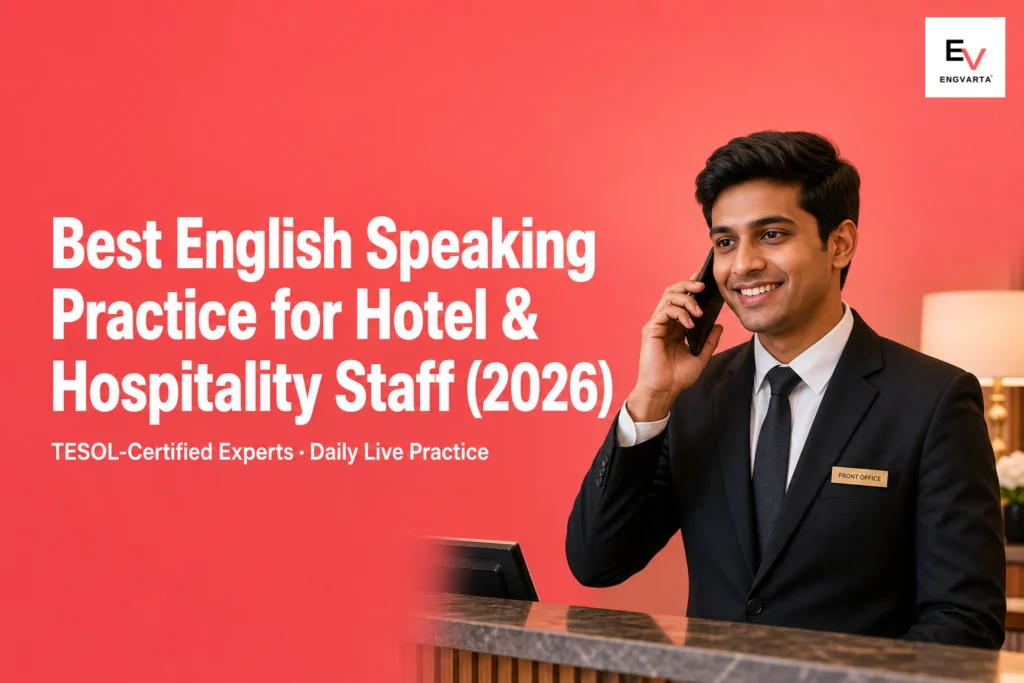
English Speaking Practice app for Hotel and Hospitality Staff in customer-facing roles
Quick VerdictFor hotel and hospitality staff in India, the fastest way to get English speaking practice that actually transfers to guest interactions is short, daily live conversations with TESOL-certified Experts, not a recorded course. EngVarta makes it easy to hold 15, 25 or 50 minute one-on-one calls in minutes — your front desk team, F&B servers, housekeeping leads and concierge agents can practice real check-in dialogue, complaint handling and upsell scripts with real-time corrections. Start with the ₹69 refundable trial (₹1 / $1 internationally). Apps like ELSA Speak help with pronunciation drills but won’t simulate the back-and-forth of a guest asking for late checkout in a hurry.

India’s hospitality industry employs over 87 million people across hotels, restaurants, airlines support, and travel services, and a large share of guest-facing roles need confident spoken English every shift. The challenge isn’t grammar — it’s responding under time pressure when a guest is impatient, switching from Hindi or a regional language mid-sentence, or handling an unfamiliar complaint without sounding rehearsed.

That is why demand for an English Speaking Practice app for Hotel and Hospitality Staff is growing among professionals who need fluent, real-time communication at work.

This guide is the practical 2026 playbook for choosing English speaking practice for hotel and hospitality staff in India — what to look for, which apps fit which role, daily drills you can run in 15 minutes, and how to track real progress instead of just course-completion certificates.

Why hotel and hospitality English is its own discipline

Generic English speaking apps optimize for casual conversation. Hospitality English has different requirements:

  • Service register — polite distance (“May I help you?”, “Allow me to verify that for you,” not informal (“Of course”).
  • De-escalation phrasing — apologizing without admitting fault, deferring without dismissing.
  • Role-specific vocabulary — front desk uses different language than F&B, which uses different language than housekeeping or concierge.
  • Accent adaptabilityCurrent Indian hotel visitors consist of Americans, Brits, Australians, Germans, Japanese, and Middle-Eastern travelers. Your team needs to understand multiple accents and be understood across them.
  • Speed under pressure — guests don’t wait for staff to mentally translate. Fluency = response time, not vocabulary size.

A generic English course teaches the vocabulary. Practical fluency for hospitality comes from repeated live conversation with someone who can interrupt, redirect, and force you to keep talking when you stumble.

The 5 apps and practice platforms worth considering in 2026

We’ve audited the leading options against actual hospitality-staff use cases — front-desk check-in, F&B order taking, room-service phone calls, complaint resolution, concierge recommendations.

Platform Best for Format Starting price (India)
EngVarta Front desk, F&B, concierge — live guest-style conversations with TESOL-certified Experts 1-on-1 live calls, 15 / 25 / 50 minutes ₹69 refundable trial · ₹2,700 / 25 sessions of 15 min
ELSA Speak Pronunciation drills (great if your team’s clarity is the main blocker) Self-paced AI feedback Monthly subscription
Cambly Casual fluency with native speakers — variable hospitality experience 1-on-1 video calls with global tutors Per-minute pricing
Duolingo Foundational vocabulary if a team member is below intermediate Gamified self-paced lessons Free tier + premium
Local English coaching classes Foundation-level group classroom learning — slow to translate into shift-floor fluency Group classroom, 2–3 hours per day Varies widely by city

Editorial note: We’re EngVarta. We’ve structured this comparison around what hospitality teams actually need from speaking practice, and we’ve listed competitor platforms by their real strengths. Pick the platform that fits your team’s specific gap — speed-of-response (live practice), pronunciation (AI feedback), or vocabulary foundation (gamified courses).

The hospitality English speaking gap most apps miss

Most English apps for the hospitality industry teach what to say. Almost none teach how to keep talking when you don’t know what to say — and that’s the single biggest fluency gap for front-line hotel staff.

A guest at a five-star hotel in Goa once asked the concierge for “a private cooking class with a local chef who teaches traditional Konkani cuisine, somewhere on a beach, and we’d like it tonight.” The concierge had every word in his vocabulary but froze for 8 seconds. The guest noticed.

The fix isn’t more vocabulary. It’s repeated live conversation where you’re forced to fill silence — paraphrase, ask clarifying questions, propose alternatives, and keep the guest engaged while you work out the answer. That muscle only develops in real-time calls, not in self-paced apps.

What makes a good hospitality-English session

  • Real-time corrections during the call — your Expert flags pronunciation issues, awkward phrasing, or wrong service register the moment it happens, not after you’ve finished talking.
  • Consolidated feedback towards the end — a 5-minute summary of patterns to fix before your next session, so you walk away with one specific thing to work on.
  • Scenario-based prompts — your Expert role-plays as the demanding guest, the frustrated guest, the non-native English-speaking guest, the VIP who needs upselling.
  • Recording you can review — listen back to your own session within 30 days, catch hesitation patterns you didn’t notice in the moment.
  • Connect time measured in minutes, not hours — practice has to fit between shifts, not require a full evening.

Role-specific daily drills (15 minutes a day)

If you have one 15-minute slot before your shift, here’s how to use it depending on your role.

Front desk and reception

  1. 2 minutes — Warm up by describing your last difficult guest interaction in English (no script, just talk).
  2. 8 minutes — Role-play check-in with an unusual request: late arrival without a reservation, room-type swap, accessibility need.
  3. 5 minutes — Practice the three phrases you’ll need most this week (apology + alternative, upsell to suite, late-checkout policy).

F&B service (waiters, hosts, bartenders)

  1. 3 minutes — Describe today’s specials out loud to your Expert as if explaining to a guest.
  2. 7 minutes — Handle three menu questions: “Is this dish spicy?”, “What’s good for vegetarians?”, “Can the chef modify this for my allergy?”
  3. 5 minutes — Practice handling a complaint about food quality without admitting fault but offering a remedy.

Housekeeping leads and supervisors

  1. 3 minutes — Explain a room-cleaning protocol to a new joiner (in English).
  2. 7 minutes – Answer a guest’s question about cleanliness, missing amenities or noise.
  3. 5 minutes — Practice scripted apologies that don’t sound robotic.

Concierge and guest services

  1. 4 minutes — Describe three things to do in your city this evening, in 30 seconds each.
  2. 6 minutes — Respond to an unusual request you’ve never handled before. Practice paraphrasing and proposing alternatives.
  3. 5 minutes — Recommend a restaurant and explain why it suits the guest’s specific preference.

How to measure progress (without certificate-chasing)

A milestone certificate is nice. What actually matters is whether your team is faster, clearer, and more confident on the shift floor next month. Track three things:

  • Hesitation count per minute — record yourself once a month doing the same role-play (check-in, complaint, upsell). Count the “um”, “uh”, and silences over 2 seconds. A 40% reduction in three months is real progress.
  • Guest feedback themes — are you getting fewer comments about “staff didn’t understand me” or “communication was slow”? Have your manager track this from guest surveys.
  • Self-rating on three scenarios per week — rate your confidence 1-10 on: handling complaints, upselling, explaining policies. Rising trend = real fluency gain.

What hotel groups should look for when training a whole team

If you’re an HR manager, GM, or training lead choosing a platform for 20-200 hospitality staff, the criteria shift:

  • Scalable 1-on-1 practice — group classes don’t deliver the per-person talk time individuals need. Look for platforms that can rotate Experts across your team.
  • Refundable trials, not free trials — a paid-but-refundable trial filters serious learners from sampling-only users. Teams who pay even ₹69 show up more consistently.
  • Per-shift scheduling flexibility — your team works split shifts and odd hours. The platform must support sessions at 7am, 11pm, or 3pm depending on roster.
  • Manager visibility — can you see who attended, what they practiced, and feedback trends across the team?
  • India + diaspora coverage — if any of your team is from Bangladesh, Nepal, Sri Lanka, or the Philippines, the platform should serve their accent context as comfortably as Indian English.

Daily habit-building beyond the practice session

The 15 minutes on a call don’t matter much if you don’t reinforce them. Cheap, repeatable daily habits that compound:

  • Free vocabulary lessons + quizzes + rewards in the EngVarta app — 5 minutes between shifts, builds the active vocabulary you’ll deploy in the next live call.
  • Listen to one hospitality-focused podcast episode — Hotel News Now, The Lobby, or Skift’s daily podcast. Repeat one phrase out loud per episode.
  • Watch one episode of a hospitality-set show with subtitles off — White Lotus, The Bear, even Hotel Hell. The point is exposure to fast-paced service dialogue.
  • Practice on the bus — silently narrate your last shift in English. Where did you stumble? Bring that phrase to your next live session.

Pricing — what realistic budgets look like

For an individual hotel staff member in India, here’s what 25 sessions of live English speaking practice typically costs in 2026:

  • EngVarta: ₹2,700 for 25 sessions of 15 minutes (~₹108 / session) at the entry plan, ₹5,130 for 25 sessions of 25 minutes (~₹205 / session) at the comparable tier.
  • International (USA, UAE, Canada, Singapore, Australia): $1 refundable trial · $45/month for 25 × 15-minute sessions · $85 for 25 × 25-minute sessions — flat USD pricing (not converted from INR).
  • Cambly: per-minute rate that varies; pricing ladder depends on weekly minutes committed.
  • Local English speaking classes: ₹2,000-₹15,000 per month depending on city and group size.

The right comparison isn’t price — it’s per-minute talk time. A 25-minute one-on-one live session gives you 20+ minutes of you actually speaking. A 2-hour classroom group session gives you 5-8 minutes of actual talk time per learner.

What Our Learners Say

Rated 4.5★ from 9,100+ reviews on Google Play

★★★★★
I took two months of subscription. This platform really helped me to improve my communication and get rid of the fear I had earlier. Now I can talk fully confident and without any fear.
★★★★★
I am learning on this platform. it is really really helpful to upgrade myself. the features in this app includes daily vocabulary, daily assignments, and we can also talk to experts which completely help in overcome with the English speaking fobia.
★★★★★
I enjoyed this course.experts encouraged me to use advanced vocabulary, idioms and phrases daily dose of assignment, quizzes and new vocabulary keep your toes
★★★★★
This app is too much helpful for me. I can surely say that every student must follow this app for their English speaking.
★★★★★
It was a very amazing experience to talk to an expert. She suggested how to improve my speaking skills and enhance my confidence level. EngVarta is the best platform to learn English fluently.
★★★★★
It's very beneficial app for children who don't speak well.
★★★★★
best app for English communication. I have tried lots of English speaking apps till date. but all have some dra backs. but this is really awesome experience of mine. best teachers and best app. 💯
★★★★★
hii i have taken your 69 rs plan for expert calling but no response from your side you gove the number i am trying to call on that number but no response r u making me fool? or what?
★★★★★
very exlent English learning app with live tuters. and they will help to me for improving English.
★★★★★
It was a great experience praticing with EngVarta. Thank you experts for helping me reach
★★★★★
Experts are friendly and supportive. Great platform to improve your communication skills.
★★★★★
Really helpful to me. Many people want to talk but can't because of people who just laugh at their efforts. This app really helps. I love this initiative.

How to start this week

  1. Download the EngVarta appGoogle Play (Android) or App Store (iOS). Suitable for kids 7+ with parent guidance.
  2. Try the ₹69 refundable trial — pick a 15-minute slot before or after your shift this week.
  3. Tell your Expert your specific role (front desk, F&B, housekeeping, concierge) so the scenarios match your daily work.
  4. Aim for 4 sessions in week one — that’s enough to build the muscle of being interrupted in English without freezing.
  5. Track your hesitation reduction over the first month using the recording feature.

Related EngVarta guides for hospitality teams

👉 Connect with EngVarta & Improve Your English Every Day!

Build fluency, confidence, and better communication skills with daily English speaking tips, real-life conversations, and expert guidance that helps you speak naturally and confidently.

📸 Instagram : https://www.instagram.com/engvarta.app/
▶️ YouTube : http://www.youtube.com/@EngVarta
📘 Facebook : https://www.facebook.com/engvarta
💼 LinkedIn : https://www.linkedin.com/company/engvarta

✨ Follow EngVarta today and take your English speaking skills to the next level — one conversation at a time!

FAQ : English Speaking Practice app for Hotel and Hospitality Staff

Which English speaking app is best for hotel and hospitality staff in India?

For working-shift practical fluency that transfers to guest interactions, live 1-on-1 platforms like EngVarta work better than self-paced apps because they force you to talk back, get interrupted, and recover under pressure. Pronunciation-focused apps like ELSA Speak are useful as a supplement if pronunciation clarity is the specific blocker.

How many sessions per week do hotel staff need to see real progress?

Four 15-minute live sessions a week, sustained for 8-12 weeks, is the typical threshold where staff report visible confidence change on the shift floor. Two sessions a week works but takes longer; one session a week is below the productive minimum.

Is EngVarta suitable for staff who are still at intermediate English?

Yes. EngVarta’s Experts are TESOL/ESL-certified and adapt session difficulty to the learner’s level. The 15-minute format is forgiving for intermediate learners — long enough for real practice, short enough not to overwhelm.

What’s the difference between EngVarta’s refundable trial and a free trial?

EngVarta offers a ₹69 refundable trial in India (and $1 internationally) rather than a free trial. The small entry fee filters out sample-only users — paid trials show up consistently. If you decide EngVarta isn’t right for you after the trial, the trial fee is refundable.

Can hotel groups use EngVarta for whole-team training?

Yes. Hotel HR teams have used EngVarta for bulk staff training. Contact EngVarta support for team plans, manager dashboards for tracking session attendance, and bulk subscription pricing.

Does EngVarta issue a certificate after the training?

EngVarta issues milestone certificates based on practice hours completed, not a curriculum-exam pass. The certificate signals consistent practice — useful for HR documentation but the real value is the fluency change, not the certificate.

Ready to Practice with Real Experts?

Try EngVarta today — ₹69 trial (India) / $1 trial (International) · 100% refundable