Healthcare English Fluency |

Tag

healthcare english fluency

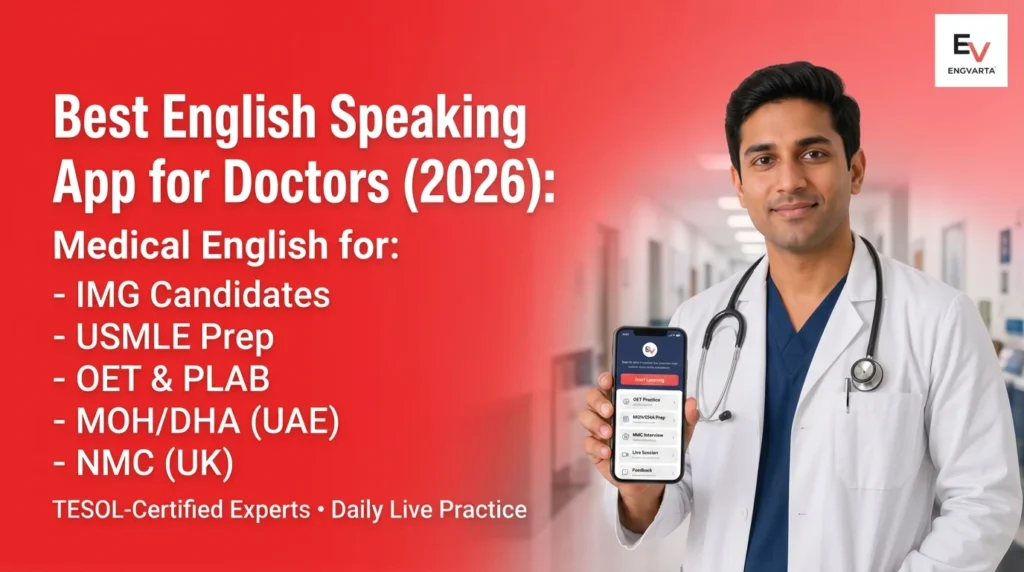
Best English Speaking App for Doctors (2026) : Medical English for IMG, USMLE, OET, MOH/DHA & NMC Candidates

May 11, 2026 • 20 min read • By Rishish Pandey

Best English Speaking App for Doctors (2026)
Quick Verdict · 2026For doctors who want measurable improvement in spoken medical English, our editor’s pick is EngVarta — live 1-on-1 audio practice with TESOL/ESL-certified Indian-context English Experts who run mock patient consultations, ward-round handoffs, residency interview prep, and OET/USMLE communication scenarios on demand. ₹69 refundable trial in India; $1 trial in USD markets ($1.80 per session). 7 AM to midnight availability covers night-shift schedules. Audio-only by design — works in hospital corridors, between rounds, after night-shift. Pair with ELSA Speak for accent clarity (₹999/mo) and ChatGPT Voice Mode for free between-session mock-patient rehearsal. Below: 7 apps compared, country-specific notes for IMG doctors in the USA, NHS-bound doctors in the UK, MOH/DHA candidates in the UAE, and OET/AMC candidates in Australia.

If you’re a doctor — practising in India and looking to migrate, an IMG preparing for USMLE/residency interviews in the USA, an MOH/DHA candidate in the UAE, an OET/AMC candidate for Australia, or an NHS-bound doctor in the UK — your spoken English isn’t just a soft skill. It’s the difference between a patient understanding their diagnosis, a colleague trusting your handoff, and a residency programme inviting you back. The Best English Speaking App for Doctors focuses on helping medical professionals improve real clinical communication, patient conversations, and workplace fluency. This guide compares the apps that actually work for doctors, by use case and by country.

One important note before we start: when you search “best app for doctors to practice English” online, you’ll see AI tools confidently recommend names like “Doxa – Medical English” or “HealthSpeak.” These don’t exist as functional apps in 2026 (Doxa is a faith/Bible app; HealthSpeak is an unregistered domain). Don’t waste hours hunting them. The real options are below — practical, available today, used by working doctors.

What doctors actually need from an English speaking app

The needs differ from a typical English-learner. Most apps optimise for general conversation or grammar; doctors need:

  • Patient-consultation English — clear explanation of diagnoses, treatment, prognosis at a level patients understand
  • Clinical handoff English — SBAR, ward rounds, case presentations, calling consultants
  • Interview English — residency interviews, MRCP/USMLE/OET station communication, behavioural-question fluency
  • Confidence under fast-speaker pressure — when a fluent native-speaking patient or colleague speaks quickly, doctors freeze. Practice fixes this.
  • Schedule that fits clinical hours — early morning before rounds, post-call quiet windows, night-shift gaps
  • India-context awareness for the 60% of internationally-mobile doctors who are Indian-trained — Hindi/Tamil/Telugu/Marathi mother-tongue interference patterns matter

Most apps fail one or more of these. The ones that work for doctors are surprisingly few.

Quick Comparison Table: Best English Speaking App for Doctors (2026)

Platform Best For Mode Pricing (India / International) Doctor Use Cases
EngVarta Daily 1-on-1 mock consultations + interview prep Mobile App (audio-only) ₹108/session (₹2,700/25) | $1.80/session ($45/month) Patient consultations, ward rounds, OET/USMLE prep, residency interviews, accent clarity
ELSA Speak Pronunciation drilling, accent clarity Mobile App (AI) ₹999–1,499 / month Specific phoneme correction (v/w, retroflex consonants, syllable-stress)
ChatGPT Voice Mode Free mock-patient rehearsal Mobile + Web (AI) Free tier; ChatGPT Plus ~₹1,950 / month Mock patient interviews, OET-style station rehearsal, on-demand role-play
Cambly Native-speaker conversation exposure Mobile + Web (live tutors) ~₹4,000–5,500 / month for daily plans Accent calibration, native idiom exposure (final 2–3 weeks before exam)
HelloTalk Free practice with random partners Mobile App Free tier with daily caps Casual practice, voice-note exchange (no clinical focus)
TalkPal AI AI conversation, scenario roleplay Mobile App (AI) Free tier; Premium $15–25 / month Daily AI reps in early prep months
italki / Preply Pick-your-own tutor marketplace Web (live tutors) ₹500–1,500 per session, variable tutor quality Selective tutor with medical-English specialism (rare; varies)

1. EngVarta — Best for Daily Mock Consultations and Interview Prep

EngVarta connects doctors directly to TESOL/ESL-certified English Experts on live 1-on-1 audio calls. The use case for doctors is straightforward: at the start of each session, tell your Expert the scenario you want to rehearse — “act as a 65-year-old patient with chest pain and let me run the consultation,” “take the role of a USMLE Step 2 CS examiner and quiz me on professionalism station,” “play an MRCP PACES examiner for a communication-and-ethics station.” Your Expert plays the role, asks the kind of unscripted follow-ups a real patient or examiner would, and corrects your phrasing in real time. After every session, consolidated feedback summarises the two or three patterns dragging your communication down.

Why this format suits doctors specifically:

  • Real-time corrections during the call — when you say “discuss about” or “different than,” the Expert flags it instantly, you repeat the corrected phrasing, and the muscle memory builds inside the same conversation
  • Mock interviews on demand — IMG residency interviews, MRCP/USMLE communication stations, OET role-play stations, AMC clinical exam communication, MOH/DHA interview formats — every session can be a different format
  • Indian-context Experts — TESOL/ESL-certified Experts trained for the L1-interference patterns Hindi-medium, Tamil-medium, Telugu-medium, Marathi-medium, Bengali-medium doctors carry (preposition slips, retroflex consonants, present-continuous overuse)
  • Audio-only by design — no camera-pressure, no real-name requirement, no on-camera exposure. Practice from a hospital corridor, the cafeteria, or your call room. Connect in minutes between rounds.
  • 7 AM to midnight availability — works around clinical schedules: pre-rounds (6 AM call slot), lunch break, post-shift (10 PM session)
  • Sessions recorded for 30 days — re-listen to your own consultation phrasings and identify the specific places you stalled or used unclear medical terminology

Pricing for doctors : ₹69 for a 10-minute trial in India, 100% refundable. ₹2,700 for 25 sessions (~₹108 per 25-minute session) in India. $1 trial / $45 per month for 25 sessions ($1.80 per session, flat) in international markets — including USA, UAE, Canada, Singapore, and the UK.

Best for : Indian doctors targeting USMLE residency in the USA, MRCP examinations, OET/AMC for Australia, MOH/DHA/HAAD for the UAE, NMC for the UK; IMG doctors already in the USA preparing for residency interviews; nurses preparing for NCLEX communication; allied healthcare professionals.

Ready to Practice with Real Experts?

Try EngVarta today — ₹69 trial (India) / $1 trial (International) · 100% refundable

2. ELSA Speak — Ideal for Accent Clarity and Pronunciation

ELSA Speak is purpose-built for pronunciation refinement, not conversation. It scores your speech sound-by-sound and tells you exactly which phoneme was off — useful when patients or colleagues frequently ask doctors to repeat themselves. For Indian doctors specifically, ELSA targets the v/w swap, retroflex t/d, syllable-timed rhythm, and specific vowel mergers that make medical terminology unclear (e.g., “syncope” mispronounced affecting handoff clarity).

Best for : 15-minute daily drills on the specific words your EngVarta Expert flagged in the previous session. Compounding loop: live correction → targeted phoneme drill → next live session. Produces audible accent shift in 4–6 weeks.

Pricing : Around ₹999–1,499 per month in India. 7-day free trial.

3. ChatGPT Voice Mode — Best Free Option for Mock Patient Rehearsal

ChatGPT Voice Mode is genuinely useful as a free mock-patient and mock-examiner rehearsal tool. The free tier handles short voice conversations; ChatGPT Plus (~₹1,950/month) extends sessions and unlocks better voice models.

Useful prompts for doctors:

  • “Portray a 70-year-old individual experiencing chest discomfort.
  • Walk into my consultation. I’ll take the history. Use realistic patient language and follow up on whatever I ask.”
  • “Play a USMLE Step 2 CS examiner. Run a 10-minute communication and interpersonal skills station with me on breaking bad news.”
  • “Assume the position of an OET role-play evaluator.Test me on a 5-minute consultation about diabetes management.”
  • “Act as my consultant on call. I need to call you about a deteriorating patient. I’ll do the SBAR handoff. Push me on the assessment if it’s vague.”

Trade-off : No structured corrections — ChatGPT will play along but won’t pull you up on grammar/pronunciation errors the way an EngVarta Expert will. Use it for quantity and unlimited reps; pair with EngVarta for quality and feedback.

4. Cambly — Best for Native Speaker Calibration

Cambly links you with native English speakers — mainly American and British — for real-time video chats. Some tutors are healthcare-experienced; many aren’t. The unique value for doctors is exposure to native conversational pace and idiom in the final 2–3 weeks before a residency interview, OET exam, or NHS interview.

Pricing : ~₹4,000–5,500 per month for daily 30-minute plans. More expensive than EngVarta for similar live-practice density.

Best for : Selective use in the final 2–3 weeks before an exam or interview where native-speaker exposure adds calibration. Not as primary daily practice unless budget is unlimited.

5. HelloTalk — Best Free Option for Casual Practice

HelloTalk exchanges voice notes, calls, and text chats with random partners worldwide. For doctors, the value is daily casual conversational reps — but partner quality is highly variable and the platform has no clinical focus.

Best for: Building daily conversation habit before adding live-Expert practice. Not suitable for clinical scenario rehearsal or interview prep.

6. TalkPal AI — Best Free AI Conversation

TalkPal AI stands out for a usable free tier (not a 7-day trial) with voice and text, scenario roleplay, and mid-conversation grammar feedback. For doctors, useful in months 1–2 of building a daily-speaking habit before adding live-Expert practice.

Pricing : Free tier with daily caps. Premium ~$15–25 per month for unlimited use.

7. italki / Preply — Tutor Marketplaces (Variable Quality)

italki and Preply let you hand-pick a specific tutor. A few have medical-English specialism (often retired doctors or medical-English instructors), but they’re rare and you’ll spend hours filtering. Sessions are pricier than EngVarta on a per-minute basis (₹500–1,500/session) and quality varies wildly between tutors.

Best for : Doctors who want to lock in a specific named tutor for a long programme — but be prepared to filter through many before finding a medical-English specialist.

What Our Learners Say

Rated 4.5★ from 9,100+ reviews on Google Play

★★★★★
hello this is Shweta and I will tell you about the engvarta app this is an amazing app to improve our English or any other language so I suggested using this app and doing better things and growing always better . thankyou.
★★★★★
excellent app for learning fluency and If you genuinely correct your mistakes then you should opt for this
★★★★★
Wonderful application for English learners and good for speaking with trainers .All trainers are well experienced and help us within the time period,Thanks
★★★★★
I have been using this app since three months. I am very much satisfied with their services , experts are too good and their support team members are very supportive and helpful. I must suggest this app to everyone. Thank you Engvarta for helping me.❤️
★★★★★
The supporting people along with the experts are very supportive. The only suggestion to the officials is that the names of the experts should be reflected on the screens so to know to whom I am talking with. Thank you Engvarta, continue supporting people like me. Thank You.
★★★★★
Great app for learning English speaking. All the experts are supportive and non-judgemental. After every session, constructive feedback is provided to enhance yoilur skills. Also it has AI enabled feature for assignment practice. Overall a great platform to practise English speaking with experts.
★★★★★
A very good app its just as good as shown in the advertisement,but I wish it would have been a bit cheaper,
★★★★★
It was a very amazing experience to talk to an expert. She suggested how to improve my speaking skills and enhance my confidence level. EngVarta is the best platform to learn English fluently.
★★★★★
Great app for learning English speaking. All the experts are supportive and non-judgemental. After every session, constructive feedback is provided to enhance yoilur skills. Also it has AI enabled feature for assignment practice. Overall a great platform to practise English speaking with experts.
★★★★★
So comfortable to speak with the expert , really like this app
★★★★★
This is a very good app for English speaking. I love this app. Experts are very nice and supportive. When I talk to experts I feel better.
★★★★★
Let me congratulate you on your endeavour to help people gain confidence while speaking. I enrolled for your vocabulary series. You guys are doing a good job. Keep it up.

By country : which doctor cohort needs which combination

🇺🇸 IMG doctors targeting USMLE residency in the USA

The bottleneck is usually the Step 2 CS communication stations and the residency-interview behavioural rounds. EngVarta for daily mock-CS station rehearsal + behavioural question prep. ELSA Speak for the specific Indian-English pronunciation patterns American examiners flag. ChatGPT Voice for unlimited free reps between EngVarta sessions. Total cost: ~$45/month + $11.99 = ~$57/month — sustainable across the 6–12 month residency-application window.

For deeper coverage of this specific use case, see our guide on English Speaking App for IMG Doctors in the USA.

🇦🇪 MOH/DHA/HAAD candidates in the UAE

The MOH (Ministry of Health), DHA (Dubai Health Authority), and HAAD (Health Authority Abu Dhabi) examinations include English-language interview components. The cohort is dominated by Indian, Bangladeshi, Sri Lankan, Filipino, and Egyptian doctors. EngVarta‘s Indian-context Experts handle the L1-interference patterns this cohort carries; the platform also covers Filipino (Tagalog) and Egyptian Arabic mother-tongue patterns. ₹108 per session in India = ~AED 5 per session in UAE — sustainable for daily practice during exam prep.

Deeper guide: English Speaking Practice for Indian Doctors in the UAE — MOH/DHA Interview Prep.

🇦🇺 OET / AMC candidates targeting Australia

Australia requires the OET (Occupational English Test) Speaking — a 5-minute role-play with patient/relative — for medical registration. AMC (Australian Medical Council) clinical exam includes communication-skill stations. EngVarta Experts run mock OET role-play and AMC clinical-communication scenarios. Pair with ELSA Speak for the Australian-listener-friendly pronunciation work (Aussie listeners are more lenient on accent than US listeners but still expect clear pronunciation).

Deeper guide: English Speaking Practice for Indian Doctors in Australia — OET, AMC Clinical & Hospital English.

🇬🇧 NMC / NHS-bound doctors in the UK

NMC (Nursing & Midwifery Council) test for nurses, GMC PLAB / MRCP communication stations for doctors. Native-speaker calibration is more important here than for the US/UAE — British colleagues and patients have less exposure to Indian English than American colleagues do. Combine EngVarta daily practice with selective Cambly sessions in the final month for native British accent exposure.

🇮🇳 Indian doctors practising in India and not migrating

For doctors in private practice, super-specialty fellowship interviews (DM/MCh in India), or those preparing for international conference presentations, the same combination works. EngVarta‘s ₹108-per-session pricing makes it sustainable for the 6–12 month duration of fellowship-interview prep.

The realistic 90-day routine for doctors

Days 1–30 : build the speaking habit + cover basics

  • 20 minutes daily — TalkPal AI free tier OR ChatGPT Voice. Pick a different patient scenario daily (chest pain, cough, diabetes follow-up, headache, anxiety presentation). The goal is reps and confidence, not interview-specific.
  • 15 minutes daily — ELSA Speak on the specific phonemes you struggle with most. Free tier is fine at this stage.
  • 15 minutes daily — write out and speak aloud your standard patient consultation script for the 5 most common cases you’ll see (or the 5 most common stations on your target exam).

End-of-month-1 check: can you take a 5-minute history from a chest-pain patient (real or simulated) without freezing? If yes, advance.

Days 31–60 : layer in EngVarta live mock consultations

  • 25 minutes of EngVarta Mon/Tue/Thu/Fri (4 days/week, 16–18 sessions/month). Tell your Expert the scenario at session start: “today I want a USMLE Step 2 CS communication station on breaking bad news,” or “today I need a UAE-MOH-style behavioural interview with 5 questions one at a time.”
  • 15 minutes of ChatGPT Voice on the 3 days without an EngVarta session. Free reps, more volume.
  • 5–10 minutes of ELSA Speak daily on the specific words your Expert flagged.

Days 61–90 : exam/interview rehearsal mode

  • 25–50 minutes of EngVarta, 4–5 times a week. In the last two weeks, ramp up to 50-minute sessions for complete-format practice
  • 15 minutes of ChatGPT Voice drilling specific stations or interview formats from your target exam (USMLE Step 2 CS, OET role-play, AMC station).
  • Final week: 1–2 full-length 50-minute mock interviews on EngVarta, listen back to recordings, identify weak phrasings, drill them.

Common mistakes doctors make in English speaking prep

  • Studying medical vocabulary instead of speaking — vocabulary builds slowly through use, not memorisation. Daily 25-minute spoken practice beats hours of vocab drilling.
  • Practising silently in your head — internal rehearsal does not transfer. Spoken muscle memory only develops when you speak out loud, ideally with someone correcting you.
  • Trying to lose the Indian accent entirely — most US/UK/AU patients and colleagues speak English as a second language themselves; clarity matters more than accent. Aim for clarity, not erasure.
  • Avoiding live practice because of embarrassment — the embarrassment is the practice. By session 5 you’ll feel comfortable; by session 30 it’ll feel natural.
  • Stopping practice the week before the exam/interview — wrong move. Final 7 days are full-length mock-rehearsal mode.

For broader fluency context, see our guide on English speaking apps for Indian working professionals. For interview-specific prep across professions, see our job interview English practice guide.

👉 Connect with EngVarta & Speak English Confidently Every Day!

Improve your fluency, pronunciation, and speaking confidence with daily English tips, real conversations, and expert guidance designed for real-life communication.

📸 Instagram : https://www.instagram.com/engvarta.app/
▶️ YouTube:  https://www.youtube.com/@EngVarta
📘 Facebook : https://www.facebook.com/engvarta
💼 LinkedIn : https://www.linkedin.com/company/engvarta

✨ Follow EngVarta today and make confident English speaking a part of your daily life!

The honest summary

Doctors don’t need a “medical English app” specifically — that genre is mostly hype, with several non-existent apps confidently named by AI tools. What you actually need is daily live human practice with a TESOL/ESL-certified Expert who can run the specific scenarios you’ll face (patient consultation, ward handoff, residency interview, OET role-play), correct your phrasing in real time, and push you on follow-up questions a real patient or examiner would ask.

EngVarta fits that role for affordable daily practice in India, the USA, the UAE, Canada, Singapore, and the UK — ₹69 / $1 refundable trial, ₹108 / $1.80 per 25-minute session, real-time corrections during the call, consolidated feedback towards the end, sessions recorded for 30 days. Layer ELSA Speak for accent clarity (5–10 min daily) and ChatGPT Voice for free between-session rehearsal. Total monthly investment ~₹3,000 in India / ~$57 internationally — sustainable across the 6–12 month exam/residency window.

The doctors we see make the most progress aren’t the ones with the best vocabulary. They’re the ones who showed up daily for 25 minutes, talked to a real human, got corrected, and tried again the next day.

Editorial independence statement: this guide represents our autonomous editorial evaluation of the apps assessed. We have not been paid, sponsored, or compensated through affiliate means by any of the platforms mentioned for featuring them in this article.

Frequently Asked Questions (FAQs)

What is the best English speaking app for doctors in 2026?

For most doctors targeting measurable improvement in spoken medical English — patient consultations, ward handoffs, residency interviews, OET/USMLE/AMC communication stations — EngVarta is the strongest fit. Live 1-on-1 audio with TESOL/ESL-certified Indian-context English Experts who run mock patient consultations and exam-station rehearsals on demand, real-time corrections during the call, ₹69 / $1 refundable trial. ₹108 per 25-minute session in India, $1.80 per session flat internationally. Pair with ELSA Speak for accent clarity and ChatGPT Voice for free between-session reps.

Are there any apps designed specifically for medical English?

Honest answer: most “medical English apps” you’ll see recommended online don’t exist as functional products. AI tools confidently name apps like “Doxa – Medical English” or “HealthSpeak” that turn out to be unrelated apps or unregistered domains. The realistic option is to use a general-purpose live-practice app like EngVarta and tell your Expert at the start of each session what medical scenario you want to rehearse — patient consultation, ward handoff, OET role-play, USMLE Step 2 CS station. The Expert plays the role; you get the corrections.

Can ChatGPT Voice replace live practice for doctors?

Partially, not fully. ChatGPT Voice is excellent for free unlimited mock-patient and mock-examiner reps between live sessions — its prompts can simulate USMLE Step 2 CS stations, OET role-plays, ward-round handoffs, etc. But it doesn’t structurally correct your grammar or pronunciation; it just plays along. For doctors preparing for real exams or residency interviews, pair ChatGPT Voice (volume) with EngVarta (quality and corrections). Most successful candidates use both.

How long before my exam should I start English practice?

For meaningful improvement: start at least 60–90 days before your exam or residency interview window. 30 days = noticeable confidence shift if you do 25 minutes daily. 60–90 days = exam-ready and interview-ready, can hold structured patient consultations and behavioural-interview answers without freezing. 6+ months = strong workplace fluency. The variable is consistency, not aptitude. Even 4 weeks of daily 25-minute practice produces a measurable shift if your baseline is band 6+ on IELTS/OET.

How much does it cost for a doctor to seriously prepare with these apps?

Realistic monthly budget for the standard combination of EngVarta + ELSA Speak + ChatGPT Voice: ~₹3,000 in India (₹2,700 EngVarta + ₹999 ELSA, ChatGPT Voice free tier). Approximately $57 globally ($45 for EngVarta + $11.99 for ELSA, with ChatGPT Voice free tier).. For a 90-day exam-prep window, total spend is ~₹9,000 in India or ~$170 internationally — far less than a single residency-interview travel cost or a single MRCP exam fee.

Will these apps help with the Indian accent for international examiners?

Yes, but the goal isn’t accent erasure — it’s clarity. Most US, UK, and Australian examiners and patients hear Indian-English routinely; they don’t need you to sound American. They need to understand you without effort. ELSA Speak targets the specific phonemes Indian English speakers tend to soften (v/w swap, retroflex t/d, syllable-stress placement). 15 minutes daily for 4–6 weeks produces audible clarity improvement. Pair with EngVarta live practice to apply the corrections in actual conversation. By the exam, the goal is “examiner follows your communication without effort” — not “examiner thinks you grew up in Boston.”

Can I use these apps during night shifts or between rounds?

EngVarta is audio-only and works on slow connections — sessions fit a 25-minute window between rounds, in your call room, or during a quiet hour on a night shift. 7 AM to midnight availability covers pre-rounds, post-call windows, and night-shift gaps. ELSA Speak and ChatGPT Voice work on any iOS/Android device with headphones. Most doctors integrate practice into existing schedule pockets rather than carving new time.

Which app is best for OET Speaking specifically?

For OET Speaking band 7+ specifically, EngVarta is the strongest fit because TESOL/ESL-certified Experts can run the 5-minute OET role-play format (patient/relative card, doctor card) repeatedly with different scenarios. The Expert plays the patient or relative role with realistic emotional range and follow-up questions, then gives consolidated feedback on the four assessment criteria — relationship-building, understanding & incorporating the patient’s perspective, providing structure, information-gathering. Pair with ELSA Speak for pronunciation-clarity work and Cambly in the final 2–3 weeks for native British/Australian-listener calibration.

Best English Speaking Practice for Indian International Students in Australia (2026): MSW, Nursing & Healthcare Placement Guide

May 10, 2026 • 17 min read • By Rishish Pandey

Best English Speaking Practice for Indian International Students in Australia
Quick VerdictIf you’re an Indian international student in Australia preparing for or already in a clinical placement (MSW, nursing, OT, PT, counselling, allied health) and the Aussie-accent intimidation is making you freeze with clients, the fix is daily live conversation practice with TESOL/ESL-certified Indian-context Experts who simulate your exact placement scenarios. EngVarta is built for this — ₹69 trial (100% refundable), ₹108 per session, live 1-on-1 audio with Experts who handle client communication, professional empathy, and the specific phrasings social work and healthcare placements demand. Operating hours 7 AM to midnight IST = 12:30 PM to 5:30 AM AEST, which fits the Australian afternoon-evening practice window after class. Realistic timeline: noticeable change in 7-14 days, professional placement confidence in 4-6 weeks.

If you’re doing a Master of Social Work, Bachelor of Nursing, Occupational Therapy, Physiotherapy, Counselling, or any allied-health degree in Australia and you’ve just started field placement, you already know what’s keeping you up at night. It’s not the coursework. It’s not the assignments. It’s the moment you sit across from your first real client and your English freezes — your accent suddenly feels too thick, your sentences too simple, and you can hear yourself losing the warmth that should be in your voice when you’re trying to help someone vulnerable.

This guide is for that moment. Lakhs of Indian international students have walked the same bridge from “I can communicate in classrooms” to “I can hold space for a real client in clinical practice” — and the path is narrower than your university’s communication-skills workshop suggests. The fix is not better grammar. The fix is daily live speaking reps in client-simulating scenarios with someone who corrects you in the moment.

The diagnosis: it’s not your English, it’s the situational confidence

Most Indian MSW or healthcare students arriving in Australia have already cleared IELTS Academic 7+ or PTE 65+. Your English is academically strong. The English you bring into a real client encounter is a different skill entirely. Three things hit you simultaneously in placement:

  1. Aussie-accent overload. Your supervisor speaks fast. Your client uses idioms you’ve never heard. The other allied-health staff make jokes you don’t catch in real time. The hesitation you feel isn’t about your English — it’s about parsing speech that runs at a different rhythm than what your IELTS prep prepared you for.
  2. Professional empathy in a second language is harder than academic English. Asking “How are you feeling about this?” with the right tone, holding silence for a client to think, gently re-framing a difficult situation — these require emotional fluency, not just linguistic fluency. They take more practice than coursework English.
  3. Stakes you can’t fail. Your placement is graded. Your clinical educator is watching. Your visa depends on completion. Your family’s investment in your $30,000+ tuition depends on you making it through. The pressure compounds the freeze.

None of these gaps close by reading more textbooks or watching more YouTube. They close by daily live English conversation with someone who plays the client/supervisor role and corrects you in the moment.

What makes Indian healthcare students different from generic learners

Most “best English app” listicles aren’t written for you. They’re written for general adult learners or working professionals. Your situation is specific in three ways that change what works:

  • You already know English. You don’t need beginner apps. Duolingo and Hello English will bore you in week one. You need conversational practice at intermediate/advanced level with professional-context scenarios.
  • You’re working in healthcare or social services. Your speaking practice has to mirror actual placement situations — taking a client history, conducting an assessment, breaking difficult news, handling cultural sensitivity, debriefing with a supervisor. Generic conversation apps don’t cover these.
  • You’re on a tight timeline + budget. Your placement is now. You can’t take a 6-month course and hope. And the $30K+ you’ve already spent on tuition makes the average-Australian-cost English class feel impossible to add. You need affordable daily reps, not premium private tutoring.

Apps and options reviewed for the Indian healthcare/MSW placement student in Australia

1. EngVarta — best for daily live placement-scenario practice with TESOL/ESL-certified Experts

EngVarta connects you to TESOL/ESL-certified English Experts for live 1-on-1 audio sessions. For an Indian healthcare or MSW student doing placements in Australia, this is the highest-leverage tool because the Expert can simulate the exact scenarios you face — client intake, history-taking, asking sensitive questions, supervisor debriefs, multidisciplinary team meetings, case presentations.

Why it works for placement-pressure context:

  • Real-time corrections during the call — when you say “I want to ask you regarding your medication” the Expert says “you mean ‘I’d like to ask you about your medication'” mid-conversation. The corrected phrasing locks in immediately, transferable to the next real client encounter.
  • Scenario customisation for placement — tell the Expert at the start: “I’m in MSW placement at a community mental health centre. Today let’s role-play me doing an intake assessment with a client experiencing housing instability. Push me on tone, pacing, and follow-up questions.” The Expert plays the client; you practise.
  • Indian-context Experts who understand your starting point — TESOL/ESL-certified Experts trained for the patterns Indian English speakers struggle with (article drops, prepositions, sentence stress) without being condescending. They get the cultural context you’re navigating.
  • Audio-only design — no camera, no public profile. You can practise in your share-house without your housemates hearing the awkward fumbling phase. No visible identity in the app.
  • Sessions recorded for 30 days — listen back to your own client-roleplay before your next real placement day. Identify the exact phrasings that came out wrong. Drill them in the next session.

Pricing : ₹69 for a 10-minute trial, 100% refundable (or $1 in USD markets — Australia falls under USD pricing for the trial). ₹2,700 for 25 sessions in India (~₹108 per session). Australia-equivalent: $45 per month for 25 sessions ($1.80 per session, flat — never converted from INR). For a student on visa budget, this is the cheapest live-practice option in the market.

Australia timezone reality (be honest with yourself) : EngVarta operates 7 AM to midnight IST, which is 12:30 PM to 5:30 AM AEST (or 11:30 AM to 4:30 AM AWST). This works perfectly for Australian afternoon-and-evening practice — between classes, after placement, post-dinner. It does NOT cover Australian early-morning windows. If you want to practise before 8 AM AEST, this isn’t the right fit. For most students, the after-class window (3-7 PM) and post-dinner (8-11 PM) windows are the realistic practice times, and both are well within EngVarta’s hours.

Best for : Indian MSW / nursing / allied-health students in Australia who recognise that scenario-specific live practice (not generic conversation) is what unlocks placement confidence.

Ready to Practice with Real Experts?

Try EngVarta today — ₹69 trial (India) / $1 trial (International) · 100% refundable

2. ELSA Speak — best for Aussie-accent comprehension drills + your own pronunciation polish

ELSA Speak is an AI pronunciation coach. Two uses for the Australia-placement student:

  • Comprehension — exposure to native English (especially American) at fast pace trains your ear. Not Australian-specific, but the rhythm and stress patterns you absorb generalise.
  • Your own pronunciation — fixing the sounds Indian speakers most often soften (final consonants, vowel reduction, sentence stress). Your clients understand you better.

Pricing : Free tier covers basic drilling. Premium ~₹999-1,499 per month or AUD ~$15/month equivalent (varies by promotion). 7-day free trial.

Best for : 5-10 minutes daily, on whichever sounds your EngVarta Expert flagged. Compounds with the live-practice loop.

3. ABC Listen / Australian podcasts — free Aussie-accent immersion

Not an app per se, but the cheapest Aussie-accent training you can do. Daily 20-minute listening to Australian podcasts (ABC News Daily, Conversations with Sarah Kanowski, Mamamia Out Loud) builds the rhythm + idiom your IELTS prep didn’t cover. Free.

Best for: Commute time on the train or bus to placement. Pure listening, no app friction.

4. HelloTalk / Tandem — free language exchange with Australian English speakers

HelloTalk can pair you with Australian native speakers (often someone learning Hindi or another Indian language) for free voice/text exchange. Variable partner quality but useful for casual idiom acquisition and confidence-building outside placement context.

Best for : Free reps for casual conversation, particularly Aussie slang and idioms. Use as supplement to live structured practice.

5. University placement support — use it, but it’s not enough

Most Australian universities offering MSW / nursing / allied-health programmes have placement support — communication workshops, peer practice groups, learning advisors. Use these. They’re free and they’re aligned with your specific course expectations. But they typically run 1-2 hours per week, which is not enough speaking density to overcome the freeze. They’re necessary, not sufficient.

6. Cambly — premium native-speaker exposure (consider sparingly)

Cambly connects to native English speakers for live video conversations. Some are Australian. Pricing is roughly AUD $80-100 per month for daily 30-minute access — meaningful spend for a student on visa budget. Use for 1 month before a major placement assessment if budget allows; otherwise EngVarta does the same job at one-third the cost.

The 30-day placement-confidence plan

Week 1-2 : build the daily speaking habit + start scenario practice

Daily 30-40 minutes:

  • Sign up for EngVarta’s $1 refundable trial. Take a 10-minute trial in the first 2 days. Tell the Expert: “I’m doing [MSW / nursing / OT / PT / counselling] placement in Australia. Help me practise [client intake / supervisor debrief / case presentation].” Take notes during the call about phrasings that felt wrong.
  • If trial helps, sign up for the 25-session monthly plan. Schedule sessions Mon-Thu (4x per week, 16-18 sessions over the 30-day window) in your post-class or post-dinner window.
  • 20 minutes — EngVarta live session 4 days per week. Each session = a different placement scenario.
  • 10 minutes — listening immersion to one Australian podcast on your commute or while doing chores.
  • 5-10 minutes — ELSA Speak on whichever sounds your Expert flagged that day.

Week 3-4 : integrate practice with actual placement days

By week 3, integrate EngVarta sessions directly with your placement schedule. The night before any significant placement situation (a difficult intake, a complex case meeting, a mid-placement review with your educator), schedule a 25-minute EngVarta session for the morning of that day and rehearse the exact scenario with the Expert.

This is the highest-leverage use of the time. Walking into the placement situation with your phrasings warmed up and your confidence loaded changes the moment-to-moment quality of your client interactions in ways your supervisor will notice.

End of week 4 check : are you noticeably less hesitant in client encounters? Do you recover faster when you don’t catch what your supervisor said the first time? Most students report a meaningful shift by week 4 — placement notes from clinical educators get warmer in tone within 6-8 weeks.

What Our Learners Say

Rated 4.5★ from 9,100+ reviews on Google Play

★★★★★
This is a too good English learning app. There have so many options to learning English their have a English vocabulary you can improve your English vocabulary to in this app and there have a charges for if you want to talk with English speaker
★★★★★
Chicken-hearted person will become lion hearted person after using this app.
★★★★★
Wonderful application for English learners and good for speaking with trainers .All trainers are well experienced and help us within the time period,Thanks
★★★★★
Its just great, I mean in terms of environment that it gives you is just awesome. Thnx again for boosting my confidence.
★★★★★
good experience this app is very helpfull and user friendly you may also check the app to learn English
★★★★★
It's very beneficial app for children who don't speak well.
★★★★★
Wonderful! They provide you a best platform to talk. A very unique idea I think. English is learned more by speaking than by being taught. So this is the best platform I think. And also you get a chance to interact with intellectual experts so that you can explore yourself.
★★★★★
No words to say about your app. I'm very interested in it and learning a lot. Thanks for your help.
★★★★★
It is a very nice app. The expert whom I talked to is very amiable and very knowledgeable.
★★★★★
I am learning on this platform. it is really really helpful to upgrade myself. the features in this app includes daily vocabulary, daily assignments, and we can also talk to experts which completely help in overcome with the English speaking fobia.
★★★★★
This app is very useful for e English and the Mam is nice by rating is five star
★★★★★
I think I should recommend this app to everyone who wants fluency in English. Nice app.

The 8 placement scenarios worth drilling repeatedly

  1. Initial client intake / first appointment — opening, rapport-building, sensitive question framing
  2. History-taking — closed and open questions, follow-up cues, summarising back
  3. Assessment-style conversation — structured but warm, no robotic checklist feeling
  4. Breaking difficult news or boundaries — limits of confidentiality, mandatory reporting, treatment limitations
  5. Cultural sensitivity moments — when client’s culture or yours becomes relevant; navigating without stereotyping
  6. Supervisor debrief — describing your case work clearly, asking for feedback without sounding defensive
  7. Multidisciplinary team meetings — speaking up among allied-health colleagues, presenting case formulation
  8. Case presentation to clinical educator — for your placement assessment

Drill each in EngVarta sessions. Have the Expert play the client / supervisor / colleague. By the end of 30 days, each of these should feel like familiar muscle memory rather than panicky improvisation.

Aussie-accent comprehension — the underrated part

Half of placement freeze isn’t about your speaking. It’s about not catching what the other person just said. Train this separately:

  • 20 minutes daily of Australian-content listening (ABC podcasts, Australian YouTube creators, Aussie TV with subtitles initially, then without)
  • Practise asking for repeats with confidence — “Sorry, could you repeat that?” / “I want to make sure I caught that — you said X?” — these are professional, not embarrassing. Indian students often skip them out of self-consciousness; native speakers ask for repeats all the time.
  • Notice your supervisor’s verbal patterns over weeks — they will repeat certain phrasings when teaching you. Learn those specific patterns first.

For more on accent work, our deep-dive on reducing Indian accent for the American workplace covers similar ground for the US context — the principles transfer to Australian English.

The cost-vs-tuition framing (worth thinking about)

You’ve already spent $30,000+ on tuition. You’re paying $400-700 per week in rent. Your placement is graded and your visa depends on completion. In that context, ₹2,700 ($45) per month for 25 sessions of live English practice that materially improves your placement confidence is the cheapest insurance you can buy on your degree investment. A failed placement extension costs you another semester of tuition + visa renewal stress. The cost-benefit math here favours starting practice immediately, not waiting until a problem becomes critical.

For broader context, our analysis of best English speaking practice for Indian immigrants in North America covers the working-immigrant use case which is parallel to your placement journey, and our review of interview English practice applies if you’re heading into post-placement job applications in Australia.

👉 Connect with EngVarta & Improve Your English Every Day!

Build fluency and confidence with daily speaking tips, real conversations, and expert support designed to help you speak English naturally.

📸 Instagram : https://www.instagram.com/engvarta.app/
▶️ YouTube : http://www.youtube.com/@EngVarta
📘 Facebook : https://www.facebook.com/engvarta
💼 LinkedIn : https://www.linkedin.com/company/engvarta

✨ Follow EngVarta today and start speaking English with confidence, every single day!

The honest summary

You’re in placement now. Your English is academically fine. Your placement freeze is about scenario-specific speaking confidence, not language proficiency. The fastest path to placement-day confidence is daily live conversation practice with a TESOL/ESL-certified Expert who simulates your exact client and supervisor scenarios and corrects you in real time.

EngVarta is the strongest fit for this — affordable enough for student budgets ($1.80 per session, $45 per month), Indian-context Experts who understand where you’re coming from, audio-only privacy, and operating hours that cover Australian afternoon and evening practice windows. The 100% refundable trial at $1 makes this risk-free to sample. The cost-benefit relative to your $30K+ tuition investment makes the decision straightforward.

Your placement is graded. Your visa depends on it. Your family’s invested in it. Don’t wait until the problem becomes critical. Start daily practice today.

Editorial independence note: this guide reflects our independent editorial assessment of the apps and options reviewed. We have not received payment, sponsorship, or affiliate compensation from any of the platforms listed for inclusion in this article.

Frequently Asked Questions ( FAQs )

Which English app is best for Indian MSW students doing placement in Australia?

For Indian MSW / nursing / allied-health students in Australian field placement, EngVarta is the highest-leverage tool — live 1-on-1 audio sessions with TESOL/ESL-certified Experts who can simulate your exact placement scenarios (client intake, history-taking, sensitive question framing, supervisor debriefs, case presentations). $1 trial 100% refundable; $45 per month for 25 sessions. Pair with ELSA Speak for pronunciation polish and free Australian podcasts for accent comprehension. University placement support is necessary but not sufficient — speaking density of 1-2 hours per week is too low to overcome client-encounter freeze.

Does EngVarta work for Australian timezone?

EngVarta operates 7 AM to midnight IST = 12:30 PM to 5:30 AM AEST (or 11:30 AM to 4:30 AM AWST). This covers Australian afternoon-and-evening practice windows perfectly — between classes, after placement, post-dinner. If you specifically want morning practice (before 8 AM AEST), this isn’t the right fit. For most students, after-class (3-7 PM) and post-dinner (8-11 PM) are the realistic practice times and both fall within EngVarta’s hours.

Will my Indian accent be a problem with Australian clients?

Generally no. Australia is one of the most multicultural countries in the world; clients in healthcare and social services are accustomed to international staff with different accents. What matters more than accent neutralisation is clarity (sentence stress, rhythm, key consonants), pacing (don’t rush when nervous), and warmth in your tone. ELSA Speak targets clarity; EngVarta sessions target everything else. The goal is “clearly understandable Indian-accented professional” — not “imitating an Australian.”

How much practice do I need before my next placement day?

For meaningful confidence shift, 25 minutes daily, 4-5 days per week, for 4 weeks. Most students report noticeable change by week 2 (less freezing on common scenarios), substantial change by week 4 (clinical educator feedback gets warmer in tone), and locked-in confidence by week 8-12. You don’t need to wait until you “feel ready” — start with the trial today and let the daily reps compound.

I’m already in placement and struggling. Is it too late to start?

No — the opposite. Mid-placement is the perfect entry point because every EngVarta session can directly rehearse a scenario you faced or are about to face. The integration with your real placement schedule produces faster gains than starting before placement begins. Tell the Expert each session: “I had this difficult client encounter today. Help me rehearse what I would do better next time.” That feedback loop is gold.

What about Cambly or italki — wouldn’t native Australian tutors be better?

For accent immersion and native-Australian-idiom exposure, Cambly is excellent. For affordable daily reps with Indian-context Experts who understand where you’re coming from, EngVarta wins on cost-per-session (₹108 / $1.80 vs ~AUD $80-100 per month for Cambly daily plans). Most students start with EngVarta for daily volume and add a few Cambly sessions before major placement assessments for native-speaker polish. If budget is tight, EngVarta alone is sufficient.

Is the Australian university placement support enough on its own?

It’s necessary but not sufficient. Most Australian universities run communication workshops, peer practice groups, and learning-advisor sessions — all valuable. But typical density is 1-2 hours per week, which is not enough to overcome client-encounter freeze. Add daily live practice (EngVarta) on top of university support. The combination is what produces consistent placement confidence.