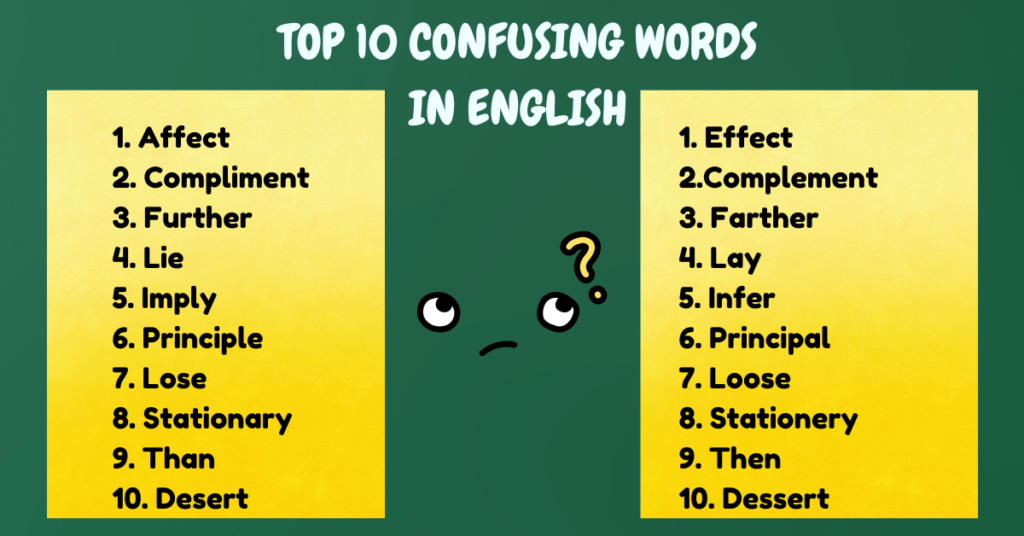
English can be a tricky language, especially when certain words look similar, sound alike, or seem interchangeable but actually have distinct meanings. These confusing words often trip up even the most proficient speakers. To help you navigate this linguistic minefield, we’ve compiled a list of the top 10 confusing words in English—and how to use them correctly.
1. Affect vs. Effect
- Affect (verb): To influence something.
- Example: The weather can affect your mood.
- Effect (noun): The result or consequence of an action.
- Example: The new policy had a positive effect on employee productivity.
Tip: If you’re talking about an action, use “affect.” If you’re talking about a result, use “effect.”
2. Compliment vs. Complement
- Compliment (noun/verb): A polite expression of praise or admiration.
- Example: She gave me a nice compliment about my dress.
- Complement (noun/verb): Something that completes or enhances something else.
- Example: The wine complements the meal perfectly.
Tip: Remember, “I” in “compliment” stands for admiration, while “E” in “complement” stands for enhancement.
3. Further vs. Farther
- Further (adjective/adverb): Refers to metaphorical or abstract distance.
- Example: Let’s discuss this further.
- Farther (adjective/adverb): Refers to physical distance.
- Example: The store is farther down the street.
Tip: Use “farther” for measurable distances and “further” for abstract concepts like time or conversation.
4. Lie vs. Lay
- Lie (verb): To recline or rest on a surface.
- Example: I need to lie down after a long day.
- Lay (verb): To place something down.
- Example: Lay the book on the table.
Tip: People lie down, but you lay things down.
5. Imply vs. Infer
How to Stop Confusing These Words in Conversation
Knowing the difference between confusing words on paper is one thing. Using the correct word in real-time conversation is another. Here are practical tips to stop mixing them up when you speak:
- Create memory hooks: For affect/effect — “Affect is the Action (both start with A), Effect is the End result (both start with E).” Simple associations stick better than grammar rules.
- Practise in sentences, not isolation: Do not just memorise definitions. Say the word in 3 different sentences out loud. Your mouth needs to practise the correct usage, not just your brain.
- Get corrected in real time: When you use the wrong word in conversation, an English expert can catch it immediately and help you self-correct. This is far more effective than studying word lists alone. EngVarta experts are trained to notice these common errors and correct them gently during your session.
- Read more, speak more: The more you encounter words in natural context (articles, conversations, podcasts), the more instinctive the correct usage becomes. There is no shortcut — exposure plus practice equals accuracy.
Confusing words are one of the most common reasons English learners lose confidence in conversation. The good news: with daily practice, these errors disappear within weeks. Start with a 10-minute EngVarta trial session (₹69 / $1, fully refundable) and experience how expert feedback accelerates your learning.
Frequently Asked Questions
What are the most commonly confused words in English?
The most commonly confused word pairs include: affect/effect, their/there/they’re, then/than, its/it’s, your/you’re, lose/loose, accept/except, and complement/compliment. These are confused because they sound similar but have different meanings.
How can I stop confusing similar English words?
Create memory hooks for each pair, practise using them in sentences out loud, and get real-time corrections from an English expert. Daily speaking practice on platforms like EngVarta helps because experts catch these errors naturally during conversation and correct them immediately.
What Our Learners Say
Rated 4.5★ from 9,100+ reviews on Google Play
Ready to Practice with Real Experts?
Try EngVarta today — ₹69 trial (India) / $1 trial (International) · 100% refundable


- Imply (verb): To suggest something without saying it directly.
- Example: He implied that he wasn’t happy with the decision.
- Infer (verb): To deduce or conclude something from evidence.
- Example: From her tone, I could infer that she was upset.
Tip: The speaker implies, while the listener infers.
6. Principle vs. Principal
- Principle (noun): A fundamental truth or law.
- Example: Honesty is a key principle in life.
- Principal (noun/adjective): The head of a school or organization, or the most important thing.
- Example: The principal of the school gave a speech.
Tip: Remember that your principal is your “pal,” while principle refers to a rule or standard.
7. Lose vs. Loose
- Lose (verb): To fail to keep, win, or maintain something.
- Example: I don’t want to lose my keys.
- Loose (adjective): Not tight or free.
- Example: The shirt is too loose on me.
Tip: Double the “O” when something is not tight, but just one “O” when you misplace something.
8. Stationary vs. Stationery
- Stationary (adjective): Not moving, remaining in one place.
- Example: The car remained stationary at the red light.
- Stationery (noun): Writing materials like paper and envelopes.
- Example: She bought new stationery for her office.
Tip: “E” in stationery is for “envelope,” while “A” in stationary is for “at rest.”
9. Than vs. Then
- Than (conjunction): Used for comparisons.
- Example: She is taller than her brother.
- Then (adverb): Refers to time or what comes next.
- Example: First, we’ll have dinner, then we’ll watch a movie.
Tip: Use “than” for comparisons and “then” for time sequences.
10. Desert vs. Dessert
- Desert (noun): A dry, sandy area with little to no vegetation.
- Example: The Sahara is the largest desert in the world.
- Dessert (noun): The sweet course at the end of a meal.
- Example: I’ll have chocolate cake for dessert.
Tip: To remember “dessert” has two “s,” think of wanting seconds of something sweet!
Conclusion
Mastering these confusing words is key to becoming more confident in your English writing and speaking. Although some words may seem tricky at first, understanding the context in which they are used can help you avoid mistakes. The more you practice, the more naturally these distinctions will come. If you’re looking to improve your spoken English and clarify any lingering doubts about word usage, apps like EngVarta (download now https://engvarta.com/) offer one-on-one conversation practice with experts, helping you gain fluency and precision in English. Happy learning!
Related reads on EngVarta:
- How to Remove Hesitation in English Speaking
- How to Build English Speaking Confidence
- Best English Speaking Apps in India
- 30-Day English Speaking Improvement Plan