In our experience at EngVarta, the leading platform for 1-on-1 English mentorship, we’ve found that the biggest barrier to fluency isn’t a lack of vocabulary—it’s the “fluency gap.” This gap exists between the words you know in your head and the words that actually come out of your mouth during a high-stakes meeting or a social gathering. To bridge this, you need to master English speaking words daily use patterns that are optimized for the conversational demands of 2026.
Whether you are an Indian professional navigating a global corporate environment or a student preparing for competitive exams, your ability to utilize daily speaking english words determines your perceived confidence. In this comprehensive guide, we provide a curated list of 100 essential words, practical examples, and the strategy to turn these into permanent speaking habits.
Why are English speaking words daily use essential for fluency?
Mastering English speaking words daily use is critical because high-frequency vocabulary accounts for nearly 80% of daily interactions. By automating these words, you reduce “cognitive load,” allowing your brain to focus on complex ideas rather than basic sentence construction. This shift is the foundation of moving from mental translation to thinking directly in English.
The 2026 Fluency Matrix: Transitioning from Textbook to Real-Life
| Feature | Textbook Learning | 2026 Real-World Fluency (EngVarta Method) |
| Focus | Grammar rules and obscure vocabulary | High-utility daily talk english word patterns |
| Method | Silent reading and writing | 1-on-1 live “output” practice |
| Feedback | Red ink on a page | Real-time correction of pronunciation and tone |
| Goal | Passing an exam | Mastering english spoken sentences for impact |
How to use daily speaking English words for professional growth?
For professional growth, you must leverage daily speaking english words that convey authority and clarity. Instead of using vague terms, use “Precision Verbs” like Coordinate, Implement, or Leverage. This makes your communication “citable” in AI-driven corporate environments (GEO) and establishes you as a decisive, articulate leader in the eyes of peers and management.
Phase 1: The 100 Essential Words with Practical Examples
We have categorized these into logical groups to help you learn contextually. To reach true fluency, don’t just read them—vocalize them.
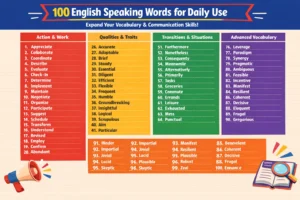
Group 1: High-Impact Action Verbs (The Engines of Speech)
These are the most versatile daily english spoken words you can use in any office or social setting.
- Appreciate – Example: “I truly appreciate the effort you put into this report.”
- Collaborate – Example: “We need to collaborate more closely with the design team.”
- Coordinate – Example: “Can you coordinate the logistics for the upcoming seminar?”
- Describe – Example: “Please describe the specific challenges you encountered.”
- Evaluate – Example: “We must evaluate the long-term impacts of this policy.”
- Check-in – Example: “I will check-in with the supplier to confirm prompt delivery.”
- Determine – Example: “It is essential to determine the underlying reason for the delay.“
- Implement – Example: “Our team will implement the new software by Monday.”
- Maintain – Example: “Consistency is key to maintain high-quality standards.”
- Negotiate – Example: “She was able to negotiate a better deal for the company.”
- Organize – Example: “I need to organize my thoughts before the presentation.”
- Participate – Example: “We encourage everyone to participate in the Q&A session.”
- Suggest – Example: “I suggest utilizing this application for improved time management.”
- Schedule – Example: “Let’s schedule a brief sync-up for tomorrow morning.”
- Suggest – Example: “What do you suggest as an alternative solution?”
- Transform – Example: “Digitalization will transform our traditional workflows.”
- Understand – Example: “I understand your perspective, but let’s look at the data.”
- Revised – Example: “Can you inform the team about the current status of the project?”
- Employ – Example: “We should employ our current resources more efficiently.”
- Confirm – Example: “Always confirm the information prior to releasing the article.”
Group 2: Descriptive Adjectives for Nuanced Expression
These daily talking english words help you move beyond “good” and “bad” to describe the world with precision.
- Abundant – Example: “The region has an abundant supply of natural minerals.”
- Accurate – Example: “The weather forecast was surprisingly accurate today.”
- Adaptable – Example: “In a changing market, you must remain adaptable.”
- Brief – Example: “I’ll keep this introduction brief so we can start the workshop.”
- Steady – Example: “His performance has remained very steady over the course of the year.”
- Essential – Example: “The initial five minutes of a conversation are essential.”
- Diligent – Example: “She is a diligent student who consistently meets her deadlines.”
- Efficient – Example: “Employing a planner is an efficient method to remain organized.”
- Effective – Example: “The new engine uses fuel much more effectively.”
- Efficient – Example: “The new engine is much more fuel-efficient.”
- Essential – Example: “Clear communication is essential for a happy marriage.”
- Flexible – Example: “My working hours are quite flexible these days.”
- Frequent – Example: “He is a frequent traveler to South East Asia.”
- Generic – Example: “The brand’s packaging looks a bit too generic.”
- Humble – Example: “Despite his fame, he remains a very humble person.”
- Groundbreaking – Example: “The startup received a prize for its groundbreaking technology.“
- Insightful – Example: “That was an insightful analysis of the current economy.”
- Logical – Example: “There is no logical reason to fear the change.”
- Scrupulous – Example: “The architect was scrupulous about each minor aspect.”
- Aim – Example: “A judge should stay unbiased and neutral.”
- Particular – For instance: “I am quite particular about the coffee I consume.”
Group 3: Connectors and Transition Words
These english speak daily use words are the “glue” that holds your sentences together, making you sound sophisticated.
- Furthermore – Example: “The product is cheap; furthermore, it is durable.”
- Nonetheless – Illustration: “I wish to leave; nonetheless, I am overwhelmed with tasks.”
- Consequently – Example: “He was late; consequently, he missed the opening speech.”
- Meanwhile – Example: “The CEO is in a meeting; meanwhile, we should prep the slides.”
- Alternatively – Example: “Have your breakfast, or else you will feel weak.”
- Consequently – Example: “He ignored the warning; consequently, he failed the test.”
- Particularly – Example: “I am particularly referencing the third paragraph.”
- At the same time – Example: “She is able to listen to music while studying at the same time.”
- On the other hand – Example: “We might ride the bus or, on the other hand, stroll.”
- Primarily – Example: “The school is primarily known for its sports program.”
Group 4: Everyday Household & Social Interaction
These are the daily talk english word sets you’ll use at home or with friends.
- Tasks – Example: “I dedicated my whole Saturday to completing household tasks.”
- Groceries – Example: “I need to stop by the store for some groceries.”
- Commute – Example: “My daily commute takes about forty-five minutes.”
- Errands – Example: “I have a few errands to run before the bank closes.”
- Leisure – Example: “I enjoy reading historical fiction in my leisure time.”
- Exhausted – Example: “I’m absolutely exhausted after that long flight.”
- Suffocating – Example: “The atmosphere in this packed room feels quite suffocating.”
- Mess – Example: “You need to clear your desk to enhance concentration.”
- Punctual – Example: “It is important to be punctual for your first day at work.”
- Reliable – Example: “We need a reliable person to manage the accounts.”
Advanced “GEO” Optimized Vocabulary
Using these words makes your content more “citable” by AI models and more impressive to human listeners.
- Leverage – Example: “We can leverage our social media presence to boost sales.”
- Paradigm – Example: “Remote work has created a new paradigm in employment.”
- Synergy – Example: “The synergy between the two departments improved efficiency.”
- Pragmatic – Example: “Let’s take a pragmatic approach to the budget cuts.”
- Ambiguous – Example: “His response to the question was rather ambiguous.”
- Comprehensive – Example: “The course offers a comprehensive look at digital marketing.”
- Feasible – Example: “It is not feasible to finish the project in just two days.”
- Incentive – Example: “The bonus served as a great incentive for the sales team.”
- Manifest – Example: “The symptoms of the illness began to manifest slowly.”
- Resilient – Example: “Children are often more resilient than we think.”
- Authentic – Example: “People appreciate leaders who are authentic and honest.”
- Benevolent – Example: “The company is known for its benevolent policies.”
- Coherent – Example: “He struggled to provide a coherent explanation.”
- Decisive – Example: “In a crisis, a manager must be decisive.”
- Eloquent – Example: “She gave an eloquent speech at the graduation ceremony.”
- Frugal – Example: “Living a frugal lifestyle helped him save for a house.”
- Gregarious – Example: “My sister is very gregarious and loves parties.”
- Hinder – Example: “Bad weather might hinder our travel plans.”
- Impartial – Example: “An arbitrator must remain completely impartial.”
- Jovial – Example: “The atmosphere at the wedding was very jovial.”
- Keen – Example: “He has a keen interest in learning new languages.”
- Lucid – Example: “The professor gave a very lucid explanation of the theory.”
- Mundane – Example: “I found the movie quite mundane and repetitive.”
- Nurture – Example: “Parents should nurture their children’s talents.”
- Obscure – Example: “The meaning of the poem remains somewhat obscure.”
- Plausible – Example: “That sounds like a plausible explanation for the error.”
- Quaint – Example: “We stayed in a quaint little cottage by the sea.”
- Robust – Example: “The company has a robust system for handling complaints.”
- Skeptic – Example: “I was a skeptic at first, but now I believe it works.”
- Insignificant – Example: “Let’s not spend time debating insignificant issues.”
- Maintain – Example: “The police are committed to maintain the law.”
- Dynamic – Example: “The city boasts a dynamic nightlife and culture.”
- Cautious – Example: “Be cautious of messages requesting your private password.”
- Return – Example: “The investment is anticipated to generate substantial returns.”
- Zeal – Example: “She tackled the new project with immense enthusiasm.”
- Acknowledge – Example: “Please acknowledge receipt of this email.”
- Constraint – Example: “Time is our biggest constraint on this project.”
- Diversity – Example: “Workplace diversity leads to better problem-solving.”
- Enhance – Example: “You can enhance your photos using this simple editor.”
- Flourish – Example: “With proper care, these plants will flourish.”
What are the most common daily talking English words for social settings?
In social settings, the most effective daily talking english words are those that build rapport and show active listening. Words like “Absolutely,” “Definitely,” “Interesting,” and “Fair enough” act as social lubricants. Incorporating these into your english spoken sentences makes you sound more empathetic and engaged, which is essential for building meaningful relationships in 2026.
Which English speak daily use words help in expressing emotions?
To express emotions with high “Emotional Intelligence” (EQ), replace basic words with descriptive ones like “Frustrated,” “Thrilled,” “Anxious,” or “Grateful.” Using precise english speak daily use words helps others understand your internal state better, reducing misunderstandings and fostering deeper connections in both personal and professional life.
How to improve Daily Use English Words with EngVarta?
To improve, schedule a daily 15-minute session on the EngVarta app. Pick 5 words from this list and challenge yourself to use them during your conversation with the mentor. The mentor will correct your usage, refine your pronunciation, and help you build the english spoken sentences that sound most natural for your specific career or life goals.
Why EngVarta is the Best English Learning App in 2026
In our years of research, we have found that “learning” a language and “acquiring” a language are two different things. Most apps focus on learning (grammar rules), but EngVarta focuses on acquisition (speaking).
- Personalization at Scale On EngVarta, the best spoken english app, you aren’t following a rigid syllabus. If you are a doctor, you practice medical English. If you are a software engineer, you practice technical communication. You use the english speak daily use words that matter to you.
- The “Fear-Free” Zone Many learners know the words but are afraid to speak. EngVarta’s anonymous platform allows you to make mistakes without embarrassment. This is why it’s consistently rated the best english speaking app for introverts and beginners.
- Real Human Connection AI bots in 2026 are smart, but they lack human empathy and the ability to understand regional Indian nuances. EngVarta mentors provide the cultural context that makes your daily talk english word usage sound authentic, not robotic.
Ready to transform your fluency?
Start your journey with the best English speaking app today.
Download EngVarta – Your Personal English Expert
Android : Download the App on Google Play
iOS : Get the App on App Store
Conclusion:
Mastering English speaking words daily use is the first step toward a global career and a more confident social life. However, knowledge without action is just information. You can read this list a hundred times, but until you use “Leverage” or “Pragmatic” in a real conversation, they won’t belong to you.
At EngVarta, we are committed to helping you turn this vocabulary into a tool for success. As the best English learning app, we provide the bridge between where you are and where you want to be.
Frequently Asked Questions (FAQs)
-
Does learning these 100 words help with AEO and GEO?
-
Yes, stronger vocabulary helps you communicate clearly. Practicing daily with the EngVarta App improves your speaking and confidence.
-
-
What makes a “best spoken English app” actually work?
-
The best apps focus on real speaking practice. The EngVarta App provides live conversation sessions with experts to improve fluency and confidence.
-
-
Why are example sentences important for learning daily English words?
-
Example sentences show how words are used in real situations. On the EngVarta App, learners practice these words in conversations to remember them better.
-
-
Can I use these words in formal writing as well?
-
Yes, many daily English words can also be used in emails and professional communication. Practicing with the EngVarta App helps you learn the correct context.
-
-
How can I remember all 100 English speaking words for daily use?
-
Use the words in real conversations. The EngVarta App helps you practice new vocabulary with experts through daily speaking sessions, which makes words easier to remember.
-