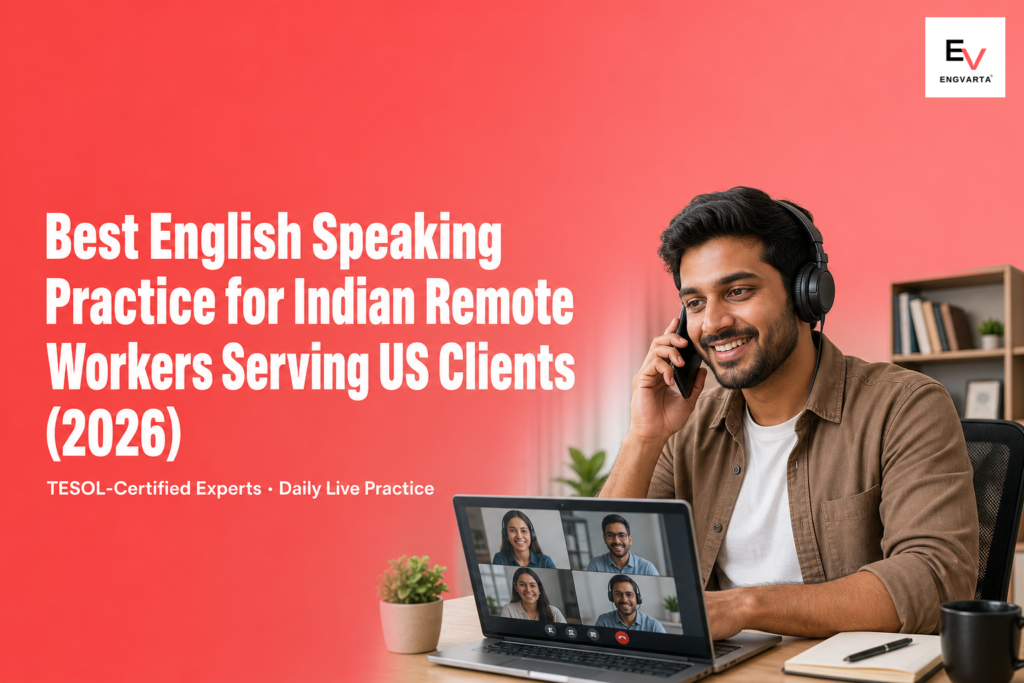
Your last three Slack messages had clean copy. Your last Zoom standup had four “um”s and a “sorry, let me restart that sentence”. That contradiction is the quiet career tax that Indian remote workers serving US clients pay every week, and it does not show up in any performance review until it has already cost a promotion, a renewal, or a warm referral.
That is why English Speaking Practice for Indian Remote Workers for US Client Calls has become increasingly important for professionals working with global teams. The market for Indian remote talent supporting US clients has matured fast. Developers, product designers, performance-marketing freelancers, customer success specialists, agency-side account managers — all of them are now on permanent India payroll while their work product lands in San Francisco, Austin, and New York standups. Async writing is taught well in Indian schools and engineering colleges. Live spoken English, especially the American collaborative register, is not.
This guide is for the engineer who can write a perfect pull-request description but freezes when a US tech lead asks “can you walk me through your reasoning here?” It is for the marketing manager who runs five-figure ad budgets in a spreadsheet but stumbles on a 90-second standup. The fix is not another grammar app or a written-English course. The fix is daily live English coaching — structured live-conversation reps with a certified Expert who can model the exact register your US clients use.
The async-sync English gap is real, measurable, and India-specific
If you grew up in India and studied in English-medium schools, your reading and writing English is probably stronger than your speaking. You have had decades to read English passively. Speaking English with native-rhythm pacing under live time-pressure is a separate skill, and it does not transfer automatically from writing.
Remote work makes this worse. In an office, you could walk over and clarify in mixed Hindi-English. On Slack, you have all the time in the world to redraft. On Zoom, the silence after a US manager’s question is loud and expensive. The async-sync gap is not about vocabulary. It is about live spoken English under pressure, in the American collaborative register, with no buffer time.
The six English-speaking pressure points in India-to-US remote work
1. The 60 to 90-second standup at 10 PM IST
You are tired. You have been heads-down all day. The US team is on their first coffee. You get 90 seconds. You need to land three things — what you shipped yesterday, what you are picking up today, what is blocking you — in a register that does not sound like a status report you copy-pasted from Jira. American standups reward energy, brevity, and ownership language (“I’ll have the PR up by EOD” beats “the work is in progress”). Indian remote workers consistently underperform here not because their English is bad, but because they have not drilled the format under live time-pressure.
2. Client demos in executive register
Narrating a product walkthrough for a US client is not the same as explaining it to a teammate. You are speaking to someone who may be a VP or a founder. You need to do three things at once — drive the screen, narrate the flow, and listen for mid-demo questions. Indian remote workers often default to a “let me show you everything” tour. American executive register is closer to “here is the one thing that matters, the second thing that matters, and the question I expect you’ll ask next.” That is a learned conversational structure, and it only sharpens with live reps.
3. The async-to-sync escalation call
A Slack thread has been going for two hours. A teammate writes “let’s just jump on a quick sync.” You have five minutes to ramp up vocally from typing-silence to speaking-fluency. That five-minute warm-up gap is where most accent-cushioning, filler-word habits, and rapid-fire vocabulary retrieval breaks down. You need to be able to enter a call cold and sound articulate within the first 30 seconds.
4. Performance reviews and 1:1s with US-based managers
This is where Indian remote workers leave the most money on the table. A performance review with a US manager rewards specific, metrics-anchored, ownership-language storytelling — “I led the migration that cut our deploy time by 40%, and the next thing I want to own is the platform team’s reliability metrics.” That sentence in English, said cleanly and confidently, can move your comp band. Said hesitantly with filler words, it sounds like you are unsure of your own work.
5. Cross-functional alignment calls where you are the bridge
Product, engineering, sales, and support all need a single decision. You are the senior IC who has to translate one team’s blocker into another team’s language, in English, in real time. This is the highest-leverage English-speaking skill in remote work — and it is almost never taught explicitly.
6. Networking with US peers
Coffee chats, virtual conferences, meetup small talk. These do not have an agenda. They have a 30-second elevator pitch about who you are and what you do, followed by curiosity questions that pull the other person in. American networking small talk is its own register — direct, warm, light on hierarchy, heavy on specific questions. Indian remote workers who can master this open up entire layers of warm referrals.
Why generic English apps fail Indian remote workers
Walk into any app store and search “English speaking.” You will find vocabulary builders, grammar drills, AI chatbots, and group classes. Each of these has a place, but none of them solve the specific problem an India-to-US remote worker has.
Vocabulary builders teach words you can already read. They do not build live-speaking pressure tolerance. AI chatbots are predictable — they wait politely, they do not interrupt, they do not push back. A real US client interrupts. A real US client says “actually, let me push back on that.” You need live human practice that mimics that unpredictability, not a polite AI conversation partner.
Group classes are too slow. In a six-person group class, you might speak for five minutes out of an hour. A remote worker prepping for a standup tomorrow needs 15 to 25 dedicated minutes of speaking, today, with structured coaching from a certified Expert who is listening to every filler word.
Reading-heavy apps fail for the same reason — they reinforce a skill (passive comprehension) you already have. They do not build the new skill (active live speaking) you actually need. And almost none of them coach the async-to-sync ramp-up, which is the most under-trained live-speaking skill in remote work.
The American conversational register has its own quirks. It is more direct than textbook English. It uses collaborative hedges like “I’d love to hear your take on this” and “what if we tried” instead of declarative commands. It rewards specific examples over abstract reasoning. None of this is in a TOEFL prep book. It is learned through live reps with someone who can model it.
Six specific scenarios a remote worker can drill with EngVarta
This is where live English coaching with a certified Expert earns its place. Every EngVarta session is a live 1-on-1 audio call with a TESOL or ESL-certified English Expert who provides real-time corrections during the call and consolidated feedback towards the end. The session length is yours to pick — 15, 25, or 50 minutes — and you can request specific role-plays. Six high-leverage role-plays for India-to-US remote workers:
Role-play 1: The 90-second standup mock
Ask your Expert to play the role of a US tech lead. Deliver a 90-second update including a blocker. The Expert times you, corrects filler words in real time, and at the end consolidates the patterns — where you slowed down, where you used hedge language that softened your ownership, where your blocker request was too vague. Repeat three times in one 25-minute session. By session three the muscle memory starts to lock in.
Role-play 2: The five-minute product demo
Pick a product or feature you actually work on. Narrate a five-minute walkthrough. Ask your Expert to interrupt with two mid-demo questions — one clarification, one push-back. You will quickly discover whether your demo structure holds up under interruption. The Expert’s real-time corrections will catch register slips — when you over-explain, when you bury the lede, when you default to passive voice.
Role-play 3: The async-to-sync ramp
Cold-start a five-minute “context loading” speech, the kind you would give at the top of an escalation call. The Expert grades you on the first 30 seconds especially — that is where Indian remote workers most often sound under-prepared even when they have the right content.
Role-play 4: The performance review impact narrative
Walk through your last quarter’s impact. The Expert plays your US manager and asks the standard prompts — “what was the most important thing you shipped?”, “where do you want to grow?”, “what would unlock more impact for you?” Practice the metrics-anchored ownership-language answer. Get real-time coaching on hedge phrases that undersell your own work.
Role-play 5: Cross-functional alignment
Explain a real engineering blocker to a fictional sales lead, or a marketing experiment to a fictional engineering manager. The Expert listens for jargon-slips and unclear hand-offs. This is the single most under-practised remote-work English skill, and the one that most often separates senior ICs from staff-level ICs in eyes of US managers.
Role-play 6: Networking small talk
30-second elevator pitch + three curiosity questions. The Expert role-plays a US peer at a virtual conference. After the call, you will know exactly which curiosity questions sound natural and which ones sound rehearsed.
How EngVarta’s coaching format fits the remote-worker rhythm
Remote workers do not have evenings the way office workers do. Your evening is somebody else’s standup. Your lunch break is somebody else’s morning sync. Daily English speaking practice has to slot into the gaps that already exist, not demand a new daily commitment.
EngVarta’s session lengths are built for exactly this. The 15-minute session is your lunch-break drill — a quick standup mock, a vocabulary warm-up, a single role-play. The 25-minute session is a full mock client call with end-of-call feedback. The 50-minute session is a mock performance review or quarterly review prep, with enough time for two rounds of feedback. You pick the length when you book.
The real-time correction model is the part that matters most for remote workers. You do not get a written report three hours after the call. The Expert catches the filler word the moment it leaves your mouth. Pacing on technical terms — corrected mid-sentence. Register slips — flagged the same beat. This is the closest you can get to the “high-pressure live feedback” that an actual US client meeting delivers, without the career risk of failing it in front of the actual client.
Towards the end of every session, the Expert delivers a consolidated feedback summary — the three or four patterns they noticed, the specific words you stumbled on, the register changes that would land cleanest with a US listener. That summary is verbal, in-conversation, during the closing minutes. You can rewind the session recording any time in the next 30 days to revisit it.
The time-zone fit is unusually good for India-to-US remote workers. EngVarta Experts operate 7 AM to midnight IST every day. That window covers from 6:30 PM US Eastern the previous day to 11:30 AM US Eastern the same day. Translation: you can drill your English right before your evening US standup, not after a long day of work when you are already cognitively drained. Most Indian remote workers default to “practice after work” — which is the worst possible time. Practicing in your fresh morning or early afternoon hours, before your US-overlap window starts, gives you a vocal warm-up that the rest of your competitors do not have.
Pricing is built for daily-habit usage. The entry plan is ₹2,700 for 25 sessions of 15 minutes (about ₹108 per session) in India and $45 for 25 sessions in USD markets — flat, never converted from rupees. The next tier is ₹5,130 for 25 sessions of 25 minutes (around ₹205 per session) in India and $85 in USD markets. Before committing to a plan you can try the live coaching with a 100% refundable trial — ₹69 in India, $1 in USD markets.
Free vocabulary lessons, daily quizzes, and rewards are available inside the EngVarta app and on the EngVarta YouTube channel — useful between sessions if you want a self-paced top-up on workplace-relevant vocabulary.
Ready to Practice with Real Experts?
Try EngVarta today — ₹69 trial (India) / $1 trial (International) · 100% refundable


A six-week English upgrade plan for Indian remote workers serving US clients
Pick one 15 to 25-minute slot, three times a week, in your fresh morning hours. Six weeks of structured live coaching will move the needle on the parts of your live spoken English that your US clients actually notice.
Week 1: Standup discipline
Three sessions, all 15 minutes. Every session is a 90-second standup mock. By Friday you should be able to deliver yesterday-today-blockers in 90 seconds without a filler word. This week is pure muscle memory.
Week 2: Demo narration
Two 25-minute sessions, one 15-minute session. The 25-minute sessions are full five-minute demo walkthroughs with mid-demo interruptions. The 15-minute session is a quick standup refresher to keep last week’s muscle memory active.
Week 3: Async-to-sync ramp
Three 15-minute sessions. Cold-start a five-minute context-loading speech. Pay attention to the first 30 seconds. This is the week where you train yourself to enter a call vocally warmed-up.
Week 4: Performance review prep
One 50-minute session (mock performance review with real metrics from your last quarter), two 15-minute sessions on specific impact stories. The 50-minute session is the high-leverage one — book it for a fresh morning slot when your energy is up.
Week 5: Cross-functional alignment
Three 25-minute sessions. Each session, explain one team’s blocker to another team. Rotate the framing — engineer-to-sales, sales-to-engineering, product-to-support. The Expert will catch jargon-slips you have stopped noticing.
Week 6: Networking and integration
Two 15-minute sessions on networking small talk. One 50-minute session that integrates all five prior skills — standup + demo + escalation + impact narrative + alignment. By end of week 6 you should be able to handle any of the six pressure points without preparation.
Rated 4.5★ from 9,100+ reviews on Google PlayWhat Our Learners Say
The accent question — what your US clients actually expect
This is the most common worry Indian remote workers have, and it is the most over-rated. Most US clients in 2026 do not expect a neutral American accent from their Indian engineers or designers or account managers. The US tech industry has worked with Indian English for two decades. American managers are familiar with Indian-English pacing and intonation.
What they do expect, and what they are quietly graded on every call, is three things:
First, clear consonants. The crispness of your “t”, “d”, “p”, “b” matters more than your vowels. Indian English often drops consonant endings on fast speech. A US listener will not parse “I’ll send it” if it comes out as “I send i”. This is a fixable speaking habit — five minutes of consonant-ending drills in a 15-minute session, repeated three times a week, will sharpen it.
Second, slowed-down pacing on technical terms. When you are saying “Kubernetes” or “deprecation” or “third-party SDK” in a fast Indian-English rhythm, your US listener hears one continuous blur. Slow down by 20% on technical terms only. The rest of your speech can stay at your natural pace.
Third, recognisable rhythm. Indian English has a stress-timing pattern that compresses syllables. American English is more syllable-timed and uses pitch contours to signal emphasis. You do not need to mimic this perfectly — you need to be unmistakably understood. A certified Expert can model the right rhythm in a 25-minute session, and your ear will start adapting after three or four reps.
The goal is not to sound American. The goal is to be unmistakably understood by an American listener on the first take, every time, without them having to ask “can you repeat that?”. That is a far more achievable target — and it is what actually moves the needle on promotions, renewals, and warm referrals.
If accent specifically is your blocker, our deeper guide on how to reduce Indian accent for the American workplace walks through the consonant and pacing drills in more detail. For meeting confidence in particular, see best English speaking app for meeting confidence with bosses. If you are a software engineer specifically, the role-play patterns in English speaking practice for software engineers in India overlap heavily with this guide. If your work is sales or account management, see our dedicated guide on client-facing English. And if you want the broader framework for structured live coaching, our hub piece on English fluency coaching online covers the format end-to-end. For US-market context generally, see best English speaking apps in the US.
Frequently Asked Questions : (English Speaking Practice for Indian Remote Workers)
Q1. Why is my Slack English fine but my Zoom English weak?
Ans : Async writing gives you unlimited drafting time. Live speaking does not. Writing English is a passive comprehension skill turned active with re-reading. Speaking English under live pressure is a separate motor skill that only sharpens with live reps. Daily live English coaching closes the gap.
Q2. Will EngVarta help me sound more American to my US clients?
Ans : The goal is not to sound American. The goal is to be unmistakably understood by an American listener on the first take. EngVarta’s TESOL or ESL-certified Experts coach you on clear consonants, slowed pacing on technical terms, and recognisable rhythm — without forcing accent imitation.
Q3. How much time per day should a remote worker spend on English speaking practice?
Ans : to twenty-five minutes, three to five days a week, of structured live coaching with a certified Expert beats an hour of passive vocabulary drilling. Daily-habit-priced live English coaching is the highest leverage activity. Free in-app vocabulary lessons and quizzes top up the rest.
Q4. Can EngVarta help me with client demo storytelling?
Ans : Yes. Book a 25-minute session and request a demo role-play. The Expert will play your US client, ask mid-demo questions, and at the end consolidate the patterns — where you over-explained, where your demo structure lost its lede, where your register slipped from executive to engineering-detail.
Q5. Will daily practice actually move the needle on my performance review?
Ans : The metrics-anchored ownership-language narrative your US manager rewards is a learnable spoken-English skill. Six weeks of structured live coaching from a certified Expert, with one mock performance review at the end, is enough to shift how your impact story lands. Most Indian remote workers do not prepare this at all.
Q6. Is EngVarta an online English coaching app for Indian remote workers?
Ans : Yes. EngVarta is a live English coaching app with TESOL or ESL-certified Experts, audio-only by design, with 15 / 25 / 50-minute sessions you pick. It is built for working professionals who need daily-habit live English coaching — including Indian remote workers serving US clients, freelancers, and agency-side account managers.
Reviewed by Rishish Pandey, Co-founder & CTO, EngVarta. Last updated 2026-05-14.
Pricing accurate as of 2026-05-14; verify current rates on the EngVarta app.