English Grammar Rules |

Tag

english grammar rules

Learn English Articles : A, An, The in Just 5 Minutes

May 19, 2025 • 16 min read • By Swati Raj

Learn English Articles: A, An, The in Just 5 Minutes

Have you ever paused mid-sentence because you weren’t sure if it’s “a umbrella” or “an umbrella”?
Or hesitated while texting because you didn’t know if it’s “a apple” or “an apple”?

These are common doubts with English Articles—A, An, and The.

They may seem like tiny words, but they can seriously affect your confidence if you’re unsure how and when to use them.

And here’s the truth: even fluent English speakers sometimes second-guess these little words.

But not after today.

In this blog, we’ll break down the grammar behind A, An, The, share real-life examples (not boring ones), and even show you when you don’t need to use articles at all. No memorization. Just logic, sound, and some fun examples.

Oh — and there’s a short video waiting for you that brings it all to life 👇
Ready? Let’s go.

👉 If you’re just starting your English journey, this guide on the best English learning apps for beginners will help you get the right tools — and mastering A, An, The is a great place to begin.

Definite Article: “The”

“The” is called the definite article because it points to a specific thing that both the speaker and listener know about.

If you’re using “the”, you’re not talking about anything—you’re talking about that one particular thing.

Use “The” when:

  • You’re referring to something unique or already mentioned
  • There’s only one of something
  • You and the listener both know what you’re talking about

Real-Life Examples:

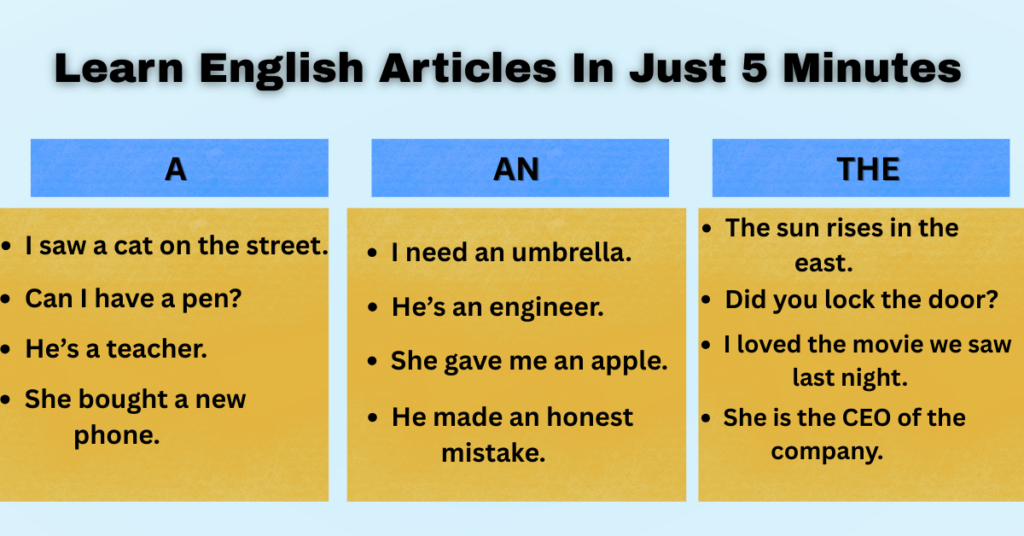
  • “The sun rises in the east.”
    → There’s only one sun. It’s universal. So we say the sun.
  • “Did you lock the door?”
    → The person you’re talking to knows which door. It’s not just any door.
  • “I loved the movie we saw last night.”
    → You’ve already talked about this movie. It’s not a random one.
  • “She is the CEO of the company.”
    → There’s only one CEO. Only one company being referred to.

Bonus Tip:

Use “the” before:

  • Superlative adjectives: the best, the tallest
  • Musical instruments: the guitar, the piano
  • Oceans, rivers, and deserts: the Ganga, the Himalayas, the Sahara

Indefinite Article: “A”

“A” is used when you’re talking about any one item, but you’re not being specific.

It’s like saying, “I don’t care which one, I just want one.”

Use “A” when:

  • The next word starts with a consonant sound
  • You’re introducing something non-specific
  • The noun is countable and singular

Real-Life Examples:

  • I saw a cat on the street.”
    → Not a specific cat, just any cat.
  • “Can I have a pen?”
    → You’re not asking for a particular pen, just any one that works.
  • “He’s a teacher.”
    → One of many teachers in the world. Nothing specific.
  • “She bought a new phone.”
    → We don’t know which phone yet.

Indefinite Article: “An”

Just like “a”, “an” also means one, but not specific.

But the only difference?

It’s used before words that begin with a vowel sound (not just a vowel letter).

Use “An” when:

The next word starts with a vowel sound (a, e, i, o, u)

The noun is non-specific, singular, and countable

Real-Life Examples:

  • “I need an umbrella.”
    → ‘Umbrella’ begins with a vowel sound: uhm-brella
  • “He’s an engineer.”
    → Begins with a vowel sound: en-jineer
  • “She gave me an apple.”
    → Not a specific apple. Just one.
  • “He made an honest mistake.”
    → Honest starts with a silent “h”, so the sound is on-est → vowel sound.

Quick Trick:

It’s about the sound, not the letter.
So you say:

  • an hour (silent “h” → vowel sound)
  • a university (“you-niversity” → starts with a consonant sound)

Omission of Articles (When NOT to Use A, An, The)

Sometimes, no article is needed at all — especially when speaking generally.

Don’t use articles with:

  • Plural or uncountable nouns (general idea)

“Cats are cute.”

“Milk is healthy.”

  • Names of people, places, companies

“Akash is my friend.”

“I visited India last year.”

“Google is a big company.”

  • Meals and time expressions

“She eats lunch at noon.”

“We’ll meet after dinner.”

  • Languages and subjects

“He speaks English.”

“Math is hard.”

Understanding the use of articles in English grammar is essential for clear and effective communication. “The” points to something specific, while “a” and “an” introduce non-specific nouns. By mastering the usage of these articles, you can enhance the precision and clarity of your English writing and conversation. Practice and exposure to the language will help you become more proficient in using articles correctly.

50+ Example Sentences: Using A, An, The Correctly

The best way to master English articles is to see them in action. Below are 55+ example sentences organized by article type — covering everyday conversations, questions, and real-life scenarios. Read them aloud to train your ear for the natural rhythm of articles.

20+ Examples with “A” (indefinite, consonant sounds)

  1. I saw a dog running in the park.
  2. She bought a car yesterday.
  3. Can you lend me a pen for a minute?
  4. He is a doctor at the city hospital.
  5. Would you like a cup of tea?
  6. I need a new laptop for college.
  7. She has a beautiful voice.
  8. There’s a cat sleeping on the sofa.
  9. He works as a software engineer.
  10. I watched a movie last night.
  11. Is there a bus stop nearby?
  12. She gave me a lovely birthday gift.
  13. I had a sandwich for lunch.
  14. He told me a funny story.
  15. We need a solution to this problem.
  16. Can I borrow a book from your shelf?
  17. She wants to buy a house in Bangalore.
  18. I saw a tiger at the zoo.
  19. He is a university student. (sounds like “you-niversity” — consonant sound)
  20. There was a long queue at the bank.
  21. She’s looking for a job in marketing.
  22. I’d like a glass of water, please.
  23. He made a mistake in the report.

15+ Examples with “An” (indefinite, vowel sounds)

  1. She is an engineer at Infosys.
  2. He ate an apple for breakfast.
  3. I need an umbrella — it’s pouring outside.
  4. It took me an hour to finish the task. (silent “h” — vowel sound)
  5. He’s an honest person you can trust. (silent “h”)
  6. She wants to become an astronaut.
  7. Can I have an orange juice?
  8. That was an interesting lecture.
  9. He is an excellent cricketer.
  10. I had an egg sandwich this morning.
  11. She bought an expensive dress for the wedding.
  12. He gave me an old book from his collection.
  13. That’s an unusual question to ask.
  14. She is an MBA graduate from IIM. (sounds like “em” — vowel sound)
  15. He made an offer I couldn’t refuse.
  16. I saw an owl sitting on the tree.
  17. She’s an artist by profession.

20+ Examples with “The” (definite article)

  1. The sun rises in the east and sets in the west.
  2. The Ganges flows through northern India.
  3. Please close the door behind you.
  4. The movie we watched yesterday was fantastic.
  5. She is the CEO of the company.
  6. The Himalayas are the tallest mountain range in the world.
  7. Can you pass the salt, please?
  8. The Taj Mahal is located in Agra.
  9. The moon looks beautiful tonight.
  10. She plays the guitar very well.
  11. He is the best student in the class.
  12. The Sahara is the largest hot desert.
  13. The book on the table belongs to Rahul.
  14. The President will address the nation tonight.
  15. I met the teacher you recommended.
  16. The Pacific Ocean is the deepest ocean.
  17. The rich should help the poor.
  18. She won the first prize in the competition.
  19. The earth revolves around the sun.
  20. Could you switch on the fan?
  21. The kids are playing in the garden.
  22. He’s the tallest person in our family.
  23. The train to Mumbai leaves at 6 PM.

Pro tip: Notice how “the” appears naturally before anything unique, previously mentioned, or specific — while “a” and “an” introduce something new. Practice saying these sentences out loud so your brain starts picking the right article automatically.

Stay Connected with EngVarta!

Follow us on our social media channels for updates, tips, and more:

Instagram :   https://www.instagram.com/engvarta.app/

Youtube :   http://www.youtube.com/@EngVarta

Facebook :   https://www.facebook.com/engvarta

LinkedIn:   https://www.linkedin.com/company/engvarta

Confused about articles? This video will fix that in 2 minutes
In this quick video, you’ll learn:

What will you learn in this video? 

1️⃣ What A, An, and The really mean

2️⃣ How to use the definite article “The”

3️⃣ When to use “A”, “An”, “The” (and when not to)

4️⃣ The one trick that makes choosing between ‘a’ and ‘an’ super easy

5️⃣ Plenty of real-life examples to ensure you get it

👉 Watch it now and never get stuck again.

Articles might be tiny, but they’re powerful.

Mastering them isn’t about memorizing a list of rules; it’s about hearing the rhythm of English and flowing with it.

Now that you know when to use A, An, and The, you’ll start noticing them everywhere. And when you use them correctly, you’ll sound more fluent, more confident, and more natural.

But don’t stop at reading.

Want to practice using A, An, The in real conversations — with real people?

On EngVarta, you can speak with live English experts who’ll gently correct your mistakes and help you gain fluency, one session at a time.

Practice grammar, pronunciation, and fluency in real time.

Download the EngVarta app and start speaking today.

Because your English deserves more than just theory — it deserves a voice.

Start Practicing Today

You’ve read the comparison. You know the numbers. The only thing left is to actually start.

Try EngVarta for ₹69. Full money-back guarantee. No risk, no booking, no excuses.

Download on Google Play →
Download on App Store →

Available on Android & iOS • 2M+ learners • 4.5★ rating

Frequently Asked Questions about English Articles (A, An, The)

What are articles in English grammar?

Articles are short words that come before nouns to specify whether you’re talking about something general or specific. English has three articles: a, an, and the. A and an are indefinite articles (used for general things). The is the definite article (used for specific things). Articles are one of the trickiest parts of English grammar for non-native speakers because their use depends on context, meaning, and sound.

When do you use ‘a’ vs ‘an’?

Use a before words that begin with a consonant sound: a book, a teacher, a university (because “university” starts with the “y” sound, not a vowel sound).

Use an before words that begin with a vowel sound: an apple, an hour (because “hour” starts with a silent “h” sound), an MBA (because “MBA” begins with the “em” sound).

The rule is about SOUND, not the letter. “An honest person” (h is silent) but “a hospital” (h is pronounced).

When do you use ‘the’?

Use the when:

  • Both speaker and listener know which specific thing you mean (“Pass the salt”)
  • You’ve mentioned the thing before (“I bought a book. The book was excellent.”)
  • There’s only one of something (“the sun,” “the President of India”)
  • Talking about specific places (“the Ganges,” “the Himalayas,” “the Indian Ocean”)
  • Using superlatives (“the best,” “the largest”)
  • Talking about musical instruments (“She plays the piano”)
  • Describing groups (“the rich,” “the poor”)

What is the difference between definite and indefinite articles?

Indefinite articles (a, an) introduce something for the first time or refer to any one of a kind. “I saw a dog in the park” — could be any dog.

Definite article (the) refers to something specific that both you and your listener can identify. “The dog in the park” — a specific dog you both know about.

Test: if you can substitute “any” or “one of many,” use a/an. If you’d substitute “this specific” or “the one we both know,” use the.

When should you NOT use any article (zero article)?

Skip articles entirely when:

  • Talking about uncountable nouns in general (“Water is essential,” not “The water is essential”)
  • Talking about plural nouns in general (“Cats are independent,” not “The cats are independent”)
  • Talking about most named cities, countries, languages, sports (“She lives in Mumbai,” “I speak Hindi,” “He plays cricket”)
  • Before meals (“for breakfast,” not “for the breakfast”)
  • Before some institutions when you mean their function (“She’s at school” — meaning attending; “She’s at the school” — meaning the building)

What are the most common mistakes Indian English speakers make with articles?

Common article errors:

  • Using “the” with general statements: “I love the music” (should be “I love music”)
  • Skipping “the” when needed: “He is going to airport” (should be “He is going to the airport”)
  • Using “a/an” with uncountable nouns: “I need an information” (should be “I need information” or “I need a piece of information”)
  • Using “the” with most country names: “I am from the India” (should be “I am from India”)
  • Mixing up “a” and “an” based on letter rather than sound: “an university” (should be “a university”)

What is an article in English with examples?

Examples of all three article types in real sentences:

  • A (indefinite, consonant sound): A teacher walked into the classroom. I want to be a doctor. He is a clever student.
  • An (indefinite, vowel sound): An apple a day keeps the doctor away. She had an honest opinion. He is an MBA graduate.
  • The (definite, specific): The teacher explained the lesson. The sun rises in the east. The students who study daily get the best results.
  • No article (general, uncountable, named places): Honesty is important. Children love chocolate. India is a diverse country.

How do I practice English articles correctly?

To master article usage:

  1. Read 10-15 minutes of English daily and notice when articles are used (or skipped)
  2. Pick ONE article rule per week (e.g., “the” with superlatives) and use it deliberately
  3. Get feedback from a teacher or expert who can flag your specific article mistakes
  4. Practice in spoken contexts — articles are often dropped or wrongly used in casual conversation, and only feedback can correct this

EngVarta’s TESOL/ESL-certified Experts catch article mistakes in real time during 1-on-1 audio sessions, with consolidated feedback at the end of each call. The $1 refundable trial lets you experience this on a topic where you typically struggle with articles.

Are there exceptions to English article rules?

Yes — English articles have many exceptions:

  • Most countries don’t take “the” (India, Japan, Brazil), but some do (the United States, the Netherlands, the Philippines)
  • Most languages don’t take “the” (English, Hindi), but exceptions include “the King’s English”
  • Cities almost never take “the,” but “The Hague” does
  • Mountain ranges take “the” (the Himalayas), but individual mountains don’t (Mount Everest)
  • “The” is used with newspapers (The Times of India) but not magazines (Time, Newsweek)

Most exceptions are absorbed through exposure rather than memorization.

Why is using English articles correctly important?

Article errors are one of the most-noticed grammar mistakes in spoken English. While they rarely change the basic meaning of what you’re saying, repeated article errors signal “non-native speaker” to native and fluent listeners. In professional contexts (interviews, presentations, client calls), correct article use makes your spoken English sound more polished. Most working professionals can master 80% of article usage in 4-6 weeks of daily practice with feedback.
What Are the 12 Rules of Grammar?

November 5, 2024 • 12 min read • By Swati Raj

What Are the 12 Rules of Grammar?

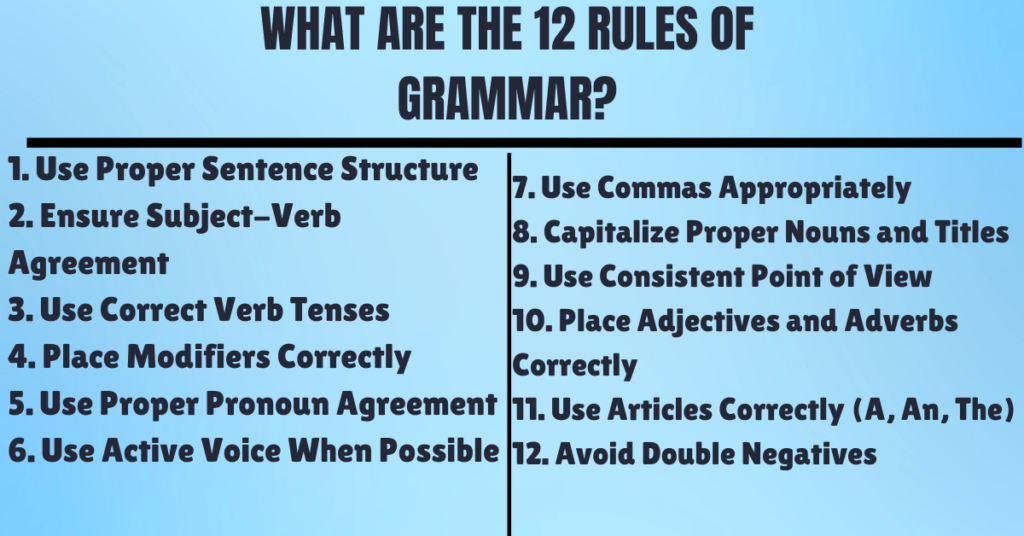
Good grammar is essential for making sure our sentences are clear, precise, and understood as we intend. Knowing a few fundamental grammar rules can help anyone, from beginners to advanced learners, improve their writing and speaking skills. Here are the 12 essential grammar rules that everyone should know.

1. Use Proper Sentence Structure

Every sentence should have at least one subject (who or what the sentence is about) and one predicate (what the subject is doing). Together, these form a complete thought. This grammar rule ensures your sentences are clear and convey a complete idea.

Example: The dog barked loudly.
Here, “The dog” is the subject, and “barked loudly” is the predicate.

2. Ensure Subject-Verb Agreement

In a sentence, the subject and verb must agree in number. This means a singular subject takes a singular verb, and a plural subject takes a plural verb. This grammar rule is key to maintaining clarity in your sentences.

Example: She walks to school. (Singular subject and verb)
Example: They walk to school. (Plural subject and verb)

3. Use Correct Verb Tenses

Verb tenses indicate when an action occurs (past, present, or future). It’s essential to use the correct tense and be consistent throughout your sentence or paragraph. This grammar rule ensures your reader or listener knows when the action is happening.

Example: He studied yesterday. (Past tense)
Example: She studies every day. (Present tense)

4. Place Modifiers Correctly

Modifiers add detail to a sentence, but they should be placed close to the word they’re modifying to avoid confusion. Misplaced modifiers can change the meaning of a sentence, so following this grammar rule is essential for accuracy.

Correct: The boy with a red hat is my friend.
Incorrect: The boy is my friend with a red hat.

5. Use Proper Pronoun Agreement

Pronouns must agree with the nouns they replace in both number (singular/plural) and gender. Following this grammar rule helps keep sentences clear and understandable.

Example: Sarah lost her book. (“Her” refers to Sarah)
Example: The students raised their hands. (“Their” refers to students)

6. Use Active Voice When Possible

In the active voice, the subject performs the action, making sentences clearer and more direct. This grammar rule can make your writing and speaking more engaging.

Active Voice: The chef prepared the meal.
Passive Voice: The meal was prepared by the chef.

7. Use Commas Appropriately

Commas help clarify meaning by separating different elements in a sentence. Use them to separate items in a list, introductory phrases, and clauses. This grammar rule is crucial for proper punctuation.

Example: After dinner, we went for a walk.
Example: She bought apples, oranges, and bananas.

8. Capitalize Proper Nouns and Titles

Always capitalize proper nouns (specific names of people, places, and things) and titles when they’re used as part of someone’s name. This grammar rule ensures correct formatting in formal writing.

Example: I visited New York City.
Example: Doctor Smith is here.

9. Use Consistent Point of View

Maintain a consistent point of view throughout a sentence or paragraph. Shifting from “I” to “you” or “he/she” within a sentence can be confusing. This grammar rule keeps the sentence focused.

Correct: I went to the market and bought some vegetables.
Incorrect: I went to the market, and you bought some vegetables.

10. Place Adjectives and Adverbs Correctly

Adjectives describe nouns, while adverbs modify verbs, adjectives, or other adverbs. Make sure they’re placed correctly to clarify what they’re modifying. This grammar rule enhances clarity.

Example: She quickly finished her homework. (Quickly modifies the verb finished)
Example: The blue car is mine. (Blue describes the car)

11. Use Articles Correctly (A, An, The)

“A” and “an” are indefinite articles and are used with non-specific nouns, while “the” is a definite article used for specific nouns. Following this grammar rule helps clarify which nouns are general and which are specific.

Example: I saw a cat. (Any cat)
Example: I saw the cat that lives in our neighborhood. (A specific cat)

12. Avoid Double Negatives

Double negatives can make sentences confusing. In English, using two negatives in the same sentence cancels each other out, making the sentence positive. This grammar rule is essential for clarity.

Incorrect: I don’t have no money.
Correct: I don’t have any money.

In Summary

These 12 grammar rules provide a strong foundation for clear, effective communication in English. Mastering them can make a significant difference in how well you express yourself, whether you’re speaking or writing. But remember, grammar alone isn’t enough. To truly build fluency, you need consistent, real-world practice. That’s where the EngVarta app comes in. It connects you with live English experts over phone calls, giving you a safe space to apply these rules in actual conversations, get instant corrections, and boost your confidence. Download the EngVarta app today and turn grammar knowledge into real communication skills. Happy learning!

Frequently Asked Questions about English Grammar Rules

What is grammar in English?

Grammar is the set of rules that governs how words combine to form sentences in a language. English grammar covers parts of speech (nouns, verbs, adjectives, etc.), tenses, sentence structure, punctuation, and word agreement. Knowing grammar helps you communicate clearly and be understood — it’s the structure underneath every sentence you speak or write.

What are the 12 basic rules of English grammar?

The 12 essential grammar rules every English learner should know:

  1. Subject-verb agreement — singular subjects take singular verbs, plural subjects take plural verbs.
  2. Use the correct tense — past, present, or future, consistently within a sentence or paragraph.
  3. Articles (a, an, the) — use them correctly with nouns to specify identity.
  4. Active vs passive voice — prefer active in most cases for clarity.
  5. Pronouns must agree with their antecedents — match number and gender.
  6. Modifiers are placed correctly — keep adjectives and adverbs near what they describe.
  7. Use prepositions correctly — different prepositions change meaning (“in” the room vs “on” the room).
  8. Capitalization rules — proper nouns, sentence starts, “I” pronoun.
  9. Punctuation — periods, commas, semi-colons, question marks each have specific uses.
  10. Conditional sentences — if/then patterns follow specific tense rules.
  11. Reported speech — direct speech to indirect speech requires tense backshift.
  12. Avoid double negatives — “I don’t know nothing” is incorrect; use “I don’t know anything.”

Why is grammar important in English?

Grammar matters because it creates clarity. Bad grammar in spoken English can change the meaning of what you’re trying to say or make you harder to understand. In professional contexts (interviews, emails, presentations), grammar errors signal lack of attention to detail. In everyday conversation, basic grammar accuracy helps native and fluent speakers process what you say without effort.

How many grammar rules are there in English?

There’s no single agreed-upon number. Comprehensive grammar reference books cover 100+ rules. For practical fluency, mastering the 12 core rules above plus 20-30 commonly-used patterns (tenses, prepositions, conditionals) is enough for most learners. Native speakers don’t consciously remember rules — they internalize patterns through exposure and use.

What are the most common grammar mistakes Indian English speakers make?

Frequent grammar errors include:

  • Using “the” with general statements (“I love the music” instead of “I love music”)
  • Confusing “since” and “for” with time expressions (“I am here since two days” — should be “for two days”)
  • Using continuous tense for stative verbs (“I am understanding” — should be “I understand”)
  • Subject-verb agreement with collective nouns
  • Mixing up “less” and “fewer” (use “less” for uncountable, “fewer” for countable)
  • Using “only” or “also” in the wrong sentence position

How can I improve my English grammar quickly?

To improve grammar in 4-8 weeks:

  1. Pick ONE grammar rule per week and use it deliberately in conversation and writing
  2. Read sector-relevant English content daily (news, blogs in your industry) — exposure cements patterns
  3. Get feedback from a teacher or expert who can flag specific mistakes you make
  4. Practice grammar in spoken contexts, not just written drills
  5. Track your most common errors in a notebook and review weekly

Grammar improves fastest when used in real conversation with someone who corrects you. Daily live practice with a TESOL/ESL-certified Expert (like through EngVarta’s $1 refundable trial) catches errors as you make them, which is more effective than self-study alone.

What is the difference between grammar and syntax?

Grammar is the broader set of rules covering all aspects of language structure (parts of speech, tense, agreement, articles, etc.). Syntax is specifically about how words are arranged in a sentence — the word order. Grammar includes syntax. For example, “The cat sat on the mat” follows English syntax (Subject-Verb-Object). Saying “Sat the cat on mat the” violates syntax even though all words are correct.

How long does it take to master English grammar?

Reaching solid functional grammar — where most of your spoken and written English is accurate — typically takes 6-12 months of consistent practice for intermediate learners. Mastering nuance (when to break grammar rules for style, regional variations, formal vs casual register) takes 2-4 years of immersion or deliberate practice. The 12 core rules above can be learned in 2-4 weeks; internalizing them takes longer.

What is the best way to practice English grammar?

The most effective grammar practice combines:

  • Live conversation with someone who corrects you in real time (1-on-1 with an expert is ideal)
  • Reading 30 minutes a day in English at your level
  • Listening to native English content (podcasts, shows) for natural rhythm
  • Writing short pieces and getting feedback
  • Targeted drills on your weakest areas (don’t just practice what you’re already good at)

Are grammar rules different in spoken English vs written English?

Yes — spoken English is more flexible. Native speakers regularly use sentence fragments, contractions (“gonna,” “wanna”), informal sentence endings, and start sentences with “And” or “But.” These would be flagged as errors in formal writing but are perfectly natural in conversation. Knowing both registers — formal grammar for writing and presentations, conversational grammar for everyday speech — is what fluent speakers do.

Active and Passive Voice in English Grammar

October 27, 2023 • 13 min read • By Richa

Active and Passive Voice in English Grammar


Active and Passive Voice in English Grammar

Understanding the difference between active and passive voice is one of the foundations of clear English writing and confident spoken English. This guide explains what each voice means, when to use it, how to convert between them, and gives 20+ practical examples to help the rules stick.

Hello, grammar enthusiasts and language learners! 

In today’s enlightening blog, we’re unraveling the mysteries of “Active and Passive Voice in English Grammar.” 

Have you ever wondered why we use active and passive voice in sentences? What’s the difference, and when should you use each one? We’re here to demystify this essential grammatical concept. 

Active and passive voice are two essential components of English grammar that determine how sentences are structured. These voices impact the clarity and focus of your writing, making it essential to grasp their distinctions. In this article, we will explore the differences between active and passive voice, understand when to use each, and examine their impact on communication.

Active Voice

Active voice is the most common and straightforward way to construct a sentence in English. In an active voice sentence, the subject of the sentence performs the action, and the object receives the action. This results in clear and direct communication. For example:

  • The cat (subject) chased (verb) the mouse (object).

In this sentence, it is clear that the cat is the one doing the chasing.

Passive Voice

Passive voice, on the other hand, shifts the focus from the doer of the action to the receiver. In passive voice sentences, the object of the action becomes the subject of the sentence. The agent (the one performing the action) may or may not be mentioned. For example:

  • The mouse (subject) was chased (verb) by the cat.

In this passive voice sentence, the focus is on the mouse and the action it endured, but the cat, the agent of the action, is not explicitly mentioned. This is a key characteristic of passive voice.

When to Use Active Voice

  • Clarity: Active voice is generally preferred when clarity is crucial. It leaves no room for ambiguity, making it easier for the reader to understand who is performing the action.
  • Directness: Active voice is more direct and concise, which is often desirable in both written and spoken communication.
  • Emphasis: Active voice allows you to emphasize the doer of the action. If you want to highlight the subject, active voice is the way to go.

When to Use Passive Voice

  • Focus on the Receiver: Passive voice is used when the focus needs to be on the receiver of the action rather than the doer. This can be helpful when the doer is unknown or less important.
  • Formal Writing: In formal writing, such as scientific reports or academic papers, passive voice is often used to maintain objectivity.
  • Variety and Style: Using passive voice strategically can add variety to your writing and alter the flow, creating a unique style.


Let’s have a look at a video where we have provided clear explanations, practical examples, and insights into when and why you should use Active and passive voice. Our goal is to make grammar learning not just informative but also empowering. By the end of this video, you’ll have a solid grasp of active and passive voice, enabling you to express yourself with precision and style.


Conclusion

Both active and passive voices have their place in the English language, and choosing the right one depends on your communication goals. Active voice is straightforward, clear, and direct, making it suitable for most situations. Passive voice, on the other hand, offers versatility, allowing you to control the focus of your sentence and convey information differently. By understanding when and how to use each, you can enhance the effectiveness of your writing and communication.


At EngVarta, we believe that understanding grammar is the key to effective communication, one voice at a time! Thank you for being a part of our language-loving community! But don’t stop here! Engvarta provides a unique platform for practicing your English language skills with live tutors. With Engvarta, you can practice your pronunciation, grammar, and conversation skills with expert tutors from around the world. So, start practicing on Engvarta today and take your English skills to the next level. Download the app for one on one spoken English practice with live English experts: https://engv.in


We’re here for you if you are passionate about speaking English. Engvarta app is an English learning app that connects you with live English Experts to help you with daily English practice. 

Subscribe to our YouTube channel for more videos about improving your communication skills – https://www.youtube.com/@EngVarta

Frequently Asked Questions about Active and Passive Voice

What is active voice in English grammar?

Active voice is when the subject of a sentence performs the action. For example: “The teacher explains the lesson.” The subject (the teacher) does the action (explains), and the object (the lesson) receives it. Active voice is the most direct way to construct a sentence in English and is generally easier to read.

What is passive voice in English grammar?

Passive voice is when the subject of a sentence receives the action rather than performs it. For example: “The lesson is explained by the teacher.” Here, the subject (the lesson) is acted upon, and the doer (the teacher) is moved to a “by” phrase or sometimes omitted entirely. Passive voice shifts the focus to the action or its result rather than the doer.

What is the difference between active and passive voice?

The key difference is who performs the action. In active voice, the subject acts (the cat chased the mouse). In passive voice, the subject is acted upon (the mouse was chased by the cat). Active voice is more direct and uses fewer words. Passive voice emphasizes the action or the receiver and is common in scientific, formal, or legal writing where the doer is unknown or less important.

How do you change a sentence from active voice to passive voice?

Three steps to convert active to passive:

  1. Move the object of the active sentence to the subject position.
  2. Change the verb to its past participle form with the appropriate “to be” verb (am, is, are, was, were, will be, has been, etc.).
  3. Move the original subject to a “by” phrase, or omit it if not needed.

Example: Active — “The chef cooked the meal.” → Passive — “The meal was cooked by the chef.”

What are some common examples of active and passive voice?

  • Active: She wrote the email. → Passive: The email was written by her.
  • Active: The team won the match. → Passive: The match was won by the team.
  • Active: The architect designed the building. → Passive: The building was designed by the architect.
  • Active: They will announce the results tomorrow. → Passive: The results will be announced tomorrow.
  • Active: People speak English in many countries. → Passive: English is spoken in many countries.

When should you use active voice vs passive voice?

Use active voice when: you want clear, concise, direct communication (most situations); the doer is important; you’re writing for general readers or business contexts.

Use passive voice when: the doer is unknown or unimportant (“The window was broken.”); you want to emphasize the action or result; you’re writing in formal, scientific, or legal style; you need to avoid blame or shift focus deliberately.

What are the rules of active voice?

The basic rule of active voice is the Subject + Verb + Object (SVO) order: the subject performs the action expressed by the verb on the object. To write strong active sentences: lead with a clear subject (avoid “There is” or “It is” openings); use strong action verbs rather than forms of “to be”; keep the doer-action-receiver order direct; and check that the subject and verb agree in number.

Why does using active voice usually improve writing?

Active voice makes writing clearer, more direct, and more engaging. Most readers process active sentences faster because the doer-action-receiver order matches how we naturally think and speak. In professional contexts (emails, reports, presentations), overusing passive voice can make writing sound stiff, evasive, or unclear. Active voice also typically uses fewer words. Use passive voice deliberately, not by default.

How can I practice active and passive voice for spoken English?

For everyday spoken English, active voice dominates because it’s faster and clearer. Daily live practice with a TESOL/ESL-certified Expert helps you internalize when each voice fits best — switching naturally between casual conversation (active-heavy) and more formal contexts like presentations or interviews (where passive voice has its place). EngVarta connects learners with certified Experts for live 1-on-1 audio practice, with real-time corrections during the call and consolidated feedback at the end. The $1 refundable trial lets you experience this on a real grammar topic before committing.

Is active voice always better than passive voice?

No. Active voice is preferred in most situations because it’s clearer and more direct, but passive voice has legitimate uses: when the doer is unknown (“The painting was stolen overnight”), when the action matters more than the doer (“Penicillin was discovered in 1928”), in scientific writing for objectivity, and when you want to soften a statement (“Mistakes were made”). Strong writing uses both — active voice as the default, passive voice when the rhetorical situation calls for it.