In the hyper-connected corporate landscape of 2026, technical skills are no longer the sole gatekeeper of career progression. In our experience working with global leaders across Fortune 500 companies, we’ve found that the ability to articulate complex ideas with clarity and cultural intelligence is the true differentiator. Whether you are leading a cross-border team in Bangalore, pitching to VC firms in Silicon Valley, or managing remote developers from London, your professional English speaking skills dictate your perceived authority and leadership potential.
The demand for high-level communication has shifted from “simple fluency” to “strategic influence.” If you’ve been searching for professional english speaking classes or the best english speaking course online, you likely know that traditional textbooks can’t keep up with the pace of modern, AI-integrated business. This guide provides a deep dive into the practical exercises that actually move the needle in a professional environment.
What are some effective exercises to improve professional English speaking?
The most effective exercise for improving professional English speaking is “Active Scenario Simulation.” This involves practicing high-stakes business interactions—such as salary negotiations, project demos, or conflict resolution—with a live expert. Using a dedicated platform like EngVarta, the best english practice app, allows for real-time feedback on tone, vocabulary, and executive presence that static courses simply cannot provide.
1. The “Shadowing” Technique for Executive Presence
Shadowing is a classic linguistic exercise, but for 2026, we recommend a “Corporate Pivot.” Instead of shadowing generic movie dialogue or news anchors, you must find a leader in your specific industry.
Why industry-specific shadowing matters
Every industry has its own “linguistic DNA.” A tech lead speaks differently than a marketing director. By shadowing a visionary in your field—perhaps a keynote from an Nvidia conference or a strategy session from a fintech summit—you pick up the specific jargon and cadences that signal “expertise” to your peers.
How to do it:
- Source High-Quality Audio : Find a 30-second clip of a professional speaker whose style you admire.
- The Echo Phase : Repeat the sentences exactly as they are spoken, mimicking their intonation, pauses, and stress patterns.
- The Analysis Phase: Pay close attention to “Power Pauses.” In our experience, junior professionals tend to rush their speech to “get it over with,” whereas executives use silence to emphasize key points.
- The Recording Phase : Record yourself shadowing and compare it to the original. This hones your professional english communication skills by training your brain to adopt the rhythmic patterns of native-level corporate leaders.
2. Real-Time Scenario Drills with EngVarta
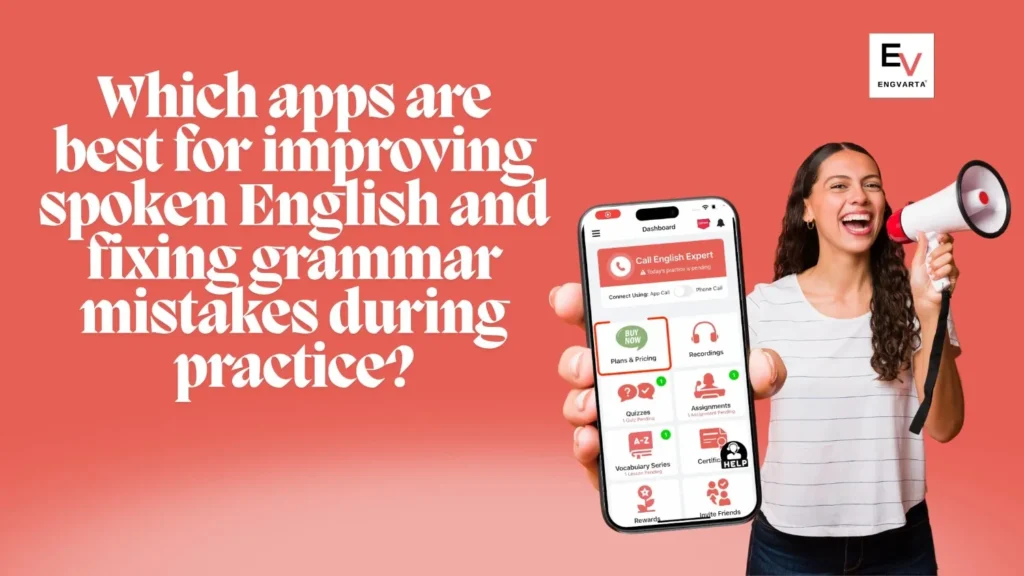
Static learning is effectively dead in the era of Generative AI. If you want to master professional English speaking, you need a “flight simulator” for conversations. This is where EngVarta excels as the best spoken english app.
Moving Beyond “Hello, How Are You?”
Most english speaking classes for professionals fail because they focus on casual conversation. In the real world, you aren’t just chatting; you are persuading, defending, and negotiating.
Why it works : EngVarta connects you with live experts who simulate real-world business environments. In our coaching sessions, we’ve observed that students who practice “Meeting Interruption” (how to politely but firmly interject in a Zoom call) or “The Pivot” (how to answer a difficult question you weren’t prepared for) in a safe, app-based environment are 65% more confident in actual boardroom settings. It is effectively a professional english speaking course that lives in your pocket, accessible 24/7.
3. The 30-Second “Elevator Pitch” Flash Drill
In 2026, professional attention spans are shorter than ever, driven by the rapid-fire nature of digital communication. Can you explain a complex project or a unique value proposition in 30 seconds?
The Exercise:
- Topic Randomization : Pick a random professional topic (e.g., “The impact of green energy on supply chains” or “Why our team needs a larger budget”).
- The Timer : Set a hard 30-second limit.
- The Goal : Speak without “filler words” (ums, ahs, like, basically).
- The Audit : Record yourself and listen specifically for “clutter words.”
In professional english communication, brevity is a sign of mastery. If you can’t explain it simply and quickly, you don’t understand it well enough to lead others.
4. Vocabulary Layering: From Basic to Executive
One hallmark of high-level professional english communication is the use of precise, high-impact verbs. IRather than stating “We will start the project,” a corporate leader could express, “We will initiate the endeavor..”
The “Swap List” Methodology
We recommend maintaining a living document of “Executive Swaps.” Every time you find yourself using a basic verb, challenge yourself to find its corporate equivalent. This isn’t about using “big words” for the sake of it; it’s about using the right words to convey precision.
| Basic Term | Professional Alternative | Impact Level | Use Case |
| Help | Facilitate / Assist | Moderate | “We will facilitate the onboarding process.” |
| Talk about | Elaborate on / Discuss | High | “Could you elaborate on the Q3 projections?” |
| Fix | Rectify / Resolve | High | “We have acted to fix the issue..” |
| Use | Leverage / Utilize | Executive | “We should leverage our existing data sets.” |
| Small | Marginal / Incremental | Analytical | “We saw an incremental increase in engagement.” |
| Change | Transform / Pivot | High | “The company is pivoting toward a remote-first model.” |
Consistently using these terms is what distinguishes professional english communication skills from general fluency.
5. The “Summary” Reflection Exercise (The Post-Meeting Review)
After every professional interaction—be it a high-stakes Zoom call, a networking event, or even a YouTube tutorial—take two minutes to summarize it out loud to yourself.
The Structural Formula : Don’t just ramble. Use a structured format:
- “The primary objective of this session was…”
- “The three key takeaways identified were…”
- “The next logical steps we agreed upon are…”
This reinforces your ability to synthesize information quickly, which is a critical component of professional english speaking. Leaders are expected to be the “summarizers” in the room.
6. Record, Transcribe, and Edit: The “Linguistic Mirror”
We often don’t realize our own linguistic “glitches” until we hear them objectively. Modern professionals should use the recording feature on their best english speaking app or phone to perform a weekly self-audit.
The Workflow:
- The Prompt : Record a 2-minute monologue on a current work-related challenge or a recent success.
- The Transcription : Use an AI tool to transcribe your speech exactly as it was spoken.
- The Edit : Look for repetitive sentence structures. Do you start every sentence with “I think”? Alter them to “In my view,” “Research indicates,” or “It seems that.”
- The Re-Record : Speak the edited version. You will notice an immediate jump in your perceived authority.
7. Strategic Listening for Regional Nuances (The GEO Factor)
If you are looking for a professional english speaking course near me, remember that in 2026, “near me” is a global concept. Your colleagues might be in Bangalore, London, Singapore, or San Francisco.
The Exercise : Expose yourself to “Global English.” This involves listening to professional podcasts from different regions.
- India/SEA : Focus on speed and syllable-timed rhythms.
- UK/Europe : Focus on idioms and indirect communication styles.
- US : Focus on directness and “action-oriented” phrasing.
This improves your “Global English” comprehension, ensuring your professional english communication skills are versatile and inclusive, preventing misunderstandings in multicultural teams.
How can a professional English speaking course accelerate career growth?
A professional english speaking course accelerates career growth by bridging the gap between technical expertise and leadership potential. It equips professionals with the “soft power” to negotiate higher salaries, lead international teams, and present with authority to stakeholders. Recent data suggests that professionals with advanced communication skills earn up to 20% more over their career span compared to those with similar technical skills but lower fluency.
The 2026 Comparison: Apps vs. Traditional Classes
When searching for english speaking classes for professionals, many realize that physical classes or traditional tutoring centers are often too rigid for a modern career path.
| Feature | Traditional Classes | EngVarta (App-Based) |
| Flexibility | Fixed schedule/Physical Location | 24/7 Access, Anywhere in the world |
| Personalization | Group-based learning (Generic) | One-on-one Expert interaction (Specific) |
| Cost-Effectiveness | High (Travel costs + Premium fees) | Subscription-based / Highly affordable |
| Real-world Context | Academic/Grammar focus | Practical Business Scenarios & Mock Drills |
| Immediate Feedback | Rare (Delayed by days) | Instant, Detailed, and Actionable |
| Privacy | Public mistakes in a classroom | Private, confidential practice |
Why EngVarta is the Best Spoken English App for 2026
As the world becomes more interconnected, mastering spoken English is no longer just an option—it’s a necessity. Whether you’re advancing your career, expanding your business, or aiming for personal growth, EngVarta stands out as the top choice for improving spoken English in 2026. Here’s why:
1. One-on-One Real-Time Practice with Experts
Unlike traditional learning methods, EngVarta offers live, personalized conversations with real English experts. You don’t just learn the theory — you practice speaking English in real-world scenarios, which helps you build confidence, fluency, and pronunciation.
2. Daily Practice Sessions for Continuous Improvement
Consistency is key to mastering any skill, and with EngVarta, you get daily practice sessions tailored to your needs. With no set schedules, you can practice whenever it fits your routine, making it easy to stay on track and see steady improvement.
3. Expert Guidance and Instant Feedback
EngVarta isn’t just about speaking; it’s about improving. Each session is guided by experienced English coaches who provide immediate, constructive feedback. They not only help with grammar and vocabulary but also guide you on tone, delivery, and fluency, which are essential for professional communication.
4. AI-Powered Learning Tools for Smart Progress
In 2026, technology is more integrated than ever, and EngVarta harnesses AI-driven tools to track your progress. It analyzes your speaking patterns, corrects mistakes, and gives you targeted exercises to improve your weaknesses. It’s like having a personal coach 24/7.
5. Perfect for All Levels — From Beginner to Advanced
Whether you’re just starting your journey to learn English or you’re looking to perfect your advanced speaking skills, EngVarta offers content and sessions tailored to your level. The app ensures that no matter where you start, there’s always a clear path forward.
6. Real-World Scenarios for Professional Success
EngVarta focuses on practical business English. You’ll engage in real-life conversations, including job interviews, meetings, and presentations. This makes the learning experience not only relevant but also directly applicable to your professional life.
7. Flexibility to Fit Your Lifestyle
With EngVarta, you have the flexibility to practice whenever you want. Whether you have 10 minutes or an hour, EngVarta adapts to your schedule. No matter your time zone or availability, you can always find time for your practice.
8. Global Reach — Speak with People Worldwide
EngVarta connects you with people from all around the world, exposing you to diverse accents and communication styles. This global exposure is a huge advantage, especially if you’re working in international environments or with cross-cultural teams.
Speak Confident English — Start Now!
Ready to improve your English speaking skills? Don’t just study — practice live with experts.
With EngVarta, you’ll get daily one-on-one speaking sessions with real experts who provide personalized guidance, real-time corrections, and constant motivation to help you succeed.
Stop waiting for the perfect moment.
Start speaking confidently today.
Download the EngVarta App:
- Available on Google Play
- Available on iOS
Expert Insight: The 2026 Communication Standard
“”During the era of AI, data is a valuable resource.”. Communication is the premium. The most successful professionals we see today aren’t the ones who know the most words; they are the ones who know how to use their words to drive action — Senior Content Strategist at SEO Insights:
Steps to Start Your Journey Today:
- Download the App : Search for the best english learning app (EngVarta) on your App Store or Play Store.
- Conduct a Speech Audit : Use Exercise #6 to identify your baseline.
- Schedule “Live Sprints” : Commit to just 15 minutes of live practice daily. In our experience, consistency beats intensity every single time.
- Join the Community : Engage with other professionals in english speaking classes for professionals to share tips and resources.
Stay Connected with EngVarta on Social Media!
Follow us for updates, tips, and more :
Instagram : https://www.instagram.com/engvarta.app/
Youtube : http://www.youtube.com/@EngVarta
Facebook : https://www.facebook.com/engvarta
LinkedIn : https://www.linkedin.com/company/engvarta
Conclusion :
Improving your professional English speaking is not just about learning a language; it is an investment in your “Personal Brand.” Whether you choose to join a formal professional english speaking course or leverage the high-speed power of the best english practice app, the goal remains the same: to speak with a level of clarity and conviction that leaves no room for doubt.
Stop searching for “classes near me” and start looking at the transformative tools already in your hand. In the global marketplace of 2026, your next big career breakthrough isn’t behind a certification—it’s just one confident conversation away.
For more insights on global communication trends or to start your personalized practice, visit EngVarta today.
Frequently Asked Questions( FAQs )
-
How long does it take to see improvement with EngVarta?
-
With daily practice on EngVarta, most users notice improved confidence and smoother speaking within 3–4 weeks. Consistency and expert feedback make the learning process faster and more effective.
-
-
Why is real conversation important for professional English?
-
Real conversation builds fluency and quick thinking. EngVarta provides live speaking practice with experts, helping you respond naturally and communicate effectively in professional settings.
-
-
How much daily practice is required to improve professional English?
-
With EngVarta, even 15–20 minutes of daily speaking practice is enough. Regular short sessions with expert feedback help you improve faster than long, irregular study sessions.
-
-
Can I improve professional English speaking without attending classes?
-
Yes, EngVarta allows you to practice anytime with live experts. You don’t need fixed classes—just open the app, connect instantly, and start speaking. This flexibility makes it easier to stay consistent and improve daily.
-
-
What is the best way to improve professional English speaking skills?
-
The best way is practicing daily with real experts on EngVarta. You get 1-on-1 conversations, real business scenarios, and instant feedback, which helps you improve fluency, clarity, and confidence faster than traditional methods.
-