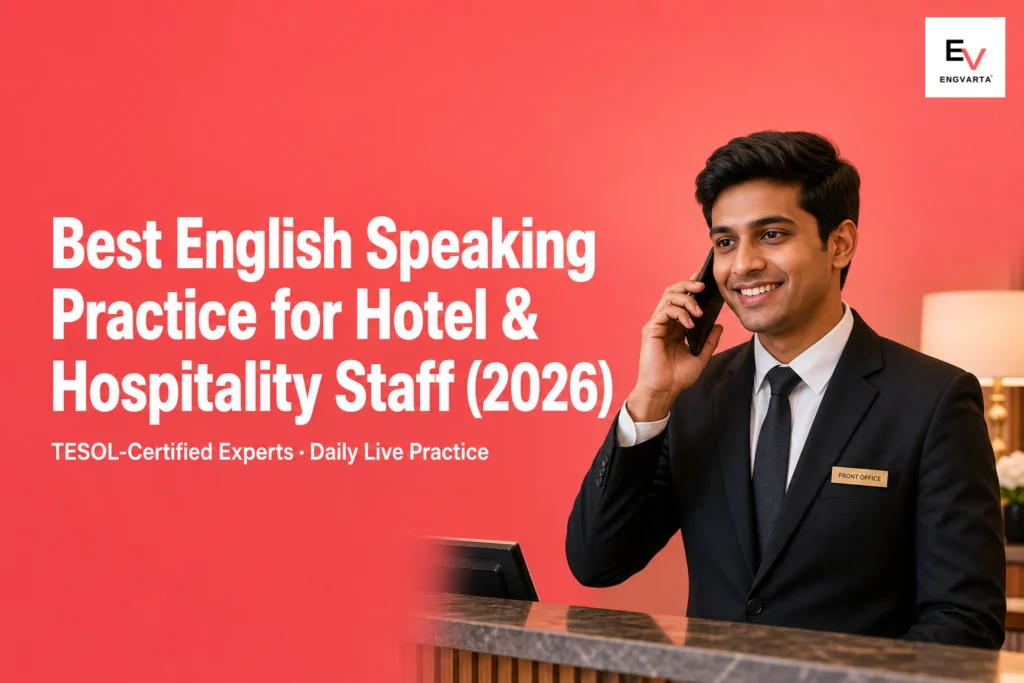
India’s hospitality industry employs over 87 million people across hotels, restaurants, airlines support, and travel services, and a large share of guest-facing roles need confident spoken English every shift. The challenge isn’t grammar — it’s responding under time pressure when a guest is impatient, switching from Hindi or a regional language mid-sentence, or handling an unfamiliar complaint without sounding rehearsed.
This guide is the practical 2026 playbook for choosing English speaking practice for hotel and hospitality staff in India — what to look for, which apps fit which role, daily drills you can run in 15 minutes, and how to track real progress instead of just course-completion certificates.
Why hotel and hospitality English is its own discipline
Generic English speaking apps optimize for casual conversation. Hospitality English has different requirements:
- Service register — polite distance (“May I help you?”, “Allow me to check that for you”), not casual (“Yeah sure”).
- De-escalation phrasing — apologizing without admitting fault, deferring without dismissing.
- Role-specific vocabulary — front desk uses different language than F&B, which uses different language than housekeeping or concierge.
- Accent flexibility — Indian hotel guests today include Americans, Brits, Australians, Germans, Japanese, Middle-Eastern travellers. Your team needs to understand multiple accents and be understood across them.
- Speed under pressure — guests don’t wait for staff to mentally translate. Fluency = response time, not vocabulary size.
A generic English course teaches the vocabulary. Practical fluency for hospitality comes from repeated live conversation with someone who can interrupt, redirect, and force you to keep talking when you stumble.
The 5 apps and practice platforms worth considering in 2026
We’ve audited the leading options against actual hospitality-staff use cases — front-desk check-in, F&B order taking, room-service phone calls, complaint resolution, concierge recommendations.
| Platform | Best for | Format | Starting price (India) |
|---|---|---|---|
| EngVarta | Front desk, F&B, concierge — live guest-style conversations with TESOL-certified Experts | 1-on-1 live calls, 15 / 25 / 50 minutes | ₹69 refundable trial · ₹2,700 / 25 sessions of 15 min |
| ELSA Speak | Pronunciation drills (great if your team’s clarity is the main blocker) | Self-paced AI feedback | Monthly subscription |
| Cambly | Casual fluency with native speakers — variable hospitality experience | 1-on-1 video calls with global tutors | Per-minute pricing |
| Duolingo | Foundational vocabulary if a team member is below intermediate | Gamified self-paced lessons | Free tier + premium |
| Local English coaching classes | Foundation-level group classroom learning — slow to translate into shift-floor fluency | Group classroom, 2–3 hours per day | Varies widely by city |
Editorial note: We’re EngVarta. We’ve structured this comparison around what hospitality teams actually need from speaking practice, and we’ve listed competitor platforms by their real strengths. Pick the platform that fits your team’s specific gap — speed-of-response (live practice), pronunciation (AI feedback), or vocabulary foundation (gamified courses).
The hospitality English speaking gap most apps miss
Most English apps for the hospitality industry teach what to say. Almost none teach how to keep talking when you don’t know what to say — and that’s the single biggest fluency gap for front-line hotel staff.
A guest at a five-star hotel in Goa once asked the concierge for “a private cooking class with a local chef who teaches traditional Konkani cuisine, somewhere on a beach, and we’d like it tonight.” The concierge had every word in his vocabulary but froze for 8 seconds. The guest noticed.
The fix isn’t more vocabulary. It’s repeated live conversation where you’re forced to fill silence — paraphrase, ask clarifying questions, propose alternatives, and keep the guest engaged while you work out the answer. That muscle only develops in real-time calls, not in self-paced apps.
What makes a good hospitality-English session
- Real-time corrections during the call — your Expert flags pronunciation issues, awkward phrasing, or wrong service register the moment it happens, not after you’ve finished talking.
- Consolidated feedback towards the end — a 5-minute summary of patterns to fix before your next session, so you walk away with one specific thing to work on.
- Scenario-based prompts — your Expert role-plays as the demanding guest, the frustrated guest, the non-native English-speaking guest, the VIP who needs upselling.
- Recording you can review — listen back to your own session within 30 days, catch hesitation patterns you didn’t notice in the moment.
- Connect time measured in minutes, not hours — practice has to fit between shifts, not require a full evening.
Role-specific daily drills (15 minutes a day)
If you have one 15-minute slot before your shift, here’s how to use it depending on your role.
Front desk and reception
- 2 minutes — Warm up by describing your last difficult guest interaction in English (no script, just talk).
- 8 minutes — Role-play check-in with an unusual request: late arrival without a reservation, room-type swap, accessibility need.
- 5 minutes — Practice the three phrases you’ll need most this week (apology + alternative, upsell to suite, late-checkout policy).
F&B service (waiters, hosts, bartenders)
- 3 minutes — Describe today’s specials out loud to your Expert as if explaining to a guest.
- 7 minutes — Handle three menu questions: “Is this dish spicy?”, “What’s good for vegetarians?”, “Can the chef modify this for my allergy?”
- 5 minutes — Practice handling a complaint about food quality without admitting fault but offering a remedy.
Housekeeping leads and supervisors
- 3 minutes — Explain a room-cleaning protocol to a new joiner (in English).
- 7 minutes — Respond to a guest’s complaint about cleanliness, missing amenities, or noise.
- 5 minutes — Practice scripted apologies that don’t sound robotic.
Concierge and guest services
- 4 minutes — Describe three things to do in your city this evening, in 30 seconds each.
- 6 minutes — Respond to an unusual request you’ve never handled before. Practice paraphrasing and proposing alternatives.
- 5 minutes — Recommend a restaurant and explain why it suits the guest’s specific preference.
How to measure progress (without certificate-chasing)
A milestone certificate is nice. What actually matters is whether your team is faster, clearer, and more confident on the shift floor next month. Track three things:
- Hesitation count per minute — record yourself once a month doing the same role-play (check-in, complaint, upsell). Count the “um”, “uh”, and silences over 2 seconds. A 40% reduction in three months is real progress.
- Guest feedback themes — are you getting fewer comments about “staff didn’t understand me” or “communication was slow”? Have your manager track this from guest surveys.
- Self-rating on three scenarios per week — rate your confidence 1-10 on: handling complaints, upselling, explaining policies. Rising trend = real fluency gain.
What hotel groups should look for when training a whole team
If you’re an HR manager, GM, or training lead choosing a platform for 20-200 hospitality staff, the criteria shift:
- Scalable 1-on-1 practice — group classes don’t deliver the per-person talk time individuals need. Look for platforms that can rotate Experts across your team.
- Refundable trials, not free trials — a paid-but-refundable trial filters serious learners from sampling-only users. Teams who pay even ₹69 show up more consistently.
- Per-shift scheduling flexibility — your team works split shifts and odd hours. The platform must support sessions at 7am, 11pm, or 3pm depending on roster.
- Manager visibility — can you see who attended, what they practiced, and feedback trends across the team?
- India + diaspora coverage — if any of your team is from Bangladesh, Nepal, Sri Lanka, or the Philippines, the platform should serve their accent context as comfortably as Indian English.
Daily habit-building beyond the practice session
The 15 minutes on a call don’t matter much if you don’t reinforce them. Cheap, repeatable daily habits that compound:
- Free vocabulary lessons + quizzes + rewards in the EngVarta app — 5 minutes between shifts, builds the active vocabulary you’ll deploy in the next live call.
- Listen to one hospitality-focused podcast episode — Hotel News Now, The Lobby, or Skift’s daily podcast. Repeat one phrase out loud per episode.
- Watch one episode of a hospitality-set show with subtitles off — White Lotus, The Bear, even Hotel Hell. The point is exposure to fast-paced service dialogue.
- Practice on the bus — silently narrate your last shift in English. Where did you stumble? Bring that phrase to your next live session.
Pricing — what realistic budgets look like
For an individual hotel staff member in India, here’s what 25 sessions of live English speaking practice typically costs in 2026:
- EngVarta: ₹2,700 for 25 sessions of 15 minutes (~₹108 / session) at the entry plan, ₹5,130 for 25 sessions of 25 minutes (~₹205 / session) at the comparable tier.
- International (USA, UAE, Canada, Singapore, Australia): $1 refundable trial · $45/month for 25 × 15-minute sessions · $85 for 25 × 25-minute sessions — flat USD pricing (not converted from INR).
- Cambly: per-minute rate that varies; pricing ladder depends on weekly minutes committed.
- Local English speaking classes: ₹2,000-₹15,000 per month depending on city and group size.
The right comparison isn’t price — it’s per-minute talk time. A 25-minute one-on-one live session gives you 20+ minutes of you actually speaking. A 2-hour classroom group session gives you 5-8 minutes of actual talk time per learner.
What Our Learners Say
Rated 4.5★ from 9,100+ reviews on Google Play
How to start this week
- Download the EngVarta app — Google Play (Android) or App Store (iOS). Suitable for kids 7+ with parent guidance.
- Try the ₹69 refundable trial — pick a 15-minute slot before or after your shift this week.
- Tell your Expert your specific role (front desk, F&B, housekeeping, concierge) so the scenarios match your daily work.
- Aim for 4 sessions in week one — that’s enough to build the muscle of being interrupted in English without freezing.
- Track your hesitation reduction over the first month using the recording feature.
Related EngVarta guides for hospitality teams
- Best English Speaking Apps for Flight Attendants, Cabin Crew & Airport Roles — sister industry with similar guest-facing English needs.
- How to Speak English Confidently at Work — Meetings, Calls & Presentations — useful for hotel supervisors and managers.
- How to Stop Freezing When Speaking English in Meetings — direct fix for the freeze-under-pressure problem.
- How to Prepare for an English Job Interview in Dubai or the Middle East — useful for staff moving to Gulf hospitality jobs.
- Mumbai English Speaking Practice for Working Professionals — city-specific guide for Mumbai-based hospitality teams.
FAQ
Which English speaking app is best for hotel and hospitality staff in India?
For working-shift practical fluency that transfers to guest interactions, live 1-on-1 platforms like EngVarta work better than self-paced apps because they force you to talk back, get interrupted, and recover under pressure. Pronunciation-focused apps like ELSA Speak are useful as a supplement if pronunciation clarity is the specific blocker.
How many sessions per week do hotel staff need to see real progress?
Four 15-minute live sessions a week, sustained for 8-12 weeks, is the typical threshold where staff report visible confidence change on the shift floor. Two sessions a week works but takes longer; one session a week is below the productive minimum.
Is EngVarta suitable for staff who are still at intermediate English?
Yes. EngVarta’s Experts are TESOL/ESL-certified and adapt session difficulty to the learner’s level. The 15-minute format is forgiving for intermediate learners — long enough for real practice, short enough not to overwhelm.
What’s the difference between EngVarta’s refundable trial and a free trial?
EngVarta offers a ₹69 refundable trial in India (and $1 internationally) rather than a free trial. The small entry fee filters out sample-only users — paid trials show up consistently. If you decide EngVarta isn’t right for you after the trial, the trial fee is refundable.
Can hotel groups use EngVarta for whole-team training?
Yes. Hotel HR teams have used EngVarta for bulk staff training. Contact EngVarta support for team plans, manager dashboards for tracking session attendance, and bulk subscription pricing.
Does EngVarta issue a certificate after the training?
EngVarta issues milestone certificates based on practice hours completed, not a curriculum-exam pass. The certificate signals consistent practice — useful for HR documentation but the real value is the fluency change, not the certificate.
Ready to Practice with Real Experts?
Try EngVarta today — ₹69 trial (India) / $1 trial (International) · 100% refundable