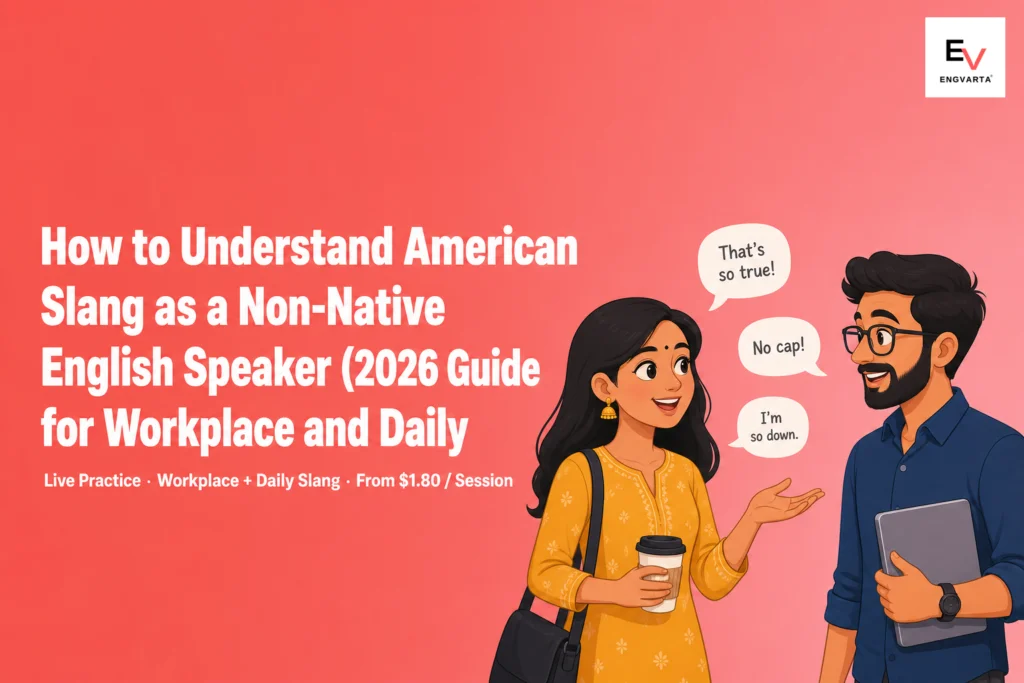
You walk out of a stand-up where your American manager said “Let’s park that and circle back tomorrow,” and the rest of the team nodded. You nodded too. You didn’t fully follow whether tomorrow is a hard meeting or a soft check-in. You spend the next ten minutes on Slack figuring out what was actually decided. This is exactly why How to Understand American Slang as a Non-Native English Speaker matters in real work scenarios.
That moment — perfectly fluent in grammar, lost in idiom — is what most non-native English speakers in the US (or working with US teams from India, Singapore, the UAE, Canada) are quietly trying to fix when they search for an “English speaking app for American slang.” This 2026 guide covers what actually
Why American Slang Is the Hidden Layer Most Courses Skip
Formal English is teachable. You can study tense, aspect, articles, modal verbs, and pass an exam on it. American workplace and social English is built on a different layer that classroom courses rarely cover:
- Idioms — phrases whose meaning isn’t the sum of the words. “Ballpark figure” doesn’t involve a stadium. “”Read between the lines” is not the same as actual reading.
- Workplace slang — “circle back,” “steel-man,” “parking lot,” “take it offline,” “ping me,” “low-hanging fruit,” “move the needle,” “deep-dive,” “table this,” “align,” and “sync up”
- Casual register fillers — “kind of,” “sort of,” “you know,” “I mean,” “like,” “anyway,” “basically,” “literally.” Native speakers use these as discourse markers; non-natives often skip them and sound stiff.
- Cultural-context phrasing — “That’s on me,” “my bad,” “no worries,” “sounds good,” “works for me,” “awesome,” “solid.” Saying “okay” instead of “sounds good” is grammatically perfect but culturally tone-deaf.
None of these are taught in school. None are well-covered by IELTS prep. They’re absorbed only through exposure plus deliberate practice with someone who can flag when you should have used the idiomatic option.
Top 6 Approaches to Master American Slang in 2026
1. EngVarta — Editor’s Pick for Live Slang Calibration
EngVarta is the live human practice slot we recommend for slang work. Each session is a 15-, 25-, or 50-minute audio call with a TESOL or ESL-certified English Expert. You speak; the Expert hears the moments where your phrasing was technically correct but unidiomatic, and offers the slang or idiom a native speaker would have used in that context.
Why it works specifically for slang:
- Live correction beats rote memorisation. Memorising 100 idioms from a list rarely sticks. Hearing “You could have said ‘let’s circle back’ instead of ‘let us discuss again later’” in the actual moment you used the stiff version — that’s how slang gets internalised.
- You can request topics that target slang directly. Pick a session topic like “workplace meetings” or “casual social conversation” and the Expert will surface the high-frequency idioms you’re missing.
- Audio-only format — no on-camera anxiety. You can practice slang from a stairwell at work, your apartment, or your commute home.
- Wide booking window — sessions across daily hours fit US time zones, Indian working hours, or Middle East / Singapore schedules.
- 30-day session recordings — replay the parts where you stumbled. Slang sticks faster the second time you hear yourself use it incorrectly and the correction next to it.
Pricing for international users : $1 refundable trial (10-minute first session). Sessions priced flat at $1.80 each. Monthly plan: $45 for 25 sessions. Pause feature for travel or deadlines.
Ready to Practice with Real Experts?
Try EngVarta today — ₹69 trial (India) / $1 trial (International) · 100% refundable


2. Active Listening at Work + Capture Habit
The cheapest tool: a notebook (or notes app) where you write three new American workplace phrases per day. Sources: your stand-up, Slack messages from US colleagues, leadership all-hands, podcasts on your commute, US-produced shows you watch in the evening.
Don’t just write the phrase — write the context. “Park it” on its own is meaningless; “Let’s park that question and come back to it after the demo” locks in both meaning and use case.
Review the captured list weekly. Pick three that match your most-common situations and use them deliberately the next week. The vocabulary moves from passive recognition into active production.
3. US Podcasts in Your Sector
Pick one US-produced podcast in your professional area — tech (e.g., Acquired, Lenny’s Podcast), business (e.g., How I Built This, Founders), finance (e.g., The Compound), management (e.g., Manager Tools). Listen 20–30 minutes per day during your commute or workout.
The point isn’t comprehension — it’s rhythm. American business podcasts have a specific cadence: hedge first, claim second, soften with humour. After 4–6 weeks of daily listening, your spontaneous English starts mirroring that cadence whether you intended it or not.
4. ELSA Speak — Pronunciation, Not Vocabulary
If your American colleagues are politely asking you to repeat yourself, the issue may be pronunciation rather than slang. ELSA Speak (~$11.99/month) is AI-driven pronunciation drilling specifically tuned to American English phonetics. It catches mispronunciations of common high-frequency words you didn’t know you were saying wrong.
Slang only lands if it’s pronounced cleanly enough that the listener can identify the phrase. ELSA fixes the pronunciation; live practice fixes the slang itself.
5. US TV Shows + Subtitles (Strategic Watching)
Casual American slang is most concentrated in workplace comedies, social dramas, and stand-up. Watching with English subtitles (not your first-language subtitles) trains your ear to associate spoken slang with its written form. After two weeks of strategic watching, you stop needing subtitles for the most common idioms.
The right shows for workplace slang: The Office, Parks and Recreation, Silicon Valley, Succession, The Bear. The right shows for casual social slang: Friends, How I Met Your Mother, Brooklyn Nine-Nine, Ted Lasso.
This works as exposure, not as a primary learning method. You’ll absorb idioms; you won’t practise producing them. Pair with live speaking practice for the production side.
6. Idiom-a-Day Apps + Browser Extensions
Several free or low-cost tools push one American idiom per day to your inbox or browser. Examples: idiom-of-the-day newsletters, Anki decks tagged for American idioms, vocabulary-builder apps that include idiom modules.
The honest read: these work as a small daily exposure habit but rarely move the needle on their own. Use as a 5-minute supplement to the higher-leverage live practice, not as your primary method.
25 High-Frequency American Workplace Phrases You Should Know
If you’re working with American teams or living in the US, these 25 are non-negotiable. Mastering them removes 80% of the “what did they just say?” moments in a typical work week:
- Circle back — revisit a topic later, usually in the same day or week.
- Park it / table it — defer a discussion to a future meeting.
- Take it offline — continue this conversation outside the current group setting.
- Ping me — send me a quick message (Slack, email, text).
- Loop in / cc — add someone to the conversation thread.
- Touch base — have a brief check-in conversation.
- Sync up / sync — align on a topic, usually verbally.
- Deep-dive — investigate something in detail.
- Move the needle — produce meaningful, measurable progress.
- Low-hanging fruit — the easiest, highest-impact opportunities.
- Game plan — the strategy or plan of action.
- Ballpark figure — a rough estimate.
- Crunch the numbers — do the math / financial analysis.
- Run the numbers — same as above.
- Bandwidth — available time/capacity to take on more work.
- Swamped / slammed — very busy.
- Heads up — advance notice or warning.
- Drop the ball — fail to do something you were responsible for.
- Get on the same page — achieve mutual understanding.
- That’s on me / my bad — I take responsibility / it was my fault.
- Win-win — outcome that benefits both sides.
- Reach out — contact someone, usually for the first time on a topic.
- Run it by — share an idea with someone for input/approval.
- Push back — respectfully disagree or resist a proposal.
- Sounds good / works for me — confirmation/agreement (warmer than “okay”).
Memorise the first 10 this week, then 10 more next week, then the last 5. Use one in a real conversation each day. By week 4, the unfamiliar layer of US workplace English is mostly familiar.
How to Learn American Slang Systematically (4-Week Routine)
Week 1: Listen and capture
- 30 minutes of US podcast/show daily. No production yet.
- Capture three phrases per day with full sentence context.
- One EngVarta session per day on neutral topics. Let the Expert flag where you sounded stiff and offer the idiomatic alternative.
Week 2: Active production starts
- Pick three captured phrases per day and use them at least once in real conversation (work, social, or in your EngVarta session).
- EngVarta session topic: pick a workplace scenario (one-on-one, team standup, client check-in). Speak the way you would in real life. Expert flags slang gaps.
Week 3: Register-switching practice
- Same volume, but consciously switch between formal (leadership review) and casual (Slack with peers) registers across the day.
- EngVarta session: ask the Expert to throw you between formal and informal scenarios mid-session.
Week 4: Stress-test
- Volunteer for the conversation you were avoiding — the leadership update, the client demo, the manager 1-on-1 about an uncomfortable topic.
- EngVarta session: rehearse the actual upcoming conversation. An expert portrays the counter-party, management, and client.
Most learners notice meaningful improvement in slang fluency by the end of week 4 with this routine. Real internalisation — the kind where idioms come out without you reaching for them — takes 3–6 months of daily practice.
What Our Learners Say
Rated 4.5★ from 9,100+ reviews on Google Play
✨ Join thousands of learners and start speaking English with confidence today!
Frequently Asked Questions ( FAQs )
Q1. What’s the best English speaking app for understanding American slang in 2026?
Ans : For learners who already speak grammatical English but want to internalise American workplace and casual slang, the highest-leverage option is daily live audio practice with a TESOL/ESL-certified Expert through an app like EngVarta ($1.80 per session, audio-only, wide daily booking window). The Expert hears the moments where your phrasing was correct but unidiomatic and offers the slang or idiom a native speaker would have used in that context. Pair with US podcasts and one captured-phrase-per-day habit for compounding effect.
Q2. Why don’t classroom English courses teach American slang?
Ans : Classroom curricula are built around grammar, formal vocabulary, and standardised exam preparation (IELTS, TOEFL, Cambridge). Slang and idioms shift too quickly and vary too much by industry, region, and generation to fit a stable curriculum. The result: graduates of classroom courses often have strong written and formal-spoken English but feel left out of casual workplace and social conversations — exactly where slang dominates.
Q3. How long does it take to sound natural with American slang as a non-native speaker?
Ans : Most learners doing 25 minutes of daily live practice plus 30 minutes of US podcast or show consumption see meaningful improvement in 4–6 weeks. Internalisation — idioms coming out without conscious recall — typically takes 3–6 months. The non-negotiable variable is daily exposure plus weekly deliberate production. Twice-a-week practice doesn’t compound for slang acquisition.
Q4. Is American slang really necessary for the workplace, or can I get by with formal English?
Ans : You can survive technical work with formal English. You’ll plateau on visibility, promotions, and informal-trust-building without idiomatic English. Most US workplace decisions happen in the informal layer — the Slack thread, the hallway chat, the lunch conversation. Professionals who only operate in formal register get respected for technical work but not invited into the strategic conversations. Idiomatic fluency is the cost of admission to the second layer.
Q5. Can I learn American slang from TV shows alone?
Ans : Watching US shows builds passive recognition — you’ll start understanding idioms when you hear them. It rarely builds active production — the ability to use the idiom yourself in a real conversation. For active production, you need live practice with someone who hears your output and corrects it. TV is the input layer; live practice is the output layer.
Q6. What’s the difference between American workplace slang and casual social slang?
Ans : Workplace slang skews toward project-management metaphors (“circle back,” “deep-dive,” “low-hanging fruit”) and softeners (“just to push back gently,” “I want to flag a concern”). Casual social slang shifts toward generation-specific phrases (“no cap,” “slay,” “bet,” “low-key,” “sus”) and emphasis fillers (“literally,” “basically,” “like”). For most working professionals, workplace slang matters more for career outcomes; social slang matters more for friendships and integration.
Q7. Does EngVarta cover American slang specifically?
Ans : EngVarta’s Experts are TESOL or ESL-certified and trained on a wide range of English variants — including American workplace and casual registers. You can request session topics like “American workplace meetings,” “casual social conversation,” or “US client calls” and the Expert will surface the high-frequency idioms you’re missing. The $1 refundable trial lets you test this on your specific gaps before committing.
Q8. Are there free apps for learning American slang?
Ans : Free options exist but tend to be passive: idiom-of-the-day newsletters, Anki flashcard decks, free YouTube playlists. They build recognition but not production. For active fluency, paid live practice through a tool like EngVarta delivers more practice time per dollar than any classroom alternative.
Editorial: This is an independent guide to American slang and the practical methods to learn it. EngVarta publishes the guide and references its own product where the use case (live human feedback on idiomatic English production) genuinely fits. No app, course, or service in this guide paid for placement, mention, or ranking. Pricing was verified at the time of writing; check provider sites for current rates.