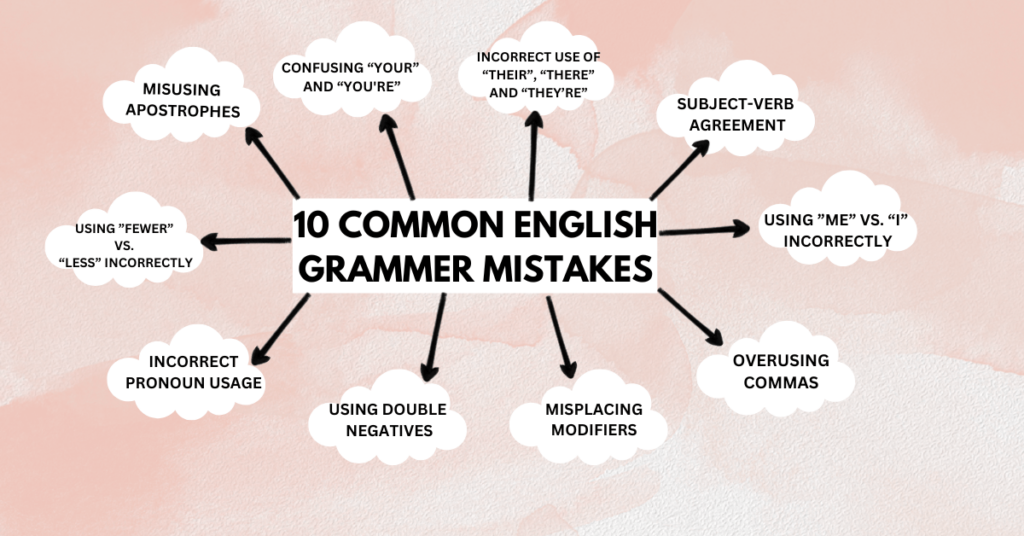
Mastering English grammar can be challenging, especially for non-native speakers. Even advanced learners often stumble over certain grammar rules. Understanding these common English grammar mistakes and learning how to avoid them can significantly improve your English communication skills. The Engvarta App, with its personalized learning sessions and expert tutors, is an excellent tool to help you tackle these errors effectively.
10 Common English Grammar Mistakes and How to Avoid Them
Misusing Apostrophes
Apostrophes are often misused, especially in possessive forms and contractions.
Mistake: Confusing “its” (possessive) with “it’s” (contraction for “it is”).
Correct Usage:
- “Its tail is long” (possessive).
- “It’s going to rain” (contraction).
How to Avoid: Practice identifying and using possessives and contractions correctly. Engvarta’s tutors can provide exercises and feedback on apostrophe usage.
Confusing “Your” and “You’re”
These two words sound similar but have different meanings.
Mistake: Using “your” when “you’re” is needed.
Correct Usage:
- “Your book is on the table” (possessive).
- “You’re going to love this movie” (contraction for “you are”).
How to Avoid: Remember that “you’re” is short for “you are.” Engvarta sessions can include practice sentences to reinforce this distinction.
Incorrect Use of “Their,” “There,” and “They’re”
These homophones can be tricky.
Mistake: Mixing up “their” (possessive), “there” (location), and “they’re” (contraction for “they are”).
Correct Usage:
- “Their house is big” (possessive).
- “The book is over there” (location).
- “They’re coming to the party” (contraction).
How to Avoid: Engvarta tutors can provide targeted exercises to practice using these words in context.
Subject-Verb Agreement
Ensuring that subjects and verbs agree in number is crucial.
Mistake: “The list of items are on the table.”
Correct Usage: “The list of items is on the table.”
How to Avoid: Regular practice with sentences that involve subject-verb agreement can help. Engvarta offers real-time feedback to correct these errors.
Using “Me” vs. “I” Incorrectly
Choosing between “me” and “I” can be confusing.
Mistake: “Me and my friend went to the store.”
Correct Usage: “My friend and I went to the store.”
How to Avoid: Remove the other person from the sentence to check if “me” or “I” fits. Engvarta tutors can offer exercises to reinforce this rule.
Overusing Commas
Commas are often used incorrectly, leading to comma splices and run-on sentences.
Mistake: “I went to the store, I bought milk.”
Correct Usage: “I went to the store, and I bought milk.” or “I went to the store. I bought milk.”
How to Avoid: Learn the rules for comma usage. Engvarta sessions can include punctuation practice to help you master this.
Misplacing Modifiers
Modifiers should be placed next to the word they modify.
Mistake: “She almost drove her kids to school every day.”
Correct Usage: “She drove her kids to school almost every day.”
How to Avoid: Practice placing modifiers correctly in sentences. Engvarta’s interactive sessions can help identify and correct misplaced modifiers.
Using Double Negatives
Double negatives create a positive statement, which can confuse the meaning.
Mistake: “I don’t need no help.”
Correct Usage: “I don’t need any help.”
How to Avoid: Recognize and avoid double negatives. Engvarta tutors can provide exercises to practice forming negative statements correctly.
Incorrect Pronoun Usage
Pronouns must agree with their antecedents in number and gender.
Mistake: “Each student must bring their book.”
Correct Usage: “Each student must bring his or her book.”
How to Avoid: Ensure pronouns agree with their antecedents. Engvarta offers detailed explanations and practice sentences to master this.
Using “Fewer” vs. “Less” Incorrectly
“Fewer” is used for countable nouns, while “less” is used for uncountable nouns.
Mistake: “There are less people here today.”
Correct Usage: “There are fewer people here today.”
How to Avoid: Practice distinguishing between countable and uncountable nouns. Engvarta sessions can include exercises to reinforce this rule.
How Engvarta Can Help
Engvarta offers a range of features that can help you avoid these common grammar mistakes:
- Personalized Learning: Engvarta provides one-on-one sessions with expert tutors who can tailor lessons to your specific needs.
- Real-Time Feedback: During your practice sessions, tutors offer immediate corrections and explanations, helping you learn from your mistakes.
- Interactive Exercises: Engvarta includes exercises that focus on common grammar mistakes, allowing you to practice and improve continuously.
- Convenience and Flexibility: You can schedule sessions at your convenience, making it easier to integrate English practice into your daily routine.
Additional Tips for Avoiding These 10 Common English Grammar Mistakes
Read Regularly
One of the best ways to improve your grammar is to read regularly. This exposes you to correct grammar usage in context, helping you internalize the rules.
Write Often
Practice writing to reinforce grammar rules. Whether it’s journaling, writing essays, or even composing emails, the more you write, the better you’ll become at avoiding common mistakes.
Use Grammar Check Tools
There are several online tools like Grammarly that can help you catch mistakes. While they shouldn’t be relied upon exclusively, they can be a great supplementary resource.
Engage in Conversations
Speaking regularly with native speakers or proficient English users can help you identify and correct your grammar mistakes. Engvarta provides a perfect platform for this kind of practice.
Review Grammar Rules
Regularly reviewing grammar rules can help keep them fresh in your mind. Make use of grammar books, online resources, and educational apps to keep learning. Two patterns most learners get wrong are voice and tense—our guide on active and passive voice in English grammar walks through both with side-by-side examples.
Seek Feedback
Don’t hesitate to ask for feedback on your writing and speaking. Engvarta tutors are there to provide constructive criticism and help you improve.
Benefits of Improving Grammar with Engvarta
Engvarta stands out as a robust platform for improving your English grammar. Here’s how:
Structured Learning Path: Engvarta offers a structured learning path that helps you progress from basic to advanced levels systematically. This ensures that you build a solid foundation and then refine your skills progressively.
Practical Applications: Engvarta’s approach is not just theoretical but also practical. You engage in real conversations, write essays, and practice through interactive exercises, which helps in better retention of grammar rules.
Expert Tutors: The tutors at Engvarta are experienced and trained to handle common grammar issues faced by learners. They provide personalized feedback, which is crucial for overcoming specific challenges.
Flexibility and Accessibility: With Engvarta, you can learn at your own pace and schedule sessions at times that suit you. This flexibility is especially beneficial for working professionals and students with busy schedules.
Confidence Building: Regular practice and feedback help in building confidence. As you see improvement in your grammar, your overall communication skills also improve, making you more confident in speaking and writing English.
Customized Sessions: Engvarta allows you to customize your learning sessions based on your specific needs and goals. Whether you need to focus on writing, speaking, or specific grammar rules, the platform adapts to your requirements.
Continuous Improvement: Engvarta tracks your progress and adapts the difficulty level accordingly. This ensures that you are always challenged and continue to improve without getting overwhelmed.
Conclusion
Avoiding 10 common English grammar mistakes is essential for effective communication in English. By understanding these mistakes and practicing regularly, you can significantly improve your language skills. The Engvarta App is an excellent resource for personalized learning and expert guidance, helping you overcome these challenges and become more confident in your English proficiency. With its structured learning path, practical applications, expert tutors, and flexibility, Engvarta provides a comprehensive solution to mastering English grammar.