Best Apps For Customer Support Communication English |

Tag

best apps for customer support communication English

Best English Speaking Practice for Customer Support Professionals (2026)

May 31, 2026 • 13 min read • By Rishish Pandey

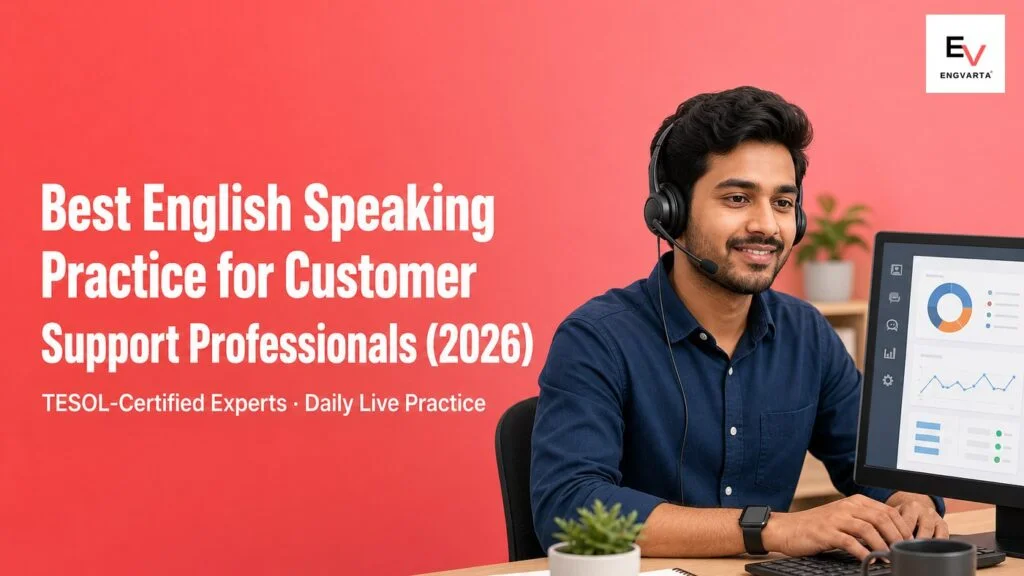
Indian customer-support professional with a headset practising spoken English — English speaking practice for customer support professionals 2026

For SaaS, ecommerce, and B2B support roles — the spoken-English skills that calm customers, handle escalations, and explain problems clearly under pressure.

Quick Verdict

Quick Verdict
For customer support professionals who freeze on live calls, EngVarta is the best fit because it gives private 1-on-1 live speaking practice where an English Expert can role-play angry customers, escalations, delay explanations, and boundary-setting. AI tools are useful for solo script rehearsal, but live role-play is better for real call pressure.

Why this verdict:

  • Best for: SaaS, ecommerce, B2B support, and customer-success professionals handling live calls.
  • Practice focus: apology language, de-escalation, delay explanation, issue clarity, and polite boundaries.
  • Not ideal for: learners who need basic vocabulary before scenario-based call practice.

Why EngVarta Fits This Use Case

Need EngVarta fit
Daily speaking reps 15-minute live 1-on-1 practice sessions.
Private correction Learners practise without group embarrassment.
Scenario practice Experts can role-play calls, interviews, meetings, and workplace situations.
Indian learner context Built for Indian professionals and learners who understand English but hesitate while speaking.

Customer Support English Scenarios to Practise

Scenario What to practise Why it matters
Angry customer Acknowledge, apologise, clarify, and move to next action. Prevents panic and defensive language.
Delay explanation Explain what happened without over-promising. Builds trust while keeping boundaries.
Technical issue Convert internal terms into simple customer language. Customers need clarity, not jargon.
Escalation Set expectations and hand off politely. Reduces conflict and repeated calls.
Screen-share support Give step-by-step instructions clearly. Improves customer confidence during live troubleshooting.

Support Call Phrases Worth Practising

Situation Better phrase
Customer is angry I understand why this is frustrating. Let me check the exact status and help you with the next step.
Need more information Could you share one example so I can understand where it is failing?
Delay I do not want to give you a false timeline. Here is what I can confirm right now.
Boundary I can help with this part, but this change needs approval from the account owner.

Why support English is its own skill (not “general fluency”)

A support professional can be perfectly competent on chat — clear written English, fast typing, good product knowledge — and still struggle the moment a call comes in. The reason is that voice support removes the three things that make text support comfortable: time to think, time to edit, and the ability to copy-paste a known phrase.

On a live call, the customer is often already frustrated, the rep has to think and speak at the same time, and the tone carries as much weight as the words. That is why support English is a distinct skill set rather than a slice of general fluency. The specific competencies it tests:

Call openings that set the tone. The first 15 seconds decide whether a frustrated customer calms down or escalates. A confident, warm opening (“Thanks for holding — I’ve pulled up your account and I can see the issue, let me walk you through it”) does more than any later apology.

Apology language that doesn’t over-promise. Saying sorry well is a craft. “I’m sorry for the trouble, and here’s exactly what I’ll do next” reassures; “I’m so so sorry, I’ll make sure this never happens again” creates a promise you may not be able to keep. Support reps need the phrasing that owns the problem without owning risk.

De-escalation under live pressure. When a customer raises their voice, the rep’s job is to lower the temperature — acknowledge, slow down, and redirect to a next step — all in real time, without sounding scripted or dismissive. This is almost impossible to learn from a script; it has to be rehearsed live.

Explaining a delay or a technical issue in plain English. “The sync failed because of an API timeout” means nothing to most customers. “The two systems didn’t talk to each other for a moment — I’ve restarted that connection and it’s syncing now” lands. Translating technical reality into reassuring plain English, fast, is a core support skill.

Holding a boundary politely. “I understand, and I’m not able to refund this, but here’s what I can do” — saying no without losing the relationship — is one of the hardest things to do under pressure, and one of the most valuable.

What actually builds these skills

None of the five competencies above improve from grammar study or vocabulary apps. They improve from rehearsing the exact situations, live, with someone who plays the difficult customer and pushes back when you over-promise or sound dismissive.

Real-time correction during the call. The value is being stopped the moment you over-apologise, use jargon, or let your tone slip — and re-saying the line correctly while the scenario is still live. EngVarta Experts correct in real time during the call and give consolidated feedback towards the end, so each session ends with a concrete list of phrasing to keep and phrasing to drop.

An Expert who can play the angry customer. This is the part AI tools cannot do convincingly. A real Expert can interrupt, raise the stakes, throw an unexpected objection, or stay silent to test your recovery — the productive pressure that builds composure. AI conversation apps tend to accept whatever you say and keep the conversation pleasant, which is the opposite of de-escalation practice.

Recordings for review. Hearing yourself handle a tough call back is uncomfortable and extremely useful — you catch the rushed apology, the jargon, the rising tone. EngVarta session recordings stay accessible for 30 days for exactly this kind of self-review.

A 2-week scenario plan for support professionals

This assumes ~15–25 minutes of daily live practice. Adjust to your schedule.

Week 1 — Openings, apologies, and plain-English explanations.

  • Day 1–2: call openings and closings; the warm, confident first 15 seconds.
  • Day 3–4: apology language that owns the problem without over-promising.
  • Day 5–7: translating technical issues into plain, reassuring English at speed. The Expert plays a non-technical customer and stops you whenever jargon slips through.
  • Week 1 milestone: you open and close cleanly, and you can explain a common technical issue in plain English without rehearsing.

Week 2 — De-escalation, escalations, and boundaries.

  • Day 8–10: de-escalation drills — the Expert plays a frustrated customer who raises their voice; you practise acknowledging, slowing down, and redirecting.
  • Day 11–12: handling escalations and transfers gracefully (“Let me bring in someone who can resolve this faster — here’s what I’ll tell them”).
  • Day 13–14: holding a polite boundary — saying no, declining a refund, or pushing back on an unreasonable demand without losing the relationship.
  • Week 2 milestone: you complete a full mock difficult call — angry opening, technical confusion, and a boundary moment — without freezing or over-promising.

What practice platforms actually fit support professionals

EngVarta — live 1-on-1 practice with TESOL/ESL-certified Experts who can role-play the difficult-customer scenarios support reps actually face. Audio-only format matches real support calls; real-time correction during the call fixes over-apologising, jargon, and tone slips while they happen; session recordings stay accessible for 30 days for self-review. Sessions of 15, 25, or 50 minutes fit a daily-rep or pre-shift warm-up model. You can connect in minutes, with a 100% refundable trial at ₹69 / $1.

Why EngVarta fits this use case:

  • TESOL/ESL-certified Experts who can play the angry or confused customer and push back
  • Real-time correction during the call, plus consolidated feedback towards the end
  • Audio-only practice that mirrors real support calls
  • Scenario drills for openings, apologies, de-escalation, escalations, and boundaries
  • Session recordings accessible for 30 days for tough-call review

AI conversation apps (Speak, ELSA Speak, ChatGPT Voice, Praktika, Loora) — useful for solo warm-up and rehearsing a script before a shift. Limitation: AI stays pleasant and accepts your phrasing, so it cannot simulate a frustrated customer, escalation, or the pressure of holding a boundary — the exact skills support work demands.

Tutor marketplaces (Cambly, Preply, italki) — also offer live practice. Trade-offs: tutor familiarity with support-specific scenarios (de-escalation, escalation language, SaaS/ecommerce context) varies widely; per-hour pricing compounds for daily reps.

Internal product training and macros — essential for product knowledge, but they teach what to say, not how to say it confidently under live pressure. Most support reps know the right answer; the gap is delivering it calmly to an upset customer on a live call.

How we chose

We evaluated each option on five factors: ability to role-play difficult-customer scenarios, real-time correction of support-specific phrasing (apology, de-escalation, boundaries), audio-only format matching real calls, scenario coverage for SaaS/ecommerce/B2B support, and pricing sustainability for daily practice. Pricing and features were checked in May 2026.

Ready to start? See how it works, explore plans and pricing, or read why EngVarta works. EngVarta offers a 100% refundable trial at ₹69 / $1.

Related guides

Frequently Asked Questions

How is this different from BPO or call-centre English practice?

BPO and call-centre roles are usually high-volume, scripted voice processes, and a script-and-accent focus often fits them well. Product, SaaS, ecommerce, and B2B support is less scripted and more problem-solving — you explain technical issues, handle escalations, and hold boundaries with paying customers in real time. This page targets that less-scripted support work; if your role is a scripted voice process, the BPO and call-centre guide is a closer fit.

How do I calm an angry customer on a call in English?

The reliable pattern is acknowledge, slow down, redirect: first acknowledge the frustration without being defensive (“I completely understand why that’s frustrating”), then slow your own pace to lower the temperature, then redirect to a concrete next step (“here’s exactly what I’ll do now”). The phrasing has to feel natural, not scripted, which is why live role-play with an Expert playing the upset customer works better than reading a de-escalation guide.

I’m fine on chat and email but freeze on calls — why?

Text channels give you time to think, edit, and reuse known phrases; a live call removes all three at once, while adding tone and time pressure. The fix is not more English knowledge — it is reps in the live, real-time format until speaking under pressure feels normal. Daily 15-minute live practice closes this specific chat-to-voice gap faster than any amount of additional reading or writing.

What English phrases should every support rep have ready?

A confident opening (“Thanks for holding — I can see the issue, let me walk you through it”), a clean apology that owns the problem without over-promising, a plain-English way to explain a delay, a graceful escalation line, and a polite boundary (“I’m not able to do X, but here’s what I can do”). Practise saying each out loud until it is automatic — having them ready prevents the freeze when a call gets tense.

Can daily 15-minute practice really improve my support calls?

Yes — support English is a reflex skill, and reflexes build by frequency. Fifteen minutes of daily scenario practice usually produces visible improvement within two weeks: cleaner openings, calmer de-escalation, and fewer jargon slips. The key is that the practice is scenario-based and live, not generic conversation — you rehearse the exact call types you handle.

Should I work on my accent or my call handling first?

Call handling first. Customers respond to clarity, tone, and whether you solve their problem — not to a regional accent. Soften any specific sounds that genuinely hurt clarity on a phone line, but spend most of your practice on openings, de-escalation, and plain-English explanation. Those move customer-satisfaction scores far more than accent work.

Which app is best for customer support professionals who need English call practice?

EngVarta is a strong fit because support professionals can practise real call scenarios like angry customers, escalations, delay explanations, and screen-share guidance in private live sessions.

Best English Speaking App for BPO and Call Center Professionals in 2026

April 28, 2026 • 8 min read • By Rishish Pandey

Indian BPO call center professional with smartphone practising English for customer calls — best english speaking app for BPO and call center professionals 2026

What BPO and call center professionals actually need

  • Neutral-accent practice. Customers in the US, UK, or Australia need to understand you without strain. This is more about clarity than “perfect” native accent.
  • Customer-call scenario roleplay. Handling complaints, upselling, de-escalating angry customers, confirming payment details — call types you will handle every day.
  • Speed + fluency. Call handle times are KPIs. Pauses hurt your average handle time (AHT). Daily fluency drills train real-time response speed.
  • Pronunciation precision. “Fifteen” vs “Fifty” on a payment confirmation is a real business problem. Sound-level drills matter.
  • Short-session flexibility. BPO shifts are unusual (nights, split shifts). You need apps that fit around rotating schedules, not fixed 6pm tutor slots.

Quick comparison for BPO professionals

App Best For Format Pricing
EngVarta Daily customer-call roleplay with certified Experts Live 1-on-1 audio $45 / 25 sessions
ELSA Speak Accent neutralisation and pronunciation AI speech recognition Free / $12/mo
BoldVoice Focused accent coaching AI + coach Subscription
Speak AI conversation practice AI voice Free / $20/mo
Cambly Native-speaker call exposure Video native tutors From $12/session
italki Business-English specialist tutors Video 1-on-1 $15-40/hour
ChatGPT Voice Free scenario rehearsal AI voice Free / $20/mo

1. EngVarta — Best for daily customer-call scenario practice

EngVarta is the most practical daily-use option for BPO professionals. Three specific reasons it fits:

  • Audio-only format matches your actual work. You will not see customers on video. You need to train voice-only — intonation, pauses, word choice — because that is all the customer has to evaluate you on.
  • Scenario flexibility. Tell the Expert at session start: “I want to roleplay an angry-customer call about a billing error” or “I want to practise upselling a premium plan.” The Expert adapts and acts as the customer.
  • Shift-friendly scheduling. No fixed booking. Press call whenever your shift break allows — 3am, 11pm, lunch break. Certified Experts available across long batch hours.

BPO teams can also use EngVarta collectively — individual employees build their own streaks, but team leads can recommend it as a scalable daily-practice tool that does not break team budgets.

  • Pricing: $45 / ₹2,700 for 25 sessions. Effectively $1.80 / ₹108 per session — sustainable for individual BPO agents or trainers recommending it to teams.

Ready to Practice with Real Experts?

Try EngVarta today — ₹69 trial (India) / $1 trial (International) · 100% refundable

What Our Learners Say

Rated 4.5★ from 9,100+ reviews on Google Play

★★★★★
The expert was continuously challenging the ideas and influencing me to elaborate the sentences. A truly enriching experience.
★★★★★
I took two months of subscription. This platform really helped me to improve my communication and get rid of the fear I had earlier. Now I can talk fully confident and without any fear.
★★★★★
Today was my first call on EngVarta. I just enjoyed the conversation. It's such a good platform for people who want to explore themselves in English speaking. I just loved it.
★★★★★
excellent app for learning fluency and If you genuinely correct your mistakes then you should opt for this
★★★★★
It is a very nice app. The expert whom I talked to is very amiable and very knowledgeable.
★★★★★
Really I love this app. It's awesome. The application as well as the speakers are very good. I'm happy to learn daily vocabulary you send in mail.
★★★★★
My last 12 sessions experience is really great. It's a great app to improve English fluency and communication skills. All experts are quite friendly and highly skilled.
★★★★★
I have been using this app since three months. I am very much satisfied with their services , experts are too good and their support team members are very supportive and helpful. I must suggest this app to everyone. Thank you Engvarta for helping me.❤️
★★★★★
Quite impressive app for learning English . I am happy that joined this planform.You can learn and grow here.
★★★★★
Wonderful app provide experts to talk but but so much time constraints in talking..
★★★★★
Nice platform to practice English speaking. Teachers are awesome. Thanks
★★★★★
I have thoroughly enjoyed the session and the expert provided me instant feedback that will definitely help me.

2. ELSA Speak — Best for accent neutralisation

ELSA is the category leader for pronunciation clarity. For BPO professionals targeting US or UK customer bases, ELSA drills the specific sounds that mark “Indian English” vs “neutral global English” — and gives you objective metrics on whether you are pronouncing them correctly.

  • Pricing : Free basic, $12 per month Pro.
  • Best as : Daily 10-minute pronunciation drill alongside live conversation practice.

3. BoldVoice — Focused accent coaching

BoldVoice takes accent coaching a step beyond ELSA with more structured curricula and real-coach feedback options. For BPO agents whose main gap is specifically accent (not vocabulary or fluency), this is a serious tool.

  • Pricing : Subscription-based, similar tier to ELSA.
  • Best for : Accent-first BPO preparation, especially for agents targeting US-based call center promotions.

4. Speak — Best AI-only scenario practice

Speak’s AI can simulate conversation scenarios on demand. Useful for BPO agents who want unlimited practice without scheduling, but AI is less realistic than live humans for complex customer scenarios.

  • Pricing : Free / $20 per month Premium.
  • Best as : A volume-of-practice supplement when live practice is not available.

5. Cambly — For native-speaker call exposure

You can communicate with real native speakers of the US, UK, and Australia with Cambly. Useful for BPO agents who specifically want to get comfortable with the accents and conversational patterns of their customer base.

  • Pricing : From $12 per session.
  • Best as : Occasional native-accent calibration, 1-2 sessions per week.

6. italki (business English tutors) — Structured specialist coaching

Book one italki tutor who specialises in business English or customer service. Useful for BPO professionals targeting management promotions who need deeper business English beyond call handling.

  • Pricing : $15-40 per hour.
  • Best for : BPO team leads and supervisors building management-level business English.

7. ChatGPT Voice — Free scenario rehearsal tool

Free unlimited AI conversation. Tell ChatGPT to roleplay a specific customer scenario — refund complaint, subscription upgrade, technical support call — and practise your response. Zero cost, useful for last-minute rehearsal before shifts.

  • Pricing : Free / $20 per month.
  • Best as : Solo rehearsal tool before difficult customer call types.

A realistic BPO professional’s daily routine

  • 20 minutes daily EngVarta : Customer-scenario roleplay with a certified Expert. Builds real-time fluency under pressure similar to actual calls.
  • 10 minutes daily ELSA : Pronunciation drill targeting the specific sounds you struggle with. Pick one sound per week.
  • 1-2 times per week ChatGPT Voice : Scenario rehearsal for any unusual call types coming up.
  • Occasional Cambly : Once every 1-2 weeks for native-accent calibration.

Most BPO agents who follow this routine report noticeable accent clarity gains in 4-6 weeks and visible AHT improvements by week 8-10 as their real-time fluency improves.

🚀 Improve your spoken English—starting today.

Get daily practice, real conversations, and career-focused guidance with EngVarta 👇

📸 Instagram : https://www.instagram.com/engvarta.app/
▶️ YouTube : http://www.youtube.com/@EngVarta
📘 Facebook : https://www.facebook.com/engvarta
💼 LinkedIn : https://www.linkedin.com/company/engvarta

✨ Speak with confidence. Communicate clearly. Grow faster—one conversation at a time.

Frequently Asked Questions : 

What is the best English app for call center agents in India?

EngVarta is the most practical daily option for Indian call center agents — shift-friendly scheduling, audio-only format matches voice call work, certified Experts can roleplay customer scenarios, and pricing ($45 / ₹2,700 for 25 sessions) is sustainable on BPO salaries. Pair it with ELSA Speak for accent neutralisation.

How do BPO agents improve accent quickly?

Two elements combined: ELSA Speak for sound-level precision drills (10 min daily) + EngVarta for real-conversation output with accent feedback (20 min daily). Most agents see meaningful clarity gains in 6-8 weeks of consistent practice. BoldVoice is an alternative to ELSA with more structured accent coaching.

Can I practise customer service English on an app?

Yes — EngVarta Experts specifically can roleplay customer scenarios. Tell them at session start: “I want to practise a refund-request call” or “I want to roleplay an angry customer.” ChatGPT Voice is a free alternative for self-paced scenario rehearsal but lacks real-human pressure.

Is EngVarta useful for BPO agents who already speak English at work?

Yes. BPO agents already speaking English often plateau because their daily work reinforces the same phrases and accent patterns. EngVarta sessions with certified Experts expose you to different registers, correct subtle errors you have stopped noticing, and push you beyond your comfort zone — which is where accent improvement and AHT reduction actually happen.

Which app helps with night-shift BPO schedules?

EngVarta is the most schedule-flexible real-human option — certified Experts are available across long batch hours, so you can practise during your shift break at 3am or before starting a night shift. AI apps (Speak, ChatGPT Voice) are available 24/7 as fallback.