Table of Contents [show]
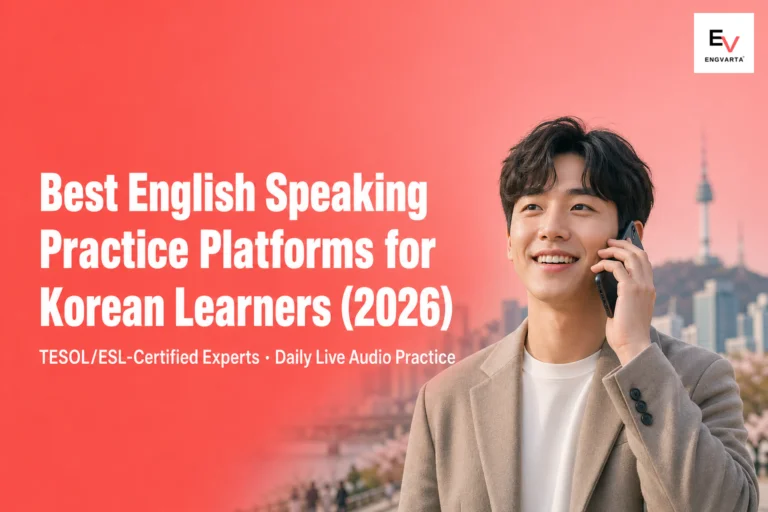
What Are the Best English Speaking Practice Platforms for Korean Learners in 2026?
For Korean adults practising English in 2026, the most useful platforms aren’t the most-marketed ones. The best english speaking app for korean learners depends on what you’re actually trying to fix — daily-conversation confidence, pronunciation precision, business-English polish, or exam preparation. After working with Korean learners on EngVarta and reviewing how Korean professionals practise outside the platform, six options stand out: EngVarta (live 1-on-1 audio with certified Experts, built for daily practice), italki (tutor marketplace with strong Korean-to-English coverage), Speak (AI conversation app, widely used across Korea), Cambly (native-speaker video sessions), Preply (marketplace alternative), and ELSA Speak (AI pronunciation coaching).
This guide breaks down how each platform fits the specific patterns Korean learners follow — long working hours, time-zone constraints with native English-speaking countries, exam-driven goals (TOEIC, OPIc, IELTS), and the very real challenge of moving from understanding English to speaking it under pressure.
A note before you read: this is a non-paid roundup. EngVarta is our product, so we have an obvious bias — disclosed upfront. The other platforms here are picked because they genuinely fit how Korean (and other international) learners practise English, not because anyone paid for the slot. No affiliate links, no sponsorships, no quid-pro-quo on rankings.
How Do These English Speaking Platforms Compare for Korean Learners?
The right pick depends on whether you want daily real-conversation practice, scheduled tutor sessions, or AI-powered drilling. Here’s the side-by-side:
| Platform | Format | Best For | Pricing (USD) | Pricing (KRW approx.) |
|---|---|---|---|---|
| EngVarta | Live 1-on-1 audio (no video) | Daily speaking practice | ~$1.80 / session ($45 for 25 sessions) | ~₩2,500 / session |
| italki | Tutor marketplace (video) | Picking your own tutor | $8–40 / hour | ~₩11,000–55,000 / hour |
| Speak | AI conversation app | Solo daily practice | $19.99 / month | ~₩27,000 / month |
| Cambly | Native-speaker video | Premium occasional sessions | $8–15 / 30 min | ~₩11,000–21,000 / 30 min |
| Preply | Tutor marketplace (video) | Structured exam prep | $5–40 / hour | ~₩7,000–55,000 / hour |
| ELSA Speak | AI pronunciation app | Accent & phoneme drills | $11.99 / month | ~₩16,000 / month |
Detailed Reviews: The 6 Best English Speaking Platforms for Korean Learners
1. EngVarta — Best for Daily Audio Speaking Practice
EngVarta is built around one specific pattern: daily English speaking practice with a real human Expert. For Korean learners juggling long working hours, the appeal is the absence of friction — you open the app, press the call button, and connect to a TESOL or ESL-certified English Expert in minutes. There’s no scheduling, no time-zone juggling with native-speaking countries, no booking ahead. Sessions run 15, 25, or 50 minutes (you choose), and the platform is open from 10:30 AM to 3:30 AM KST — about 17 hours a day, comfortably covering morning practice before work, lunch sessions, after-work windows, and late-evening practice.
How sessions work: The Expert listens, corrects pronunciation, grammar, and fluency in real time during the call, and shares consolidated feedback towards the end of the session. Sessions are recorded and accessible for 30 days, so you can review your own mistakes. The audio-only design works on slower mobile networks (useful when commuting on Seoul subways) and removes camera-pressure for self-conscious learners — a real factor for many Korean adults who find video calls socially demanding.
Pros: Real human conversation (not AI) · TESOL/ESL-certified Experts · Daily-practice priced at ~$1.80 / ~₩2,500 per session · Audio-only — works on slow networks · Real-time corrections plus consolidated feedback · No scheduling needed · $1 / ~₩1,400 refundable trial · Available 10:30 AM–3:30 AM KST (about 17 hours a day).
Cons: Audio-only (no video for those who prefer it) · Not 24/7 — the 3:30 AM–10:30 AM KST overnight window is unavailable · Indian Expert pool may have unfamiliar accents for some Korean learners initially — though that becomes a strength for global English exposure.
Pricing: Trial is $1 / ~₩1,400 for 10 minutes, 100% refundable. Plans start from $45 / ~₩63,000 for 25 sessions, or roughly $1.80 / ₩2,500 per session. Plans go up to 300 sessions and can be paused. See full pricing.
2. italki — Best for Picking Your Own Tutor
italki is the best fit for Korean learners who want to choose a specific tutor and stick with them. The platform separates Professional Teachers (formally certified) from Community Tutors (no formal credential but often more affordable), so you can match your budget to your goal — a TOEIC-prep teacher might run $25–40 / hour, while a community tutor for casual conversation could be $8–15. Crucially for Korean learners, italki has strong tutor coverage of teachers who specifically work with Korean speakers and understand the common pronunciation patterns (the “l/r” distinction, /θ/ vs /s/, syllable timing).
How sessions work: You browse tutor profiles, watch their intro videos, book a lesson at a time that works for both of you, and meet over italki’s video classroom. Most tutors offer a discounted trial lesson. Sessions are video-first.
Pros: Wide tutor selection · Choose your own tutor based on profile, reviews, accent · Strong Korean-to-English tutor coverage · Two-tier pricing (professional vs community) · Discounted first lessons available · Multi-language support if you want to study a third language alongside English.
Cons: Marketplace decision fatigue — spending hours browsing tutors before settling on one · Per-hour pricing compounds for daily practice · Scheduling friction (book ahead, time-zone match) · Quality varies between tutors even within the same tier.
Pricing: No fixed monthly fee — you buy lessons individually. Community Tutor lessons typically $8–15 / hour (~₩11,000–21,000); Professional Teachers $20–40 / hour (~₩27,000–55,000). For daily practice math, that works out to $240–1,200 / month at the low end — significantly higher than per-session-priced platforms like EngVarta.
3. Speak — Best for Solo Daily AI Practice
Speak is one of the most-downloaded language apps in Korea — for good reason. Its AI conversation simulations let Korean learners drill speaking practice 24/7 without the social cost of speaking poorly to a real person. The app is structured around scenario-based conversations (ordering coffee, work meeting introductions, travel scenarios) where the AI plays the other speaker and gives feedback on your responses.
How sessions work: The app prompts you with a scenario, you speak responses, and the AI rates your pronunciation, grammar, and fluency. There’s a strong gamification layer — streaks, lessons completed, vocabulary acquired.
Pros: 24/7 availability · No social pressure (you’re talking to AI) · Strong scenario-based curriculum · Gamified habit-building · Useful for repetition and vocabulary recall · Available across iOS and Android.
Cons: Conversations are scripted/scenario-based — not free-form · AI can’t catch nuanced errors a human teacher would (cultural register, idiomatic register, real conversational tone) · Doesn’t replicate the productive pressure of speaking with a real person · Premium subscription is $19.99 / month with limited free tier.
Pricing: $19.99 / month (~₩27,000); $99.99 / year for the annual plan. 7-day free trial.
4. Cambly — Best for Premium Video Sessions With Native Speakers
Cambly is a strong pick for Korean professionals who specifically want video conversation with native English speakers and have the budget for premium occasional sessions. The platform’s tutor pool is largely from the US, UK, Canada, and Australia, which means exposure to a wider range of native accents than most India-based or AI-based platforms.
How sessions work: You open the app, get matched with an available tutor, and start a video call. Sessions are billed by minutes, in packages.
Pros: Large pool of native-English tutors · Strong brand · On-demand video model · Useful for accent exposure to American/British/Australian English · Good for learners who specifically want to read facial cues during conversation.
Cons: Per-minute pricing makes daily practice expensive · Video bandwidth requirement is harder on mobile data · Inconsistent tutor quality without a hard certification floor (TESOL not required) · Camera-on default adds anxiety for self-conscious learners.
Pricing: Plans start around $8 for 30 min/day for 12 weeks, scaling to $15+ per 30-min session. Monthly subscriptions in the $99–269 / month range depending on minutes per day.
5. Preply — Best for Structured Exam Prep
Preply is functionally similar to italki — both are tutor marketplaces — but Preply skews toward more structured, exam-oriented learning. For Korean learners specifically preparing for TOEIC, OPIc, or IELTS, Preply’s tutor filter for “exam prep” is well-populated.
How sessions work: Browse tutors, book hourly sessions, meet via Preply’s video classroom. Subscription model encourages weekly cadence rather than à la carte.
Pros: Strong exam-prep tutor pool (TOEIC / OPIc / IELTS specialists) · Structured weekly cadence via subscription · Wide tutor selection across price tiers · Free trial lesson with most tutors.
Cons: Same marketplace decision fatigue as italki · Per-hour pricing compounds for daily practice · Subscription model commits you to weekly volume · Tutor quality varies.
Pricing: $5–40 / hour depending on tutor (~₩7,000–55,000). Weekly subscription tiers from ~$60 / month for low cadence to $200+ / month for daily.
6. ELSA Speak — Best for Pronunciation Drilling
ELSA Speak is laser-focused on AI-driven pronunciation feedback. For Korean learners specifically working on accent reduction — especially the L/R distinction, /θ/ vs /s/, vowel length, and stress patterns that don’t exist in Korean — ELSA’s phoneme-level scoring is genuinely useful.
How sessions work: You read words and sentences aloud; the app scores your pronunciation phoneme-by-phoneme and shows you which sounds need work.
Pros: Best-in-class AI pronunciation scoring · Phoneme-level diagnostic feedback · Strong for accent-reduction work · Free tier is usable.
Cons: Pronunciation-only — doesn’t develop fluency, vocabulary, or conversational range · No human conversation · Drilling individual sounds doesn’t fully translate to real-conversation confidence · Limited grammar / sentence-level feedback.
Pricing: Free tier available; Pro at $11.99 / month (~₩16,000) or $74.99 / year.
How Should Korean Learners Pick the Right Platform?
The honest answer: most Korean learners benefit from two platforms used in combination — one for daily real-conversation practice, one for solo drilling. Here’s a decision matrix:
- Daily speaking confidence is your goal → EngVarta (or italki if you want a specific named tutor)
- You want to pick your own tutor → italki
- You want premium video with native speakers → Cambly
- You’re prepping for TOEIC / OPIc / IELTS specifically → Preply (or italki Professional Teacher tier)
- Pronunciation reduction is your specific focus → ELSA Speak
- You want unlimited solo AI practice between real sessions → Speak
- Budget-tightest combination → ELSA (free tier) + EngVarta refundable trial → pick one as your daily anchor
Frequently Asked Questions
Is daily English speaking practice realistic for working Korean adults?
Yes — with the right format. The bottleneck for most Korean professionals isn’t motivation; it’s friction (booking ahead, time zones, video bandwidth, social anxiety on camera). Audio-only on-demand platforms like EngVarta remove most of that friction by letting you open the app and connect in minutes. 15-minute daily sessions during commute or lunch are realistic; 50-minute sessions work for weekend deep practice.
What’s the difference between EngVarta and italki for Korean learners?
italki is a marketplace — you browse profiles, pick your tutor, book ahead. Per-hour pricing. Strong if you want a specific named tutor every time. EngVarta is on-demand — press call, connect to an available certified Expert in minutes. Per-session pricing. Strong for daily practice volume because friction is lower. Many learners use both: italki for one structured weekly tutor session, EngVarta for daily quick practice.
Are there platforms specifically for Korean speakers learning English?
Speak originated in Korea and is widely used there. italki and Preply have strong Korean-aware tutor pools you can filter for. EngVarta isn’t Korea-specific but is used by learners across 50+ countries; the audio-only design works particularly well for learners who find video calls socially demanding. ELSA Speak is also popular among Korean learners for accent work specifically.
Can I get TOEIC or OPIc preparation on these platforms?
Yes — Preply and italki both have tutors who specialize in TOEIC, OPIc, and IELTS preparation. EngVarta’s Experts can do exam-prep conversation practice but the platform isn’t structured around exam syllabi specifically; it’s built for general fluency-building. For exam prep, supplement EngVarta’s daily practice with weekly Preply or italki sessions with an exam specialist.
What’s the most affordable way to practise English speaking daily as a Korean learner?
For real-human daily practice, EngVarta is the most cost-efficient at ~$1.80 / ₩2,500 per session. For solo AI practice, ELSA Speak’s free tier or Speak’s monthly subscription work out to less than ₩1,000 / day. The most realistic combination for most working Korean adults: a free or low-cost AI app for daily warmup + 3–5 EngVarta sessions per week for real human conversation. Total monthly cost: roughly $25–40 / ₩35,000–55,000.
The Honest Bottom Line
The best english speaking app for korean learners isn’t any single platform — it’s the one you’ll actually use daily. Most learners over-spend on premium video tutoring because it feels “serious,” then under-use it because of scheduling friction. The format that wins long-term is the one with the lowest barrier to opening the app on a busy Tuesday at 8 PM.
For most Korean adults, that means a combination of one on-demand real-conversation platform (EngVarta or italki) for the actual speaking practice, plus an AI app (Speak or ELSA Speak) for solo drilling. Try the EngVarta refundable trial for $1 / ~₩1,400 to see whether the daily-audio format clicks for your schedule before committing to a plan.
Try EngVarta — refundable trial · See how sessions work · View plans & pricing
Found this useful? Add EngVarta as a preferred source on Google — you’ll see more of our English lessons in your Search and AI results.