Spoken English For Healthcare Professionals |

Tag

spoken English for healthcare professionals

English Speaking Practice for Indian Nurses in USA (2026): NCLEX, Workplace Floor English, and the First 90-Day Problem

May 23, 2026 • 16 min read • By Rishish Pandey

English Speaking Practice for Indian Nurses in USA in hospital communication settings
Quick VerdictIndian nurses moving to the USA in 2026 face three distinct English challenges, and the apps marketed for nursing English usually address only one. Challenge 1: the CGFNS English requirement (TOEFL iBT 84+ or IELTS 6.5+ or PTE Academic 55+) — this is a test-prep problem solved by exam-specific tutoring. Challenge 2: NCLEX-RN itself is in English but tests clinical reasoning, not language — it does NOT have a speaking section. Challenge 3 (the one nobody talks about): the first 90 days on an American hospital floor where you give shift handover (SBAR), call physicians on the phone, talk to family members about discharge planning, and respond to rapid-response calls — all in spoken American English, with Indian-accent and Indian-medical-English terminology that often does not map cleanly to American hospital speech. The third challenge is the make-or-break one; it determines whether you pass probation and keep the job. This guide focuses on the third challenge — workplace spoken English for Indian nurses transitioning to American hospitals — and shows how daily live conversation practice with TESOL/ESL-certified Experts at ₹108-205 per session is the affordable, realistic path to floor-ready confidence.

The Three English Challenges Indian Nurses Face — And Which One Apps Actually Solve

If you are an Indian nurse pursuing NCLEX-RN and US employment in 2026, you will hit three separate language hurdles. Most “English app for nurses” marketing collapses them into one. Understanding which app solves which is the whole question. English Speaking Practice for Indian Nurses in USA becomes important because each stage — exams, workplace communication, and patient interaction — demands a different type of spoken English confidence.

Challenge 1: Pre-licensure English exam (CGFNS / VisaScreen requirement)

To get your VisaScreen certificate (required for occupational visa), you must show English proficiency through one of: TOEFL iBT (84 minimum, with 26 on Speaking), IELTS Academic (6.5 overall, 7.0 on Speaking for nurses), or PTE Academic (55 overall, 50 on Speaking). This is a standardized test problem. It rewards test-specific techniques, not workplace English. Plan 2-4 months of test-specific prep with sample papers, mock tests, and exam-format speaking drills. EngVarta works for Speaking-section drilling (it builds the confidence and fluency to perform under timed conditions) but pair it with an exam-specific tutor or course for the technique side.

Challenge 2: NCLEX-RN itself

NCLEX-RN is a clinical-reasoning exam in English. It has no Speaking section. You read questions, you select answers (or perform NCSBN-style alternate-format items like SATA, hot spot, drag-and-drop). The English requirement is reading comprehension at a registered-nurse level. Indian nurses from English-medium nursing colleges are usually already strong here; the bottleneck is clinical reasoning and US-specific protocols (HIPAA, JCAHO standards, US drug brand names), not English fluency. Spoken-English apps are not the right tool for NCLEX prep. Use UWorld, Kaplan, Saunders, or Archer.

Challenge 3: Workplace spoken English — the hidden 90-day problem

This is the challenge that breaks careers and gets ignored in most online advice. You have passed your English exam, you have passed NCLEX, you have your green card or H-1B, you have started at a US hospital. Now you face:

  • Shift handover in SBAR format (Situation, Background, Assessment, Recommendation) — verbal, fast, with a stranger nurse, on a noisy floor.
  • Phone calls to physicians about deteriorating patients (“Doctor, I am calling about Mr Jones in 412, he has been desatting since 14:00, his saturation is now 88% on 4 liters…”) — your accent and pace matter, the doctor is busy, mishearing can kill.
  • Family conversations about discharge planning, advance directives, end-of-life decisions — these require warmth, plain language, no medical jargon, and the ability to read emotion.
  • Rapid-response and code-blue communication — yelling clear short orders in chaos.
  • Calling other departments (lab, radiology, pharmacy, RT) to coordinate care.
  • Documentation hand-off to the next shift — verbal supplement to the chart.

This is not vocabulary; this is rhythm, register, and confidence under pressure. The Indian-trained nurse who can chart perfectly in English will still struggle here because nothing in your training simulated American hospital speech rhythm.

Why the 90-Day American Hospital Floor Is the Hardest Adjustment

We have spoken to Indian nurses across multiple US states about what specifically tripped them up in the first 3 months. The patterns:

  • Speed of American speech. The average American nurse speaks 160-180 words per minute during handover. Most Indian nurses are comfortable at 110-130 wpm in English. The first week feels like everyone is talking too fast.
  • SBAR rhythm. SBAR sounds simple but in practice it is a compressed verbal package. Indian nurses often elaborate (especially in Background) and lose the receiving nurse’s attention. American SBAR is brutally short.
  • Phone communication with physicians. The doctor wants the situation in 15 seconds. If your sentence structure is “So, the patient is — I mean, he was admitted yesterday for, um, congestive heart failure, and I think his lasix dose maybe should be…”, you lose the doctor’s attention. Crisp grammar and pace matter.
  • Idioms and slang from co-workers. “He’s circling the drain”, “we’re slammed today”, “she’s frequent flyer”, “he’s a code brown coming in”. These are normal hospital English but no nursing program teaches them.
  • Family conversations. An Indian nurse used to formal patient communication often comes across as cold or distant to American families who expect warmth, eye contact, and casual friendliness alongside clinical accuracy.
  • Code situations. When you are running a code, you need to say “I’m starting compressions, count 30” not “Sorry doctor, I think we should do compressions now if that’s okay?”

The orientation period (4-12 weeks depending on hospital and unit) is supposed to fix this. In practice, orientation is medication administration training, EHR (Epic, Cerner, Meditech) training, and policy training. It does not specifically train spoken English rhythm. You are expected to absorb that by listening. The majority of Indian nurses complete thishowever, it requires 4-8 months and you are evaluated throughout.

The Solution: Daily Live Conversation Practice Before You Land

The honest reality is that no app or course can fully prepare you for an American hospital floor before you arrive. What is achievable: get your spoken English to a level where the first 30 days feel manageable rather than overwhelming, so you can absorb the rhythm faster. The way to do that is daily live conversation practice with someone trained to push your pace, simulate hospital scenarios, and correct your delivery in real time.

The structural requirements for the practice partner:

  • Available daily (not weekly) — rhythm is built by frequency, not session length.
  • Affordable enough to sustain for 8-12 weeks.
  • Live human conversation, not AI — only humans can simulate hospital pushback and emotion.
  • Adaptive — can switch from SBAR drill to family-conversation simulation to phone-doctor handover.
  • Trained on professional scenarios — not just casual conversation tutoring.

EngVarta meets all five. The platform connects you 1-on-1 with TESOL/ESL-certified Experts over phone (no video, which matches the phone-with-doctor scenario you will face daily). Sessions are 15, 25, or 50 minutes — most nurses prefer 25-min slots for one full SBAR drill + one family-conversation drill per session. At standard EngVarta plan pricing — ₹2,700 for 25 × 15-min sessions or ₹5,130 for 25 × 25-min sessions in India (or $45-85/month internationally) — daily practice is sustainable across the full 8-12 week prep window.

What to Specifically Request When Practicing for US Hospital Floor English

If you are using EngVarta or any daily live practice for this purpose, here is what to tell the Expert at session start:

Weeks 1-3: SBAR and phone-physician drills

  • “I want to practice giving SBAR handover. Play the role of the receiving nurse. Push me to speed up if I elaborate too much.”
  • “I want to practice calling a physician about a deteriorating patient. Play the busy doctor who interrupts me if I take too long to get to the situation.”
  • “Push my pace — interrupt me if I use too many filler words like ‘so’, ‘actually’, ‘I think’.”

Weeks 4-6: Family conversations and patient education

  • “I plan to rehearse discussing discharge planning with a patient’s family following surgery.” Assume the role of the concerned family member.”
  • “Let’s focus on educating patients about a new medication today.”. Play a 72-year-old patient who is confused and worried about side effects.”
  • “I want to practice the conversation with a family who is upset about wait times or care delivery.”

Weeks 7-12: Code-team and inter-departmental

  • “Today: code-blue scenario. Play the team leader giving rapid orders. I respond with closed-loop communication (‘starting compressions, 30:2, time 14:23’).”
  • “I want to practice calling the pharmacy for a stat medication clarification. They are busy and will push back.”
  • “I want to practice giving an admission report to the next shift while the unit is loud and chaotic.”

Real-World Stack: What Works for Indian Nurses Going to the US in 2026

Phase Timeline English tool Clinical tool
Pre-IELTS / TOEFL / PTE 4-6 months before exam Test-specific course + daily EngVarta for Speaking drills
Pre-NCLEX 3-6 months before NCLEX EngVarta daily for confidence-building (medical vocab in spoken form) UWorld / Kaplan / Saunders
Pre-arrival (visa approved, travel pending) 6-12 weeks before US arrival EngVarta daily — request hospital-scenario role-plays Hospital orientation materials if provided
First 90 days in US 0-3 months after arrival EngVarta daily 15-min slots before shifts (USD pricing $45/mo) Hospital orientation, preceptor shadowing
Steady state 3-12 months Optional weekly sessions for refinement Continuing education, certification (BLS, ACLS, PALS)
👉 Improve Your English with EngVarta — Every Day!

Boost your fluency, confidence, and communication skills with daily English speaking tips, real-life conversations, and expert guidance designed to help you speak naturally and confidently.

📸 Instagram: https://www.instagram.com/engvarta.app/
▶️ YouTube: http://www.youtube.com/@EngVarta
📘 Facebook: https://www.facebook.com/engvarta
💼 LinkedIn: https://www.linkedin.com/company/engvarta

✨ Follow EngVarta today and take your English speaking skills to the next level — one conversation at a time!

Conclusion :

The biggest English challenge for an Indian nurse moving to the US is not the licensure exam — it is the first 90 days on the floor. Most prep advice ignores this. The path that works:

  1. Pass IELTS / TOEFL / PTE with test-specific prep — use EngVarta daily for Speaking-section confidence.
  2. Pass NCLEX with clinical-reasoning prep — UWorld or Kaplan.
  3. In the 6-12 weeks before you land in the US, switch your EngVarta practice to hospital scenarios — SBAR, phone-doctor, family conversations.
  4. Once you arrive, continue daily 15-min EngVarta sessions before shifts for the first 90 days at USD pricing ($45/month).
  5. Layer optional accent work (ELSA Speak) and certification prep (BLS, ACLS, PALS) as you settle in.

Start with EngVarta’s ₹69 refundable trial (or $1 in the US) to test the role-play format. The full prep stack stays affordable across the 12-month build because EngVarta is the only platform whose per-session price supports daily practice volume — Cambly at the same volume would cost an order of magnitude more.

Ready to Practice with Real Experts?

Try EngVarta today — ₹69 trial (India) / $1 trial (International) · 100% refundable

Frequently Asked Questions

Q1. Does EngVarta have a special “nursing English” track?

Ans:EngVarta does not have a pre-built nursing curriculum, but Experts adapt to your scenario request at session start. If you say “I am preparing for US hospital nursing — let’s practice SBAR handover today”, the Expert will play the receiving nurse role and run the drill. Many Indian nurses on the platform request hospital-scenario practice and the rotating Expert pool means you encounter different conversational styles (which actually helps — your real American hospital floor will have many different colleagues with different styles).

Q2. How do I practice the SBAR handover format in daily 15-minute sessions?

Ans: SBAR (Situation, Background, Assessment, Recommendation) is the most common handover script on US hospital floors. Practical drill: at the start of a session, give a 30-second clinical scenario — e.g., “65-year-old, post-op day 2, hip replacement, vitals stable, pain 7/10, asking for stronger meds.” Then deliver the full SBAR in 60-90 seconds. The Expert plays the receiving night-shift nurse and asks one clarifying question. Run 3-4 reps per week and the format becomes automatic by week 4-5 — meaning you walk into your real shift with the script already grooved in.

Q3. Will American patients and family members actually understand my Indian accent?

Ans: Most of the time, yes. Modern US hospitals are accent-diverse and patients are used to nurses from many backgrounds (Filipino, Caribbean, Hispanic, Indian). The real friction points are usually three specific habits: speaking too fast (Indian-MT speakers often deliver English at Hindi/Tamil pace), dropping articles like “the” and “a”, and collapsing consonant clusters (“strengths” → “strenghs”). All three are addressable in 6-8 weeks of daily practice. The accent itself is rarely what causes “could you repeat that?” — pace and consonant clarity are.

Q4. Will EngVarta help me with TOEFL / IELTS / PTE Speaking sections specifically?

Ans:Partially. EngVarta builds general spoken fluency and confidence, which raises your Speaking-section performance significantly. But it does not teach exam-specific techniques (e.g., TOEFL’s integrated tasks, IELTS’s cue-card format). Pair daily EngVarta sessions with a 2-3 week exam-specific course or tutor in the final month before your test. For IELTS Speaking cue-card-specific practice with AI feedback, see our sister product Fixolang.

Q5. I am a male Indian nurse — does the Indian-male-nurse identity affect anything?

Ans:Male nurses are common in US hospitals and there is no specific identity hurdle. The English challenges are the same as for female Indian nurses: pace, SBAR rhythm, family conversation warmth. Practice topics are identical.

Q6. How long should I practice daily?

Ans:15-25 minutes daily is the right dose for nursing-prep purposes. Longer sessions don’t help proportionally — fluency is built by frequency, not session length. Aim for 5-7 sessions per week; if you miss a day, don’t try to make up by doing a double session. Just resume the next day.

Q7. What if my hospital does not give a full orientation?

Ans:Some Indian nurses report short or weak orientation programs at smaller US hospitals or staffing-agency placements. In those cases, daily 15-min EngVarta sessions in your first 90 days become more important — you are essentially supplementing the orientation yourself. Schedule sessions before your shift starts so you arrive at work warmed up.

Q8. Should I focus on losing my Indian accent?

Ans: No — focus on intelligibility, not accent loss. American hospitals are full of nurses with non-American accents (Filipino, Korean, Indian, Hispanic, Caribbean). What matters is whether the receiving nurse, the doctor on the phone, and the worried family can understand your key words. EngVarta Experts focus on stress patterns, key-word clarity, and pace — not accent neutralization. If you want specific accent reduction, layer one ELSA Speak monthly subscription on top.

Best English Speaking Practice for Indian Doctors in UAE (2026): MOH/DHA Interview Prep + Daily Patient-Counselling English

May 10, 2026 • 11 min read • By Rishish Pandey

Best English Speaking Practice for Indian Doctors in UAE
Quick VerdictIf you are an Indian doctor relocating to the UAE — or already practising there and worried that hospital rounds, patient consults, or the MOH/DHA licensing interview expose your spoken English — your fastest fix is daily 1-on-1 conversation practice with TESOL/ESL-certified Experts. EngVarta’s refundable ₹69 (US$1) trial gives you a real 25-minute call so you can judge if real-time corrections during the call feel useful before committing. Most readers below are slotting EngVarta alongside an OET-specific course (Express English / OET First) — one for medical-exam English, one for the everyday conversational fluency that decides how patients, nurses, and consultants actually perceive you.

The hardest part of moving from an Indian hospital to a Dubai, Abu Dhabi, or Sharjah hospital is rarely the medicine — it is the unspoken English bandwidth tax of every shift. The Best English Speaking Practice for Indian Doctors in UAE focuses on helping doctors handle real patient conversations, workplace communication, and daily hospital interactions with confidence. A consultant from Jaipur, six weeks into a rotation at a Mediclinic in Dubai, put it like this: “I know all the differentials. I just freeze when an Emirati patient’s family asks me three questions in a row in casual English.”

This guide is for Indian MBBS/MD/MS doctors at three career points: (1) preparing for MOH, DHA, or DOH licensing exams and the interview that follows; (2) recently passed and starting in a UAE hospital where rounds, hand-offs, and family counselling all happen in English; (3) already practising but quietly losing patients or second-opinion referrals because consultations feel “stiff.”

Editorial note: We tested or interviewed users of every platform listed. EngVarta is the platform we operate; the rest are independent products. Price points were live-checked the week we wrote this — verify before you pay.

What “good English” actually means for an Indian doctor in the UAE

The OET (Occupational English Test) measures one slice — clinical English in standardised scenarios. UAE healthcare regulators require OET (or IELTS Academic) for licensing, so OET prep is non-negotiable. But OET will not teach you:

  • Pace and turn-taking with an Emirati or Filipino nurse who speaks fast, layered English.
  • Patient-family counselling — explaining a paediatric fever plan to a worried Bangladeshi mother in plain English without jargon, then again in slightly different phrasing because she didn’t catch it.
  • Confidence under interruption — UAE consultants and senior surgeons interrupt; you need to hold your point in real-time English, not over-prepared sentences.
  • Telephonic English — pharmacy callbacks, lab clarifications, on-call hand-offs.

So the right plan is two-track: an OET-specific course for the exam, plus daily conversational practice with corrections so the everyday English actually stretches.

1. EngVarta — for daily conversational fluency and patient-counselling rehearsal

EngVarta is the app we operate, so take this section as direct disclosure. It is built for Indians who can read and write English at a high level but struggle to speak with the speed and confidence the UAE workplace expects.

How it works: connect in minutes to a TESOL/ESL-certified English Expert for a 15-, 25-, or 50-minute spoken session. Tell them you are a doctor preparing for MOH/DHA/DOH or already on rotation in a UAE hospital. They will run conversational drills tailored to that — patient-history taking, family explanations, on-call hand-offs, interview-style questions. You receive real-time corrections during the call (so the right phrasing locks in immediately) and a consolidated feedback summary at the end so you can revisit the patterns later. Recordings of every session are accessible for 30 days.

The refundable trial is ₹69 in India / US$1 internationally — that is one full 25-minute call with an Expert. If the format does not click, the money is refundable. Beyond the trial: ₹2,700 for 25 sessions in India, US$45/month for 25 sessions internationally, US$1.80/session if you prefer pay-as-you-go.

Where it fits an Indian doctor in UAE : daily or alternate-day 25-minute slots fit between shifts. The Expert can role-play a worried family member, a fast-talking Filipino nurse, or a senior consultant in your specialty so you rehearse the exact failure modes you face on a ward.

Limitations : EngVarta is not an OET prep platform. You will not get OET-style scoring rubrics or model-letter-writing feedback here. Pair it with an OET-specific course below.

Ready to Practice with Real Experts?

Try EngVarta today — ₹69 trial (India) / $1 trial (International) · 100% refundable

2. Express English (Dubai) — for OET preparation in-person or live online

Express English, based in Dubai, runs OET classes for the four healthcare-language sub-tests (Listening, Reading, Writing, Speaking). They publish OET pass-rate data and run small-group cohorts plus 1-to-1 coaching. Live-online options are available for doctors still in India.

Where it fits : if you are still preparing for the OET exam itself, this is exam-specific scaffolding — model answers for the speaking role-plays, referral-letter templates for the writing sub-test. Combine with EngVarta to keep day-to-day fluency growing in parallel.

3. OET First — affordable online OET prep with mock interviews

OET First is a fully online OET prep service used by South Asian doctors targeting the UK, Australia, and the GCC. They lean heavily on mock OET speaking interviews with feedback — the closest a candidate can get to the real test environment without booking it.

Where it fits : if Express English’s Dubai pricing is heavy and you want OET-only prep at a lower price point, OET First’s online cohort is a sensible alternative. Same caveat — OET only; pair with conversational practice elsewhere.

4. RGI Education / REI.ae — OET training for the UAE healthcare market

UAE-based training centres like REI.ae offer in-person OET cohorts. The advantage of in-person — especially in the weeks immediately before the exam — is the small-group rehearsal of the OET role-plays with a teacher who has watched dozens of candidates pass and fail. The disadvantage is fixed schedules; if you are already on rotation, evening cohorts are more realistic than daytime ones.

Where it fits : good for the final 6 weeks before your OET. Less useful for the longer arc of “becoming fluent enough to enjoy your job.”

5. SyscOMS Institute — combined English + OET pathway

SyscOMS is one of the older OET-prep institutes serving doctors in the UAE. They publish bundled English-fundamentals + OET-prep tracks for doctors who feel their general English (not just exam English) needs work. Worth considering if you scored a 6 on a practice IELTS Academic and feel the gap is in foundations.

6. Live English tutors via Preply / italki — flexible, but uneven

Marketplace platforms like Preply and italki put you in front of dozens of English tutors. Some have medical-English experience; many do not. You will spend three or four trial calls before you find a tutor who actually understands a doctor’s communication problems. If you have time to filter, you can build a custom plan around one or two strong tutors. Most working doctors do not have that filtering time, which is why a curated platform like EngVarta tends to win — every Expert is already qualified to lead a session, no audition phase needed.

What about the apps everyone Googles? (Cambly, Duolingo, Speak)

Honest take from doctors we have spoken to in Dubai and Abu Dhabi:

  • Cambly — native-speaker conversation, but you spend US$10–15 per 30 minutes and the tutor may not understand a medical scenario. The format is “free chat”, which is the wrong format when you have a specific clinical-English gap.
  • Duolingo — a tap-and-match grammar app. Great for absolute beginners. Worse than useless for an MBBS/MD-trained doctor whose written English is already strong but whose spoken English is the bottleneck.
  • Speak — AI conversation app. Useful for accent and pronunciation drilling. Cannot rehearse a paediatric counselling scene with you. Pair it with human practice; do not let it be your only practice.

Suggested 90-day plan for a doctor who has just landed in the UAE

  • Days 1–30 (still on OET prep) : 4 OET classes/week with Express English or OET First. Add 3 EngVarta 25-minute sessions/week — focus on patient-history role-plays and family counselling.
  • Days 31–60 (post-OET, on rotation) : Drop OET-specific work. Increase EngVarta to 5 sessions/week — focus on shift hand-offs, on-call telephonic English, and consultant interactions in your specialty.
  • Days 61–90 (settling in) : 3 EngVarta sessions/week. Use the consolidated feedback summaries to track recurring weak spots — speed, intonation, hesitation markers like “actually” and “basically” overuse.

What Our Learners Say

Rated 4.5★ from 9,100+ reviews on Google Play

★★★★★
I am learning on this platform. it is really really helpful to upgrade myself. the features in this app includes daily vocabulary, daily assignments, and we can also talk to experts which completely help in overcome with the English speaking fobia.
★★★★★
engverta is good for those who is struggling to speak English...I m new commer but I feel good experience with engverta experts they listen our broken English, they rectify mistakes ,they talk withvery humbly..
★★★★★
It's a beautiful app for beginners. All experts are so good. They talk with you frankly like your friends, so you don't feel bored and you get interest to learn English.
★★★★★
Engvarta is the best app for the people who are really serious in their learning English.
★★★★★
This app is amazing! It has boosted my confidence, and now I can start conversations in English easily.
★★★★★
Thanks EngVarta I appreciate your platform sir for those who willing to learn speaking English fluently
★★★★★
Wonderful app provide experts to talk but but so much time constraints in talking..
★★★★★
Good app to express yourself because in our house there are no environment n EngVarta provides you environment
★★★★★
Great app for learning English speaking. All the experts are supportive and non-judgemental. After every session, constructive feedback is provided to enhance yoilur skills. Also it has AI enabled feature for assignment practice. Overall a great platform to practise English speaking with experts.
★★★★★
I have thoroughly enjoyed the session and the expert provided me instant feedback that will definitely help me.
★★★★★
This is a very good app for English speaking. I love this app. Experts are very nice and supportive. When I talk to experts I feel better.
★★★★★
This app is too much helpful for me. I can surely say that every student must follow this app for their English speaking.

👉 Improve Your English with EngVarta — Every Single Day!

Build fluency, confidence, and natural speaking skills with daily English tips, real conversations, and expert guidance designed to help you speak English confidently in real-life situations.

📸 Instagram : https://www.instagram.com/engvarta.app/
▶️ YouTube : https://www.youtube.com/@EngVarta
📘 Facebook : https://www.facebook.com/engvarta
💼 LinkedIn : https://www.linkedin.com/company/engvarta

✨ Follow EngVarta today and start speaking English with confidence every day!

Frequently Asked Questions

Do I need OET if my IELTS Academic is already a 7?

UAE healthcare regulators (MOH, DHA, DOH) accept IELTS Academic 7+ as an alternative to OET in most cases. Verify on the regulator’s current requirements page — rules update periodically. If your IELTS is below 7, OET is usually the faster path because it is medicine-contextualised.

Is EngVarta useful if my real problem is OET writing, not speaking?

No. EngVarta is a spoken-English practice platform. For OET writing — referral-letter formatting, register, lay-vs-clinical phrasing — go to an OET-specific course like Express English, OET First, or REI.ae. Use EngVarta in parallel for the speaking sub-test rehearsal and day-to-day fluency.

How much does daily English practice cost in UAE Dirham?

EngVarta’s pay-as-you-go price is US$1.80 per session (about AED 6.60 at current rates). The 25-session monthly pack is US$45 (about AED 165). Most doctors run 3–5 sessions per week, putting monthly spend in the AED 100–250 range. OET-specific cohorts are a separate cost and run AED 1,500–4,000 depending on the institute.

Can the Expert simulate a Dubai hospital scenario?

Yes. Tell the Expert at the start of the call what scenario you want — patient history, family counselling, ward round, on-call hand-off, MOH/DHA interview. They will set the role-play accordingly and give corrections in real time, then a consolidated feedback summary at the end.

Will speaking practice fix my Indian accent?

The goal is clarity, not accent erasure. Most UAE patients and colleagues come from across South Asia, the Levant, the Philippines, and Africa — your Indian accent will not be unusual. What matters is pace, pronunciation of key clinical terms, and turn-taking under interruption. EngVarta’s Experts work on those mechanics, not on flattening your accent.


Best English Speaking Apps for Healthcare Workers (Nurses & Doctors) (2026)

April 28, 2026 • 8 min read • By Rishish Pandey

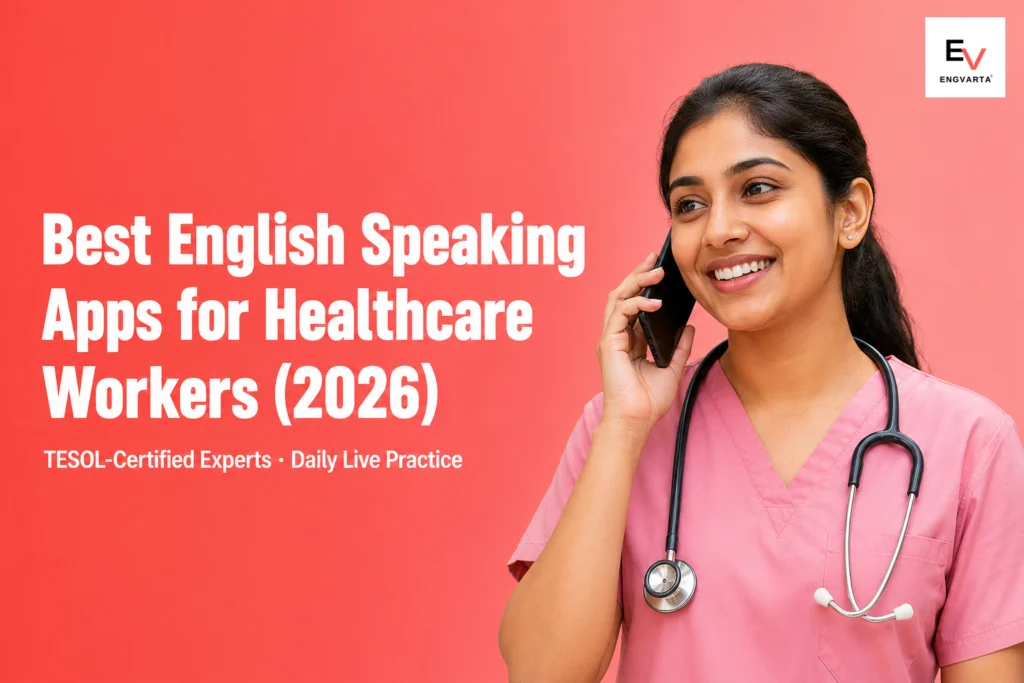
Indian nurse with smartphone practising English at hospital — best english speaking apps for healthcare workers 2026

For healthcare professionals—nurses, doctors, physiotherapists, and pharmacists—spoken English is not just a soft skill. It directly impacts your ability to secure roles in hospitals across the US, UK, Canada, Ireland, Australia, or the UAE. It also affects how confidently you handle patient interactions, handovers, and critical communication where clarity matters.

Generic apps are not designed for medical communication. You need tools that cover clinical conversations, OET-style scenarios, patient empathy language, and shift handovers. The best English speaking apps for healthcare workers focus on these real-world needs. Here are seven top apps in 2026 designed specifically for healthcare professionals.

What healthcare professionals actually need from an English app

  • OET preparation if you are targeting UK/Ireland/Australia. The OET (Occupational English Test) has medical-specific speaking scenarios. Many nurses need a 350+ score for registration.
  • Patient-communication practice. Explaining diagnoses, asking about symptoms, giving instructions — this uses a specific register that generic English tutors rarely drill.
  • Shift handover language. Concise, structured, precise spoken English — SBAR-format handovers, for example.
  • Empathy phrasing. “How are you feeling?” vs “Are you in pain?” — small differences that impact patients’ trust.
  • Practise after shifts. Short-session apps that work during the 20-minute break between shifts beat 60-minute scheduled tutoring.

Quick comparison : Best English Speaking Apps for Healthcare Workers

App Best For Format Pricing
EngVarta Daily patient-communication and handover practice Live 1-on-1 audio $45 / ₹2,700 for 25 sessions
E2 Language (OET) Structured OET preparation Self-study + live From $50/month
Specialised Language Prep (SLP) Medical English courses Course + tutor $299+
italki (medical English tutors) Specialist medical tutors Video 1-on-1 $15-40/hour
Preply (medical English) Same marketplace model Video 1-on-1 $15-60/hour
ELSA Speak Pronunciation for patient clarity AI drills Free / $12/mo
Cambly Native speakers for accent adaptation Video native tutors From $12/session

1. EngVarta — Best for daily patient-communication and handover practice

EngVarta is the most practical daily-use option for healthcare workers because of scheduling realities. Nurses rarely have 60 minutes after a 12-hour shift. They do have 20 minutes before bed or during lunch — and EngVarta’s 15-25 minute sessions fit.

Tell the Expert at the start of your session what you want to practise:

  • “I want to practise explaining a diabetes diagnosis to a patient.”
  • “Can we roleplay a nursing shift handover?”
  • “I want to practise taking patient history.”
  • “Help me prepare for my OET Part 2 roleplay.”

The Expert will adapt. Many EngVarta Experts have medical English exposure from working with healthcare-bound learners. Even without specific medical expertise, the structure of conversation practice — forcing you to produce English under pressure and getting corrections — is exactly what healthcare English demands.

  • Pricing: $45 / ₹2,700 for 25 sessions. $1 / ₹69 trial.
  • Best for: Nurses and doctors preparing for overseas work; healthcare workers already abroad needing to improve daily communication; OET candidates supplementing formal prep.

Ready to Practice with Real Experts?

Try EngVarta today — ₹69 trial (India) / $1 trial (International) · 100% refundable

What Our Learners Say

Rated 4.5★ from 9,100+ reviews on Google Play

★★★★★
It's a great place to learn and practice English Fluency..here you get a chance of one on one communication with experts.. They'll guide you throughout your learning journey..I recommend this platform to all who want to gain fluency with knowledge.
★★★★★
Wonderful application for English learners and good for speaking with trainers .All trainers are well experienced and help us within the time period,Thanks
★★★★★
Engvarta is a platform where we start from the 0 level to 100 level. That is the best thing I have never seen in my life. There are so many part and so many way, they are always try to teach you until you become a good speaker. Thank you Engvarta
★★★★★
good experience this app is very helpfull and user friendly you may also check the app to learn English
★★★★★
The app has been great in improving your English speaking skills. Experts have great knowledge and indeed all are amicable and they create the environment which is necessary for learning the language.
★★★★★
Great app for learning English speaking. All the experts are supportive and non-judgemental. After every session, constructive feedback is provided to enhance yoilur skills. Also it has AI enabled feature for assignment practice. Overall a great platform to practise English speaking with experts.
★★★★★
engverta is good for those who is struggling to speak English...I m new commer but I feel good experience with engverta experts they listen our broken English, they rectify mistakes ,they talk withvery humbly..
★★★★★
Engvarta provides the best platform for learners to learn and get comfortable with the language by offering a comfortable and judgment-free environment with regular feedback. Engvarta is the best English learning app available.
★★★★★
It's a incredible app... It builds my confidence to speak English fluently, gives you practice to start your conversation without any hesitation, provides daily free vocabulary and quizes also...Expensive but amazing & worth it...
★★★★★
Thanks EngVarta I appreciate your platform sir for those who willing to learn speaking English fluently
★★★★★
Experts are friendly and supportive. Great platform to improve your communication skills.
★★★★★
An awesome app to learn and practice English especially for those who don't have English speaking people around them. EngVarta is something I had missed and must have known about much before.

2. E2 Language (OET) — Best for structured OET preparation

E2 Language is one of the most established OET prep providers. Structured video lessons, mock tests, live classes, and OET-specific speaking practice make it the top choice for learners whose primary goal is clearing OET for medical registration.

  • Pricing: From $50 per month for course access.
  • Best for: Nurses and doctors targeting a specific OET score for registration in UK/Ireland/Australia.
  • Honest caveat: Classroom-style — limited daily speaking reps. Pair with EngVarta for conversation volume.

3. Specialised Language Prep (SLP) — Medical English specialists

SLP and similar niche providers offer courses specifically built around medical English — clinical vocabulary, case presentations, ethics discussions. Smaller market, higher quality per niche.

  • Pricing: $299+ for multi-week courses.
  • Best for: Doctors and senior healthcare professionals who need deep clinical English beyond OET scope.

4. italki (medical English tutors) — Specialist 1-on-1

On italki you can filter for tutors with medical, nursing, or healthcare English experience. Some are former nurses teaching English, which is the ideal combination.

  • Pricing: $15-40 per hour.
  • Best for: Healthcare workers wanting a single long-term tutor who builds domain-specific understanding of their goals.

5. Preply — Similar medical-English specialists

Preply has a similar model with subscription-based tutor bundles. Good for structured weekly sessions; less good for daily reps due to per-hour pricing.

  • Pricing: $15-60 per hour.
  • Best for: Committed weekly prep with a dedicated tutor.

6. ELSA Speak — Pronunciation for patient safety

Patient miscommunication is a documented safety risk. If your pronunciation makes “15 milligrams” sound like “50 milligrams,” that is life-threatening. ELSA drills specific sound-level clarity.

  • Pricing: Free / $12 per month.
  • Best as: A daily 10-minute supplement focused on medical-terminology pronunciation.

7. Cambly — Native-speaker accent adaptation

Useful for healthcare workers relocating to the US, UK, or Australia who need to get used to patient accents. Listening to and responding to native English speakers is training for the real-world accent exposure you will face on the ward.

  • Pricing: From $12 per session.
  • Best as: Occasional native exposure; pair with daily EngVarta.

🚀 Start improving your English today!

Follow EngVarta for daily speaking practice, real conversations, and career-focused tips 👇

📸 Instagram : https://www.instagram.com/engvarta.app/
▶️ YouTube : http://www.youtube.com/@EngVarta
📘 Facebook : https://www.facebook.com/engvarta
💼 LinkedIn : https://www.linkedin.com/company/engvarta

✨ Build confidence. Speak fluently. Grow professionally—one conversation at a time.

Frequently Asked Questions ( FAQs )

What is the best English app for nurses preparing for OET?

E2 Language is the best structured OET prep course. EngVarta is the best daily affordable speaking-practice supplement. Most serious OET candidates combine both — E2 for curriculum and mock tests, EngVarta for daily conversation reps and OET Part 2 roleplay practice.

Do I need medical English-specific tutors or can general English tutors work?

For OET-specific speaking test prep: yes, you want medical English specialists (italki, Preply, or E2). For general spoken confidence and fluency: general English tutors work fine — EngVarta Experts adapt to whatever scenario you bring to the session. Many nurses use general tutors for daily reps and medical specialists for test-specific prep.

How long does it take for a nurse to improve English enough for overseas work?

From “can pass a written test but struggle verbally” to “ready to speak with patients confidently” typically takes 2-4 months of daily speaking practice. OET score improvements of 30-50 points (on the 0-500 scale) commonly happen in 6-8 weeks of combined structured prep + daily live practice.

Is EngVarta useful if I am already working as a nurse in an English-speaking country?

Yes. Many nurses already abroad use EngVarta to build patient-communication confidence, practise difficult conversations (breaking bad news, explaining procedures), and reduce accent-related miscommunication risks. Daily 15-25 minute sessions fit around shift schedules.

What is the cheapest way for a nurse to practise English daily?

ChatGPT Voice (free tier) for solo practice + EngVarta at $1.80 / ₹108 per session for live human practice is the most affordable combination. Roughly $45-90/month for daily live practice. Compared to per-hour tutor pricing ($450+/month for daily practice), this is a significant saving.