September 11, 2024 • 9 min read • By Swati Raj
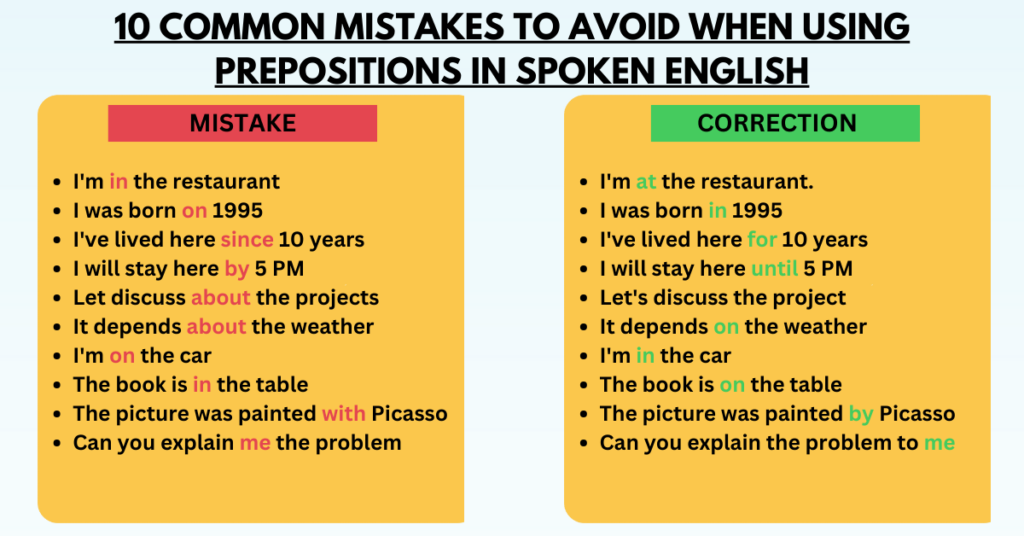
Prepositions are those small but mighty words that link nouns, pronouns, or phrases to other words within a sentence. They’re everywhere in spoken English, but mastering their use can be tricky, especially for non-native speakers. Today, we’ll go over 10 common mistakes people make with prepositions and how to avoid them.
1. Confusing ‘In’ and ‘At’ for Locations
- Mistake: Saying, “I’m in the restaurant” when you mean, “I’m at the restaurant.”
- Correction: Use ‘at’ when you’re talking about specific locations, like “at the office” or “at the park.” Use ‘in’ when you’re referring to something more general or enclosed, like “in the city” or “in the car.”
2. Using ‘On’ Instead of ‘In’ for Months and Years
- Mistake: Saying, “I was born on 1995″ instead of “I was born in 1995.”
- Correction: Use ‘in’ for months, years, centuries, and long periods of time, like “in March” or “in 2025.” Use ‘on’ for specific days or dates, like “on Tuesday” or “on December 12th.”
3. Mixing Up ‘For’ and ‘Since’ with Time Expressions
- Mistake: Saying, “I’ve lived here since 10 years” instead of “I’ve lived here for 10 years.”
- Correction: Use ‘for’ when talking about the length of time (a duration), like “for 10 years.” Use ‘since’ when you’re referring to the starting point in time, like “since 2010.”
4. Incorrect Use of ‘By’ and ‘Until’
- Mistake: Saying, “I will stay here by 5 PM” instead of “I will stay here until 5 PM.”
- Correction: ‘Until’ is used to indicate the time something will continue to happen, like “until 5 PM.” ‘By’ is used to show the deadline or when something must be completed, like “Please finish this by Friday.”
5. Incorrect Use of ‘To’ After ‘Discuss’
- Mistake: Saying, “Let’s discuss about the project” instead of “Let’s discuss the project.”
- Correction: The verb ‘discuss’ doesn’t require a preposition. You should say, “Let’s discuss the project,” without ‘about.’
6. Confusing ‘On’ and ‘About’ After ‘Depend’
- Mistake: Saying, “It depends about the weather” instead of “It depends on the weather.”
- Correction: Always use ‘on’ after the verb ‘depend,’ as in “It depends on the weather,” or “It depends on you.”
7. Mixing Up ‘In’ and ‘On’ with Transportation
- Mistake: Saying, “I’m on the car” instead of “I’m in the car.”
- Correction: Use ‘in’ for smaller vehicles like cars or taxis (“in the car”) and ‘on’ for larger modes of transportation like buses, trains, and planes (“on the bus”).
8. Using ‘In’ Instead of ‘On’ for Surfaces
- Mistake: Saying, “The book is in the table” instead of “The book is on the table.”
- Correction: Use ‘on’ when referring to something that’s on a surface, like “on the table,” “on the floor,” or “on the shelf.”
9. Confusing ‘With’ and ‘By’
- Mistake: Saying, “The picture was painted with Picasso” instead of “The picture was painted by Picasso.”
- Correction: Use ‘by’ when you’re talking about the agent or doer of an action (“painted by Picasso”), and ‘with’ when you’re referring to the tool or instrument used (“painted with a brush”).
10. Incorrect Use of ‘To’ After ‘Explain’
- Mistake: Saying, “Can you explain me the problem?” instead of “Can you explain the problem to me?”
- Correction: The verb ‘explain’ needs to be followed by the object first and then the person it’s explained to: “Explain the problem to me.”
How to Avoid These Mistakes?
- Practice Listening and Reading: Exposure to correct usage through podcasts, TV shows, and books will help you naturally pick up the right prepositions.
- Use an English Learning App: Apps like EngVarta provide real-time conversations with English experts, helping you identify and correct preposition mistakes in real time.
- Create Flashcards: Make a list of common preposition phrases and review them daily.
- Speak Regularly: The more you practice speaking English, the more natural it is to use prepositions.
Mastering prepositions may seem challenging, but with practice, you’ll find yourself making fewer and fewer mistakes. Prepositions can often change the entire meaning of a sentence, so using them correctly is key to fluency.
By avoiding these 10 common mistakes, you’ll see a noticeable improvement in your spoken English!
Ready to master prepositions and speak English confidently? Download EngVarta today and start practicing with live experts!
Frequently Asked Questions about English Prepositions
What are English prepositions and why are they tricky?
Prepositions are short words (in, on, at, by, for, of, to, with, from, about) that connect nouns, pronouns, or phrases to other words in a sentence. They’re tricky because they don’t translate directly between languages — Hindi, Tamil, Bengali, and other Indian languages handle position/direction/time differently than English. Learners often calque from their native language, leading to errors like “I’m interested in to learn” (should be “interested in learning”) or “good in maths” (should be “good at maths”).
What are the most common English preposition mistakes?
Frequent errors Indian English speakers make: (1) “Good IN English” → “good AT English”. (2) “Discussing ABOUT this” → “discussing this” (no preposition needed). (3) “Married WITH her” → “married TO her”. (4) “Different THAN” → “different FROM”. (5) “On Monday morning” → “on Monday morning” (correct) but “in the morning” (correct), “at night” (correct). Time prepositions: AT exact times, ON days, IN months/seasons/years. Place prepositions: AT specific locations, ON surfaces, IN enclosed spaces.
What’s the difference between in, on, and at?
For TIME: AT for exact times (at 5pm, at noon), ON for specific days (on Monday, on Christmas), IN for longer periods (in May, in 2026, in winter). For PLACE: AT for specific points (at the bus stop, at the door), ON for surfaces (on the table, on the wall), IN for enclosed spaces (in the room, in the car, in India). When in doubt, think of the preposition as zooming in: IN is broadest (a country), ON is narrower (a street), AT is specific (a corner).
How can I avoid preposition mistakes in spoken English?
Effective strategies: (1) Memorise high-frequency verb-preposition combinations as PHRASES (depend on, listen to, agree with, look forward to, instead of memorising “depend” and “on” separately). (2) Read English daily and note every preposition usage that surprises you. (3) Get feedback from a TESOL/ESL-certified Expert who flags preposition errors as they happen — these errors are often invisible to learners. EngVarta‘s daily 1-on-1 sessions catch preposition mistakes in real conversation, with corrections in the moment.
What are essential English prepositions to know?
Top 20 high-frequency prepositions: in, on, at, by, for, of, to, with, from, about, after, before, between, during, into, through, without, against, among, beyond. Mastering these covers ~95% of everyday English usage. Memorise common phrases that use them (“by the way”, “for instance”, “in fact”, “of course”) rather than learning prepositions in isolation.
How long does it take to master English prepositions?
Most learners reach 80% accuracy on common prepositions in 6-12 months of daily practice with feedback. Reaching 95%+ accuracy takes 1-2 years because some preposition uses are highly idiomatic (e.g., “interested IN” vs “fond OF” — no logical reason for the difference). Acceptance helps: native speakers often disagree on “correct” preposition use too. Focus on the patterns that matter for clarity.
Should I memorise preposition rules or learn them in context?
Both, but lean toward CONTEXT. Rules give you a starting framework (time prepositions: at/on/in pattern). Context (real sentences, conversations, written examples) is what locks usage into memory. Reading English daily and noting prepositions in their natural context is more effective than memorising rule lists. Active production (speaking, writing) with corrections is the fastest path to accuracy.