Have you ever paused mid-sentence because you weren’t sure if it’s “a umbrella” or “an umbrella”?
Or hesitated while texting because you didn’t know if it’s “a apple” or “an apple”?
These are common doubts with English Articles—A, An, and The.
They may seem like tiny words, but they can seriously affect your confidence if you’re unsure how and when to use them.
And here’s the truth: even fluent English speakers sometimes second-guess these little words.
But not after today.
In this blog, we’ll break down the grammar behind A, An, The, share real-life examples (not boring ones), and even show you when you don’t need to use articles at all. No memorization. Just logic, sound, and some fun examples.
Oh — and there’s a short video waiting for you that brings it all to life 👇
Ready? Let’s go.
👉 If you’re just starting your English journey, this guide on the best English learning apps for beginners will help you get the right tools — and mastering A, An, The is a great place to begin.
Definite Article: “The”
“The” is called the definite article because it points to a specific thing that both the speaker and listener know about.
If you’re using “the”, you’re not talking about anything—you’re talking about that one particular thing.
Use “The” when:
- You’re referring to something unique or already mentioned
- There’s only one of something
- You and the listener both know what you’re talking about
Real-Life Examples:
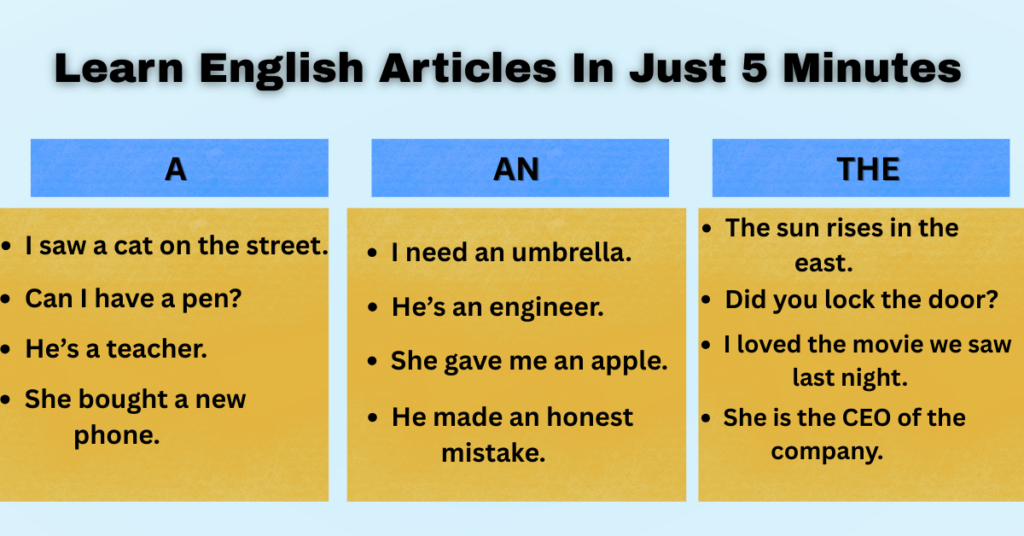
- “The sun rises in the east.”
→ There’s only one sun. It’s universal. So we say the sun. - “Did you lock the door?”
→ The person you’re talking to knows which door. It’s not just any door. - “I loved the movie we saw last night.”
→ You’ve already talked about this movie. It’s not a random one. - “She is the CEO of the company.”
→ There’s only one CEO. Only one company being referred to.
Bonus Tip:
Use “the” before:
- Superlative adjectives: the best, the tallest
- Musical instruments: the guitar, the piano
- Oceans, rivers, and deserts: the Ganga, the Himalayas, the Sahara
Indefinite Article: “A”
“A” is used when you’re talking about any one item, but you’re not being specific.
It’s like saying, “I don’t care which one, I just want one.”
Use “A” when:
- The next word starts with a consonant sound
- You’re introducing something non-specific
- The noun is countable and singular
Real-Life Examples:
- “I saw a cat on the street.”
→ Not a specific cat, just any cat. - “Can I have a pen?”
→ You’re not asking for a particular pen, just any one that works. - “He’s a teacher.”
→ One of many teachers in the world. Nothing specific. - “She bought a new phone.”
→ We don’t know which phone yet.
Indefinite Article: “An”
Just like “a”, “an” also means one, but not specific.
But the only difference?
It’s used before words that begin with a vowel sound (not just a vowel letter).
Use “An” when:
The next word starts with a vowel sound (a, e, i, o, u)
The noun is non-specific, singular, and countable
Real-Life Examples:
- “I need an umbrella.”
→ ‘Umbrella’ begins with a vowel sound: uhm-brella - “He’s an engineer.”
→ Begins with a vowel sound: en-jineer - “She gave me an apple.”
→ Not a specific apple. Just one. - “He made an honest mistake.”
→ Honest starts with a silent “h”, so the sound is on-est → vowel sound.
Quick Trick:
It’s about the sound, not the letter.
So you say:
- an hour (silent “h” → vowel sound)
- a university (“you-niversity” → starts with a consonant sound)
Omission of Articles (When NOT to Use A, An, The)
Sometimes, no article is needed at all — especially when speaking generally.
Don’t use articles with:
- Plural or uncountable nouns (general idea)
“Cats are cute.”
“Milk is healthy.”
- Names of people, places, companies
“Akash is my friend.”
“I visited India last year.”
“Google is a big company.”
- Meals and time expressions
“She eats lunch at noon.”
“We’ll meet after dinner.”
- Languages and subjects
“He speaks English.”
“Math is hard.”
Understanding the use of articles in English grammar is essential for clear and effective communication. “The” points to something specific, while “a” and “an” introduce non-specific nouns. By mastering the usage of these articles, you can enhance the precision and clarity of your English writing and conversation. Practice and exposure to the language will help you become more proficient in using articles correctly.
50+ Example Sentences: Using A, An, The Correctly
The best way to master English articles is to see them in action. Below are 55+ example sentences organized by article type — covering everyday conversations, questions, and real-life scenarios. Read them aloud to train your ear for the natural rhythm of articles.
20+ Examples with “A” (indefinite, consonant sounds)
- I saw a dog running in the park.
- She bought a car yesterday.
- Can you lend me a pen for a minute?
- He is a doctor at the city hospital.
- Would you like a cup of tea?
- I need a new laptop for college.
- She has a beautiful voice.
- There’s a cat sleeping on the sofa.
- He works as a software engineer.
- I watched a movie last night.
- Is there a bus stop nearby?
- She gave me a lovely birthday gift.
- I had a sandwich for lunch.
- He told me a funny story.
- We need a solution to this problem.
- Can I borrow a book from your shelf?
- She wants to buy a house in Bangalore.
- I saw a tiger at the zoo.
- He is a university student. (sounds like “you-niversity” — consonant sound)
- There was a long queue at the bank.
- She’s looking for a job in marketing.
- I’d like a glass of water, please.
- He made a mistake in the report.
15+ Examples with “An” (indefinite, vowel sounds)
- She is an engineer at Infosys.
- He ate an apple for breakfast.
- I need an umbrella — it’s pouring outside.
- It took me an hour to finish the task. (silent “h” — vowel sound)
- He’s an honest person you can trust. (silent “h”)
- She wants to become an astronaut.
- Can I have an orange juice?
- That was an interesting lecture.
- He is an excellent cricketer.
- I had an egg sandwich this morning.
- She bought an expensive dress for the wedding.
- He gave me an old book from his collection.
- That’s an unusual question to ask.
- She is an MBA graduate from IIM. (sounds like “em” — vowel sound)
- He made an offer I couldn’t refuse.
- I saw an owl sitting on the tree.
- She’s an artist by profession.
20+ Examples with “The” (definite article)
- The sun rises in the east and sets in the west.
- The Ganges flows through northern India.
- Please close the door behind you.
- The movie we watched yesterday was fantastic.
- She is the CEO of the company.
- The Himalayas are the tallest mountain range in the world.
- Can you pass the salt, please?
- The Taj Mahal is located in Agra.
- The moon looks beautiful tonight.
- She plays the guitar very well.
- He is the best student in the class.
- The Sahara is the largest hot desert.
- The book on the table belongs to Rahul.
- The President will address the nation tonight.
- I met the teacher you recommended.
- The Pacific Ocean is the deepest ocean.
- The rich should help the poor.
- She won the first prize in the competition.
- The earth revolves around the sun.
- Could you switch on the fan?
- The kids are playing in the garden.
- He’s the tallest person in our family.
- The train to Mumbai leaves at 6 PM.
Pro tip: Notice how “the” appears naturally before anything unique, previously mentioned, or specific — while “a” and “an” introduce something new. Practice saying these sentences out loud so your brain starts picking the right article automatically.
Confused about articles? This video will fix that in 2 minutes
In this quick video, you’ll learn:
What will you learn in this video?
1️⃣ What A, An, and The really mean
2️⃣ How to use the definite article “The”
3️⃣ When to use “A”, “An”, “The” (and when not to)
4️⃣ The one trick that makes choosing between ‘a’ and ‘an’ super easy
5️⃣ Plenty of real-life examples to ensure you get it
👉 Watch it now and never get stuck again.
Articles might be tiny, but they’re powerful.
Mastering them isn’t about memorizing a list of rules; it’s about hearing the rhythm of English and flowing with it.
Now that you know when to use A, An, and The, you’ll start noticing them everywhere. And when you use them correctly, you’ll sound more fluent, more confident, and more natural.
But don’t stop at reading.
Want to practice using A, An, The in real conversations — with real people?
On EngVarta, you can speak with live English experts who’ll gently correct your mistakes and help you gain fluency, one session at a time.
Practice grammar, pronunciation, and fluency in real time.
Download the EngVarta app and start speaking today.
Because your English deserves more than just theory — it deserves a voice.
You’ve read the comparison. You know the numbers. The only thing left is to actually start.
Frequently Asked Questions about English Articles (A, An, The)
What are articles in English grammar?
Articles are short words that come before nouns to specify whether you’re talking about something general or specific. English has three articles: a, an, and the. A and an are indefinite articles (used for general things). The is the definite article (used for specific things). Articles are one of the trickiest parts of English grammar for non-native speakers because their use depends on context, meaning, and sound.
When do you use ‘a’ vs ‘an’?
Use a before words that begin with a consonant sound: a book, a teacher, a university (because “university” starts with the “y” sound, not a vowel sound).
Use an before words that begin with a vowel sound: an apple, an hour (because “hour” starts with a silent “h” sound), an MBA (because “MBA” begins with the “em” sound).
The rule is about SOUND, not the letter. “An honest person” (h is silent) but “a hospital” (h is pronounced).
When do you use ‘the’?
Use the when:
- Both speaker and listener know which specific thing you mean (“Pass the salt”)
- You’ve mentioned the thing before (“I bought a book. The book was excellent.”)
- There’s only one of something (“the sun,” “the President of India”)
- Talking about specific places (“the Ganges,” “the Himalayas,” “the Indian Ocean”)
- Using superlatives (“the best,” “the largest”)
- Talking about musical instruments (“She plays the piano”)
- Describing groups (“the rich,” “the poor”)
What is the difference between definite and indefinite articles?
Indefinite articles (a, an) introduce something for the first time or refer to any one of a kind. “I saw a dog in the park” — could be any dog.
Definite article (the) refers to something specific that both you and your listener can identify. “The dog in the park” — a specific dog you both know about.
Test: if you can substitute “any” or “one of many,” use a/an. If you’d substitute “this specific” or “the one we both know,” use the.
When should you NOT use any article (zero article)?
Skip articles entirely when:
- Talking about uncountable nouns in general (“Water is essential,” not “The water is essential”)
- Talking about plural nouns in general (“Cats are independent,” not “The cats are independent”)
- Talking about most named cities, countries, languages, sports (“She lives in Mumbai,” “I speak Hindi,” “He plays cricket”)
- Before meals (“for breakfast,” not “for the breakfast”)
- Before some institutions when you mean their function (“She’s at school” — meaning attending; “She’s at the school” — meaning the building)
What are the most common mistakes Indian English speakers make with articles?
Common article errors:
- Using “the” with general statements: “I love the music” (should be “I love music”)
- Skipping “the” when needed: “He is going to airport” (should be “He is going to the airport”)
- Using “a/an” with uncountable nouns: “I need an information” (should be “I need information” or “I need a piece of information”)
- Using “the” with most country names: “I am from the India” (should be “I am from India”)
- Mixing up “a” and “an” based on letter rather than sound: “an university” (should be “a university”)
What is an article in English with examples?
Examples of all three article types in real sentences:
- A (indefinite, consonant sound): A teacher walked into the classroom. I want to be a doctor. He is a clever student.
- An (indefinite, vowel sound): An apple a day keeps the doctor away. She had an honest opinion. He is an MBA graduate.
- The (definite, specific): The teacher explained the lesson. The sun rises in the east. The students who study daily get the best results.
- No article (general, uncountable, named places): Honesty is important. Children love chocolate. India is a diverse country.
How do I practice English articles correctly?
To master article usage:
- Read 10-15 minutes of English daily and notice when articles are used (or skipped)
- Pick ONE article rule per week (e.g., “the” with superlatives) and use it deliberately
- Get feedback from a teacher or expert who can flag your specific article mistakes
- Practice in spoken contexts — articles are often dropped or wrongly used in casual conversation, and only feedback can correct this
EngVarta’s TESOL/ESL-certified Experts catch article mistakes in real time during 1-on-1 audio sessions, with consolidated feedback at the end of each call. The $1 refundable trial lets you experience this on a topic where you typically struggle with articles.
Are there exceptions to English article rules?
Yes — English articles have many exceptions:
- Most countries don’t take “the” (India, Japan, Brazil), but some do (the United States, the Netherlands, the Philippines)
- Most languages don’t take “the” (English, Hindi), but exceptions include “the King’s English”
- Cities almost never take “the,” but “The Hague” does
- Mountain ranges take “the” (the Himalayas), but individual mountains don’t (Mount Everest)
- “The” is used with newspapers (The Times of India) but not magazines (Time, Newsweek)
Most exceptions are absorbed through exposure rather than memorization.
Why is using English articles correctly important?
Article errors are one of the most-noticed grammar mistakes in spoken English. While they rarely change the basic meaning of what you’re saying, repeated article errors signal “non-native speaker” to native and fluent listeners. In professional contexts (interviews, presentations, client calls), correct article use makes your spoken English sound more polished. Most working professionals can master 80% of article usage in 4-6 weeks of daily practice with feedback.