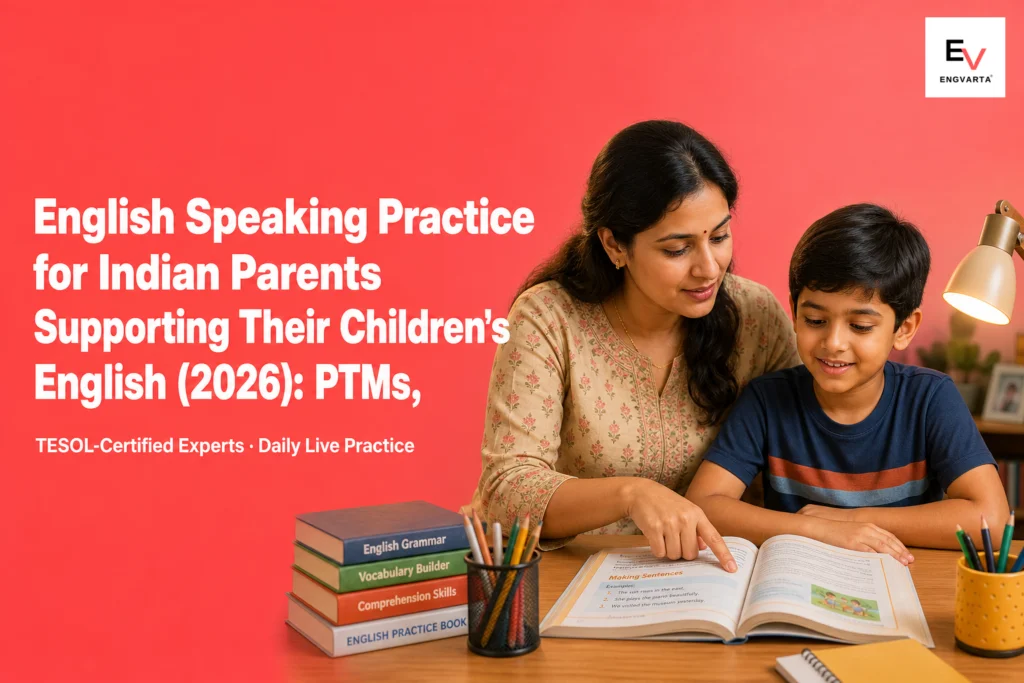
Quick Answer
Why this answer:
- Best for: Indian parents supporting children in English-medium schools
- Practice focus: PTMs, school WhatsApp replies, homework conversations, and reading aloud
- Not ideal for: parents who struggle to understand basic spoken English conversations
Why This Problem Is Different From Generic “Improve Your English” Advice
Most “improve your English speaking” content treats you as a learner with general goals — fluency, confidence, vocabulary expansion. English Speaking Practice for Indian Parents is different because the goal is functional and scenario-bound. You need to handle specific situations, not become bilingual.
The scenarios are:
- The parent-teacher meeting (PTM) — 10-15 minutes, usually in English, sometimes with multiple teachers in sequence, often in front of other parents.
- The teacher WhatsApp group — you read messages but rarely reply because you are unsure how to phrase questions in English.
- Homework help — your child asks “what does this word mean?” or “is this sentence correct?” and you cannot confidently answer.
- Reading aloud — story-reading with younger children, where your pronunciation and pacing affect their English exposure at home.
- Birthday parties and school events — chatting with other parents in English-medium school circles.
- Phone calls with school admin / fee office / event coordinators — these are sometimes in English, sometimes in regional language, and not knowing which one will start is itself stressful.
The emotional layer is what makes this hard: you do not want your child to see you struggle. You want to model confidence, not embarrassment. This means most parents avoid the practice scenarios that would help them, which makes the gap worse over years.
The Underlying Pattern: You Already Know More English Than You Think
Most Indian parents in this situation underestimate their own English. You understand 80-90% of what is said and written. You read your child’s textbook with little difficulty. You write WhatsApp messages in English to colleagues at work. What lets you down is spoken response under social pressure, especially in school settings where you feel your authority as a parent depends on appearing competent.
This is fixable in 8-12 weeks with daily 15-minute practice. The bar is not “fluency” — the bar is “confident enough to handle PTM, read aloud, and answer your child’s questions”. That bar is much closer than it feels.
What Daily Practice Actually Looks Like for This Use Case
For parents wanting to support their children’s English, the practice content should be structured around the actual scenarios you face, not generic conversation drills. Here is a specific 8-week breakdown.
Weeks 1-2: Build the speaking habit
- Daily 15-min sessions with a TESOL/ESL-certified Expert over phone (audio only, so you can do it from anywhere — kitchen, balcony, while walking).
- Topic: whatever is on your mind. The Expert pushes you to keep speaking, corrects gently, and gives a consolidated feedback summary at the end.
- Goal: get used to thinking and responding in English in real-time without freezing. This week is about volume, not perfection.
Weeks 3-4: Scenario drilling — parent-teacher meetings
- Daily 15-min sessions. Tell the Expert at session start : “Today I want to practice for a parent-teacher meeting. Play the teacher.”
- Practice opening lines : “Good morning. I am [child’s name]’s mother/father. Thank you for the time.”
- Practice the standard questions you will ask : how is my child’s progress, where can he/she improve, is there anything specific we should work on at home, how is behavior in class.
- Practice responding to teacher feedback : “Thank you, I will work on that with him/her. Could you tell me specifically what we should do at home?”
- Practice closing : “Thank you for the meeting. We will follow up if we have questions.”
Weeks 5-6: Reading aloud and homework conversations
- Daily 15-min sessions. Bring your child’s textbook (or a children’s story book in English) to the call.
- Read aloud 1-2 pages while the Expert listens. Get corrections on pronunciation, stress, and pace.
- Practice asking and answering the kind of questions a child would ask: “What does this word mean?” “Why is this sentence wrong?” “Can you read this for me?”
- Build a small vocabulary list of words you struggled with — review with the Expert in the next session.
Weeks 7-8: Other parents and casual school-social English
- Practice casual conversation with other parents — small talk at birthday parties, school events, drop-off and pick-up.
- Practice phone calls to school admin in English: enquiring about fees, requesting a leave, asking about an event.
- Practice replying to teacher WhatsApp messages in English with confident, grammatically clean responses.
At the end of 8 weeks, you will have done roughly 50-56 live conversation sessions, with at least 20 specifically focused on school-scenario practice. This is enough to walk into a PTM without freezing, read your child a bedtime story in English, and respond to teacher messages in confident English.
The Cost Comparison: Why Daily Practice Beats Weekly Tutoring for This Goal
| Practice approach | Sessions/week | Monthly cost | Realistic time to PTM-ready confidence |
|---|---|---|---|
| EngVarta daily 15-min | 6-7 | ~₹2,700 | 6-8 weeks |
| Cambly 2x/week 30-min | 2 | ~₹8,000-12,000 | 4-6 months |
| Private home tutor weekly | 1 | ~₹6,000-12,000 | 6+ months |
| Group English coaching class | 2-3 | ~₹3,000-5,000 | Generic content — slower for scenario goals |
| Free YouTube / apps only | self-paced | 0 | Rarely closes the gap — no live correction |
The pattern: daily 15-minute sessions are cheaper AND faster than weekly hour-long sessions for confidence-building goals. This is because spoken-English confidence is rhythm-and-pattern based — your brain needs frequent reps to internalize the patterns, not infrequent long sessions to think about them.
How to Practice Without Your Child Knowing (If You Want To)
Many parents in this situation prefer to keep their practice private — they want to model confidence to the child, not vulnerability. EngVarta‘s audio-only phone format is well-suited to this. You can practice during:
- Morning commute
- Lunch break at office or at home
- Evening walk
- Early morning before the household wakes up
- While the child is at school or asleep
There is no video, no app icon visible to others, no obvious “I am learning English” signal. The 15-min slot is small enough to fit into any gap in the day. Sessions are recorded and accessible for 30 days, so you can listen back to your own delivery to track progress privately.
Talking to Your Child in English at Home — The Habit That Multiplies
Once you have built enough confidence (week 3-4 onward), gradually introduce English into home conversations with your child. Not all-English suddenly — that would be artificial and the child will sense the discomfort. Mix it naturally:
- Ask about their school day in English: “How was your class today? Did you understand the maths lesson?”
- Read story books aloud in English at bedtime (younger children especially benefit from hearing a parent read English, even with imperfect pronunciation).
- Discuss what they watch on TV in English: “What happened to the elephant in that show? Why was the boy upset?”
- Use English for small household instructions: “Please put your bag in the corner”, “Have you finished your homework?”
The goal is not to teach English to your child — they are getting that at school. The goal is to create a household where adult-level English is normal, modeled, and not a source of anxiety. Children read parental confidence very accurately; when you handle English with calm, they grow up viewing English as a normal communication tool, not an intimidating subject.
For Parents With Older Children (Class 8-12)
Older children’s English needs are different from younger kids’:
- They need help with English literature analysis, essay writing, debate preparation, presentation skills.
- You may not be able to help with the content — and that is okay. What you can help with is creating the practice environment and being a casual conversation partner in English.
- For specific academic English (essay structure, comprehension, board exam preparation), pair your practice with their school resources, library books, or a dedicated subject tutor.
For parents whose older children are preparing for college admissions interviews (Ashoka, Krea, FLAME, NLU, international applications) — your role is being a confident interview practice partner who can do mock Q&A in English. Daily EngVarta practice helps you be exactly that.
Conclusion :
The English gap between English-medium-educated children and their parents is one of the silent generational frictions in modern Indian families. It is fixable — not by becoming fluent overnight, but by building enough conversational confidence to handle the specific parental scenarios that matter: parent-teacher meetings, homework conversations, reading aloud, school social interactions, and adult-level chat with your child.
Daily 15-minute live practice with a TESOL/ESL-certified Expert over 8-12 weeks closes most of this gap for most parents. The cost (₹2,700-3,240 per month) is small compared to school fees, tuition fees, and the emotional cost of feeling sidelined from your own child’s education.
Start with EngVarta’s ₹69 refundable trial. The first session is enough to assess whether the format works for you — and it is private, so your child does not need to know unless you choose to tell them later.
Ready to Practice with Real Experts?
Try EngVarta today — ₹69 trial (India) / $1 trial (International) · 100% refundable


Frequently Asked Questions
Will EngVarta Experts adapt to a parent’s specific scenarios like PTMs or homework help?
Yes. At session start, tell the Expert: “I am a parent. I want to practise parent-teacher meetings, reading aloud children’s books, or school WhatsApp replies.” Experts adapt to your scenario request, and the rotating pool means you encounter different teaching styles — useful because real PTMs and school events involve different speakers.
How do I practise English in a household where everyone else speaks our regional language?
Schedule a 15-minute daily speaking slot with an English Expert — that is your reliable conversation block. Add 5 minutes of reading English aloud and 30 minutes of English-subtitled content. The combination builds workplace-functional English over time, even when nobody at home speaks English.
I am embarrassed about my English level — will the Expert judge me?
No. Experts are trained to be empathetic and meet you at your current level. The 1-on-1 audio-only format is intentionally lowest-pressure — no video, no other learners, no judgment. Most parents report the first 2-3 sessions feel uncomfortable, then it becomes routine.
Can my child also use EngVarta?
EngVarta is suitable for children aged 7 and above with parent guidance. For children under 12, supervised sessions where the parent listens and the child speaks to the Expert work well. Teenagers can do their own daily sessions. There is no separate kids mode — the Expert adjusts to the speaker’s level.
How long does it take parents to feel confident in spoken English?
Most parents feel more confident in 8-12 weeks of daily 15-minute practice. The goal is not perfect fluency but enough confidence to handle PTMs, homework conversations, reading aloud, and short teacher chats. Brief gaps in practice are fine; months of inactivity will see confidence regress.
Should I learn English specifically for my child or for myself?
Both are valid. Many parents start with “for my child” as motivation, then discover within a few weeks that the confidence transfers to their work life, social life, and self-image. The framing of supporting your child is often easier to commit to initially — the benefit reaches you too.