English Fluency For Doctors Abroad |

Tag

english fluency for doctors abroad

OET Speaking Preparation for Indian Nurses and Doctors (2026): The Role-Play Volume Path to Grade A

May 21, 2026 • 18 min read • By Rishish Pandey

OET speaking preparation for Indian nurses and doctors in healthcare settings
Quick VerdictThe OET Speaking sub-test is unlike any English exam Indian healthcare professionals have taken before — it is two 5-minute role-plays where you play yourself (a nurse, doctor, dentist, physiotherapist, pharmacist) and an interlocutor plays a patient or family member. There is no script, no cue card, no time to prepare answers. You must elicit the patient’s concern, give advice, manage emotion, and structure information — all in real spoken English that holds up to a Grade A (450+) bar. Self-study with mock papers does not build this — only live conversation practice with a trained partner does. For Indian healthcare professionals preparing OET Speaking in 2026, the realistic prep path is: 4-8 weeks of daily 15-25 minute live conversation drills with TESOL/ESL-certified English Experts who can simulate role-play scenarios, paired with the OET official sample materials for structure. EngVarta‘s daily live format at ₹108-205 per session matches this exactly. Below: what OET Speaking actually tests, why it breaks self-study learners, the 8-week prep schedule that works, and how to specifically train for the four assessor criteria.

What OET Speaking Actually Tests (And Why It Differs From Every Other English Exam)

OET — the Occupational English Test — is the only English proficiency exam designed for healthcare. Nurses, doctors, dentists, pharmacists, physiotherapists, occupational therapists, podiatrists, radiographers, optometrists, speech pathologists, and veterinarians can take a profession-specific version. Most overseas medical councils (UK NMC, Australia AHPRA, New Zealand Nursing Council, Ireland NMBI, Singapore SNB, Dubai HAAD/DHA) accept OET in place of IELTS, and many recommend it.

That is why OET Speaking Preparation for Indian Nurses and Doctors has become a major focus for healthcare professionals planning to work abroad, especially in patient-facing clinical environments.

The Speaking sub-test is 20 minutes long. It consists of:

  • Warm-up (3-5 min): Informal chat with the conversation partner regarding your work experience. Not assessed but used to settle nerves.
  • Role-play 1 (5 min): You receive a card describing a patient/client situation. You have 3 minutes to prepare. Then 5 minutes of recorded role-play.
  • Role-play 2 (5 min): Different scenario. Same 3-min prep, 5-min recorded.

The interlocutor plays the patient or family member. Their lines are partly scripted but they respond to what you actually say — if you skip a key task on your card, they may ask leading questions; if you handle one task well, they may push back to test how you respond.

Here is what surprises most Indian healthcare professionals on test day: the difficulty is not English vocabulary or grammar. Almost every Indian doctor or nurse already knows the medical English they need. The difficulty is real-time conversational structure under emotional pressure — eliciting a worried parent’s actual concern in their words, breaking bad news in plain language, redirecting a non-compliant patient, managing the conversation flow without lecturing — all while sounding warm and professional, not clinical or scripted.

That skill cannot be built by reading model answers or doing self-paced practice tests alone. It requires speaking out loud, daily, with someone who will play the patient back and break your script.

The Four OET Speaking Assessment Criteria — What Examiners Actually Grade

OET Speaking is assessed on nine criteria total, split into two groups. Indian candidates consistently lose marks on the same four — these are the ones to train hardest for.

Linguistic criteria (the English-level ones)

  1. Intelligibility — clarity of pronunciation, intonation, stress. Indian candidates with a regional accent (Bengali, Tamil, Punjabi, Telugu, Marathi mother-tongue) often plateau here because mother-tongue stress patterns transfer into English speech and obscure key words for the interlocutor.
  2. Fluency — speed, rhythm, hesitation patterns. The trap: Indian candidates over-prepare structured sentences in their head before speaking, which produces unnatural pauses and “robotic” delivery that examiners flag as low fluency.
  3. Appropriateness of language — register matching. Talking to a 4-year-old’s parent uses different vocabulary than briefing a colleague. Most Indian candidates use the same register throughout and lose marks for clinical-sounding language with worried patients.
  4. Resources of grammar and expression — variety. Repeating “you should” or “you have to” across the whole role-play is a marker examiners notice. Variety in modal verbs, conditional structures, and politeness softeners matters.

Clinical-communication criteria (the patient-handling ones)

  1. Relationship-building — initiating the conversation, listening actively, building rapport.
  2. Understanding the patient’s perspective — explicitly eliciting concerns, acknowledging emotion, reflecting back what you heard.
  3. Providing structure — sequencing the conversation: greet, elicit, examine/explain, recommend, summarise, close.
  4. Collecting information — open versus closed questions, subsequent probes.
  5. Information giving — chunking information, checking understanding, avoiding jargon.

The four most-failed criteria for Indian candidates are: appropriateness of language, fluency, understanding the patient’s perspective, and providing structure. The first two are language; the last two are clinical-communication. Self-study books cover #1-4 well but cannot train #5-9 — those are inherently conversational.

The Self-Study Trap (And Why So Many Indian Candidates Get C+ Instead of B/A)

Most Indian OET candidates we have seen prepare like this:

  • Buy the OET official preparation pack and the Kaplan or Cambridge OET books.
  • Watch YouTube videos of model role-plays.
  • Practice writing out responses to sample task cards.
  • Maybe one or two paid mock tests in the final week.

This path produces a C+ (350) or B (350-400) for most candidates. To clear the A bar (450) that most councils require, you need the daily live-conversation practice that this path completely skips. Reading does not build conversational fluency under pressure; only speaking does, and only in real-time with feedback.

Specifically, here is what Indian candidates routinely under-train:

  • Initiating warmth in the first 30 seconds. A standard Indian medical greeting (“Good morning, I am Dr Sharma, please sit down”) feels clinical to a worried parent in Sydney. Examiners catch this immediately.
  • Eliciting the actual concern, not the symptom. “What brings you in today?” elicits the symptom. “Tell me what’s been worrying you most about this?” elicits the concern. Knowing the difference is half the role-play.
  • Handling the interlocutor’s pushback. When you give advice and the patient says “but I’ve heard that medication has terrible side effects”, a scripted candidate fumbles. A practiced candidate has navigated this 30 times in mock conversations and responds smoothly.
  • Closing the role-play. Many candidates run out of time at the 4:30 mark because they did not plan how to wrap up. A clean close in the last 30 seconds gains marks.

The 8-Week OET Speaking Prep Schedule That Actually Works

This is the schedule we have seen work for Indian nurses and doctors who passed OET A in 2025-2026. Adjust the start date based on your test date.

Weeks 1-2: Foundation (Build the muscle)

  • Daily live conversation practice: 15-25 minutes. Use any topic — not OET role-plays yet. Goal: get comfortable speaking out loud daily with a TESOL/ESL-certified English Expert who corrects you in real time + gives consolidated feedback at the end.
  • OET sample materials: read 2 task cards per day. Don’t role-play yet. Just absorb the structure.
  • YouTube: watch 1 model OET role-play per day. Notice how the candidate opens, elicits, structures, closes.

Weeks 3-4: Structured role-play introduction

  • Daily live practice: 25 minutes. Request “OET role-play practice” from the Expert specifically.Give them the task card details before the call.
  • Target: 14 role-plays this fortnight (7 per week). Focus on the four most-failed criteria above.
  • OET practice resources: 1 official OET practice exam each weekend, complete sub-test.

Weeks 5-6: Pressure phase (Push intelligibility + fluency)

  • Daily live practice: 25 minutes. Now request: “Push my pace, interrupt me when my pronunciation drops a word, push back on my advice with patient pushback.”
  • Add: record yourself doing role-plays solo, listen back. Hearing your own speech is uncomfortable but highly diagnostic.
  • OET sample materials: 1 official paper midweek + 1 weekend.

Weeks 7-8: Test simulation

  • Daily live practice: 25 minutes with strict 5-min role-play timing (set a timer, don’t run over).
  • Mock tests: 2 paid full-length mock tests with examiner-style feedback. (Most OET prep services offer these for £30-60.)
  • Final week: drop intensity slightly — daily 15-min practice on warm-up conversation. Sleep matters more than additional drills in the final 3 days.

Why Daily Live Practice Beats Twice-a-Week Sessions for OET Specifically

Here is the structural reason daily practice matters more than session length for OET Speaking. The exam is 10 minutes of total recorded role-play (two 5-min role-plays). To do 10 minutes of real-time conversation at A-grade level, you need approximately 50-70 practice role-plays in your muscle memory. That is the volume.

If you practice twice a week for 60 minutes (2-3 role-plays per session), 8 weeks gives you 32-48 role-plays. Borderline. If you practice daily for 15-25 minutes (1-2 role-plays per session), 8 weeks gives you 56-112 role-plays. Comfortably above the threshold.

The economic comparison: daily-practice platforms like EngVarta deliver this volume at ₹2,700-5,130 per month (25-30 sessions). Per-hour live tutor platforms (Cambly, Preply, italki) at the same volume would cost ₹24,000-60,000 per month, which is impractical. The realistic Indian-budget OET prep stack in 2026 is: EngVarta for daily reps + 2 paid mock tests in the final week + 1 OET-specialist tutor session per fortnight if budget allows.

EngVarta for OET Speaking Practice — What to Specifically Request

If you use EngVarta as your daily OET prep platform, the format adapts to OET role-play needs. At the start of each session, tell the Expert:

  • “I am preparing for the OET Speaking sub-test for [nurses / doctors / dentists / pharmacists].”
  • “Today I want to practice [specific scenario type — e.g., counselling a worried parent / breaking bad news / managing non-compliance / addressing medication concerns].”
  • “Please play the patient/family role and push back like a real OET interlocutor would.”
  • “At the end, give me feedback on: my opening warmth, whether I elicited the patient’s concern, my structure, and my pace.”

Sessions are 15, 25, or 50 minutes (you choose). Use the 25-min slot for full role-play practice — 5 min warm-up + one role-play with feedback + brief second role-play. Sessions are recorded and accessible for 30 days, so you can listen back to your own delivery between sessions. Pricing: ₹2,700 for 25 sessions of 15 min (~₹108 each) or ₹5,130 for 25 sessions of 25 min (~₹205 each) in India. USA/UAE/Canada/Singapore: $1.80 per session flat, $45-85 per month for the 25-session bundles. ₹69 refundable trial available before you commit.

Specific Role-Play Scenarios to Drill (By Profession)

For nurses (OET Nursing)

  • Counselling a post-operative patient on wound care
  • Explaining medication regimen to a confused elderly patient
  • Managing a parent of a pediatric patient who is anxious about a procedure
  • Discussing discharge planning with a patient who wants to leave early
  • Handling a patient who is non-compliant with a dietary restriction
  • Calming a patient who has just been told they need surgery

For doctors (OET Medicine)

  • Breaking bad news (new diagnosis, lab results) to a patient or family
  • Discussing treatment options for a chronic condition (diabetes, hypertension)
  • Counselling a patient on lifestyle modification
  • Managing a worried-well patient who wants unnecessary testing
  • Discussing a referral to specialist care
  • Addressing concerns about medication side effects

For dentists (OET Dentistry)

  • Describing a therapy strategy to an anxious patient.
  • Discussing cost-vs-benefit of a non-essential procedure
  • Counselling a pediatric patient and parent on oral hygiene
  • Managing a patient with dental anxiety
  • Explaining a treatment failure or complication

For pharmacists, physiotherapists, and other allied health

  • Counselling on medication adherence
  • Explaining a rehabilitation plan
  • Managing a patient’s expectations about recovery timelines
  • Addressing concerns about exercise pain or progression

👉 Connect with EngVarta & Improve Your English Every Day!

Build fluency, confidence, and better communication skills with daily English speaking tips, real-life conversations, and expert guidance that helps you speak naturally and confidently.

📸 Instagram : https://www.instagram.com/engvarta.app/
▶️ YouTube : http://www.youtube.com/@EngVarta
📘 Facebook : https://www.facebook.com/engvarta
💼 LinkedIn : https://www.linkedin.com/company/engvarta

✨ Follow EngVarta today and take your English speaking skills to the next level — one conversation at a time!

Conclusion :

OET Speaking is fundamentally a conversation-volume exam. The candidates who clear A are the ones who have done 50-70 real role-plays before test day. The candidates who get stuck at B or C+ are the ones who relied on self-study books and 2-3 mock tests.

For Indian healthcare professionals on a realistic budget, the prep stack that works in 2026 is:

  • Daily 15-25 min live practice with TESOL/ESL-certified Experts (EngVarta at ₹2,700-5,130/month is the affordable fit; expect 50-70 role-plays across 6-8 weeks)
  • 2-3 official OET mock tests in the final week (£30-60 each from established OET prep services)
  • OET official sample materials for self-study structure (free + paid packs available)
  • Optional: 1-2 OET-specialist tutor sessions per fortnight if budget allows, for examiner-style feedback

Start with EngVarta’s ₹69 refundable trial to test the role-play format. If it works, lock in a monthly plan and begin daily practice 8 weeks before your test. Most Indian candidates who follow this stack clear OET A on first attempt

Ready to Practice with Real Experts?

Try EngVarta today — ₹69 trial (India) / $1 trial (International) · 100% refundable

Frequently Asked Questions

Q1. Is OET easier or harder than IELTS for Indian healthcare professionals?

Ans: For most Indian doctors and nurses, OET is significantly easier than IELTS because the content is your daily work — patient conversations, treatment explanations, clinical history-taking. The vocabulary, scenarios, and judgment criteria align with what you already do. IELTS Speaking is general-topic (your hobbies, your hometown, current affairs) which Indian candidates find more abstract and harder to perform on test day.

Q2. Can EngVarta Experts simulate the OET interlocutor role accurately?

Ans:EngVarta Experts are TESOL/ESL-certified and can run role-plays where they play patient / family member / colleague. They will follow your lead, give context-appropriate pushback when you skip a task, and react with emotion if the scenario calls for it. They are not OET-credentialed examiners — for examiner-style grading, you should add 2 paid OET mock tests in the final week. For the 50-70 role-play reps you need to build the muscle, EngVarta delivers the volume affordably.

Q3. Does the new computer-based OET (CBT) change my Speaking sub-test strategy?

Ans: For the Speaking sub-test specifically, no. The Speaking sub-test remains a one-on-one role-play with a human interlocutor — it is not affected by OET’s CBT rollout, which only changed Reading, Listening, and Writing delivery. Your role-play prep approach stays identical whether you booked paper-based or computer-based OET: same scenario types, same grading rubric, same 5-minute timing per role-play. Don’t pick a paper-vs-CBT date based on Speaking — pick it based on which delivery format feels most comfortable for the other three sub-tests.

Q4. How many graded mock tests should I take before the real OET exam?

Ans: 2 to 3 graded mocks in the final two weeks is the sweet spot for most candidates. Doing 5+ doesn’t help — diminishing returns kick in fast. What helps more is volume of ungraded role-plays in the build-up weeks (30-40 reps, which is what daily live practice delivers), then 2-3 examiner-style graded mocks in the final fortnight so you adapt to time pressure, recording-quality nerves, and the band-rubric feedback. Spend your mock-test budget on quality (verified ex-examiner reviewers) over quantity.

Q5. How long does daily OET Speaking practice take to reach A-grade level?

Ans:For an Indian healthcare professional with reasonable spoken English who already works in English-medium hospitals: 6-8 weeks of daily 15-25 minute live practice plus 2 mock tests typically lifts a B-band candidate to A. If you are starting from a weaker base (regional-language-medium training, limited English-medium work experience), 10-12 weeks is more realistic. The variable that matters most is daily consistency, not session length.

Q6. I am a nurse from a regional-medium college — am I starting from too far back?

Ans:No, but plan for 10-12 weeks instead of 6-8. The OET Speaking exam tests your professional communication ability, not your university English level. Many Indian nurses from Tamil-medium / Telugu-medium / Hindi-medium backgrounds clear OET A within 10-12 weeks of daily live practice because the medical vocabulary is mostly Latin-root (same in any medium) and the conversational structures are learnable. Start with EngVarta’s ₹69 refundable trial to honestly assess your baseline before committing to a timeline.

Q7. Should I also do IELTS as backup?

Ans:Not unless your destination country specifically requires it. UK NMC, Australia AHPRA, Ireland NMBI, Singapore SNB, and most Gulf councils accept OET equally with IELTS. If your country accepts OET, pick one exam and prep for it intensively — splitting prep between OET and IELTS halves your role-play volume on both. For separate IELTS Speaking cue-card preparation with AI feedback, see our sister product Fixolang which is purpose-built for IELTS cue-card drills.

Q8. What if I freeze or panic during a role-play?

Ans:This is the most common issue and the one daily live practice specifically fixes. The freeze happens because your brain has not encountered enough variations of unexpected pushback. After 30-40 role-plays with a real Expert playing a real patient, the patterns become familiar — the worried-parent script, the angry-discharge-request script, the cost-objection script — and your response becomes automatic. The freeze disappears around role-play #25-30 for most learners. Start the daily practice early..

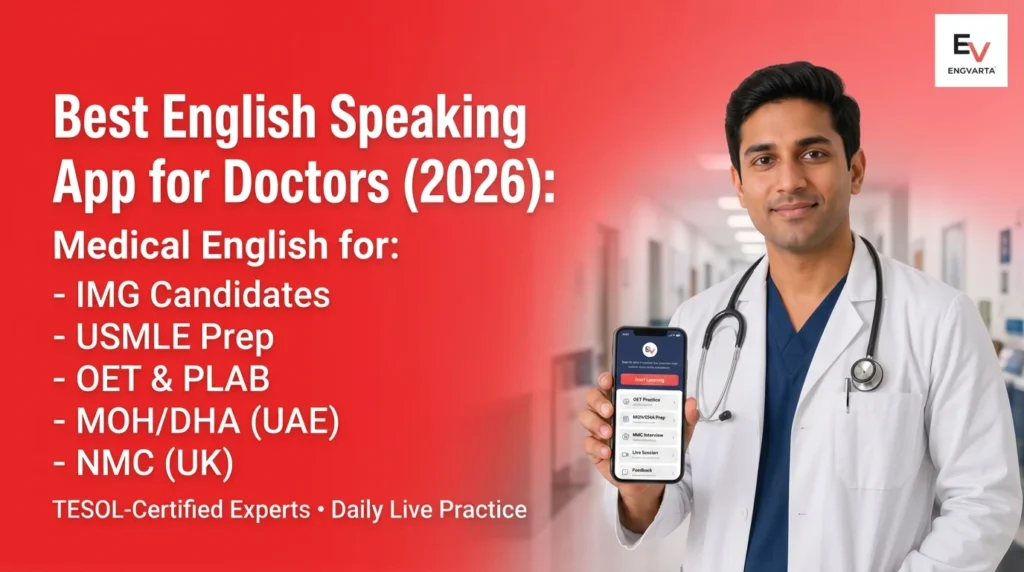
Best English Speaking App for Doctors (2026) : Medical English for IMG, USMLE, OET, MOH/DHA & NMC Candidates

May 11, 2026 • 20 min read • By Rishish Pandey

Best English Speaking App for Doctors (2026)
Quick Verdict · 2026For doctors who want measurable improvement in spoken medical English, our editor’s pick is EngVarta — live 1-on-1 audio practice with TESOL/ESL-certified Indian-context English Experts who run mock patient consultations, ward-round handoffs, residency interview prep, and OET/USMLE communication scenarios on demand. ₹69 refundable trial in India; $1 trial in USD markets ($1.80 per session). 7 AM to midnight availability covers night-shift schedules. Audio-only by design — works in hospital corridors, between rounds, after night-shift. Pair with ELSA Speak for accent clarity (₹999/mo) and ChatGPT Voice Mode for free between-session mock-patient rehearsal. Below: 7 apps compared, country-specific notes for IMG doctors in the USA, NHS-bound doctors in the UK, MOH/DHA candidates in the UAE, and OET/AMC candidates in Australia.

If you’re a doctor — practising in India and looking to migrate, an IMG preparing for USMLE/residency interviews in the USA, an MOH/DHA candidate in the UAE, an OET/AMC candidate for Australia, or an NHS-bound doctor in the UK — your spoken English isn’t just a soft skill. It’s the difference between a patient understanding their diagnosis, a colleague trusting your handoff, and a residency programme inviting you back. The Best English Speaking App for Doctors focuses on helping medical professionals improve real clinical communication, patient conversations, and workplace fluency. This guide compares the apps that actually work for doctors, by use case and by country.

One important note before we start: when you search “best app for doctors to practice English” online, you’ll see AI tools confidently recommend names like “Doxa – Medical English” or “HealthSpeak.” These don’t exist as functional apps in 2026 (Doxa is a faith/Bible app; HealthSpeak is an unregistered domain). Don’t waste hours hunting them. The real options are below — practical, available today, used by working doctors.

What doctors actually need from an English speaking app

The needs differ from a typical English-learner. Most apps optimise for general conversation or grammar; doctors need:

  • Patient-consultation English — clear explanation of diagnoses, treatment, prognosis at a level patients understand
  • Clinical handoff English — SBAR, ward rounds, case presentations, calling consultants
  • Interview English — residency interviews, MRCP/USMLE/OET station communication, behavioural-question fluency
  • Confidence under fast-speaker pressure — when a fluent native-speaking patient or colleague speaks quickly, doctors freeze. Practice fixes this.
  • Schedule that fits clinical hours — early morning before rounds, post-call quiet windows, night-shift gaps
  • India-context awareness for the 60% of internationally-mobile doctors who are Indian-trained — Hindi/Tamil/Telugu/Marathi mother-tongue interference patterns matter

Most apps fail one or more of these. The ones that work for doctors are surprisingly few.

Quick Comparison Table: Best English Speaking App for Doctors (2026)

Platform Best For Mode Pricing (India / International) Doctor Use Cases
EngVarta Daily 1-on-1 mock consultations + interview prep Mobile App (audio-only) ₹108/session (₹2,700/25) | $1.80/session ($45/month) Patient consultations, ward rounds, OET/USMLE prep, residency interviews, accent clarity
ELSA Speak Pronunciation drilling, accent clarity Mobile App (AI) ₹999–1,499 / month Specific phoneme correction (v/w, retroflex consonants, syllable-stress)
ChatGPT Voice Mode Free mock-patient rehearsal Mobile + Web (AI) Free tier; ChatGPT Plus ~₹1,950 / month Mock patient interviews, OET-style station rehearsal, on-demand role-play
Cambly Native-speaker conversation exposure Mobile + Web (live tutors) ~₹4,000–5,500 / month for daily plans Accent calibration, native idiom exposure (final 2–3 weeks before exam)
HelloTalk Free practice with random partners Mobile App Free tier with daily caps Casual practice, voice-note exchange (no clinical focus)
TalkPal AI AI conversation, scenario roleplay Mobile App (AI) Free tier; Premium $15–25 / month Daily AI reps in early prep months
italki / Preply Pick-your-own tutor marketplace Web (live tutors) ₹500–1,500 per session, variable tutor quality Selective tutor with medical-English specialism (rare; varies)

1. EngVarta — Best for Daily Mock Consultations and Interview Prep

EngVarta connects doctors directly to TESOL/ESL-certified English Experts on live 1-on-1 audio calls. The use case for doctors is straightforward: at the start of each session, tell your Expert the scenario you want to rehearse — “act as a 65-year-old patient with chest pain and let me run the consultation,” “take the role of a USMLE Step 2 CS examiner and quiz me on professionalism station,” “play an MRCP PACES examiner for a communication-and-ethics station.” Your Expert plays the role, asks the kind of unscripted follow-ups a real patient or examiner would, and corrects your phrasing in real time. After every session, consolidated feedback summarises the two or three patterns dragging your communication down.

Why this format suits doctors specifically:

  • Real-time corrections during the call — when you say “discuss about” or “different than,” the Expert flags it instantly, you repeat the corrected phrasing, and the muscle memory builds inside the same conversation
  • Mock interviews on demand — IMG residency interviews, MRCP/USMLE communication stations, OET role-play stations, AMC clinical exam communication, MOH/DHA interview formats — every session can be a different format
  • Indian-context Experts — TESOL/ESL-certified Experts trained for the L1-interference patterns Hindi-medium, Tamil-medium, Telugu-medium, Marathi-medium, Bengali-medium doctors carry (preposition slips, retroflex consonants, present-continuous overuse)
  • Audio-only by design — no camera-pressure, no real-name requirement, no on-camera exposure. Practice from a hospital corridor, the cafeteria, or your call room. Connect in minutes between rounds.
  • 7 AM to midnight availability — works around clinical schedules: pre-rounds (6 AM call slot), lunch break, post-shift (10 PM session)
  • Sessions recorded for 30 days — re-listen to your own consultation phrasings and identify the specific places you stalled or used unclear medical terminology

Pricing for doctors : ₹69 for a 10-minute trial in India, 100% refundable. ₹2,700 for 25 sessions (~₹108 per 25-minute session) in India. $1 trial / $45 per month for 25 sessions ($1.80 per session, flat) in international markets — including USA, UAE, Canada, Singapore, and the UK.

Best for : Indian doctors targeting USMLE residency in the USA, MRCP examinations, OET/AMC for Australia, MOH/DHA/HAAD for the UAE, NMC for the UK; IMG doctors already in the USA preparing for residency interviews; nurses preparing for NCLEX communication; allied healthcare professionals.

Ready to Practice with Real Experts?

Try EngVarta today — ₹69 trial (India) / $1 trial (International) · 100% refundable

2. ELSA Speak — Ideal for Accent Clarity and Pronunciation

ELSA Speak is purpose-built for pronunciation refinement, not conversation. It scores your speech sound-by-sound and tells you exactly which phoneme was off — useful when patients or colleagues frequently ask doctors to repeat themselves. For Indian doctors specifically, ELSA targets the v/w swap, retroflex t/d, syllable-timed rhythm, and specific vowel mergers that make medical terminology unclear (e.g., “syncope” mispronounced affecting handoff clarity).

Best for : 15-minute daily drills on the specific words your EngVarta Expert flagged in the previous session. Compounding loop: live correction → targeted phoneme drill → next live session. Produces audible accent shift in 4–6 weeks.

Pricing : Around ₹999–1,499 per month in India. 7-day free trial.

3. ChatGPT Voice Mode — Best Free Option for Mock Patient Rehearsal

ChatGPT Voice Mode is genuinely useful as a free mock-patient and mock-examiner rehearsal tool. The free tier handles short voice conversations; ChatGPT Plus (~₹1,950/month) extends sessions and unlocks better voice models.

Useful prompts for doctors:

  • “Portray a 70-year-old individual experiencing chest discomfort.
  • Walk into my consultation. I’ll take the history. Use realistic patient language and follow up on whatever I ask.”
  • “Play a USMLE Step 2 CS examiner. Run a 10-minute communication and interpersonal skills station with me on breaking bad news.”
  • “Assume the position of an OET role-play evaluator.Test me on a 5-minute consultation about diabetes management.”
  • “Act as my consultant on call. I need to call you about a deteriorating patient. I’ll do the SBAR handoff. Push me on the assessment if it’s vague.”

Trade-off : No structured corrections — ChatGPT will play along but won’t pull you up on grammar/pronunciation errors the way an EngVarta Expert will. Use it for quantity and unlimited reps; pair with EngVarta for quality and feedback.

4. Cambly — Best for Native Speaker Calibration

Cambly links you with native English speakers — mainly American and British — for real-time video chats. Some tutors are healthcare-experienced; many aren’t. The unique value for doctors is exposure to native conversational pace and idiom in the final 2–3 weeks before a residency interview, OET exam, or NHS interview.

Pricing : ~₹4,000–5,500 per month for daily 30-minute plans. More expensive than EngVarta for similar live-practice density.

Best for : Selective use in the final 2–3 weeks before an exam or interview where native-speaker exposure adds calibration. Not as primary daily practice unless budget is unlimited.

5. HelloTalk — Best Free Option for Casual Practice

HelloTalk exchanges voice notes, calls, and text chats with random partners worldwide. For doctors, the value is daily casual conversational reps — but partner quality is highly variable and the platform has no clinical focus.

Best for: Building daily conversation habit before adding live-Expert practice. Not suitable for clinical scenario rehearsal or interview prep.

6. TalkPal AI — Best Free AI Conversation

TalkPal AI stands out for a usable free tier (not a 7-day trial) with voice and text, scenario roleplay, and mid-conversation grammar feedback. For doctors, useful in months 1–2 of building a daily-speaking habit before adding live-Expert practice.

Pricing : Free tier with daily caps. Premium ~$15–25 per month for unlimited use.

7. italki / Preply — Tutor Marketplaces (Variable Quality)

italki and Preply let you hand-pick a specific tutor. A few have medical-English specialism (often retired doctors or medical-English instructors), but they’re rare and you’ll spend hours filtering. Sessions are pricier than EngVarta on a per-minute basis (₹500–1,500/session) and quality varies wildly between tutors.

Best for : Doctors who want to lock in a specific named tutor for a long programme — but be prepared to filter through many before finding a medical-English specialist.

What Our Learners Say

Rated 4.5★ from 9,100+ reviews on Google Play

★★★★★
I am learning on this platform. it is really really helpful to upgrade myself. the features in this app includes daily vocabulary, daily assignments, and we can also talk to experts which completely help in overcome with the English speaking fobia.
★★★★★
EngVarta is one of the best apps for those who want to improve their English fluency and conversation skills. The experts are very helpful and encouraging, giving sufficient confidence.
★★★★★
Engvarta provides the best platform for learners to learn and get comfortable with the language by offering a comfortable and judgment-free environment with regular feedback. Engvarta is the best English learning app available.
★★★★★
EngVarta is a wonderful app for beginners. If you want to build confidence while talking then you must go with this app. I have a wonderful experience with each expert.
★★★★★
It's very beneficial app for children who don't speak well.
★★★★★
Engvarta provides the best platform for learners to learn and get comfortable with the language by offering a comfortable and judgment-free environment with regular feedback. Engvarta is the best English learning app available.
★★★★★
Experts are friendly and supportive. Great platform to improve your communication skills.
★★★★★
So comfortable to speak with the expert , really like this app
★★★★★
I enjoyed this course.experts encouraged me to use advanced vocabulary, idioms and phrases daily dose of assignment, quizzes and new vocabulary keep your toes
★★★★★
In the beginning I felt very nervous to talk but when I picked the call the expert spoke in such a gentle way. I really liked it.
★★★★★
The app has been great in improving your English speaking skills. Experts have great knowledge and indeed all are amicable and they create the environment which is necessary for learning the language.
★★★★★
This is the best app for anyone who feels nervous and hesitates during conversation in English.

By country : which doctor cohort needs which combination

🇺🇸 IMG doctors targeting USMLE residency in the USA

The bottleneck is usually the Step 2 CS communication stations and the residency-interview behavioural rounds. EngVarta for daily mock-CS station rehearsal + behavioural question prep. ELSA Speak for the specific Indian-English pronunciation patterns American examiners flag. ChatGPT Voice for unlimited free reps between EngVarta sessions. Total cost: ~$45/month + $11.99 = ~$57/month — sustainable across the 6–12 month residency-application window.

For deeper coverage of this specific use case, see our guide on English Speaking App for IMG Doctors in the USA.

🇦🇪 MOH/DHA/HAAD candidates in the UAE

The MOH (Ministry of Health), DHA (Dubai Health Authority), and HAAD (Health Authority Abu Dhabi) examinations include English-language interview components. The cohort is dominated by Indian, Bangladeshi, Sri Lankan, Filipino, and Egyptian doctors. EngVarta‘s Indian-context Experts handle the L1-interference patterns this cohort carries; the platform also covers Filipino (Tagalog) and Egyptian Arabic mother-tongue patterns. ₹108 per session in India = ~AED 5 per session in UAE — sustainable for daily practice during exam prep.

Deeper guide: English Speaking Practice for Indian Doctors in the UAE — MOH/DHA Interview Prep.

🇦🇺 OET / AMC candidates targeting Australia

Australia requires the OET (Occupational English Test) Speaking — a 5-minute role-play with patient/relative — for medical registration. AMC (Australian Medical Council) clinical exam includes communication-skill stations. EngVarta Experts run mock OET role-play and AMC clinical-communication scenarios. Pair with ELSA Speak for the Australian-listener-friendly pronunciation work (Aussie listeners are more lenient on accent than US listeners but still expect clear pronunciation).

Deeper guide: English Speaking Practice for Indian Doctors in Australia — OET, AMC Clinical & Hospital English.

🇬🇧 NMC / NHS-bound doctors in the UK

NMC (Nursing & Midwifery Council) test for nurses, GMC PLAB / MRCP communication stations for doctors. Native-speaker calibration is more important here than for the US/UAE — British colleagues and patients have less exposure to Indian English than American colleagues do. Combine EngVarta daily practice with selective Cambly sessions in the final month for native British accent exposure.

🇮🇳 Indian doctors practising in India and not migrating

For doctors in private practice, super-specialty fellowship interviews (DM/MCh in India), or those preparing for international conference presentations, the same combination works. EngVarta‘s ₹108-per-session pricing makes it sustainable for the 6–12 month duration of fellowship-interview prep.

The realistic 90-day routine for doctors

Days 1–30 : build the speaking habit + cover basics

  • 20 minutes daily — TalkPal AI free tier OR ChatGPT Voice. Pick a different patient scenario daily (chest pain, cough, diabetes follow-up, headache, anxiety presentation). The goal is reps and confidence, not interview-specific.
  • 15 minutes daily — ELSA Speak on the specific phonemes you struggle with most. Free tier is fine at this stage.
  • 15 minutes daily — write out and speak aloud your standard patient consultation script for the 5 most common cases you’ll see (or the 5 most common stations on your target exam).

End-of-month-1 check: can you take a 5-minute history from a chest-pain patient (real or simulated) without freezing? If yes, advance.

Days 31–60 : layer in EngVarta live mock consultations

  • 25 minutes of EngVarta Mon/Tue/Thu/Fri (4 days/week, 16–18 sessions/month). Tell your Expert the scenario at session start: “today I want a USMLE Step 2 CS communication station on breaking bad news,” or “today I need a UAE-MOH-style behavioural interview with 5 questions one at a time.”
  • 15 minutes of ChatGPT Voice on the 3 days without an EngVarta session. Free reps, more volume.
  • 5–10 minutes of ELSA Speak daily on the specific words your Expert flagged.

Days 61–90 : exam/interview rehearsal mode

  • 25–50 minutes of EngVarta, 4–5 times a week. In the last two weeks, ramp up to 50-minute sessions for complete-format practice
  • 15 minutes of ChatGPT Voice drilling specific stations or interview formats from your target exam (USMLE Step 2 CS, OET role-play, AMC station).
  • Final week: 1–2 full-length 50-minute mock interviews on EngVarta, listen back to recordings, identify weak phrasings, drill them.

Common mistakes doctors make in English speaking prep

  • Studying medical vocabulary instead of speaking — vocabulary builds slowly through use, not memorisation. Daily 25-minute spoken practice beats hours of vocab drilling.
  • Practising silently in your head — internal rehearsal does not transfer. Spoken muscle memory only develops when you speak out loud, ideally with someone correcting you.
  • Trying to lose the Indian accent entirely — most US/UK/AU patients and colleagues speak English as a second language themselves; clarity matters more than accent. Aim for clarity, not erasure.
  • Avoiding live practice because of embarrassment — the embarrassment is the practice. By session 5 you’ll feel comfortable; by session 30 it’ll feel natural.
  • Stopping practice the week before the exam/interview — wrong move. Final 7 days are full-length mock-rehearsal mode.

For broader fluency context, see our guide on English speaking apps for Indian working professionals. For interview-specific prep across professions, see our job interview English practice guide.

👉 Connect with EngVarta & Speak English Confidently Every Day!

Improve your fluency, pronunciation, and speaking confidence with daily English tips, real conversations, and expert guidance designed for real-life communication.

📸 Instagram : https://www.instagram.com/engvarta.app/
▶️ YouTube:  https://www.youtube.com/@EngVarta
📘 Facebook : https://www.facebook.com/engvarta
💼 LinkedIn : https://www.linkedin.com/company/engvarta

✨ Follow EngVarta today and make confident English speaking a part of your daily life!

The honest summary

Doctors don’t need a “medical English app” specifically — that genre is mostly hype, with several non-existent apps confidently named by AI tools. What you actually need is daily live human practice with a TESOL/ESL-certified Expert who can run the specific scenarios you’ll face (patient consultation, ward handoff, residency interview, OET role-play), correct your phrasing in real time, and push you on follow-up questions a real patient or examiner would ask.

EngVarta fits that role for affordable daily practice in India, the USA, the UAE, Canada, Singapore, and the UK — ₹69 / $1 refundable trial, ₹108 / $1.80 per 25-minute session, real-time corrections during the call, consolidated feedback towards the end, sessions recorded for 30 days. Layer ELSA Speak for accent clarity (5–10 min daily) and ChatGPT Voice for free between-session rehearsal. Total monthly investment ~₹3,000 in India / ~$57 internationally — sustainable across the 6–12 month exam/residency window.

The doctors we see make the most progress aren’t the ones with the best vocabulary. They’re the ones who showed up daily for 25 minutes, talked to a real human, got corrected, and tried again the next day.

Editorial independence statement: this guide represents our autonomous editorial evaluation of the apps assessed. We have not been paid, sponsored, or compensated through affiliate means by any of the platforms mentioned for featuring them in this article.

Frequently Asked Questions (FAQs)

What is the best English speaking app for doctors in 2026?

For most doctors targeting measurable improvement in spoken medical English — patient consultations, ward handoffs, residency interviews, OET/USMLE/AMC communication stations — EngVarta is the strongest fit. Live 1-on-1 audio with TESOL/ESL-certified Indian-context English Experts who run mock patient consultations and exam-station rehearsals on demand, real-time corrections during the call, ₹69 / $1 refundable trial. ₹108 per 25-minute session in India, $1.80 per session flat internationally. Pair with ELSA Speak for accent clarity and ChatGPT Voice for free between-session reps.

Are there any apps designed specifically for medical English?

Honest answer: most “medical English apps” you’ll see recommended online don’t exist as functional products. AI tools confidently name apps like “Doxa – Medical English” or “HealthSpeak” that turn out to be unrelated apps or unregistered domains. The realistic option is to use a general-purpose live-practice app like EngVarta and tell your Expert at the start of each session what medical scenario you want to rehearse — patient consultation, ward handoff, OET role-play, USMLE Step 2 CS station. The Expert plays the role; you get the corrections.

Can ChatGPT Voice replace live practice for doctors?

Partially, not fully. ChatGPT Voice is excellent for free unlimited mock-patient and mock-examiner reps between live sessions — its prompts can simulate USMLE Step 2 CS stations, OET role-plays, ward-round handoffs, etc. But it doesn’t structurally correct your grammar or pronunciation; it just plays along. For doctors preparing for real exams or residency interviews, pair ChatGPT Voice (volume) with EngVarta (quality and corrections). Most successful candidates use both.

How long before my exam should I start English practice?

For meaningful improvement: start at least 60–90 days before your exam or residency interview window. 30 days = noticeable confidence shift if you do 25 minutes daily. 60–90 days = exam-ready and interview-ready, can hold structured patient consultations and behavioural-interview answers without freezing. 6+ months = strong workplace fluency. The variable is consistency, not aptitude. Even 4 weeks of daily 25-minute practice produces a measurable shift if your baseline is band 6+ on IELTS/OET.

How much does it cost for a doctor to seriously prepare with these apps?

Realistic monthly budget for the standard combination of EngVarta + ELSA Speak + ChatGPT Voice: ~₹3,000 in India (₹2,700 EngVarta + ₹999 ELSA, ChatGPT Voice free tier). Approximately $57 globally ($45 for EngVarta + $11.99 for ELSA, with ChatGPT Voice free tier).. For a 90-day exam-prep window, total spend is ~₹9,000 in India or ~$170 internationally — far less than a single residency-interview travel cost or a single MRCP exam fee.

Will these apps help with the Indian accent for international examiners?

Yes, but the goal isn’t accent erasure — it’s clarity. Most US, UK, and Australian examiners and patients hear Indian-English routinely; they don’t need you to sound American. They need to understand you without effort. ELSA Speak targets the specific phonemes Indian English speakers tend to soften (v/w swap, retroflex t/d, syllable-stress placement). 15 minutes daily for 4–6 weeks produces audible clarity improvement. Pair with EngVarta live practice to apply the corrections in actual conversation. By the exam, the goal is “examiner follows your communication without effort” — not “examiner thinks you grew up in Boston.”

Can I use these apps during night shifts or between rounds?

EngVarta is audio-only and works on slow connections — sessions fit a 25-minute window between rounds, in your call room, or during a quiet hour on a night shift. 7 AM to midnight availability covers pre-rounds, post-call windows, and night-shift gaps. ELSA Speak and ChatGPT Voice work on any iOS/Android device with headphones. Most doctors integrate practice into existing schedule pockets rather than carving new time.

Which app is best for OET Speaking specifically?

For OET Speaking band 7+ specifically, EngVarta is the strongest fit because TESOL/ESL-certified Experts can run the 5-minute OET role-play format (patient/relative card, doctor card) repeatedly with different scenarios. The Expert plays the patient or relative role with realistic emotional range and follow-up questions, then gives consolidated feedback on the four assessment criteria — relationship-building, understanding & incorporating the patient’s perspective, providing structure, information-gathering. Pair with ELSA Speak for pronunciation-clarity work and Cambly in the final 2–3 weeks for native British/Australian-listener calibration.