Daily English Practice Apps |

Tag

daily english practice apps

How to Learn English Speaking Fluently — Complete Path for Indian Working Professionals (2026)

May 26, 2026 • 12 min read • By Rishish Pandey

how to learn english speaking fluently indian working professionals 2026

Quick Answer

To learn English speaking fluently as an Indian working professional in 2026, do daily live 1-on-1 speaking practice with a TESOL-certified English Expert. EngVarta works well because live correction builds spoken muscle memory faster than AI-only apps or passive content.

Why this answer:

  • Best for: working professionals with functional reading/writing English
  • Practice focus: real workplace scenarios — standups, client calls, presentations
  • Not ideal for: learners who need foundational vocabulary or grammar work first

What “Fluency” Actually Means for an Indian Working Professional

Most Indian working professionals who say “I want to learn English speaking fluently” do not actually need to learn English. You already read English emails, write business documents, follow client calls, and understand technical concepts in English. What you require is something unique: verbal fluency under pressure.

That gap shows up as:

  • Long pauses while you mentally translate from Hindi (or your mother tongue) into English before responding.
  • Filler words — “actually”, “so basically”, “I mean”, “you know” — taking over your speech.
  • Freezing when a senior leader interrupts or asks an unexpected question.
  • Sentences that lose their main verb halfway through.
  • Avoiding speaking in meetings because typing in chat feels safer.
  • Confidence that drops the moment the listener is a native English speaker.

None of this is a vocabulary problem. None of it is a grammar problem. It is a real-time-conversation-under-pressure problem, and it is built or fixed through one specific kind of practice: daily live spoken conversation reps with feedback.

Why Most Indian Working Professionals Get Stuck at “Intermediate Forever”

The typical Indian working-professional fluency journey looks like this. School English-medium, college English-medium, work English-medium. You can read and write at a strong level. Then you try to “improve spoken English” and you reach for: a YouTube channel, a free app, maybe a paid app like Duolingo or Speak, sometimes a weekly Zoom class on the weekend. Three months pass. You feel slightly more confident reading new vocabulary but you are still freezing in meetings.

This is the intermediate-forever trap. The reason it happens:

  • YouTube and self-study are passive. Listening to other people speak does not train you to speak. You can only learn to speak by speaking.
  • AI apps are low-stakes and predictable. ELSA Speak, Speak, Duolingo, Gemini Voice, ChatGPT Voice — they help build pronunciation and vocabulary muscles but they cannot simulate the unpredictability of real human conversation. Real meetings have interruptions, off-topic small talk, emotional pushback, follow-up questions you did not see coming. AI cannot replicate this at fluency-building scale.
  • Weekly long sessions are wrong-shaped. A 60-minute weekly class with a tutor builds knowledge ABOUT spoken English. It does not build the daily-rhythm muscle of automatic spoken response. Frequency beats duration for fluency every time.
  • Group classes hide your specific gap. In a group of 8 learners, you speak for 5-7 minutes total. That is not enough reps to build automatic response.

The fluency-building path that actually works has three properties: live human conversation, daily frequency, and real-time correction. Almost no platform delivers all three at a working-professional budget. EngVarta is the one we have seen deliver it consistently for Indian learners.

The Complete Fluency Path for Indian Working Professionals — 12-Week Map

Phase 1 (Weeks 1-3): Build the speaking habit, not the skill

The first 3 weeks are about getting comfortable speaking English out loud, daily, with another human, without freezing. You’re not attempting to sound slick. You are trying to remove the friction of starting to speak.

  • Daily commitment: 15 minutes of 1-on-1 live conversation with a TESOL/ESL-certified Expert. Same time each day if possible — morning before work, lunch break, or evening commute.
  • Topic: any everyday subject — your weekend, current events you read about, your work day, your hobbies. The speech is what matters, not the topic.
  • Goal: by end of week 3, you should be able to speak for 15 minutes without long pauses or freezing. You will still make errors — that is expected and fine.
  • What to avoid: trying to “prepare” what to say before each session. The point is to speak unprepared.

Phase 2 (Weeks 4-7): Drill work-specific scenarios

Now that speaking out loud is automatic, you start drilling the exact scenarios that trip you up at work. Each session should target one scenario.

  • Client call practice: tell the Expert “today play my US/UK client who wants a status update”. Practice 90-second client updates.
  • Meeting interruption recovery: ask the Expert to interrupt you mid-sentence and force you to restart cleanly.
  • Disagreeing respectfully: practice the “acknowledge then counter” pattern with the Expert playing a sceptical senior leader.
  • Standup updates: the 60-second standup format with yesterday, today, blockers.
  • 1-on-1 with manager: practice opening, candid update, asking for feedback.
  • Presentation Q&A: if your role includes presentations, practice handling unexpected audience questions.

By end of week 7, you should be able to handle each of these in their target time window without panic.

Phase 3 (Weeks 8-10): Add pressure and pace

The Expert pushes harder. Faster pace, more interruption, harder questions, less patience. This is where the real meeting-pressure fluency gets trained.

  • Daily 15-25 minute workouts, with the Expert deliberately pushing the pace.
  • Record one session each week and listen back. Hearing your own filler words and pause patterns is uncomfortable but highly diagnostic. The recording is accessible for 30 days afterwards, which is plenty of review window.
  • If you have a real upcoming meeting, client call, or presentation, do a specific mock with the Expert the day before.

Phase 4 (Weeks 11-12 and beyond): Consolidate and maintain

  • Drop to 4-5 sessions per week as a maintenance cadence (instead of daily).
  • Use sessions to target any scenarios that still feel hard.
  • By week 12, the difference compounds: less freezing, fewer filler words, faster response, automatic phrasing for the patterns you have drilled most.

Continue indefinitely at maintenance cadence. Fluency built in 12 weeks regresses if you stop completely for 6-8 weeks; staying at 4-5 sessions per week locks it in.

The Six Habits That Separate Plateau-ers from Progressors

  1. Daily, not weekend-only. Frequency is the variable that matters. 7 sessions of 15 minutes per week beats 1 session of 105 minutes.
  2. Speaking before thinking. If you spend 5 seconds composing each sentence in your head, you train translation, not fluency. Practice starting to speak before the sentence is finished in your head — and let your brain finish it as you go.
  3. Recording yourself. Once a week, listen back to a session recording. The first time is uncomfortable. By the third time, you start hearing patterns you can fix.
  4. Specific scenarios, not generic conversation. “Tell me about your day” sessions do less than “play my product manager pushing back on my project estimate” sessions.
  5. Multiple Experts, not the same one. distinct pushback patterns, accents, and conversational approaches. The rotating Expert pool at EngVarta actually trains you for the unpredictability of real workplace interactions better than one fixed tutor would.
  6. Brutal honesty about gaps. If you freeze on a specific scenario, drill that specific scenario every day until it stops freezing you — instead of avoiding it.

What Tools Help (Beyond the Live-Human Core)

Daily live human practice is the core. These supplementary tools are useful in narrow ways:

  • ELSA Speak — solo AI pronunciation drilling. Good for accent and clarity work between sessions. ~10-15 min/day on top.
  • Speak / Gemini Voice / ChatGPT Voice — AI roleplay for low-stakes scenario rehearsal. Useful for thinking out loud about an upcoming meeting on your own time.
  • Reading aloud — pick any English newspaper article and read it out loud daily. Builds rhythm and stress patterns at zero cost.
  • Movies and shows with subtitles off — train listening comprehension at real pace. Watch the same scene twice — once with subs, once without.
  • Toastmasters or work-internal speaking groups — useful for prepared-speech practice. Does not replace daily 1-on-1 reps for the conversational fluency you need.

Instead of using these as the core, use them as add-ons. The fluency-plateau trap reappears in a matter of weeks if you solely do these and neglect the everyday live practice.

How Much Money and Time This Really Takes

Honest numbers for a 12-week fluency path:

  • Time per day: 15-25 minutes of live practice, 5-7 days per week. Fits during commute (audio-only on Bluetooth), lunch break, or before-work slot.
  • Money: ₹2,700 for 25 sessions of 15 minutes on EngVarta’s entry plan. Longer-session and longer-commitment plans come with discounts you can check at sign-up. Try the ₹69 refundable trial first.
  • Total commitment for a 12-week sprint: ~25-35 hours of speaking practice + the cost of the plan. That is roughly one-third of one week’s working hours spread across three months.
  • What you should expect: noticeable difference in meeting confidence by week 4. Substantial difference by week 8. Compounded benefits beyond week 12 if you maintain the habit.

For Working Professionals Who Want a Deeper Comparison of Platforms

If you are still deciding which platform to use for the daily-practice layer, we have a full feature-by-feature comparison of live English speaking platforms for working professionals covering EngVarta, Cambly, italki, and Preply — with side-by-side pricing, format, Expert background, and use-case mapping.

The Honest Verdict

English speaking fluency is not learned. It is built. The build process is daily live spoken reps with feedback, sustained over 8-12 weeks. Almost everyone who hits the spoken-English plateau gets there by trying to learn fluency instead of building it.

For Indian working professionals in 2026, the path is: start with EngVarta’s ₹69 refundable trial to test the live-conversation format. If it suits you, commit to daily 15-minute sessions for 12 weeks and lock in the entry plan. Most people notice the shift by week 4 and feel like a different speaker by week 12.

Compounding works in both directions — every week of skipped practice puts you back into intermediate-forever territory. Every week of consistent daily practice moves you measurably forward.

What Our Learners Say

Rated 4.5★ from 9,100+ reviews on Google Play

★★★★★
This app is amazing, it's helpful and good. The tutors are very excellent. I am improving and don't shy anymore.
★★★★★
Wonderful application for English learners and good for speaking with trainers .All trainers are well experienced and help us within the time period,Thanks
★★★★★
I think I should recommend this app to everyone who wants fluency in English. Nice app.
★★★★★
excellent app for learning fluency and If you genuinely correct your mistakes then you should opt for this
★★★★★
EngVarta is a wonderful app for beginners. If you want to build confidence while talking then you must go with this app. I have a wonderful experience with each expert.
★★★★★
Experts are friendly and supportive. Great platform to improve your communication skills.
★★★★★
This is a too good English learning app. There have so many options to learning English their have a English vocabulary you can improve your English vocabulary to in this app and there have a charges for if you want to talk with English speaker
★★★★★
I find the app very helpful and user friendly. The UI design is very soothing for eye. Students can get good benefit out of it if they regularly use it to practise their spoken English. Good luck to the app team for building a professional app for the greater good.
★★★★★
I am learning on this platform. it is really really helpful to upgrade myself. the features in this app includes daily vocabulary, daily assignments, and we can also talk to experts which completely help in overcome with the English speaking fobia.
★★★★★
Quite impressive app for learning English . I am happy that joined this planform.You can learn and grow here.
★★★★★
It was a wonderful experience talking to an expert for the first time.
★★★★★
Great app to overcome inferiority of speaking English.

Ready to Practice with Real Experts?

Try EngVarta today — ₹69 trial (India) / $1 trial (International) · 100% refundable

Frequently Asked Questions

Q1. How long does it really take an Indian working professional to become competent in English?

Ans : Most professionals with functional reading and writing English see meaningful spoken fluency improvement in 8-12 weeks of daily 15-25 minute live practice. Conversational confidence in workplace scenarios comes first; near-native fluency takes longer. Consistency beats intensity — daily small reps outperform weekend bursts.

Q2. Is daily 15-minute practice really enough? Should I do longer sessions?

Ans : Daily 15-minute live practice is enough for most working professionals to build fluency. Longer 25-minute sessions help when you need deeper role-plays (mock interviews, mock client calls). Frequency matters more than length — five 15-minute sessions a week beat one 75-minute session for spoken muscle memory.

Q3. Should I focus on accent reduction or vocabulary first when working on fluency?

Ans : Neither. Focus on clarity, sentence structure, and confidence first. Indian English is a recognised global variety — accent reduction is optional and pays back slowly. You naturally expand your vocabulary through in-person conversations. The fastest fluency gain comes from daily speaking reps, not from drilling accent or vocab in isolation.

Q4. How do I measure progress objectively without taking a test?

Ans : Record yourself in week 1 and week 6 doing the same scenario — describe your work week, answer a mock interview question, explain a project. Compare filler words per minute, freezing moments, and sentence completion rate. Most learners can hear the difference between week 1 and week 8.

q5. I freeze when speaking English to my US or UK clients specifically — what works for that?

Ans : Practise client-call scenarios daily with an Expert role-playing the client. Brief them on the client’s accent, communication style, and typical objections. Three weeks of daily 25-minute client-call drills meaningfully reduces freeze. Recording each session and reviewing your hesitation moments accelerates the gain.

Q6. Can I learn English fluently from YouTube or free apps alone?

Ans : Passive content (YouTube, podcasts, free apps) builds vocabulary and listening but won’t make you fluent in speaking. Speaking fluency requires reps where someone corrects you in real time. Most learners reach a plateau after three months when passive content is combined with regular, hands-on practice.

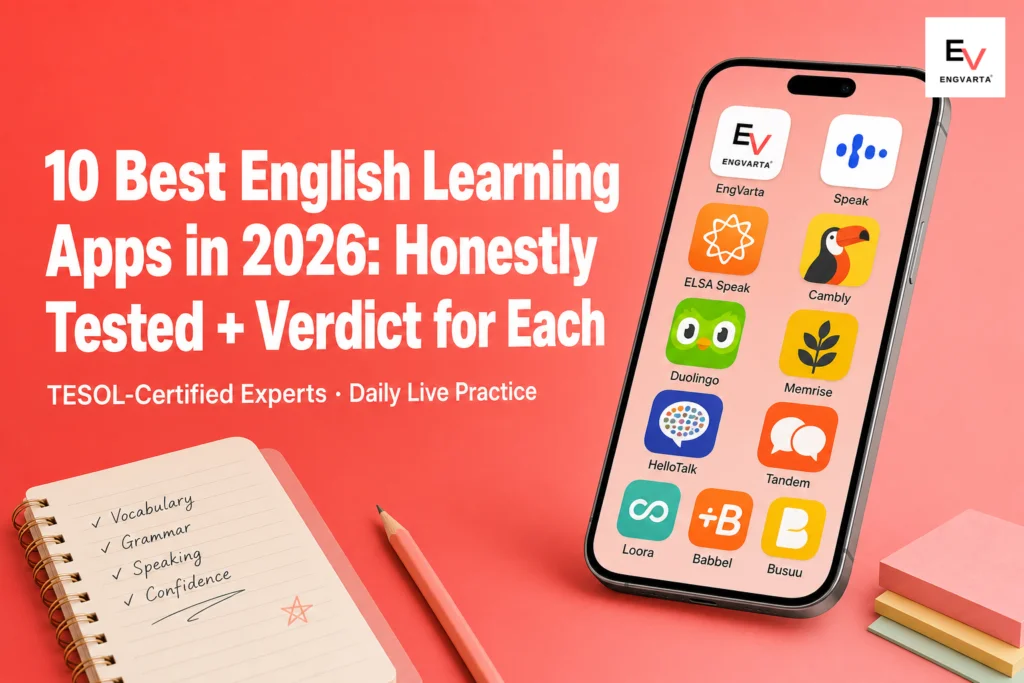
10 Best English Learning Apps in 2026: Honestly Tested + Verdict for Each

May 5, 2026 • 13 min read • By Rishish Pandey

10 best english learning apps — banner
Quick Verdict (2026)I’ve tested 10 of the most-recommended English learning apps in 2026 — here’s the honest verdict. The best for fluency on a timeline: EngVarta (live human practice, ~$1.80/session) for Indian + South Asian learners, paired with ELSA Speak for accent. The best for unlimited AI reps: Speak (~$25/month) or cheaper alternatives Loora / Talkpal. The best for vocabulary habit: Duolingo (free) or Memrise. The best for premium native-speaker exposure: Cambly. Avoid: apps that promise “fluent in 30 days” with no human practice component, free apps that bait-and-switch into expensive subscriptions, and apps that don’t actually let you speak (text-only chatbots, scripted-drill-only apps).

If you’ve been searching for the 10 Best English Learning Apps in 2026, you’ve likely run into the same issue most learners face: dozens of apps, all claiming to be #1. Reddit threads, YouTube videos, and app store reviews add more noise than clarity. This guide cuts through that with a real, hands-on test of the 10 Best English Learning Apps, along with a clear verdict on what each app does well—and where it falls short.

This analysis comes from the perspective of a TESOL/ESL practitioner who has helped lakhs of learners build conversational English—primarily across Indian, South Asian, Filipino, and GCC-expat audiences. The recommendations are straightforward and outcome-focused. EngVarta is included as one of the evaluated apps, and while I’m the publisher, the rankings are based on actual learner results, not marketing

The 10 Apps Tested + Honest Verdict

1. EngVarta — Best Live Human Practice (My Pick for Most Learners)

EngVarta is the live-human option. Each session is a 15, 25, or 50-minute audio call with a TESOL/ESL-certified Expert who corrects you in real time and shares consolidated feedback at the end.

What it does well : The 7 AM to midnight India-time window covers most working-pro schedules. Audio-only design works on slow data and removes camera-pressure. ~$1.80 per session is sustainable for daily practice. Used by lakhs of learners across India + US, UAE, Canada, Singapore. Issues milestone certificates as you complete practice-hour thresholds.

What it doesn’t do : No 24/7 unlimited reps (sessions are scheduled, max ~4-5 per day). No video tutoring. Not free.

Verdict: 9/10. The pick for working professionals, IELTS/CELPIP candidates, government employees, and anyone targeting measurable fluency progress on a timeline. Trial is ₹69 ($1), 100% refundable.

Ready to Practice with Real Experts?

Try EngVarta today — ₹69 trial (India) / $1 trial (International) · 100% refundable

2. Speak — Best AI Conversation Reps

Speak is the most-popular AI conversation app in 2026. AI-driven roleplay, voice-first interface, gamified streaks.

What it does well : truly unlimited 24/7 practice; reasonable scenario library (interviews, casual chat, work meetings).

What it doesn’t do : AI corrections are over-polite; accent recognition gaps for non-native speakers; no real accountability. ~$20–25/month.

Verdict : 7/10. Solid for unlimited low-pressure reps, especially early-stage or anxious learners.

3. ELSA Speak —  Best Pronunciation Tool

ELSA isn’t a conversation app — it’s a pronunciation drill tool. AI grades your pronunciation phoneme-by-phoneme.

What it does well : precise feedback on specific sounds (v/w swap, retroflex T/D, “th” sound, vowel duration). Specifically tuned for non-native English.

What it doesn’t do : conversation; you’re reading scripted prompts.

Verdict : 8/10 for pronunciation specifically; not a standalone fluency solution. ~$11.99/month.

4. Duolingo — Best Vocabulary + Daily Habit

One thing Duolingo excels at is persuading you to open the app each day. The streak mechanics are addictive; the lessons are bite-sized.

What it does well : vocabulary building, grammar awareness, daily-habit anchor.

What it doesn’t do : conversation. Instead of actual dialogue, the speaking activities are programmed single-sentence drills.

Verdict : 8/10 for vocabulary + habit; 3/10 for actual fluency. Pair with a speaking-focused app once you’re past the first 50 hours of Duolingo. Free; Super tier ~$7/month.

5. Cambly — Best Premium Native-Speaker Practice

Cambly connects you to native English-speaker tutors over video.

What it does well : high-quality native-speaker exposure; you can pick the tutor you click with.

What it doesn’t do well : daily practice on a normal budget — ~$10 per 15-minute lesson means most users do 2–3 sessions per week, which is below the daily-practice frequency fluency requires.

Verdict : 8/10 for higher-budget learners who specifically want native-speaker exposure.

EngVarta vs Cambly vs Preply vs italki detailed comparison →

6. HelloTalk — Best Free Language Exchange

Connects you with English native speakers who are interested in learning your language.

What it does well : genuinely free for basic use; exposure to native speakers.

What it doesn’t do : structured practice, expert correction, consistency — conversation quality varies wildly partner-to-partner.

Verdict : 6/10 for free exposure if you’re intermediate already; 4/10 for structured progress.

7. Tandem — Similar to HelloTalk With Better Matching

Same core concept as HelloTalk; matching algorithm is slightly better. Same trade-offs — no expert correction, variable partner quality. Free / ~$7–14/month for paid features.

Verdict : 6/10. Use HelloTalk OR Tandem; one is enough.

8. Loora — Direct Speak Alternative

AI-driven voice conversation, similar to Speak. Slightly more business and professional context in the scenario library.

Verdict : 7/10. ~$15–20/month.

9. Talkpal — Cheaper AI Conversation

Another direct AI-conversation app. Stronger grammar correction emphasis than Speak. ~$12–18/month.

Verdict : 7/10.

10. Memrise — Best for Listening + Real-Life Phrases

Uses videos of native speakers to teach phrases in real-life context.

What it does well : listening comprehension, natural phrase exposure.

What it doesn’t do : conversation practice. ~$8.49/month.

Verdict : 7/10 as a listening supplement.

The 5 Apps to AVOID (My Honest Take)

  1. Apps promising “fluent in 30 days.” Marketing copy, not reality. Real fluency takes 6–12+ months of daily practice. Apps that promise faster usually skip the speaking-practice component entirely.
  2. Free apps that bait-and-switch into expensive subscriptions. Several “free” apps lock conversation features behind $40–80/month tiers. Before registering, review the cost page.
  3. Text-only chatbots that claim to teach speaking. Speaking is a different skill from typing. An app that doesn’t make you actually speak out loud won’t build verbal fluency.
  4. Scripted-drill-only apps marketed as conversation apps. If “practice conversation” means reading 1-line prompts to a mic, it’s not conversation practice. Real conversation requires unscripted back-and-forth.
  5. Apps with no native-speaker or certified-tutor verification. Many cheap tutoring marketplaces let anyone become a “tutor” without any credentials. The tutoring quality varies from excellent to actively harmful.

How to Stack These Apps for Real Fluency

One app rarely delivers fluency. The learners I see actually become fluent in 6–12 months use a stack:

  • 15–30 min daily speaking practice — live human Expert (EngVarta) or AI conversation app (Speak/Loora/Talkpal). Non-negotiable core.
  • 10 min pronunciation drilling — ELSA Speak, 3–4 days a week.
  • 10 min vocabulary & grammar habit — Duolingo or Memrise, daily.
  • 20 min listening immersion — English podcasts, YouTube, or Memrise videos in your target accent.
  • One “hard” conversation per week — volunteer for difficult presentations, take client calls. Real-pressure reps.

Total time: ~75 minutes/day. Total cost (EngVarta + ELSA + Duolingo Super): ~$64/month. That’s the actual path to fluency in 2026.

The Decision Framework: Which Apps for Which Learner?

Learner Profile Recommended Stack Monthly Cost
Indian working pro, timeline goal EngVarta + ELSA + Duolingo ~$64
College student / fresher EngVarta + Duolingo ~$52
Absolute beginner Speak + Duolingo (3 months) → switch to EngVarta + ELSA ~$32 → $64
Zero-budget learner EngVarta YouTube + HelloTalk + Duolingo free $0
Higher-budget premium learner EngVarta + Cambly + ELSA ~$140
IELTS / CELPIP / TOEFL prep (4–8 weeks) EngVarta + ELSA ~$57
Privacy-first / introvert Speak + ELSA ~$37

The Honest Truth About Timeline

For an intermediate learner doing 25 minutes of daily live practice with feedback (EngVarta or equivalent):

  • 3–6 weeks: Visibly less hesitation, faster word recall
  • 6–9 months: Conversational fluency — you no longer translate from your native language
  • 12–18 months: Full professional fluency including domain vocabulary, presentation comfort, salary-negotiation language

For absolute beginners, add 6–12 months. For advanced learners polishing accent and idiom usage, the same timelines apply but visible improvement starts sooner.

What Our Learners Say

Rated 4.5★ from 9,100+ reviews on Google Play

★★★★★
best app for English communication. I have tried lots of English speaking apps till date. but all have some dra backs. but this is really awesome experience of mine. best teachers and best app. 💯
★★★★★
I have been using this app since past 7 months. All experts are really good and helpful.
★★★★★
I took two months of subscription. This platform really helped me to improve my communication and get rid of the fear I had earlier. Now I can talk fully confident and without any fear.
★★★★★
hii i have taken your 69 rs plan for expert calling but no response from your side you gove the number i am trying to call on that number but no response r u making me fool? or what?
★★★★★
It was a great experience praticing with EngVarta. Thank you experts for helping me reach
★★★★★
Thank u so much @engvarta it is very good for learning English daily I learn new words daily I get new vocabulary again thnxx again 👍🏻👍🏻
★★★★★
very exlent English learning app with live tuters. and they will help to me for improving English.
★★★★★
It's a great place to learn and practice English Fluency..here you get a chance of one on one communication with experts.. They'll guide you throughout your learning journey..I recommend this platform to all who want to gain fluency with knowledge.
★★★★★
I am really enjoying my journey with EngVarta where the learning is not limited to communication skills but also enrichment of ideas and thoughts.
★★★★★
It was a great experience praticing with EngVarta. Thank you experts for helping me reach
★★★★★
This is a very good app for English speaking. I love this app. Experts are very nice and supportive. When I talk to experts I feel better.
★★★★★
I enjoyed this course.experts encouraged me to use advanced vocabulary, idioms and phrases daily dose of assignment, quizzes and new vocabulary keep your toes

Be part of our community and keep improving your English every single day!

For a head-to-head Speak vs ELSA Speak breakdown (pricing, accent depth, conversation realism) — see our Speak vs ELSA Speak comparison.

Frequently Asked Questions ( FAQs )

Q1. What are the 10 best English learning apps in 2026?

Ans : Based on hands-on testing: EngVarta (live human, best for fluency on a timeline), Speak (best AI conversation), ELSA Speak (best pronunciation), Duolingo (best vocabulary + habit), Cambly (best premium native-speaker), HelloTalk + Tandem (best free language exchange), Loora and Talkpal (Speak alternatives), Memrise (best listening). Different apps fit different goals; most learners use 2–3 in combination.

Q2. Which English learning app actually works best for fluency?

Ans : For measurable fluency progress on a timeline (job interview, IELTS, promotion), EngVarta delivers fastest because live TESOL/ESL-certified Experts handle accent recognition and targeted MTI corrections better than AI. For unlimited low-pressure AI conversation reps, Speak is reasonable. Most successful learners use EngVarta + ELSA + Duolingo as a stack.

Q3. Are paid English learning apps worth the money?

Ans : Depends on your goal. For casual exposure, free apps (Duolingo, HelloTalk, EngVarta YouTube) are enough. For measurable fluency progress on a timeline, paid live-practice (~$45/month for EngVarta daily) or paid AI conversation (~$25/month for Speak) deliver visible results in 4–8 weeks — far cheaper than 1-on-1 tutoring or institute classes.

Q4. Can I become fluent in English using only free apps?

Ans : Possible but slow. Free apps (Duolingo + HelloTalk + EngVarta YouTube) can deliver basic fluency over 18–24 months of daily use, IF you’re self-disciplined and find consistent native-speaker conversation partners. Most learners who become fluent in under 12 months use at least one paid live-practice or AI conversation app.

Q5. What’s the best English learning app for Indian and South Asian learners?

Ans : EngVarta is the most-used by Indian, Bangladeshi, Sri Lankan, and other South Asian learners — TESOL/ESL-certified Experts familiar with mother-tongue-influence patterns from Hindi, Tamil, Telugu, Marathi, Bengali, Punjabi, Gujarati, and Sinhala. Sessions are audio-only, ~$1.80 per session, 7 AM to midnight India time daily. Pair with ELSA for accent and Duolingo for vocabulary.

Q6. Which app should an absolute beginner start with?

Ans : Speak (low social pressure, AI doesn’t judge) or Duolingo (gamified, vocabulary-focused) for the first 30–60 days. After basic conversational footing is established, switch to or add EngVarta for measurable fluency progress with a real Expert.

Q7. Are AI English apps as good as human tutors in 2026?

Ans : AI apps have improved dramatically and are useful for unlimited low-stakes reps. For the fastest fluency gains, live human Experts still outperform AI on accent recognition (especially for Indian, Bangladeshi, Sri Lankan, Filipino, and Egyptian accents), correction precision, and real accountability. Most serious learners combine both.

Q8. What’s the worst mistake people make picking English learning apps?

Ans : App stacking without a speaking-practice component. Three vocabulary apps and zero conversation apps means you’ll know more words but still freeze in real conversations. The non-negotiable: at least one app in your stack has to make you actually speak out loud daily with feedback.

Q9. Is Duolingo enough to learn English?

Ans : No. Duolingo is great for vocabulary and daily-streak habit but not designed for conversation practice. Pair Duolingo with EngVarta or Speak for actual conversation practice. Duolingo alone delivers vocabulary growth without conversational fluency — the most common mistake on Reddit threads.

Q10. How much should I spend monthly on English learning apps?

Ans : Realistic ranges in 2026: $0 (Duolingo + HelloTalk + EngVarta YouTube; slow but works); $25–35/month (Speak alone or Talkpal + Duolingo); $45–65/month (EngVarta + ELSA + Duolingo, the highest-leverage stack for most learners); $140+/month (premium with Cambly added). Most successful learners spend $50–70/month for 6–12 months and reach conversational fluency.


Editorial independence: This is a hands-on review of 10 English learning apps in 2026. EngVarta is the publisher and is reviewed alongside competitors. The rankings and verdicts reflect actual learner outcomes I’ve observed across the lakhs of learners EngVarta serves. No app paid for inclusion or placement.